Zimbabwe can’t pay for imports, narrows trade deficit – The Zimbabwean

According to latest figures released by Zimbabwe National Statistics Agency (ZIMSTAT) on Wednesday, Zimbabwe has significantly cut its electricity import bill amid foreign currency shortages and a heavy debt burden.

ZIMSTAT said Zimbabwe’s trade deficit narrowed to $93.6m in May, bringing the cumulative year-to-date total deficit to $332m. The trade deficit was $1.3bn in the comparable 2018 period.

For the past five months, the electricity monthly import bill for the southern African country has averaged $3.4m, down from an average of $13.7m in 2018. This is partly because the country does not have adequate foreign currency to meet supplies and had a debt overhang to Eskom which prevented further supplies.

Energy minister Fortune Chasi is in South Africa to negotiate electricity supplies with his counterpart Gwede Mantashe, according to information minister Monica Mutsvangwa.

Diesel imports used averaged $93.3m in 2018, but now only $73.6m worth of fuel is being imported. For petrol, imports have dropped to $36m from $44m in 2018.

This has resulted in crippling shortages in energy supplies in Zimbabwe.

‘Twin evils’

Overall, by the same time last year, Zimbabwe had a cumulative trade deficit of $1.3bn, and Finance Minister Mthuli Ncube described it as one of the “twin evils” affecting the country’s economy.

The other was a budget deficit which reached $2,8bn or 11.7% of GDP in 2018.

The latest figures, however, suggest that a reversal of these “twin evils/deficits”, with Ncube speaking of a budget surplus since the beginning of the year.

Not anything to smile about

Analysts, however, say the deficit is nothing to smile about, as it driven by the country’s inability to pay for critical imports.

“From October last year, the government has not provided any foreign currency to import electricity despite the crippling shortages. It has also struggled to pay for adequate fuel supplies, and all this feeds into the trade figures,” said Analyst Walter Mandeya of Trigrams Investment.

He said as a result, the reduction in trade deficit is not by design, but forced.

“As much as government had planned to reduce the trade deficit, I don’t think the plan was to reduce key imports such as fuel and electricity, we simply can’t do without those two and the impact of the shortages have been telling on the economy,” he said.

South Africa

Imports from South Africa dropped from an average $230.6m per month in 2018 to $136.6m in 2019.

Exports also fell from an average $188m per month in 2018 to $141.7m in 2019.

Zimbabwe further exported more than it imported from South Africa. Exports for the five months to May stood at $708.9m against imports of $683.2m for the same period.

In 2018, Zimbabwe imported more from SA than it exported.

The Perfect Storm is Coming
10 Zimbabwean students leave for two-week training at Huawei HQ in China

Post published in: Business

The Top Of The Biglaw Heap In Labor & Employment Law

Why Law Firms Are Moving to the Cloud

Why Law Firms Are Moving to the Cloud

Cloud-based practice management software can help meet the growing expectations of clients, staff, and an increasingly competitive legal marketplace. Download the guide here to learn how.

Cloud-based practice management software can help meet the growing expectations of clients, staff, and an increasingly competitive legal marketplace. Download the guide here to learn how.

Jay Powell Politely Asks Congress To Please Shut Up About The GD Gold Standard

This guy can clearly put up with a lot, but…

Make Money Mondays: Marketing to Millionaires

Post Update 7/8/19 noon: Apparently I spoke to soon in recommending a purchase of Marketing to the Affluent prior to reading it. I’ve been receiving some negative feedback from those who bought the book both about Kennedy’s political views as well as the organization of the material in the book and its value. I’ll read the book myself, but you may want to keep this in mind if you decide to buy a copy.

Ask most lawyers about who their ideal client is, and most will answer with something along the lines of “anyone who can pay.”  Moreover, most lawyers imagine that those clients who come to our door and can pay, actually will pay – and it’s only a matter of finding those clients.   But turns out, there’s a little more to it than that.

In this excerpt from his new book Marketing to the Affluent, Dan Kennedy shares some observation about a particular category of affluent: those who are self-made. This group includes business owners and entrepreneurs.  Kennedy writes:

They may have nearly unrestricted spending power in reality, but not necessarily mentally and emotionally. Most are conflicted about money. They know they need to think, feel, and act rich, but they also battle guilt, fear, anxiety, and abhorrence of waste.

A very valuable sub-segment of these self-made affluents is business owners and entrepreneurs. Here you may very well find your best customers, clients, or patients.

So how can solos and smalls target this desirable category?  The good news is that most likely, there’s a natural affinity between the self-made affluent and solo and small lawyers who, after all, are also self made.  In fact, Kennedy describes that the self-made affluent will reward you with their business if they admire you. 

On the flip side, the self-made affluent “pride themselves on being smart about money, getting good deals and bargains and negotiating successfully” -a trait that lawyers don’t particularly appreciate in clients.  In fact, I’ve often heard lawyers complain about wealthier clients who simply don’t want to pay their bills even though they have the money. Memo to clueless lawyers: sometimes it’s not about the money, but the value.  And that’s the most important takeaway when it comes to marketing to the self-made applicant. Don’t assume that they’ll pay your fees just because they can. Instead, you need to show them why the work that you do can bring them value – maybe help them to make more money or to transform their life or business or protect what they have (provided that you have the data to show that the cost-benefit of risk reduction make sense).

As for me, I haven’t yet read Dan Kennedy’s new book  but it’s loaded up on my phone for my trip this weekend. Hope to review it when I return.

Princely Sums For Warhol Foundation And Bubkes For Photographer In Copyright Dispute

(Photo by Jonathan Daniel/Getty Images)

The artist Prince, with his eyes sad and gaze unaverted, peers out from the confines of a stark and moving photograph, inviting the viewer to commiserate, to share his pain. This 1981 work, created by Lynn Goldsmith, captured Prince at his most compelling and is now at the center of a lawsuit between Goldsmith and the Andy Warhol Foundation. Had Prince knew the distress this photograph would cause another artist decades after its taking, his countenance would have been even more dour.

In 1984, Vanity Fair licensed the photograph from Goldsmith for use as “source art” to be adapted by Andy Warhol as part of one of his signature derivatives. This derivative ran in Vanity Fair’s November issue and included a credit to Goldsmith for the “source art” used by Warhol.

Warhol also used the Goldsmith photograph as “source art” for a series of silk screens and other pieces, most of which were sold off for exorbitant sums. When Prince passed in 2016, Vanity Fair republished the Goldsmith/Warhol work online. This republication was so successful that Vanity Fair used the work as the cover image for a new publication it created and sold commemorating Prince’s life. In this new publication, Goldsmith’s credit was removed from the work. And Vanity Fair paid a license fee only to the Andy Warhol Foundation (which by that time controlled Warhol’s copyrights).

When she caught wind of the above, Goldsmith contacted the AWF and noted that the new publication incorporates both her and Warhol’s creative material and that both authors had previously been credited and compensated. This had been acknowledged expressly in the Vanity Fair article and did not seem to be a disputed issue. Yet, she was rebuffed and then sued by the AWF.

The AWF sought declaratory relief in the form of a court order finding the licensing and exploitation without consent of Goldsmith’s material to be “fair use” and thus not infringement.

As readers of this column know, this writer is no fan of the amorphous and raggedly applied “fair use” doctrine, which has, over the years, transitioned from focusing on the commercial impact of the disputed use to whether that use is “transformative.” And, along the way, it has swallowed up the once exclusive right of an artist to create derivative works from her material.

This case illustrates why that transition is so problematic. The now all-important “transformative” analysis in Goldsmith’s case ventured into the mire of the metaphysical, an always dicey undertaking. The court homed in on the fact that Goldsmith’s photograph illustrates that Prince is “not a comfortable person” and is instead a “vulnerable human being.” The court then notes “in contrast,” that Warhol’s work features a “flatter” depiction that “transforms” Prince “from a vulnerable, uncomfortable person to an iconic, larger-than-life figure.” Through this flattening, the court concludes that the “humanity” was removed from Goldsmith’s photograph and the work transformed in the process.

Now, the above may be true, and Judge Koeltl, who wrote this decision, is a very sharp and astute jurist with a firm grasp on copyright principles, but I cannot make heads or tails out of what this passage means or how the “removal of humanity” fits within the fair use factors codified at Section 107 of the Copyright Act. The “fair use” test has now become so bloated and convoluted that nobody can find their way out.

Surely, if you trace a photograph on paper it is going to look flatter. And the bit about how the flattening “transforms” Prince from vulnerable to iconic does little to distract from the fact that this was a simple embellished copy. The true crux of the court’s analysis is revealed as almost an aside at the end of the “transformative” analysis, when the court states that the work basically looks like (or is “recognizable” as) a Warhol so should be protected as a Warhol.

Yet, the fact that a work is “recognizable” as coming from one artist is irrelevant to whether the use is a “fair use,” at least from a statutory standpoint. Indeed, when an artist of outsized fame like Warhol is involved in a “fair use” review, the process is further distorted as courts tend to look beyond the four corners of the artwork at issue to consider the fame of the artist. This, too, is not contemplated by the statute.

The Goldsmith “fair use” analysis got so muddled that the court even trotted out Justice Stewart’s “I know it when I see it” obscenity test, which is certainly of no assistance to artists and not the direction the “fair use” test should be heading. In the end, the court found that the work looks like a Warhol and should thus be protected by fair use. This ruling would seem to indicate that a famous artist with a known aesthetic can more easily claim fair use than a lesser-known artist, which is also not within the spirit of the Copyright Act.

This decision is also another nail in the coffin of one of the statutorily guaranteed exclusive rights that Congress granted to authors under the Copyright Act in an effort to incentivize the creation of artistic works. R.I.P, we can now mutter, at least in the Second Circuit, to the exclusive right to create derivative works.

17 USC 106(2) of the Copyright Act still provides an author with the “exclusive right” to “prepare derivative works based upon the copyrighted work[.]” And a “derivative” is still defined as “a work based upon one or more preexisting works,” such as those that “recast, transformed, or adapted” the prior work. Indeed, a “work consisting of editorial revisions, annotations, elaborations, or other modifications which, as a whole, represent an original work of authorship,” is still an archetypal “derivative work.”

But, this exclusive right was jettisoned here despite the fact that Warhol’s Prince works are certainly an “elaboration on” or “modification of” Goldsmith’s photograph. Indeed, as the Copyright Act’s legislative history makes clear, the infringing work will “incorporate a portion of the copyrighted work in some form.” That is exactly what Warhol’s Prince work does — incorporates a portion (and a large one at that) of Goldsmith’s work. Yet, the AWF has been adjudged free to exploit and monetize Warhol’s elaboration on Goldsmith’s work without any compensation whatsoever to Goldsmith.

An illuminating way to look at the equities here is to imagine Goldsmith and Warhol in the same studio back in the 1980s, with Goldsmith creating the photograph and then handing it to Warhol to trace and flatten and color. Had that happened, it could not be disputed that the work was a joint work and each artist would thus receive 50 percent of any profits from the work (or contracted for a different split of the profits). But, because Warhol simply appropriated the work without collaborating with Goldsmith, he (or his foundation, rather) may exploit and monetize the derivative without any compensation to Goldsmith. This does not seem to further the purpose of the Copyright Act.

While the AWF should be able to profit from the marketing and sale of Warhol’s Prince works, which are undoubtedly alluring in their own right, Goldsmith, as the creator of the source for those works, should not be left out in the cold. As a staunch advocate for artists’ rights, Prince is likely to be rolling over in his beret given this decision, which will hopefully be challenged on appeal.


Scott Alan Burroughs, Esq. practices with Doniger / Burroughs, an art law firm based in Venice, California. He represents artists and content creators of all stripes and writes and speaks regularly on copyright issues. He can be reached at scott@copyrightLA.com, and you can follow his law firm on Instagram: @veniceartlaw.

Alex Acosta Just Delivered A Dumpster Fire Of A Press Conference

Labor Secretary Alex Acosta showed up at his press conference today adamant that he wasn’t holding this debacle of an event to send any signals to the White House. He then proceeded to offer us an hour of him trying to send signals to the White House in a desperate bid to hold onto his own job amid heightened scrutiny of that time that he let Jeffrey Epstein get a sweetheart deal before sealing all the records and cutting Epstein’s victims out of the whole process.

If this was his pitch, expect to see him gone within the week.

A lot can happen of course. Acosta might be able to convince his boss that he needs to stay to “own the libs” or something, but based solely on that press conference Acosta tried and miserably failed to connect with Trump.

Trump, who destroyed Jeb Bush’s air of inevitability by branding him “low energy” couldn’t have appreciated Acosta’s measured, meandering effort to heap responsibility for Epstein’s ludicrous plea deal on everyone but himself. He did, however, take off his “smart person” glasses right off the bat in a clumsy attempt to look like he was “getting tough,” so there was that. What Trump wanted to see was Brett Kavanaugh throwing a sneering temper tantrum and what he got was a series of weasely “well, actually…” statements thrown together.

Over the course of the hour, we heard alternatively that Epstein’s deal was the fault of Florida state prosecutors, or maybe the judge, or his superiors at main Justice, or the career prosecutor. One America News, an organization that astoundingly gets press credentials to events like this, even tried to pin all the blame on Robert Mueller. But it was never Acosta’s fault. Never ever.

According to Acosta it was definitely the fault of Epstein’s victims, who he repeatedly blamed for “not coming forward” even though many have come forward and Acosta knows full well that his office strung those victims along making what a federal judge has branded “material omissions” in the process. Acosta tried to argue that a culture of victim shaming kept him from building a case based on victim testimony. And then he proceeded to victim shame them in real time for allegedly “not being loud enough.”

Acosta, whose current office oversees sex trafficking efforts and has affirmatively tried to slash those by upwards of 80 percent, shockingly argued that his former office — you know, the Department of Justice — couldn’t possibly have brought Epstein to trial based on all that evidence they were putting under seal because, golly, what if they were to lose? That’s why this had to be swept under the rug with a 13-month prison sentence that let Epstein walk free every day for 12 hours, because there was a chance the government might lose. Left somewhat unresolved at the presser was how this fear of failure jived with the decision to immunize Epstein’s co-conspirators. Apparently, that was an effort to get the goods on Epstein… but then they didn’t get enough evidence? So, why did they immunize these people again? It’s all so confusing.

To hear Acosta tell it, the U.S. federal government are a bunch of hapless losers who never can win the big one instead of an entity wielding awesome prosecutorial power and securing convictions over 90 percent of the time. In the reality-based timeline that the rest of us live in, the only barrier to Epstein’s conviction in 2008 was a lack of will.

Specifically Acosta’s lack of will.


HeadshotJoe Patrice is a senior editor at Above the Law and co-host of Thinking Like A Lawyer. Feel free to email any tips, questions, or comments. Follow him on Twitter if you’re interested in law, politics, and a healthy dose of college sports news. Joe also serves as a Managing Director at RPN Executive Search.

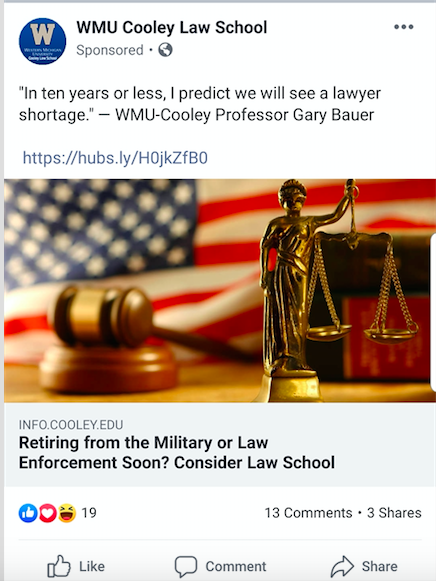
Despite Evidence To The Contrary, Cooley Law School Claims There Will Be A Lawyer Shortage

Oh my, the  just brings a nearly unending stream of amusement to us here at Above the Law. Whether they’re claiming they’re the number two law school in the nation (don’t worry, we aren’t living in the upside down — it was Cooley’s own ranking that put Cooley at #2 with a methodology we declared “intellectually insulting”), sponsoring a baseball stadium, or fighting with the ABA over whether they should be accredited (which they wanted to keep quiet), the law school is known for bringing the lolz. And whaddya know? They’re at it again.

A tipster sent us an interesting bit of Cooley Law School sponsored content that makes the pretty… interesting claim that there just aren’t enough lawyers:

If that doesn’t seem like it comports with the realities of the legal profession as it exists in 2019, well, you’re onto something. The truth is something we’ve documented repeatedly in the past — there now are more law school applicants than at any point since the recession. Within legal academia, there’s been a sort of a prevailing wisdom that the country’s slip towards fascism under Donald Trump has encouraged more people to become educated about the law, in a phenomenon (one that’s even been skewered by The Onion) known as the “Trump Bump.” And it’s something that’s been going on for several application cycles at this point. But Cooley is out there posting spon con on July 8th, 2019, as if it’s 2010 and the recession (complete with law firm layoffs) caused by the mortgage-backed securities disaster made laying out money for law school a bad bet.

Of course a law school like Cooley has a vested interest in trying to convince unsuspecting applicants that the jobs will be there, ripe for the plucking when they graduate. But the truth is, for the class of 2018, only 29.7 percent of Cooley grads have long-term, full-time legal jobs, compared with the national average of 68.3 percent. With even more people going to law school in 2019, and without a significant increase in the amount of legal jobs, the situation is bound to only get worse for those who fall for Cooley’s outdated puff piece.


headshotKathryn Rubino is a Senior Editor at Above the Law, and host of The Jabot podcast. AtL tipsters are the best, so please connect with her. Feel free to email her with any tips, questions, or comments and follow her on Twitter (@Kathryn1).

Worst IVF Nightmare Ever: Couple Forced To Give Up Twins Conceived From Crazy Double Embryo Mix-Up

Infertility is an incredibly difficult road. And IVF is no picnic. It involves spending thousands of dollars, countless shots and medications, a deeply emotional rollercoaster, and at the end, the hopeful parent or parents-to-be are holding their breath that the odds will be in their favor and their dream of a child will be fulfilled.

A New York couple — known as A.P. and Y.Z in their recently filed federal suit in the Eastern District of New York — have one of the most painful and heart-wrenching stories I’ve heard yet. The couple, like many, were unable to conceive naturally, and suffered failed IUI fertility treatments. So they looked for other solutions. The plaintiffs found the website and other promotional materials of CHA Fertility Center Los Angeles, and they were persuaded to sign up for treatment. CHA claims to be “known as the ‘mecca of reproductive medicine’ with world-class treatments for infertility” and states that they “ensure each [patient] receives the most appropriate and advanced treatment necessary.” Sounds like CHA takes a lot of pride in their work, right?  Hold on.

According to the complaint, the plaintiffs traveled to California to undergo fertility treatment with CHA Fertility. Embryos were formed from the plaintiffs’ eggs and sperm. After genetic testing was completed, Plaintiffs received the good news that they had five normal embryos — four female, and one male. I promise there won’t be much math in the rest of the column, but the genders of the embryos does matter.  The couple went through one failed transfer. On the second transfer, they opted to transfer two female embryos to Plaintiff A.P. The plaintiffs were ecstatic to learn soon after that the transfer worked and they were carrying twins. But that’s actually where the nightmare began.

As the pregnancy progressed, A.P. went in for regular obstetrical care, including the ultrasound where doctors can tell you the sex of the baby. The obstetrician reported that based on the ultrasound, both babies were … boys. Naturally, plaintiffs were confused. They only had one male embryo, and it had not, to their understanding, been transferred. Plaintiffs called CHA Fertility. The clinic reassured them that ultrasound tests were not always accurate. And in fact, the doctor explained that his own wife had been told based on a sonogram that they were having a boy, but in fact had a girl. The doctor assured plaintiffs that “they were having girls and nothing was wrong.” Oh. OK. Sorry to bother you, doctor.

But despite the doctor’s own personal experience, he was quite wrong about the ultrasound, which had been read accurately. So when A.P. gave birth at the end of March 2019, plaintiffs were shocked that their babies were in fact both boys. It gets worse though. Neither of the babies appeared to be the same race as the plaintiffs. Representatives of CHA Fertility flew out to New York to conduct genetic testing of the babies. Sure enough, neither of the babies were genetically related to the plaintiffs. Instead, they were related to other patients of CHA. To make matters even worse, the twins weren’t even genetically related to each other! The “testing revealed that Baby A was genetically matched to Couple A, and Baby B was genetically matched to Couple B.” Wow. How does that even happen? That’s not just two families’ embryos being switched, that’s three families have mixed-up embryos in one transfer. It’s almost impressively incompetent.

The complaint explains that as a result of the DNA tests, “Plaintiffs were required to relinquish custody of Baby A and Baby B, thus suffering the loss of two children.” That must have been traumatic. I am traumatized just thinking about those moments in the hospital. To make matters worse, the clinic won’t say where the plaintiffs’ own embryos are!

A.P. essentially unknowingly and unwillingly acted as a gestational surrogate for two other families. So what is the legal theory for the plaintiffs to recover? All of them, you may say. Actually, plaintiffs list 16 counts, including: medical malpractice, negligence, negligent infliction of emotional distress, intentional infliction of emotional distress, reckless and wanton misconduct, battery, and multiple breaches of duty. Honestly, it’s amazing that CHA didn’t offer plaintiffs millions of dollars in recompense before they filed their complaint, just to avoid what may be company-ending bad publicity.

In any event, if the allegations are true, and the world is a just place, plaintiffs no doubt should be entitled to a substantial recovery. Unfortunately, the law continues to be ill-fitted to address reproductive negligence claims and their unique aspects. In the meantime, we await the verdict as well as the premier of the horror movie based on these events.


Ellen TrachmanEllen Trachman is the Managing Attorney of Trachman Law Center, LLC, a Denver-based law firm specializing in assisted reproductive technology law, and co-host of the podcast I Want To Put A Baby In You. You can reach her at babies@abovethelaw.com.

Former Lawyer For Brendan Dassey Of ‘Making A Murderer’ Kicked Off Judicial Bench For Acting Like A Cat

Len Kachinsky

We fail to see how staring at a court employee for 45 minutes while tapping a pencil and making cat noises constitutes the maintenance of high standards of personal conduct or promotes the integrity of the judiciary.

— an excerpt from a judicial disciplinary opinion of the Wisconsin Supreme Court, where Len Kachinsky, who served as lawyer for Making a Murderer’s Brendan Dassey, was suspended from working as a reserve municipal judge for a three-year period (retroactive to July 2018) thanks to his incredibly strange interactions with a court manager who accused him of harassment.


Staci ZaretskyStaci Zaretsky is a senior editor at Above the Law, where she’s worked since 2011. She’d love to hear from you, so please feel free to email her with any tips, questions, comments, or critiques. You can follow her on Twitter or connect with her on LinkedIn.

Jay Powell’s Probably Only Got A Few Hours Left

With Kuddles and Capitol Hill saying he’s safe, the Fed chairman is almost certainly doomed.