
As
I
continue
to
play
catch
up
on
some
of
the
news
announced
during
ILTACON,
the
e-discovery
company
Everlaw
made
two
notable
announcements
there:
The
expansion
from
private
to
open
beta
of
its
AI
Deep
Dive,
a
tool
that
can
answer
complex
questions
about
large
document
collections,
and
its
having
secured
FedRAMP
certification
for
its
AI
Assistant
features.
Deep
Dive
Moves
to
Open
Beta
Deep
Dive,
which
the
company
had
previously
code-named
“Project
Query,”
allows
legal
teams
to
query
entire
document
corpuses
in
seconds
using
natural
language
questions.
The
tool
synthesizes
answers
grounded
in
facts
extracted
from
specific
documents,
providing
citations
and
access
to
underlying
source
materials
for
verification.
“Deep
Drive
helps
legal
teams
uncover
insights
in
an
entire
corpus
of
data
sooner
by
simply
asking
questions
related
to
specific
issues,
parties,
or
events
and
get
answers
in
just
seconds,”
the
announcement
said.
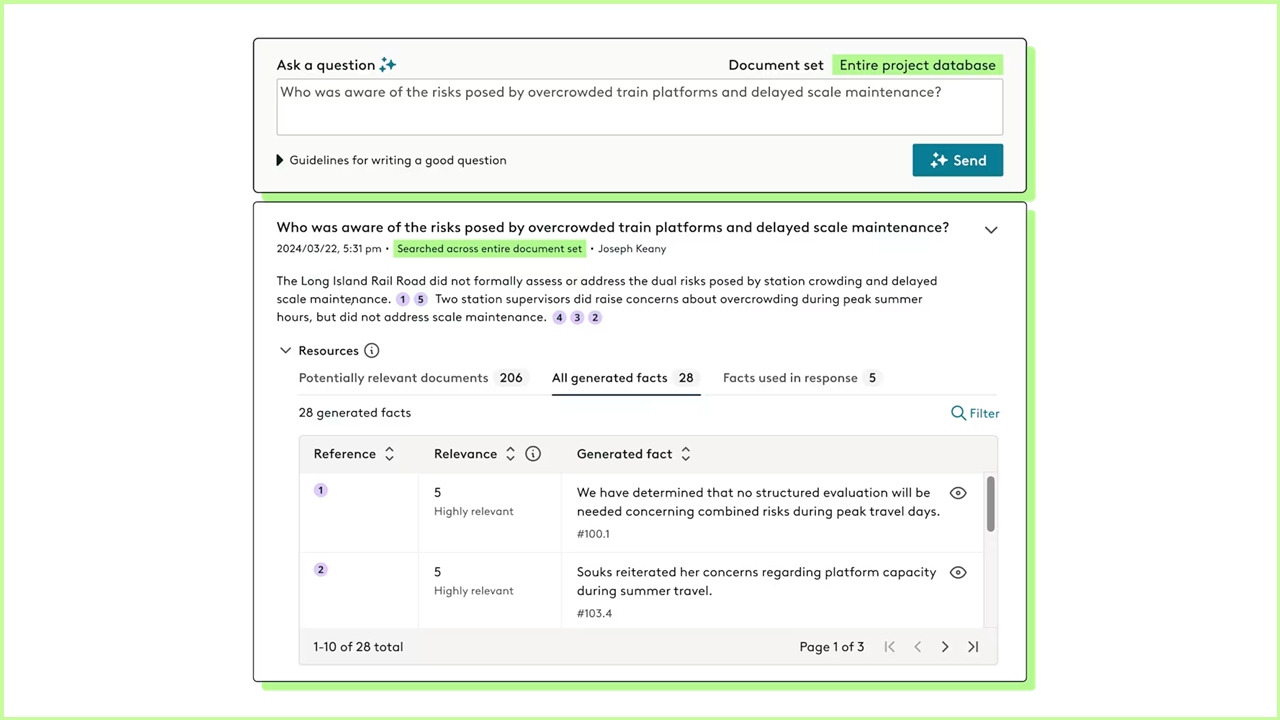
“Answers
are
supported
with
a
list
of
facts
and
referenceable
resources
so
users
can
dive
deeper
into
the
breakdown
of
information
available
as
part
of
the
response.”
During
a
media
briefing
at
ILTACON,
Everlaw
CEO
AJ
Shankar
demonstrated
the
technology
using
the
1.3
million
document
dataset
from
the
Mallinckrodt
opioid
litigation.
He
showed
how
the
AI
tool
processes
queries
by
first
identifying
relevant
document
subsets,
extracting
pertinent
facts,
scoring
their
relevance,
and
then
synthesizing
responses
with
full
citations.
When
Shankar
asked
Deep
Dive
how
opioids
work,
for
example,
it
returned
what
appeared
to
be
a
scientifically
grounded
explanation,
drawn
from
documents
within
the
corpus,
complete
with
citations
to
the
specific
documents
containing
the
information.
Transparency
and
Verification
The
tool
works
by
first
identifying
roughly
10,000
potentially
relevant
documents,
then
narrowing
them
to
approximately
50
of
the
most
pertinent
sources.
From
these,
it
extracts
and
scores
specific
facts,
showing
users
exactly
which
documents
support
each
claim
and
allowing
them
to
verify
the
underlying
sources.
“We
want
to
be
very
transparent
to
the
user,”
Shankar
said
as
he
clicked
through
screens
that
showed
relevance
scores
and
document
excerpts,
“so
you
can
check
up
on
the
site,
you
can
look
at
this
specific
document
and
the
request.”
At
the
same
time,
Shankar
was
candid
about
the
system’s
limitations.
“Does
that
mean
that
it
gives
you
great
answers
every
time?
Absolutely
not,”
he
said.
“…
Just
as
you’d
check
the
facts
if
an
intern
or
associate
brought
you
something
interesting,
you
want
to
check
the
facts
here.”
However,
one
check
built
into
the
system
is
that,
if
insufficient
evidence
exists
within
the
document
set
for
it
to
answer
a
question,
it
will
tell
you
so,
answering,
“No
promising
answers
were
discovered.”
Shankar
also
noted
that
Deep
Dive
is
not
suitable
for
comprehensive
document
review
or
privilege
determinations
–
Everlaw
has
other
AI
tools
designed
for
those
purposes.
“I
would
not
use
it
in
relevance
or
privilege
review
because
those
are
casting
wide
nets,”
Shankar
explained.
“Your
obligation
in
relevance
is
pretty
broad.
You
don’t
want
to
miss
things.”
Noting
that
Everlaw
already
has
a
constellation
of
products
designed
to
help
with
document
review,
timeline
creation,
information
synthesis
and
more,
Shankar
said
Deep
Dive
is
yet
another
approach,
with
its
own
time
and
place,
and
yet
is
perhaps
“the
most
transformative.”
“We
expect
it
to
be
essential
for
many
large
cases
over
time,”
he
said.
“It’s
not
going
to
solve
all
your
problems,
it’s
not
going
to
solve
discovery,
but
it’s
going
to
be
able
to
help
guide
discovery
at
every
step
of
the
way.”
Under
the
Hood
Everlaw’s
Deep
Dive
uses
retrieval-augmented
generation
(RAG)
combined
with
sophisticated
reasoning
models,
including
OpenAI’s
o3
model
for
analysis
and
synthesis,
Shankar
said.
In
developing
the
product,
he
said,
Everlaw’s
strategy
was
to
leverage
the
“billions
and
billions
of
dollars”
invested
by
foundation
model
providers,
with
Everlaw’s
developers
focusing
on
implementation
rather
than
on
reinventing
the
wheel.
They
worked
closely
with
Google
on
advanced
embedding
models
and
maintain
commercial
agreements
with
all
major
AI
providers,
including
OpenAI,
with
the
goal
of
positioning
themselves
to
use
the
best
available
tools
as
the
landscape
evolves.
Documents
are
processed
into
chunks
of
200-300
words
with
overlapping
context
windows
to
preserve
meaning
across
sentence
and
paragraph
boundaries.
The
system
typically
analyzes
around
10,000
documents
before
narrowing
results
to
approximately
50
most
relevant
sources.
Shankar
noted
this
limitation
is
by
design
rather
than
technical
constraint:
“The
bigger
the
set,
the
lower
the
signal
to
noise
ratio
of
the
facts.”
Potential
Use
Cases
At
the
briefing,
Chuck
Kellner,
senior
strategic
discovery
advisor
at
Everlaw,
outlined
three
“out
of
the
box”
use
cases
for
Deep
Dive:
-
Last-minute
deposition
preparation,
especially
in
the
face
of
a
last-minute
data
dump
from
an
unfamiliar
opposing
party. -
Early
case
assessment
to
determine
litigation
strategy,
allowing
legal
teams
to
quickly
probe
their
documents
for
evidence
supporting
or
undermining
their
positions. -
Improved
planning
for
document
review
based
on
actual
case
content
rather
than
assumptions
from
complaints
or
other
pleadings.
The
tool
has
been
tested
across
49-50
matters
in
private
beta,
with
document
counts
averaging
150,000
per
case
and
ranging
up
to
10
million
documents.
User
testimonials
included
a
case
where
attorneys
immediately
discovered
a
previously
missed
key
document
during
an
onboarding
session.
Future
Development
Planned
enhancements
for
Deep
Dive
include
more
sophisticated
query
planning,
conversational
threading
to
build
on
previous
questions,
and
expanded
context
analysis,
Shankar
said.
The
company
expects
to
announce
general
availability
later
this
year,
though
no
specific
timeline
was
provided.
FedRAMP
Certification
Separately,
Everlaw
announced
forthcoming
FedRAMP
certification
for
its
EverlawAI
Assistant,
its
suite
of
generative
AI
tools,
enabling
federal
government
agencies
to
adopt
the
platform’s
generative
AI
capabilities.
The
certification,
which
Everlaw
expects
to
receive
in
September,
covers
its
gen
AI
features
Review
Assistant,
Coding
Suggestions,
and
Writing
Assistant.
Everlaw
said
this
makes
it
the
first
e-discovery
vendor
to
have
its
full
portfolio
of
gen
AI
features
FedRAMP
authorized.