
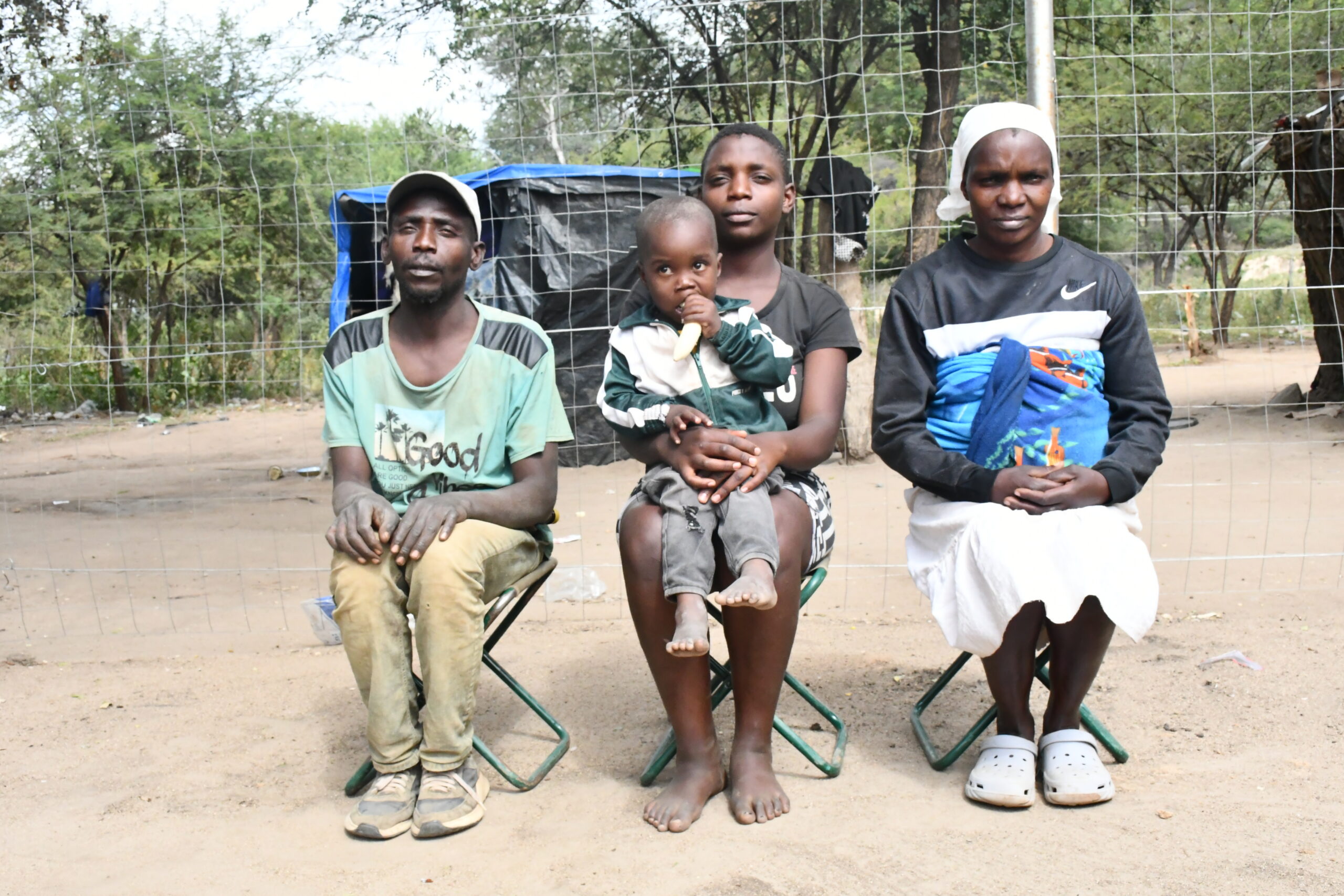

Zibusiso
Ndlovu
(left)
with
his
family,
his
wife
(right)
and
eldest
daughter
and
one
of
his
sons
(centre)
With
the
fear
of
losing
his
job
and
the
little
income
he
was
getting
at
the
end
of
each
month
weighing
heavily
on
him,
Zibusiso
decided
to
leave
his
general
hand
job
at
one
of
the
foreign-owned
commercial
gold
mines
in
Gwanda.
He
became
one
among
thousands
of
people
who
had
joined
the
gold
mining
rush
at
small
scale
artisanal
mining
sites
across
the
country
as
the
deteriorating
economic
situation
continued
to
affect
the
population.
But
life
has
not
been
as
kind
as
he
hoped
it
would
be.
After
20
years,
Zibusiso
is
still
here.
The
promises
of
gold
have
faded,
but
his
determination
remains.
“There
is
not
so
much
change”,
Zibusiso
recounts.
“Life
is
not
as
good
as
people
think
it
is
for
miners.
We
go
for
two
months
without
an
income.
To
survive,
we
must
borrow
from
our
‘sponsors’*
who
will
then
recover
their
money
once
we
realise
any
profits”,
adds
Zibusiso.
Regardless,
Zibusiso
continues
to
toil
daily
to
meet
the
basic
needs
of
his
family
of
six
children,
four
of
them
still
in
school,
and
a
wife
he
met
in
2003
in
Tshebetshebe,
just
two
years
after
he
arrived
in
2001.
“On
a
good
day,
we
make
between
500
to
1,500
Rands.
But
good
days
are
rare,”
he
says.
Daily,
Zibusiso
works
long
hours
underground
in
mine
shafts
that
are
anything
between
30
and
300
metres
deep.
He
is
painfully
aware
of
the
dangers
–
unstable
shafts,
toxic
dust
and
harmful
chemicals,
and
the
ever-present
risk
of
injury,
yet,
driven
by
the
need
to
provide
for
his
family,
he
soldiers
on,
armed
with
little
more
than
a
shovel,
plastic
containers,
a
hammer
and
a
wheelbarrow
among
other
basic
mining
equipment-no
safety
gear,
no
personal
protective
equipment.
This
exposes
him
and
many
other
small-scale
artisanal
miners
to
serious
health
conditions
such
as
respiratory
issues,
silicosis,
tuberculosis
and
physical
injuries.
“It’s
dangerous,
I
know,
but
these
are
the
sacrifices
we
make
for
our
loved
ones,”
says
Zibusiso.
“My
family
comes
first.
I
make
sure
that
I
support
them
from
the
proceeds
I
get
from
mining.
This
means
that
things
such
as
protective
clothing
and
proper
mining
equipment
are
not
a
huge
priority
for
me.”
Zibusiso’s
family
lives
about
five
kilometres
from
the
mine.
They
visit
every
two
to
three
weeks
to
check
up
on
him
and
collect
money
for
the
family’s
basic
needs.
Sadly,
Zibusiso’s
eldest
daughter
was
home
when
we
met
him
as
he
was
yet
to
pay
school
fees
for
her
and
three
other
siblings
two
weeks
after
schools
had
opened.
*Sponsors
for
gold
mining
are
individuals
who
typically
provide
funding,
equipment,
food
and
other
necessities
to
a
group
of
artisanal
miners.
In
exchange,
the
small-scale
artisanal
miners
(also
known
as
othseketstha
in
Ndebele),
pay
some
proceeds
from
the
sale
of
gold
and
give
a
certain
percentage
to
these
sponsors
for
their
support.
“As
you
can
see,
she
is
still
home
because
I
haven’t
been
able
to
raise
school
fees
yet,
but
I
hope
that
I
will
get
something
so
I
can
pay
the
school.”
While
the
economic
situation
has
not
changed
much
for
Zibusiso,
he
has
found
a
ray
of
hope
on
the
healthcare
side.
In
the
past,
he
and
his
colleagues
could
not
even
afford
to
take
time
off
work
to
seek
treatment,
often
enduring
severe
symptoms
silently.
But
now
things
have
improved
due
to
a
Médecins
Sans
Frontières
(MSF)
comprehensive
health
outreach
programme,
as
artisanal
miners
and
the
host
community
can
now
access
healthcare
services.
The
outreach
programme
aims
to
bridge
the
health
services
gap
and
bring
essential
healthcare
services
directly
to
the
miners’
doorsteps.
Through
the
Artisanal
Small-Scale
Gold
Mining
Basic
Healthcare
project
(ASGM-BHC),
MSF
works
hand
in
hand
with
the
Ministry
of
Health
and
Child
Care
to
deliver
free,
accessible
care
to
over
30
mining
sites
in
the
Gwanda
district.
The
project
offers
screenings,
treatment
for
common
illnesses,
mental
health
support,
and
health
education,
all
while
working
closely
with
the
Ministry
of
Health
and
Child
Care
to
improve
service
delivery
for
hard-to-reach
communities.
“We
used
to
walk
long
distances
of
up
to
5km
to
the
nearest
clinic.
Sometimes
we
would
commute
to
Gwanda
which
is
about
20km
away
to
receive
treatment.
Besides
paying
for
treatment,
getting
the
service
itself
was
hard
because
sometimes
medication
was
not
available
regardless
of
time
spent
in
queues
and
travel
time.
We
would
only
seek
treatment
when
one’s
health
condition
deteriorated
because
we
did
not
always
have
the
money
and
time
to
do
so.
Our
work
demands
that
we
work
every
day,
this
is
how
one
gets
more
money,
and
in
the
spirit
of
teamwork,
you
cannot
be
away
from
work,”
Zibusiso
says.
“For
the
first
time
in
24
years
of
my
experience
as
an
artisanal
miner,
I
had
never
experienced
this.
We
are
getting
treatment
for
almost
everything
here,
where
we
work.
We
are
now
receiving
treatment
for
most
of
the
conditions
here
at
the
mine.
TB,
HIV
and
STIs
are
very
common
conditions
affecting
miners,”
Zibusiso
says.
Artisanal
miners
like
Zibusiso
are
often
criminalised
or
forgotten,
operating
in
informal
spaces
where
survival
is
the
only
constant
but
he
is
grateful
to
MSF
for
giving
him
and
his
fellow
miners
a
health
life
line
to
enable
them
to
at
least
work
for
the
betterment
of
their
families
with
less
worry
on
their
health
needs
and
that
of
their
families.
Post
published
in:
Business