
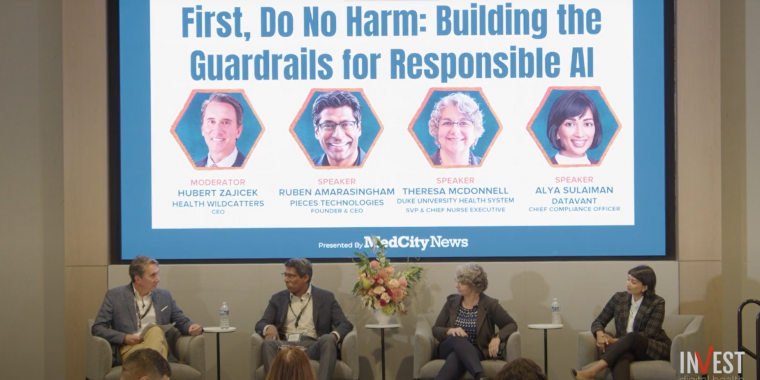

Healthcare
organizations
are
using
AI
more
than
ever
before,
but
plenty
of
questions
remain
when
it
comes
to
ensuring
the
safe,
responsible
use
of
these
models.
Industry
leaders
are
still
working
to
figure
out
how
to
best
address
concerns
about
algorithmic
bias,
as
well
as
liability
if
an
AI
recommendation
ends
up
being
wrong.
During
a
panel
discussion
last
month
at
MedCity
News’
INVEST
Digital
Health
conference
in
Dallas,
healthcare
leaders
discussed
how
they
are
approaching
governance
frameworks
to
mitigate
bias
and
unintended
harm.
They
think
that
the
key
pieces
are
vendor
responsibility,
better
regulatory
compliance
and
clinician
engagement.
Ruben
Amarasingham
—
CEO
of
Pieces
Technologies
a
healthcare
AI
startup
acquired
by
Smarter
Technologies
last
week
—
noted
that
while
human-in-the-loop
systems
can
help
curb
bias
in
AI,
one
of
the
most
insidious
risks
is
automation
bias,
which
refers
to
people’s
tendency
to
overtrust
machine-generated
recommendations.
“One
of
the
biggest
examples
in
the
commercial
consumer
industry
is
GPS
maps.
Once
those
were
introduced,
when
you
study
cognitive
performance,
people
would
lose
spatial
knowledge
and
spatial
memory
in
cities
that
they’re
not
familiar
with
—
just
by
relying
on
GPS
systems.
And
we’re
starting
to
see
some
of
those
things
with
AI
in
healthcare,”
Amarasingham
explained.
Automation
bias
can
lead
to
“de-skilling,”
or
the
gradual
erosion
of
clinicians’
human
expertise,
he
added.
He
pointed
to
research
from
Poland
that
was
published
in
August
showing
that
gastroenterologists
using
AI
tools
became
less
skilled
at
identifying
polyps.
Amarasingham
believes
that
vendors
have
a
responsibility
to
monitor
for
automation
bias
by
analyzing
their
users’
behavior.
“One
of
the
things
that
we’re
doing
with
our
clients
is
to
look
at
the
acceptance
rate
of
the
recommendations.
Are
there
patterns
that
suggest
that
there’s
not
really
any
thought
going
into
the
acceptance
of
the
AI
recommendation?
Even
though
we
might
want
to
see
a
100%
acceptance
rate,
that’s
probably
not
ideal
—
that
suggests
that
there
isn’t
the
quality
of
thought
there,”
he
declared.
Alya
Sulaiman,
chief
compliance
and
privacy
officer
at
health
data
platform
Datavant,
agreed
with
Amarasingham,
saying
that
there
are
legitimate
reasons
to
be
concerned
that
healthcare
personnel
could
blindly
trust
AI
recommendations
or
use
systems
that
effectively
operate
on
autopilot.
She
noted
that
this
has
led
to
numerous
state
laws
imposing
regulatory
and
governance
requirements
for
AI,
including
notice,
consent
and
strong
risk
assessment
programs.
Sulaiman
recommended
that
healthcare
organizations
clearly
define
what
success
looks
like
for
an
AI
tool,
how
it
could
fail,
and
who
could
be
harmed
—
which
can
be
a
deceptively
difficult
task
because
stakeholders
often
have
different
perspectives.
“One
thing
that
I
think
we
will
continue
to
see
as
both
the
federal
and
the
state
landscape
evolves
on
this
front,
is
a
shift
towards
use
case-specific
regulation
and
rulemaking
—
because
there’s
a
general
recognition
that
a
one-size-fits-all
approach
is
not
going
to
work,”
she
stated.
For
instance,
we
might
be
better
off
if
mental
health
chatbots,
utilization
management
tools
and
clinical
decision
support
models
all
had
their
own
set
of
unique
government
principles,
Sulaiman
explained.
She
also
highlighted
that
even
administrative
AI
tools
can
create
harm
if
errors
occur.
For
example,
if
an
AI
system
misrouted
medical
records,
it
could
send
a
patient’s
sensitive
information
to
the
wrong
recipient,
and
if
an
AI
model
incorrectly
processed
a
patient’s
insurance
data,
it
could
lead
to
delays
in
care
or
billing
mistakes.
While
clinical
AI
use
cases
often
get
the
most
attention,
Sulaiman
stressed
that
healthcare
organizations
should
also
develop
governance
frameworks
for
administrative
AI
tools
—
which
are
rapidly
evolving
in
a
regulatory
vacuum.
Beyond
regulatory
and
vendor
responsibilities,
human
factors
—
like
education,
trust
building
and
collaborative
governance
—
are
critical
to
ensuring
AI
is
deployed
responsibly,
said
Theresa
McDonnell,
Duke
University
Health
System’s
chief
nurse
executive.
“The
way
we
tend
to
bring
patients
and
staff
along
is
through
education
and
being
transparent.
If
people
have
questions,
if
they’ve
got
concerns,
it
takes
time.
You
have
to
pause.
You
have
to
make
sure
that
people
are
really
well
informed,
and
at
a
time
when
we’re
going
so
fast,
that
puts
additional
stressors
and
burdens
on
the
system
—
but
it’s
time
well
worth
taking,”
McDonnell
remarked.
All
panelists
agreed
that
oversight,
transparency
and
engagement
are
crucial
to
safe
AI
adoption.
Photo:
MedCity
News