
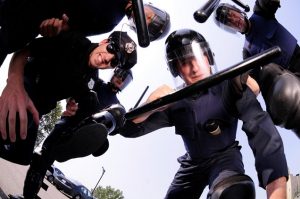

via
Getty)
Sean
Charles
Dunn,
a
paralegal
at
the
Department
of
Justice,
got
acquitted
in
early
November
for
throwing
a
Subway
sandwich
at
a
federal
agent
during
what
he
thought
was
an
ICE
raid.
He
was
threatened
with
a
felony
charge,
but
the
grand
jury
refused
to
indict,
so
prosecutors
pursued
his
case
as
a
misdemeanor.
He
lost
his
job
in
the
interim
but
was
ultimately
acquitted
at
trial.
Apparently,
DC
jurors
did
not
believe
that
a
Subway
sandwich,
no
matter
how
intentionally
lobbed
at
an
agent,
constituted
assault.
Spitting,
however,
because
of
the
visceral
element
and
the
possibility
of
disease
transmission,
is
a
whole
different
animal.
Special
laws
have
been
enacted
that
penalize
spitting
as
a
felony
whether
it
reaches
the
other
person’s
skin
or
not.
I
learned
this
firsthand
when
a
close
friend
of
my
son
was
arrested
during
the
June
2025
No
Kings
rally
in
Los
Angeles.
Angus
—
a
24
-year-old
college
grad,
a
musician
and
set
assistant
in
L.A.,
with
no
criminal
record
and
as
far
from
an
“Antifa”
agitator
as
a
monk
—
went
to
the
protest
with
my
son.
It
was
festive,
full
of
marchers,
picnickers,
grandmas
and
kids,
funny
signs
and
costumes.
But
when
phalanxes
of
Los
Angeles
national
guards
in
heavy
armor
accompanied
by
other
federal
law
enforcement
and
LAPD
moved
in
to
order
the
crowd
to
disperse,
things
changed.
They
shouted
through
bullhorns
and
fired
rubbers
bullets,
some
of
which
ripped
through
protest
signs
even
though
it
was
daylight
and
the
allotted
protest
time
had
not
expired.
Some
in
the
crowd
stood
their
ground
as
law
enforcement
closed
in
with
shields,
batons,
and
other
riot
gear.
As
they
approached
Angus,
he
did
something
stupid.
He
spat
at
them
—
something
he’ll
regret
for
the
rest
of
his
life.
A
hunk
of
phlegm
landed
on
an
officer’s
shoe
and
face
shield.
Within
moments,
Angus
was
dog-piled
by
a
group
of
soldiers,
disappearing
beneath
the
scrum
of
heavily
armed
men.
He
didn’t
reappear
for
four
days.
He
had
been
in
federal
custody,
not
allowed
to
call
friends
or
family
who,
naturally,
were
frantic.
He
described
this
as
the
hardest
time
of
his
ordeal,
not
knowing
what
he
was
being
charged
with
or
when
he’d
see
a
judge.
He
finally
saw
a
federal
magistrate
and
learned
that
federal
prosecutors
were
charging
him
with
felony
assault
—
a
crime
that
carries
the
possibility
of
eight
years.
As
U.S.
Attorney
Pam
Bondi
told
Fox
News,
“You
can
run,
but
you
can’t
hide.
We
are
coming
after
you
federally.
If
you
assault
a
police
officer,
if
you
rob
a
store,
if
you
loot,
if
you
spit
on
a
police
officer,
we
are
coming
after
you.”
Two
days
after
being
arraigned,
prosecutors
gave
Angus
an
ultimatum:
plead
guilty
to
a
misdemeanor,
or
they’d
indict.
The
plea
bargain
compelled
Angus
to
serve
four
months
in
federal
prison.
That’s
a
lot
of
time
for
a
guy
exercising
his
First
Amendment
rights,
albeit
a
little
too
enthusiastically.
Ironically,
he
had
to
make
his
decision
around
the
time
of
July
4th,
a
day
that
celebrates
America’s
freedom
from
tyrannical
governments.
Being
convicted
of
a
federal
crime
carries
long-term
consequences.
There
is
none
of
the
expungement
or
sealing
of
records
which
can
happen
in
state
courts.
Whatever
crime
is
pleaded
to,
the
person
carries
the
rest
of
their
lives.
Angus
was
released
from
jail
and
mulled
over
options
with
his
attorney,
friends,
and
family.
Most
found
that
compelling
four
months
in
jail
for
spitting
during
a
protest
rally
was
outrageous.
But
what
choice
did
he
have?
Could
he
risk
being
indicted?
Although
a
Washington,
D.C.,
grand
jury
refused
to
indict
the
sandwich
man,
that
was
no
guarantee
they’d
do
the
same
in
L.A.
There
was
no
doubt
that
Angus
spit,
and
federal
law
is
clear
—
if
done
intentionally
against
a
federal
officer,
that’s
a
crime
even
if
no
harm
ensues.
Having
a
felony
record
does
a
lot
more
damage
than
a
misdemeanor.
It
prevents
the
person
from
getting
certain
jobs,
bank
loans,
housing,
and
even
travelling
to
certain
countries.
Angus
and
his
attorney
looked
at
all
the
angles.
The
spitting
was
not
on
video.
The
officer
exaggerated
what
had
happened
and
claimed
some
landed
on
his
skin
in
spite
of
his
face
visor
and
shield.
However,
the
possibility
of
ending
up
with
a
felony
conviction
and
being
sentenced
to
more
than
four
months
was
high
a
risk
to
run.
A
lot
of
cases
turn
on
a
dime
—
the
political
winds
of
the
time;
the
direction
of
higher-ups
in
the
prosecution
offices;
the
political
whims
of
the
Department
of
Justice.
Ultimately,
it
comes
down
to
a
cost
benefit
analysis,
how
much
risk
a
person
is
willing
to
handle.
Maybe
the
prosecution
would
not
have
indicted.
Maybe
it
was
a
bluff.
Maybe,
even
if
they
did,
Angus
would
have
been
indicted
only
for
a
misdemeanor,
or
maybe
he
wouldn’t
have
been
found
guilty
after
trial.
But
with
the
stern
rhetoric
of
the
Justice
Department
backed
by
the
vociferousness
of
the
U.S.
president
himself,
Angus
ultimately
decided
it
was
a
risk
he
couldn’t
take.
Angus’
parents,
two
research
scientists
from
Washington
State,
got
involved.
They
called
his
federal
public
defender
to
intercede.
She
then
spoke
to
her
supervisor,
who
then
spoke
to
the
head
of
the
prosecutor’s
office.
Character
letters
streamed
in
about
Angus’s
good
nature,
talents,
and
peacefulness.
It
helped
the
needle
budge
incrementally.
The
prosecution
still
insisted
Angus
serve
jail
time
on
a
misdemeanor
plea,
but
instead
of
four
months,
they
agreed
to
leave
it
up
to
a
judge
to
determine
what
amount
of
time
was
warranted.
But,
they
said,
it
had
to
be
at
least
two
weeks
and
could
still
be
as
much
as
four
months.
Angus
accepted
the
plea
deal.
While
this
wasn’t
a
total
victory,
it
saved
him
a
felony
conviction
and
left
the
possibility
that
his
jail
sentence
would
be
less
than
four
months.
Angus
had
to
report
to
federal
probation
during
the
pendency
of
his
case.
He
couldn’t
go
within
a
certain
distance
of
federal
buildings.
He
had
to
get
permission
to
travel
out
of
the
district.
Finally,
the
day
came
when
the
judge
pronounced
sentence.
At
least
20
well-wishers,
friends,
and
family
filled
the
courtroom.
In
the
six
months
since
the
time
of
the
crime,
the
political
climate
in
the
U.S.
had
shifted.
Trump’s
popularity
was
on
the
decline;
a
D.C.
jury
found
the
Subway
sandwich
defendant
not
guilty
of
even
a
misdemeanor.
It
appeared
reason
was
taking
hold
over
intimidation.
The
judge
commented
how
in
all
his
years
on
the
bench
he’d
never
see
the
prosecution
ask
for
jail
time
for
a
young
man
with
no
criminal
record
who
spit
during
a
protest
rally.
He
did,
however,
reiterate
that
it
was
against
the
law
and
should
not
be
done
ever
again.
Angus
thought
he
might
not
have
to
do
any
time
at
all,
but
that
was
a
misreading
of
the
plea
agreement.
No
matter
how
sympathetic
the
judge,
he
had
to
give
him
a
minimum
of
two
weeks
in
federal
prison.
And
that’s
what
Angus
got
—
two
weeks.
He’ll
turn
himself
in
to
start
the
sentence
in
January.
Undoubtedly,
the
conviction
will
impact
Angus’s
future.
He’ll
never
shake
himself
loose
from
it.
One
thing
is
for
certain
—
he’ll
never
spit
at
law
enforcement
again.
But
how
it
will
impact
his
and
his
friends’
interest
in
standing
up
for
what
they
believe
in,
taking
part
in
rallies,
and
making
their
voices
heard,
remains
to
be
seen.
Toni
Messina
has
tried
over
100
cases
and
has
been
practicing
criminal
law
and
immigration
since
1990.
You
can
follow
her
on
Twitter: @tonitamess.