
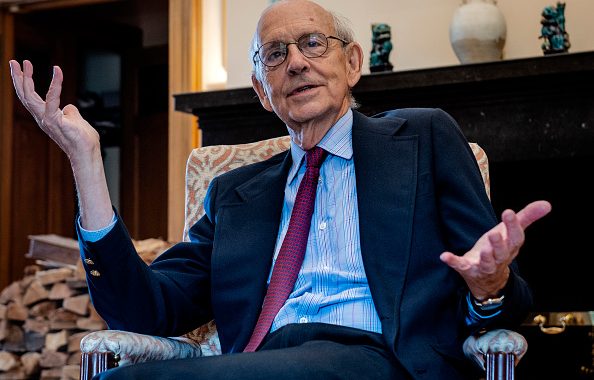
by
Bill
O’Leary/The
Washington
Post
via
Getty
Images)
Justice
Stephen
Breyer
may
no
longer
sit
on
the
Supreme
Court,
but
he
still
has
thoughts
about
his
old
workplace.
Tomorrow,
Open
to
Debate
is
dropping
a
wide-ranging
interview
with
Breyer
covering
everything
from
his
personal
account
of
the
day
he
was
nominated
to
the
Supreme
Court
to
the
mechanics
of
the
conversations
justices
have.
He
also
gives
his
secret
strategy
for
making
sure
he’d
get
assigned
an
opinion
with
just
three
little
words.
However,
a
good
deal
of
the
conversation
explores
themes
from
his
latest
book
Reading
the
Constitution:
Why
I
Chose
Pragmatism
Not
Textualism.
Breyer’s
book
and
the
related
discussion
provide
a
frustrating
take
on
judicial
philosophy.
Not
because
the
justice
fails
to
lay
out
intellectual
case
against
either
textualism
or
originalism,
but
because
he
addresses
them
with
the
respect
they
have
done
nothing
to
deserve.
There’s
nobility
in
raising
the
level
of
discourse
through
professional
and
respectful
engagement.
But
it’s
also
the
kind
of
nobility
that
gets
offed
in
the
first
season
of
Game
of
Thrones.
It’s
a
matter
of
victory
conditions.
Textualists
don’t
care
about
convincing
everybody,
they
just
need
their
trash
ideas
treated
“fairly”
by
respected
people
so
they
can
pawn
off
their
worldview
as
reasonable
disagreement.
Defenestration
via
Overton
Window.
Efforts
to
unilaterally
elevate
the
conversation
miss
the
mark
because
they
fail
to
grasp
this
victory
condition
issue.
The
conservative
legal
movement
doesn’t
care
that
you
can
respectfully
poke
holes
in
their
chosen
interpretive
philosophy
—
they
more
or
less
know
it
sucks
—
they
just
want
it
treated
with
unearned
dignity
on
the
public
stage
so
they
can
trade
on
the
patina
of
credibility
that
affords.
The
Open
to
Debate
crew
notes
that
they
recorded
a
prior
debate
titled
“Should
SCOTUS,
the
Supreme
Court,
focus
on
the
original
meaning
of
the
Constitution?”
and
I
know
that
because
I
was
on
that
one!
I
recall
Professor
Randy
Barnett
laid
out
“five
normative
arguments”
for
originalism
and
I
was
allowed
to
ask
a
question
at
the
end
prompting
him
to
concede
his
“number
one”
argument.
If
only
I’d
been
able
to
ask
more
questions,
we
could’ve
knocked
them
all
out!
But
the
point
is
even
the
defender
of
originalism
was
willing,
when
pressed,
to
admit
he
wasn’t
even
persuaded
by
the
top
argument
he
presented.
It’s
just
throwing
pasta
on
the
wall
and
hoping
the
other
side
is
polite
about
it.
This
doesn’t
mean
forfeiting
critique
or
descending
into
Twitter-thread
invective.
Refusing
to
engage
is
its
own
vice.
But
tone
matters.
If
the
argument
registers
as
polite
disagreement
rather
than
scathing
teardown,
textualists
can
declare
mission
accomplished.
If
there’s
a
quote
from
the
discussion
that
captures
this
disconnect,
it’s
this
one:
So
if
you,
you
say
to
the
textualists,
what,
uh,
“Do
you
agree
with
Brown
versus
Board
of
Education?”
They
say,
“Yes,
of
course.”
Ahem.

This
isn’t
hyperbole.
During
the
first
Trump
administration,
Democrats
took
to
asking
his
judicial
nominees
if
they
would
at
the
very
least
agree
that
Brown
v.
Board
was
correct
and
they…
struggled
mightily.
They
weren’t
being
asked
if
Brown
required
a
return
of
bussing
or
anything,
just
if
—
on
its
own
facts
—
they
agreed
with
the
unanimous
Supreme
Court
opinion
against
Jim
Crow
education.
Koosh
balls
aren’t
even
that
soft.
And
yet
it
caused
much
hemming
and
hawing
among
Trump’s
nominees.
Indeed,
the
counsel
shepherding
GOP
nominees
through
the
Judiciary
Committee
at
the
time
threw
a
tantrum
that
it
was
unfair
“gutter
politics”
to
make
nominees
defend
desegregation
while
under
oath.
So
when
Justice
Breyer
grants
the
champions
of
textualism
and
originalism
the
benefit
of
the
doubt
that
they
would
“of
course”
say
they
support
Brown,
he
doesn’t
grasp
the
conservative
legal
movement’s
YOLO
era
where
they’ve
stopped
pretending
and
just
raw
dog
judicial
review.
There
are
certainly
still
originalist
wizards
willing
to
offer
lip
service
to
Brown
ending
de
jure
segregation
while
playing
semantic
games
to
guarantee
de
facto
segregation,
but
for
a
lot
of
them
the
hood
is
now
off.
Or
on
as
the
case
may
be.
Either
way,
it
renders
this
academic
sparring
session
with
textualism
a
naive
exercise.
He’s
saying
they
would
say
“of
course”
as
if
these
folks
have
some
good
faith
belief
in
Brown,
when
recent
events
make
pretty
clear
the
movement
only
ever
said
“of
course”
to
further
the
con
that
their
philosophy
had
any
depth
to
it.
The
whole
approach
feels
like
chiding
Orval
Faubus
that
his
articulation
of
states’
rights
misreads
the
Federalist
Papers.
As
the
ubiquitous
goose
meme
would
ask,
“A
STATE’S
RIGHT
TO
DO
WHAT?!?”
The
point
forcefully
expressed
by
our
feathered
friend
is
that
the
philosophy
is
inextricable
from
its
purpose.
That’s
the
nut
that
an
academic
conversation
about
this
stuff
can’t
get
at:
originalism’s
whole
appeal
is
that
constitutional
law
was
better
in
the
1700s.
“For
who?”
the
goose
might
ask.
Which
is
wrong
because
it
should
be
“for
whom”
but
geese
are
terrible
at
grammar.
But
when
someone
decides
they’re
an
originalist,
you
can’t
haggle
with
them
over
finer
points
of
workability
—
valid
though
those
points
may
be
—
because
they’re
in
it
for
the
value
it
represents.
They’re
in
it
because
they
actually
believe
in
a
backward-looking
world.
Tear
down
originalism
from
the
ivory
towers
and
they’ll
just
invent
a
new
mechanism
to
get
there.
Which
is
all
to
say
the
conversation
is
interesting
but
incomplete.
Until
someone
in
Breyer’s
position
delivers
their
sharp
argument
without
conceding
the
textualist/originalist
covert
demand
for
respectability,
these
discussions
do
little
to
derail
the
steady
advance
of
a
jurisprudence
of
witch-hunters.
The
episode
is
out
tomorrow
and
covers
this
and
much
more.
Check
it
out
here:
7/4: Thinking
Twice:
Reading
the
Constitution
with
Justice
Stephen
G. Breyer
[Open
to
Debate]
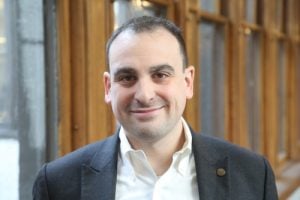 Joe
Joe
Patrice is
a
senior
editor
at
Above
the
Law
and
co-host
of
Thinking
Like
A
Lawyer.
Feel
free
to email
any
tips,
questions,
or
comments.
Follow
him
on Twitter or
Bluesky
if
you’re
interested
in
law,
politics,
and
a
healthy
dose
of
college
sports
news.
Joe
also
serves
as
a
Managing
Director
at
RPN
Executive
Search.