

What’s
Changing
For
two
decades
federal
loans
functioned
as
something
close
to
a
guarantee
that
law
school
could
be
financially
accessible.
Even
those
facing
modest
salary
outcomes
could
borrow
what
they
needed,
repay
on
an
income-driven
schedule,
and
utilize
forgiveness
programs
to
eventually
become
debt-free.
Starting
this
July,
new
federal
regulations
are
eliminating
the
Graduate
PLUS
loan
for
new
borrowers
and
cap
how
much
graduate
students
can
borrow
through
federal
loan
programs.
This
will
leave
many
law
students
with
a
gap
between
federal
aid
and
their
actual
expenses.
Those
without
family
money
or
significant
scholarships
are
left
with
private
loans
as
their
financing
option.
And
private
lending
presents
a
very
different
scenario.
Why
Private
Loans
Are
Harder
to
Navigate
Graduate
PLUS
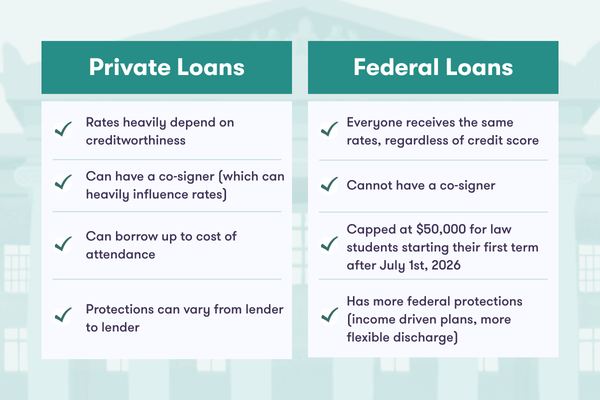
loans
allowed
students
to
borrow
up
to
the
full
cost
of
attendance
with
the
barest
of
credit
requirements
–
something
opponents
of
the
program
often
cited
as
problematic.
Interest
rates
were
fixed
at
the
same
levels
for
every
borrower.
Private
loan
approval
and
rates
heavily
depend
on
the
creditworthiness
of
the
borrower.
Law
students
in
their
early
to
mid-twenties
may
struggle
to
meet
minimum
credit
length
requirements
even
if
they
have
done
no
damage
to
their
credit.
There
is
going
to
be
an
increased
need
for
creditworthy
cosigners
for
borrowers
who
are
unable
to
secure
financing
based
on
their
own
history.
Given
the
20-year
availability
of
the
Graduate
PLUS
loan,
the
financial
education
surrounding
private
loan
selection
has
been
missing
from
the
conversation.
For
instance,
many
borrowers
do
not
realize
that
shopping
around
for
a
student
loan
rate
is
highly
advantageous
as
rate
ranges
on
school
lender
lists
do
not
give
solid
information
on
where
a
borrower
will
fall
in
that
range.
According
to
Experian
and
MyFICO,
multiple
student
loan
applications
do
not
impact
your
FICO
score
when
applications
are
completed
within
a
14-45
day
timeframe.
While
federal
loans
all
follow
the
same
set
of
rules
and
regulations,
the
terms
of
a
private
loan
can
vary
significantly
from
lender
to
lender.
Borrowers
must
navigate
disclosures
carefully
to
ensure
they
understand
the
differences
between
products.
Here
are
a
few
key
items
to
take
into
consideration
when
comparing
products:
-
Interest
rate
and
APR -
Term
Length -
Repayment
options
(deferred,
fixed,
interest
only,
full
repayment) -
Cosigner
release
availability
(if
applicable) -
Death
and
disability
discharge -
Clerkship
deferment
availability -
Discounts
(autopay,
graduation,
etc.)
Juno’s
Group
Negotiation
Model
Juno
was
built
on
a
straightforward
premise:
borrowers
negotiating
together
have
leverage
that
borrowers
negotiating
alone
never
will.
Juno
isn’t
a
lender.
It’s
a
collective
bargaining
group
for
borrowers.
The
idea
is
simple:
lenders
are
often
willing
to
offer
better
deals
to
groups
than
to
individuals.
From
November
to
May,
Juno
encourages
as
many
students
as
possible
to
sign
up
for
the
negotiation
group
to
maximize
impact.
New
deals
secured
through
negotiation
are
released
each
June
and
students
can
see
personalized
rates
based
on
their
credit
score
through
a
soft
credit
check.
Over
the
past
8
years,
Juno
has
helped
its
members
navigate
the
process
resulting
in
negotiated
group
deals
to
the
tune
of
over
$1B
in
student
loans
and
student
loan
refinancing.

Past
negotiations
have
resulted
in:
-
Discounted
rates
and
exclusive
benefits:
lenders
offered
Juno
members
reduced
rates
or
cash
back,
making
Juno
an
obvious
choice
for
borrowers. -
Broader
eligibility
—
In
2025,
85%
of
approved
Juno
members
secured
loans
without
a
cosigner,
compared
to
~20%
of
the
broader
market. -
A
rate
match
guarantee:
borrowers
who
found
a
lower
rate
through
an
eligible
lender
were
able
to
get
the
rate
matched
and
1%
of
their
loan
value
in
cash
back.
Additionally,
Juno
is
committed
to
providing
strong
borrower
education.
This
includes
access
to
resource
hubs,
live
webinars,
and
free
one-on-one
meetings
with
experts.
The
Bigger
Picture
Federal
loans
built
a
degree
of
equity
into
the
system.
Credit
(or
lack
thereof)
and
family
wealth
didn’t
determine
whether
you
could
become
a
lawyer.
As
those
protections
shrink,
there’s
a
real
risk
that
private
lending
becomes
the
new
gatekeeper
to
the
legal
profession.
Juno’s
model
doesn’t
wait
for
policy
to
change.
It
works
within
the
existing
private
market
to
give
borrowers
more
power
—
and
in
doing
so,
helps
keep
legal
education
within
reach
for
more
people

The
information
provided
in
this
article
is
current
as
of
April
1,
2026,
and
is
intended
for
general
informational
purposes
only.
It
does
not
constitute
legal,
financial,
or
tax
advice.
Readers
should
consult
their
own
advisors
before
making
any
decisions.
Terms
and
conditions
may
apply
to
the
loan
products
discussed.
Federal
student
loans
offer
certain
borrower
protections
and
benefits—such
as
income-driven
repayment
plans
and
potential
forgiveness
options—that
are
important
to
consider.
To
learn
more,
visit
studentaid.gov.
Leah
Young
is
the
Student
Success
Resource
Lead
at
Juno.
She
has
nearly
20
years
of
experience
in
student
financial
aid
and
financial
literacy
initiatives.
Leah
served
as
a
Law
School
Director
of
Admissions
and
Financial
Aid
and
was
an
Accredited
Financial
Counselor®
for
a
legal
education
non-profit
prior
to
joining
Juno’s
efforts
to
expand
quality
private
loan
options
post-OBBBA.