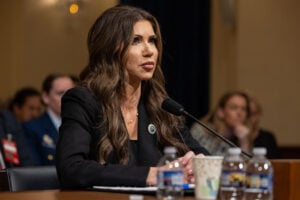
by
Nathan
Posner/Anadolu
via
Getty
Images)
On
January
10,
Minnesota
Reps.
Ilhan
Omar,
Angie
Craig,
and
Kelly
Morrison
became
the
latest
members
of
Congress
to
be
turned
away
when
they
attempted
to
inspect
an
ICE
facility
in
Minneapolis.
After
first
being
allowed
inside,
they
were
quickly
hustled
off
the
premises
by
personal
edict
of
DHS
Secretary
Kristi
Noem.
In
the
wake
of
the
murder
of
Renee
Good
and
in
defiance
of
federal
law
and
a
court
order,
Noem
has
now
barred
members
of
Congress
from
inspecting
immigration
facilities
without
notice
and
her
personal
permission.
She
claims
to
have
discovered
ONE
WEIRD
TRICK
to
exclude
Members
of
Congress
from
ICE
facilities.
It’s
a
transparently
bad
faith
gimmick
—
and
it
just
might
work.
The
conflict
started
last
summer
when
Trump
announced
his
plan
to
raise
the
number
of
beds
in
immigration
facilities
from
41,000
to
100,000
to
accommodate
his
deportation
dragnet.
Private
prison
groups
squealed
with
glee
as
they
dove
into
a
trough
of
no-bid
contracts,
re-opening
decrepit
facilities
that
had
been
shuttered
due
to
lack
of
demand,
and
throwing
up
squalid
tents
in
which
to
imprison
ICE’s
victims.
Under
§
527
of
the
2024
Consolidated
Appropriations
Act
—
AKA
the
budget
bill
—
ICE
must
allow
legislators
to
inspect
“any
facility
operated
by
or
for
the
Department
of
Homeland
Security
used
to
detain
or
otherwise
house
aliens.”
DHS
cannot
use
allocated
funds
to
block
access
by
members
of
Congress,
and
those
lawmakers
don’t
have
to
call
first.
This
has
caused
substantial
friction
between
DHS
and
congressional
Democrats.
Most
notably,
the
US
Attorney’s
Office
for
New
Jersey
charged
Newark
Mayor
Ras
Baraka
with
trespassing
at
the
ICE
facility
in
his
own
backyard,
only
to
drop
the
charges
against
him
and
indict
Rep.
LaMonica
McIver
for
assault.
Clearly
DHS
would
prefer
to
run
what
are
effectively
concentration
camps
in
secret,
so
in
June
Noem
announced
a
new
policy
requiring
legislators
to
request
access
a
week
in
advance
and
allowing
entry
at
her
sole
discretion.
In
July,
a
group
of
lawmakers
led
by
Rep.
Joe
Neguse
of
Colorado
sued
to
block
enforcement
of
the
seven-day
notice
requirement.
And
on
December
17,
Judge
Jia
Cobb
in
DC
enjoined
the
policy
for
violating
§
527’s
ban
on
using
budget
funds
to
exclude
legislators
from
the
facilities.
Congress
hasn’t
passed
a
budget
in
two
years,
but
it
has
enacted
a
series
of
continuing
resolutions
to
keep
the
government
funded,
most
recently
in
December.
Each
of
those
resolutions
specifies
that
additional
funds
“shall
be
available
to
the
extent
and
in
the
manner”
provided
in
the
prior
budget,
meaning
that
§
527
still
applies.
The
Appropriations
Bill
isn’t
the
only
source
of
funding
for
Noem’s
goons,
though.
Congress
gave
DHS
nearly
$30
billion
under
the
One
Big
Beautiful
Bill
Act
for
hiring,
training,
enforcement,
and
“facility
upgrades
to
support
enforcement
and
removal
operations.”
Section
527
does
not
apply
to
OBBBA
funds.
But
during
discovery
DHS
conceded
that
it
wasn’t
using
OBBBA
funds
to
run
detention
facilities,
so
Judge
Cobb
barred
enforcement
of
the
Noem
memo
and
ordered
DHS
to
let
the
legislators
back
in.
Spotting
a
loophole,
Noem
issued
new
guidance
on
January
8
purporting
to
reinstate
the
banned
policy,
but
this
time
using
only
OBBBA
funds:
ICE
must
ensure
that
this
policy
is
implemented
and
enforced
exclusively
with
money
appropriated
by
the
OBBBA.
To
that
end,
any
time
or
resources
spent
conducting
activities
otherwise
subject
to
Section
527’s
limitations
must
be
appropriately
logged
and
funded
from
OBBBA
funding.
Given
the
extent
of
the
funding
made
available
to
ICE
through
the
OBBBA,
I
anticipate
that
there
is
more
than
sufficient
funding
available
for
the
limited
expenses
associated
with
implementing
and
enforcing
these
policies.
Translation:
We’re
going
to
evade
legislative
oversight
with
this
bottomless
slush
fund
Congress
awarded
us.
Of
course,
money
is
fungible.
Just
declaring
that
it
came
from
one
pot
and
not
another
—
particularly
when
you’ve
been
claiming
the
opposite
for
months
—
doesn’t
make
it
so.
Rep.
Neguse,
et
al,
may
argue
that
the
facilities
run
on
regular
budget
funds,
and
DHS
can’t
carve
out
one
specific
type
of
interaction
by
“logging”
it
(whatever
that
means)
as
funded
by
OBBBA.
Perhaps
the
plaintiffs
will
demand
court
oversight
to
verify
that
the
funding
really
is
coming
from
a
different
pot.
Or
perhaps
the
Trump
administration
will
get
away
with
evading
Congressional
oversight
by
telling
yet
another
obvious
lie
and
demanding
that
it
be
accorded
a
presumption
of
regularity
it
long
since
frittered
away.
Subscribe
to
read
more
at
Law
and
Chaos….
Liz
Dye produces
the
Law
and
Chaos Substack and podcast. You
can
subscribe
by
clicking
the
logo: