
Happy
Monday!
I
stayed
up
way
too
late
this
weekend making
history with
112,000+
other
people
at
the
largest
ticketed
concert
ever
held
in
the
U.S.
– Zach
Bryan at
the
Big
House.
I
was
visiting
my
son
who
is
a
junior
at
the
University
of
Michigan,
and
I
have
to
say
it
was
pretty
special
to
be
belting
out
lyrics
with
my
husband
and
children
at
the
top
of
our
lungs
amidst
thousands
of
fans
under
the
pink
skies
of
a
Michigan
sunset,
which
I’ve
hopefully taught
‘em
to
enjoy.

Big
House,
Ann
Arbor
(photo
by
Renee
Jefferson)
This
week
you
can
join
me
LIVE
at
an
event
featuring
my
book Shortlisted:
Women
in
the
Shadows
of
the
Supreme
Court hosted
by
the
Dallas
Allied
Bars
Equality
Committee
and
the
Dallas
Women
Lawyers
Association
on
Tuesday
from
noon-1PM
central.
Learn
more
and
register here.
Other
speakers
include Judge
Rebecca
Rutherford,
U.S.
District
Court
for
the
Northern
District
of
Texas
and Professor
Cheryl
Wattley (UNT
Dallas).

I’m
also
happy
to
share
a
recent
review
of Shortlisted.
Even
though
the
book
was
first
published
in
2020
with
a
paperback
update
in
2022,
the
themes
seem
to
resonate
now
more
than
ever.
Here’s
an
excerpt
from
the
review:
One
of
the
book’s
standout
features
is
its
meticulous
research
that
supports
the
authors’
arguments.
The
writing
style
strikes
a
remarkable
balance
between
academic
rigor
and
accessibility.
Even
as
someone
not
deeply
entrenched
in
the
intricacies
of
the
American
judicial
system,
I
found
the
explanations
clear
enough
to
engage
me
deeply.
The
first
half
unveils
a
narrative
steeped
in
history,
examining
how
female
presence
was
regarded
as
both
revolutionary
and
contentious—especially
in
a
time
when
presidents
would
endorse
women’s
suffrage
yet
remain
hesitant
to
genuinely
support
women
in
positions
of
power.Notably,
the
authors
don’t
shy
away
from
the
complexities
that
arise
after
women
are
appointed.
The
challenges
they
present—such
as
balancing
familial
expectations
and
professional
responsibilities—are
all
too
relatable.
I
found
myself
reflecting
on
the
broader
implications
not
only
in
the
court
but
in
workplaces
everywhere,
as
women
juggle
identities
that
society
often
complicates
for
them.
Read
the
full
review here.
And
my
co-author Dean
Hannah
Brenner
Johnson (Southern
Illinois)
and
I
are
always
happy
to
speak
about
the
book.
We’ve
given
talks
to
a wide
range
of
audiences.
Please
reach
out
to
either
(or
both!)
of
us
if
you
have
an
engagement
in
mind.
Now
for
your
headlines.
I
can’t
blame
the
slow
start
to
my
Monday
only
on
my
late
night
concert
over
the
weekend.
I
am
definitely
still
recovering
from
the
onslaught
of
legal
ethics
news
from
the
past
week.
We
of
course
have
more
than
ten
headlines…so
let’s
turn
now
to
the
top
fifteen.
You
might
want
to
grab
a
cup
of
coffee
for
this
read.
☕️
Highlights
from
Last
Week –
Top Ten Fifteen
Headlines
#1 “If
the
Trump
administration
can
do
this,
then
no
American
is
safe
from
political
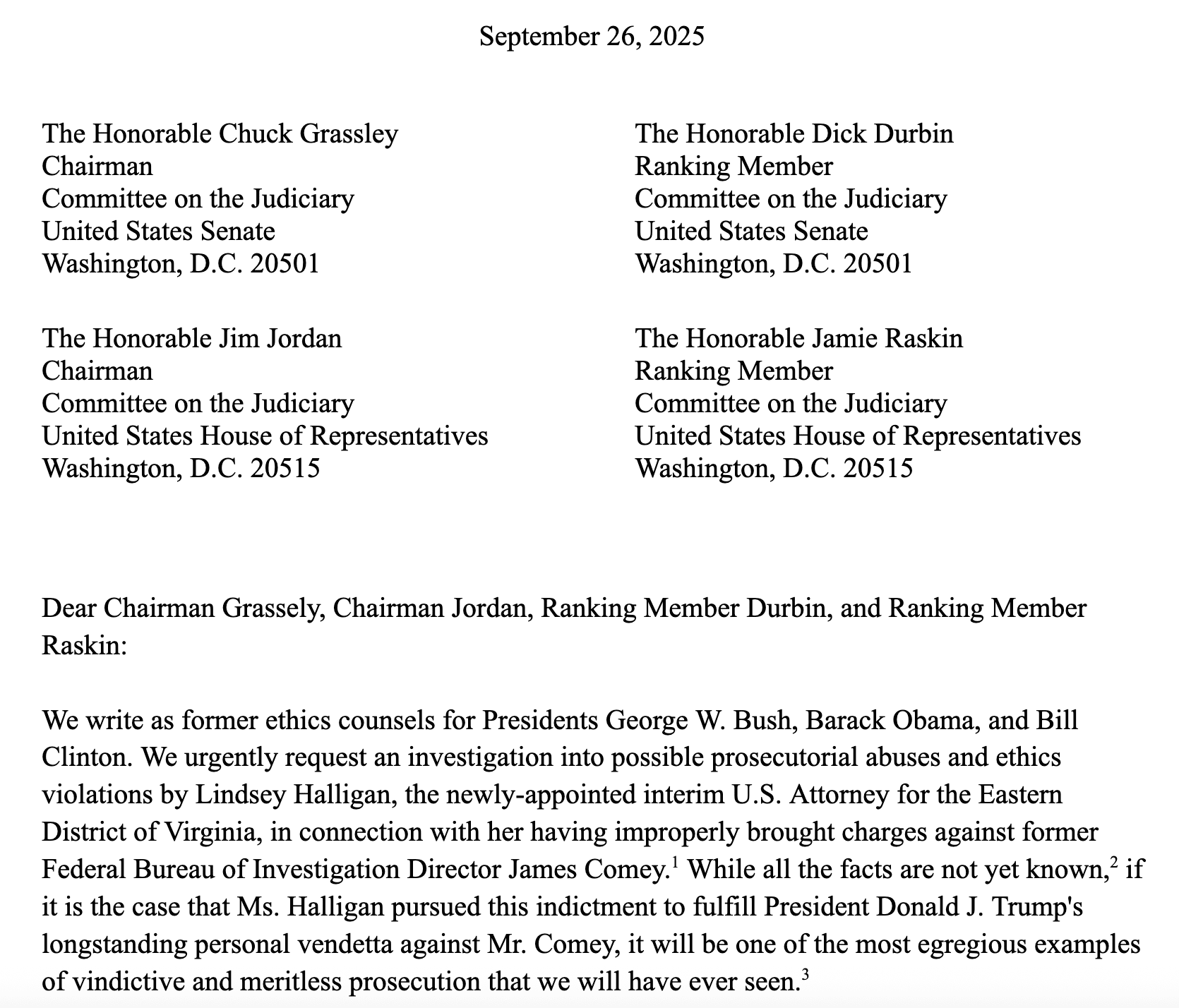
prosecution.” A
letter
to
Congress
from Norman
Eisen, Richard
Painter,
and Virginia
Canter:
“We
write
as
former
ethics
counsels
for Presidents
George
W.
Bush, Barack
Obama,
and Bill
Clinton.
We
urgently
request
an
investigation
into
possible
prosecutorial
abuses
and
ethics
violations
by Lindsey
Halligan,
the
newly-appointed
interim
U.S.
Attorney
for
the
Eastern
District
of
Virginia,
in
connection
with
her
having
improperly
brought
charges
against
former Federal
Bureau
of
Investigation
Director
James
Comey.
…
In
the
United
States,
a
president
should
never
order
prosecutions
of
his
enemies.”
Read
the full
letter
here and
an
op-ed
from
the
authors
published
on
MSNBC here.
#2
“‘At
Professional
Risk’:
Charging
Comey
Could
Land
Lindsey
Halligan
in
Hot
Water.” From Vanity
Fair: “An
ethics
professor
from
Halligan’s
law
school
warns
that
if
she
pursues
charges
against
the
former
FBI
director
without
probable
cause,
she
could
be
disciplined
by
the
Florida
bar.”
Read
more here.
#3 “Newman
Makes
Full-Court
Press
in
Appeals
Challenge
of
Suspension.” From Bloomberg
Law: “Judge
Pauline
Newman,
the
country’s
oldest
active
federal
judge,
asked
the
full
D.C.
Circuit
to
reconsider
her
constitutional
challenge
to
the
law
her
colleagues
used
to
suspend
her
from
hearing
new
cases.
The
full
appellate
court
should
heed
a
three-judge
panel’s
implicit
invitation’
to
take
the
case
en
banc
and
revisit
a
precedent
preventing
the
court
from
considering
Newman’s
arguments
on
the
merits,
she
argued
in
a petition filed
Sept.
19
at
the
US
Court
of
Appeals
for
the
District
of
Columbia
Circuit.
The
panel
in
August
upheld
a
D.C.-based
district
court’s
dismissal
of
Newman’s
lawsuit
seeking
reinstatement.”
Read
more here.
#4
“Amy
Coney
Barrett
Explains
Why
She
Won’t
Explain
Her
Recusals.” From Politico: “Justice
Amy
Coney
Barrett indicated
Thursday
that
one
reason
she
chooses
not
to
explain
why
she
recuses
herself
from
cases
for
ethics
reasons
is
because
her
friends
or
family
could
face
unwanted
public
attention,
threats
or
worse.
The
comments
from
Barrett
are
a
rare
sign
that
a
recent
surge
in
threats
against
judges
and
their
families
are
affecting
how
members
of
the
Supreme
Court
carry
out
their
official
duties.
During
a
stop
in
Washington
to
promote
her
new
book,
Barrett
was
asked
why
some
justices
explain
their
decisions
to
recuse
from
cases,
while
others
don’t.”
Read
more here.
#5
“I
Sought
to
Protect
an
Immigrant
Legal
Client.
Instead,
I’m
Facing
Trump’s
New
Sanctions.” From The
Guardian: “Facing
the
specter
of
conditions
in
El
Salvador’s
Cecot
facility
and
the
plight
of
other
immigrants
having
been
removed
without
notice,
I
had
previously
secured
a class
action against
removals
for
my
own
district
around
Los
Angeles,
and
I
wanted
to
extend
such
protection
to
this
client.
I
knew
President
Trump
had
issued
a proclamation attempting
to
justify
removals
after
the
fact,
but
I
used
my
best
judgment
and
skills
to
ask
the
court
to
enforce
the
actual
law
as
written.
The
government
nevertheless
proceeded
to
take
my
client
out
of
the
United
States.
So
I
was
taken
aback
when
the
government
asked
the
judge
to
punish
me
for
my
efforts
via
a
motion
for
sanctions
–
which
is
a
novel
strategy
by
the
administration
to
go
after
immigration
attorneys
personally
by
attempting
to
ruin
their
record
or
fine
them. I
was
now
a
target.”
Read
more here.
#6 “Private
Equity
Circles
Law
Firms,
But
Will
They
Sell?” From
the Wall
Street
Journal: “U.S.
law
firms
want
cash,
and
private
equity
wants
to
buy
U.S.
law
firms.
But
bringing
the
two
industries
together
is
harder
than
it
looks,
dealmakers
say.”
Read
more here.
#7
“Fla.
Bar
Must
Conduct
Bondi
Ethics
Probe,
State
Justices
Told.” From Law360: “An
attorney
has
doubled
down
on
his
attempt
to
force
the
Florida
Bar
into
investigating U.S.
Attorney
General
Pam
Bondi for
alleged
unethical
conduct,
arguing
to
the
state
Supreme
Court
that
the
bar
has
a
clear
legal
duty
to
do
so.
In
a
lengthy
Thursday
filing, John
May responded
to
the
bar
as
well
as
the
federal
government
and
the
state
of
Florida,
both
of
which
supported
the
decision
not
to
investigate
Bondi.
May
and
other
petitioners
argued
that
the
bar
provided
no
valid
argument
as
to
why
it
is
not
required
to
conduct
an
investigation
into
a
sworn
complaint
against
an
attorney.”
Read
more here.
#8
“AI
Drives
Arizona’s
First-in-Nation
Judicial
Tech
Competence
Rule.” From JD
Supra: “The
Arizona
Supreme
Court
has
added
the
ethical
obligation
of
technology
competence
to
the
state’s
judicial
ethics
code.
The
court’s
decision
to
explicitly
insert
a
technology
competence
requirement
into
its
rules
for
judges
is
a
first
in
the
nation.
Effective
Jan.
1,
2026,
Rule
2.5
of
the
Arizona
Code
of
Judicial
Conduct
will
have
a new
Comment
1,
which
reads:
“Competence
in
the
performance
of
judicial
duties
requires
the
legal
knowledge,
skill,
thoroughness,
and
preparation
reasonably
necessary
to
perform
a
judge’s
responsibilities
of
judicial
office,
including
the
use
of,
and
knowledge
of
the
benefits
and
risks
associated
with,
technology
relevant
to
service
as
a
judicial
officer.”
The
Arizona
high
court’s
action
appears
to
be
the
first
state
to
explicitly
write
a
duty
of
technology
competence
into
its
judicial
ethics
code.
Judicial
ethics
opinions
in
Michigan
(Ethics
Op.
JL-155,
Oct.
27,
2023)
and
West
Virginia
(Ethics
Op.
2023-22,
Oct.
13,
2023)
have
previously
found
a
duty
of
technology
competence
implied
in
a
judicial
officer’s
general
duty
of
competency,
however.”
Read
more here.
#9 “Trial
Separation:
Courtroom
Lawyers
Are
Breaking
Up
With
Big
Law.” From
the Wall
Street
Journal: “Law
firms
are
increasingly
divided
into
two
factions:
lawyers
who
go
to
court
and
those
who
don’t.
Rainmaking
corporate
lawyers
who
paper
up
boardroom
deals
have
amassed
significant
power
at
global
law
firms.
Meanwhile,
litigators,
whose
contribution
to
the
firms’
bottom
line
is
modest
by
comparison,
have
been
sidelined
and
frustrated
in
their
efforts
to
take
on
controversial
clients,
especially
in
the
Trump
era.
Big-name
trial
lawyers
are
voting
with
their
feet
by
leaving
major
law
firms
and
going
to
boutique
outfits
dedicated
to
litigation.”
Read
more here (gift
link).
#10 “Law
Firms
With
Trump
Deals
Probed
by
Democrats
on
Commerce
Work.” From Bloomberg
Law: “Democrats
in
Congress
want
more
information
on
three
major
law
firms’
possible
work
for
the
Commerce
Department
after
making
deals
with
the
White
House
to
evade
executive
orders. Rep.
Jamie
Raskin (D-Md.)
and Sens.
Adam
Schiff (D-Calif.)
and Richard
Blumenthal (D-Conn.)
on
Wednesday
sent
letters
to Paul
Weiss, Kirkland
&
Ellis,
and Skadden,
requesting
information
about
their
lawyers’
work
for
the
department.
The
firms
are
among
a
group
of
nine
that
pledged
nearly
$1
billion
in
free
legal
services
on
causes
shared
with President
Donald
Trump’s administration
in
a
series
of
agreements
beginning
in
March.”
Read
more here.
#11
“Lawyers
Accused
of
AI
Misuse
in
FIFA
Case
Fined
$24,400.” From Reuters: “A
federal
judge
in
Puerto
Rico
has
sanctioned
two
plaintiffs’
lawyers
over
error-filled
court
filings
in
a
lawsuit
involving
professional
soccer,
awarding
more
than
$24,400
in
legal
fees
to Paul
Weiss, Sidley
Austin and
other
law
firms
that
accused
the
lawyers
of
misusing
artificial
intelligence
in
the
case. Chief
U.S.
District
Judge
Raúl
Arias-Marxuach said
in
a
Tuesday order, that
the
fees
were
justified
based
on
court
filings
that
included
at
least
55
defective
citations
to
cases.”
Read
more here.
#12
“Supreme
Court
of
Texas
Likely
to
Remove
ABA
as
‘Final
Say’
on
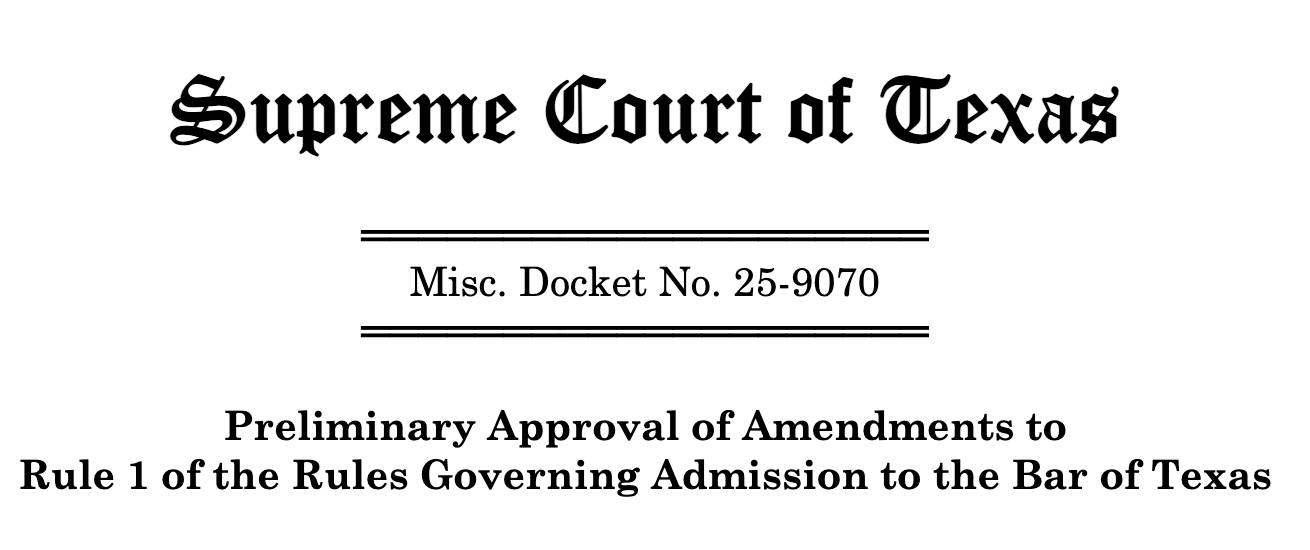
Accreditation.” From Josh
Blackman (South
Texas)
in The
Volokh
Conspiracy:
“On
September
26,
2025,
the
Supreme
Court
of
Texas
issued
a momentous
order.
The
Justices
likely
signaled
that
the
ABA
will
no
longer
have
the
‘final
say’
on
accreditation.”
Read
more here.
#13
“On
LawNext:
Justice
Workers
—
Reimagining
Access
to
Justice
as
Democracy
Work,
with
Rebecca
Sandefur
and
Matthew
Burnett.” From LawSites :
“With
as
many
as
120
million
legal
problems
going
unresolved
in
America
each
year,
traditional
lawyer-centered
approaches
to
access
to
justice
have
consistently
failed
to
meet
the
scale
of
need.
But
what
if
the
solution
is
not
just
about
providing
more
legal
services
—
what
if
it
lies
in
fundamentally
rethinking
who
can
provide
legal
help?
In
today’s
episode,
host Bob
Ambrogi is
joined
by
two
of
the
nation’s
leading
researchers
on
access
to
justice: Rebecca
Sandefur,
professor
and
director
of
the
Sanford
School
of
Social
and
Family
Dynamics
at
Arizona
State
University
and
a
faculty
fellow
at
the
American
Bar
Foundation,
and Matthew
Burnett,
director
of
research
and
programs
for
the
Access
to
Justice
Research
Initiative
at
the
American
Bar
Foundation
and
an
adjunct
professor
of
law
at
Georgetown
University
Law
Center.
They
argue
that
the
access
to
justice
crisis
is
actually
a
crisis
of
democracy.
As
cofounders
of Frontline
Justice,
they
have
been
pioneering
research
on
‘justice
workers’
—
community
members
trained
to
help
their
neighbors
navigate
legal
issues.”
Read
more
and
listen here.
#14
“How
Should
a
DOJ
Political
Appointee
Think
About
a
Trump-Weaponized
DOJ?” From Jack
Goldsmith (Harvard)
in Executive
Functions:
“The
Justice
Department
is
filled
with
dozens
of
Trump
political
appointees—Senate-confirmed
senior
officials,
non-confirmed
deputies
and
special
assistants,
and
others.
I
am
trying
to
imagine
how
these
officials
are
processing
recent
events
at
the
Department—and
how
they
justify
to
themselves
continued
service
there.”
Read
more here.
#15
“‘I’m
a
Tough
Cookie.’
Alina
Habba,
Trump’s
Favorite
Lawyer,
Explains
Herself.’” From Vanity
Fair:
“And
there
is
no
better
advocate
for
Habba
than
Habba
herself.
She
is
funny,
profane,
nimble,
and
fierce.
She
responds
to
attacks
about
her
being
unqualified
for
the
job
by
detailing
her
years
of
running
successful
law
firms
and
of
representing
Trump
as
ample
preparation
for
the
role
of
US
attorney.”
Read
more here.
(You
might
recall
from LER
No.
40 that
Habba
was
among
the
lawyers
indicted
for
their
work
involving
Trump
in
2024.)
Get
Hired
Did
you
miss
the
350+
job
postings
from
previous
weeks?
Find
them
all here.
Upcoming
Ethics
Events
&
Other
Announcements
Did
you
miss
an
announcement
from
previous
weeks?
Find
them
all here.
Keep
in
Touch
-
News
tips?
Announcements?
Events? A
job
to
post? Reading
recommendations? Email [email protected] –
but
be
sure
to
subscribe
first,
otherwise
the
email
won’t
be
delivered.
Renee
Knake
Jefferson
holds
the
endowed
Doherty
Chair
in
Legal
Ethics
and
is
a
Professor
of
Law
at
the
University
of
Houston.
Check
out
more
of
her
writing
at
the Legal
Ethics
Roundup.
Find
her
on
X
(formerly
Twitter)
at @reneeknake or
Bluesky
at legalethics.bsky.social.