
Ed.
note:
Please
welcome
Renee
Knake
Jefferson
back
to
the
pages
of
Above
the
Law.
Subscribe
to
her
Substack,
Legal
Ethics
Roundup, here.
Welcome
to
what
captivates,
haunts,
inspires,
and
surprises
me
every
week
in
the
world
of
legal
ethics.
Happy
Monday!
It
was
a
whirlwind
of
legal
ethics
news
last
week,
so
let’s
jump
right
in.
Highlights
from
Last
Week
–
Top
Ten
Headlines
#1 “DOJ
Sues
All
Federal
Judges
in
Maryland
Over
Deportation
Order.” From
the Washington
Post:
“The Justice
Department sued
all
15
federal
district
court
judges
in
Maryland
on
Tuesday
over
an
order
that
pauses
any
deportations
under
legal
challenge
in
the
state
for
48
hours.
Legal
experts
described
the
move as
an
unprecedented
attack
on
judicial
independence,
while
government
lawyers
said
it
was
necessary
to
preserve President
Donald
Trump’s constitutional
authority
over
immigration.
Longtime
court
watchers
said
they
could
not
recall
another
instance
in
which
the
Justice
Department,
which
usually
represents
members
of
the
judicial
branch
in
court,
sued
the
entire
roster
of
judges
in
a
district.”
“It
is
reckless
and
irresponsible
and
yet
another
direct
frontal
assault
on
the
federal
courts
of
this
country,”
said
retired
federal
judge J.
Michael
Luttig,
who
served
on
the U.S.
Court
of
Appeals
for
the
4th
Circuit from
1991
to
2006.
Read
more here (gift
link).
#2 “Justice
Dept.
Leader
Suggested
Violating
Court
Orders,
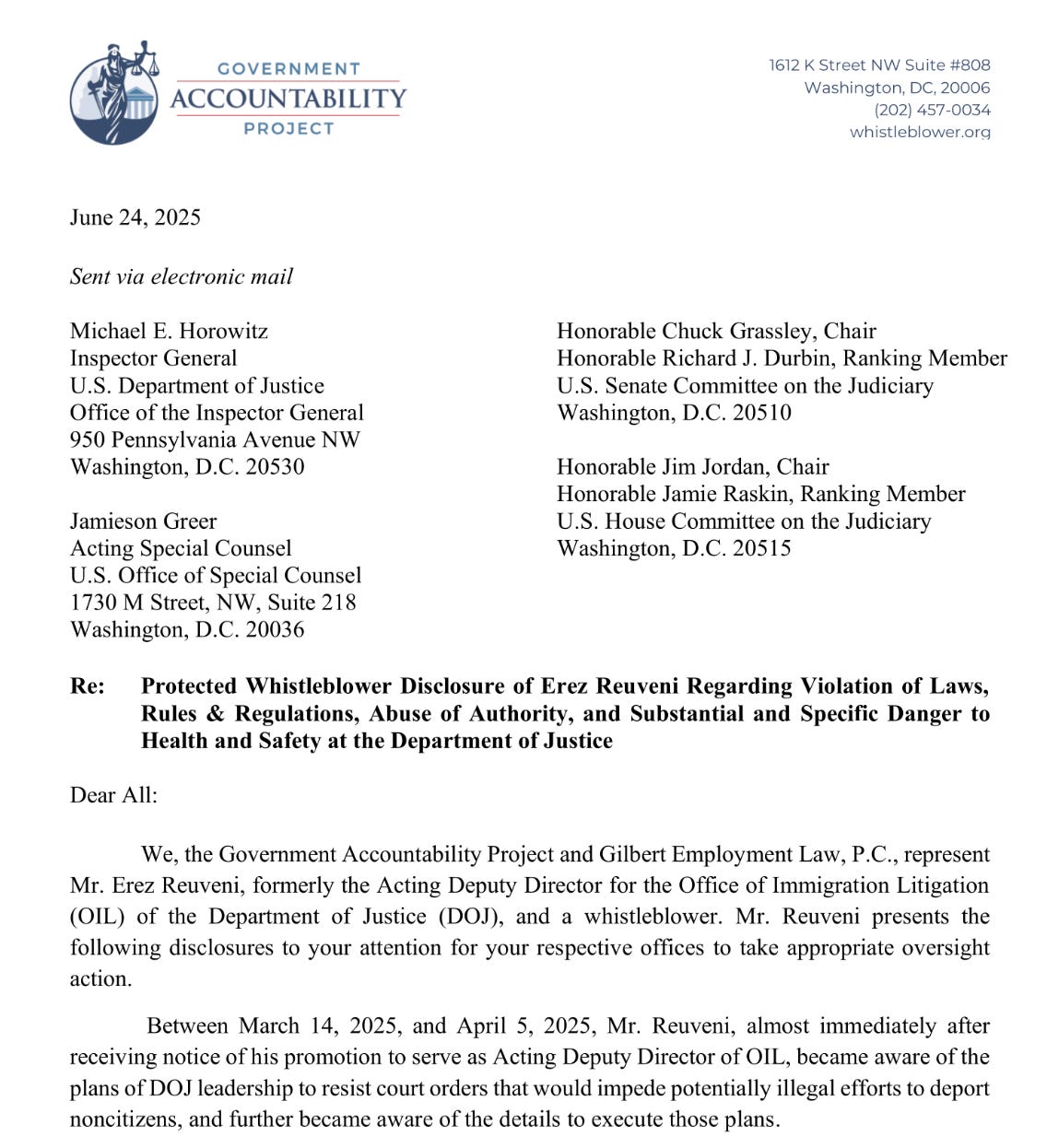
Whistle-Blower
Says.” From
the New
York
Times:
“A
senior Justice
Department official, Emil
Bove
III,
told
subordinates
he
was
willing
to
ignore
court
orders
to
fulfill
the
president’s
aggressive
deportation
campaign,
according
to
a
whistle-blower
complaint
by
a
department
lawyer
who
has
since
been
fired.
The
account
by
the
dismissed
lawyer, Erez
Reuveni,
paints
a
disturbing
portrait
of
his
final
three
weeks
on
the
front
lines
of
the
Trump
administration’s
legal
efforts
to
ship
immigrants
overseas,
often
with
little
notice
or
recourse.
In
Mr.
Reuveni’s
telling,
Mr.
Bove
discussed
disregarding
court
orders,
adding
an
expletive
for
emphasis,
and
other
top
law
enforcement
officials
showed
themselves
ready
to
stonewall
judges
or
lie
to
them
to
get
their
way.”
Read
more here (gift
link).
For
more
commentary,
head
over
to
this Substack
post by Brad
Wendel (Cornell)
where,
among
other
observations,
he
catalogs
the
eight
–
yes
eight-
professional
conduct
rules
implicated.
As
Brad
says:
“Don’t
take
my
word
for
it.
Read
through
the letter and,
if
you’re
a
lawyer,
ask
yourself
what
you
would
have
done.”

#3 “Lawyer
Who
Pushed
Bogus
Trump
Elector
Scheme
Is
Disbarred
in
New
York.” From
the New
York
Times:
“Kenneth
Chesebro,
a
lawyer
who
helped
spearhead
a
brazen
legal
effort
to
use
phony
slates
of
pro-Trump
electors
to
overturn
the
2020
presidential
election,
was
disbarred
in
New
York
on
Thursday,
cementing
an
indefinite
ban
issued
last
year.
The
decision
by
a
New
York
State
appellate
court
concluded
a
strange
legal
journey
for
a
Harvard-educated
lawyer
who
worked
for
former Vice
President
Al
Gore during
the
2000
presidential
election
recount
in
Florida
and
later
evolved
into
a
supporter
of
President
Trump.
In
a seven-page
opinion,
the
court
cited
a
criminal
racketeering
case
centered
on
the
fake
electors
in
Georgia,
where
in
2023
Mr.
Chesebro
pleaded
guilty.
The
New
York
court
said
Thursday
that
Mr.
Chesebro’s
“criminal
conduct
—
conspiracy
to
commit
filing
false
documents
—
is
unquestionably
serious”
and
that
he
had
undercut
“the
very
notion
of
our
constitutional
democracy
that
he,
as
an
attorney,
swore
an
oath
to
uphold.”
Read
more here.
#4 “Lawyers
Market
Big
#MeToo
Verdicts,
but
Their
Clients
Struggle
to
Collect.” From
the Wall
Street
Journal:
“The
cases
reveal
an
unpleasant
reality
about
#MeToo
verdicts
and
other
civil
judgments:
Winning
is
hard
enough,
but
collecting
can
be
even
harder.
…
Plaintiffs,
on
top
of
what
they
pay
lawyers
handling
their
lawsuits,
must
pay
for
time
spent
by
the
judgment
enforcers,
or
give
them
a
cut
of
any
amounts
collected.
The
plaintiffs
have
to
cover
some
costs
upfront,
so
they
sometimes
turn
to
firms
that
finance
such
work.
Those
specialty
funders
often
take
a
first
cut
of
any
recoveries.”
Read
more here (gift
link).
#5 “A
Fourth
Judge
Has
Blocked
a
Trump
Executive
Order
Targeting
Elite
Law
Firms.” From NPR:
“A
federal
judge
has
struck
down
President
Trump’s
executive
order
targeting
the
law
firm Susman
Godfrey,
delivering
the
latest
in
a
series
of
legal
wins
for
firms
that
have
challenged
the
president’s
punitive
campaign
against
Big
Law.
The
ruling
Friday
from U.S.
District
Judge
Loren
AliKhan marks
the
fourth
time
out
of
four
that
a
federal
judge
has
permanently
blocked
one
of
Trump’s
executive
orders
seeking
to
punish
an
elite
law
firm.”
Read
more here.

#6 “Former
Supreme
Court
Justice
Kennedy
Says
‘Democracy
is
at
Risk’.” From Politico:
“Former Supreme
Court Justice
Anthony
Kennedy warned
Thursday
that
acrimonious
political
discourse
and
threats
to
judges
are
eroding
the
ability
of
the
United
States
to
serve
as
an
example
of
democracy
worldwide.
‘Many
in
the
rest
of
the
world
look
to
the
United
States
to
see
what
democracy
is,
to
see
what
democracy
ought
to
be,’
Kennedy
said
during
an
online
forum
about
threats
to
the
rule
of
law.
‘If
they
see
a
hostile,
fractious
discourse,
if
they
see
a
discourse
that
uses
identity
politics
rather
than
to
talk
about
issues,
democracy
is
at
risk.
Freedom
is
at
risk.’”
Read
more here.
#7 “Litigation
Funders
And
Lawyers
Face
40.8%
Tax
In
One,
Big,
Beautiful
Bill.” From Forbes:
“The
litigation
funding
industry—and
many
lawyers
and
law
firms—are
worried
about
a
provision
inserted
in
the
pending
tax
bill. Senator
Thom
Tillis (R-N.C.)
introduced
the
Tackling
Predatory
Litigation
Funding
Act
in
the
Senate,
you
can
read
the
text here.
A
companion
bill
was
introduced
in
the
House
by Kevin
Hern (R-Okla.).
The
litigation
funding
tax
was
not
in
the
House-passed
One,
Big,
Beautiful
Bill
Act,
but
the
Senate’s
reconciliation
bill
includes
it.
Its
ostensible
goal
as
described
by
Tillis
when
he
introduced
it
is
to
prevent
foreign
influence
in
the
U.S.
court
system
and
stem
frivolous
lawsuits.
Some
insurers
and
trade
groups
support
it,
you
can
see
a
list here.
Investors
(both
foreign
and
domestic)
often
help
fund
lawsuits,
and
the
U.S.
is
full
of
lawsuits.
But
given
the
elephant
gun
approach
of
the
proposed
new
tax,
domestic
funders
are
equally
worried,
as
are
lawyers
and
law
firms.”
Read
more here.
#8 “Florida
Judge
Sided
with
Trump
While
Advocating
for
Nomination.” From Bloomberg
Law:
“A
Florida
state
judge
was
angling
for
a
federal
judicial
nomination
from Donald
Trump when
he
sided
with
the
president
in
a
defamation
case
before
his
court. Ed
Artau,
who’s
now
under
consideration
for
South
Florida’s
US
trial
court,
met
with
the
White
House
roughly
two
weeks
after
he
wrote
his
February
concurring
opinion
allowing
Trump’s
defamation
suit
against
the
Pulitzer
Prize
Board
to
proceed,
according
to
his Senate
Judiciary
Questionnaire made
public
by Accountable.US,
a
progressive
watchdog
group.
The
disclosure
was
first
reported
Friday
by Politico.
The
timing
of
Trump’s
announcement
that
he’d
tapped
Artau
for
the
federal
bench
soon
after
the
judge’s
decision
in
the
case
raised
concerns
about
his
impartiality
in
the
defamation
case
and
the
process
by
which
he
was
chosen.”
Read
more here.
#9 “The
Future
is
Now:
Why
Trial
Lawyers
and
Judges
Should
Embrace
Generative
AI
Now
and
How
to
Do
It
Safely
and
Productively.” From JD
Supra:
“The
unprecedented
rapid
advancement
of
generative
artificial
intelligence
(AI)
worldwide
presents
the
legal
profession
with
a
pivotal
opportunity
for
transformation.
The
legal
system
is
deeply
rooted
in
tradition,
precedent,
and
established
practices,
which
is
good;
however,
this
does
not
mean
we
should
avoid
technology.
The
legal
practice
must
be
open
to
change
and
embrace
AI,
just
as
it
did
with
computers
and
online
communications.
We
can
keep
our
traditions
of
ethics,
justice,
and
precedent,
but
also
utilize
generative
AI
to
make
our
practices
more
efficient,
consistent,
and
responsive
to
the
demands
of
the
modern
world.”
Read
more here.
#10 “Maine’s
Highest-Ranking
Justices
Will
Not
Weigh
Complaints
Against
Peers.” From
the Portland
Press
Herald:
“According
to
new
rules,
ethics
complaints
against
members
of
the Maine
Supreme
Judicial
Court instead
will
be
heard
by
a
panel
of
lower
court
judges.”
Read
more here.
Get
Hired
Did
you
miss
the
150+
job
postings
from
previous
Roundups?
Find
them
all here.
Upcoming
Ethics
Events
&
Other
Announcements
Did
you
miss
an
announcement
from
previous
Roundups?
Find
them
all here.
Keep
in
Touch
-
News
tips?
Announcements?
Events? A
job
to
post? Reading
recommendations? Email [email protected] –
but
be
sure
to
subscribe
first,
otherwise
the
email
won’t
be
delivered.
Renee
Knake
Jefferson
holds
the
endowed
Doherty
Chair
in
Legal
Ethics
and
is
a
Professor
of
Law
at
the
University
of
Houston.
Check
out
more
of
her
writing
at
the Legal
Ethics
Roundup.
Find
her
on
X
(formerly
Twitter)
at @reneeknake or
Bluesky
at legalethics.bsky.social.