
LexisNexis
Legal
&
Professional
today
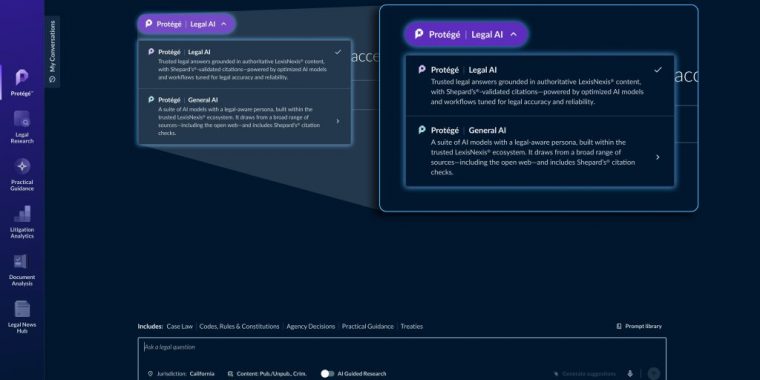
introduced
Protégé
General
AI,
expanding
its
artificial
intelligence
platform
to
include
secure
access
to
multiple
general-purpose
AI
models
alongside
its
existing
legal-specific
AI
tools.
This
eliminates
the
need
to
switch
contexts
between
legal-specific
and
general-purpose
AI
tools
and
provides
a
higher
degree
of
security
when
using
the
general
tools.
Launched
as
a
preview
version
for
U.S.
customers,
it
allows
legal
professionals
to
access
models
including
OpenAI’s
GPT-5,
GPT-4o,
and
o3,
as
well
as
Anthropic’s
Claude
Sonnet
4,
all
within
the
company’s
existing
Lexis+
AI
workflow.
Users
can
switch
between
general-purpose
and
legal-specific
AI
with
a
toggle
function.
The
new
general
AI
capability
works
alongside
Protégé
Legal
AI,
which
uses
multiple
legal-tuned
models
including
GPT-4o,
GPT-4.1,
Claude
3.7,
Claude
4,
fine-tuned
GPT-4o-mini,
and
fine-tuned
Mistral.
The
legal
AI
version
grounds
responses
in
LexisNexis
legal
content
and
validates
citations
through
Shepard’s
citation
service.
Protégé
General
AI
draws
from
open-web
sources
and
is
designed
for
tasks
including
research,
drafting
communications
for
both
legal
and
non-legal
audiences,
and
breaking
down
complex
problems.
The
system
includes
a
Shepard’s
Citation
Agent
that
checks
legal
sources
included
in
general
AI
responses.
Different
Models,
Different
Strengths
According
to
LexisNexis,
each
general
AI
model
offers
specific
strengths
when
used
for
legal
work:
-
GPT-5
combines
general
and
domain
knowledge
with
reasoning
and
non-reasoning
capabilities. -
Claude
Sonnet
4
offers
a
natural
fluency
that
provides
well-structured
responses
for
everyday
tasks,
communications
and
brainstorming. -
GPT-4o
is
good
for
everyday
tasks
such
as
general
exploration,
brainstorming,
and
web-based
information
integration. -
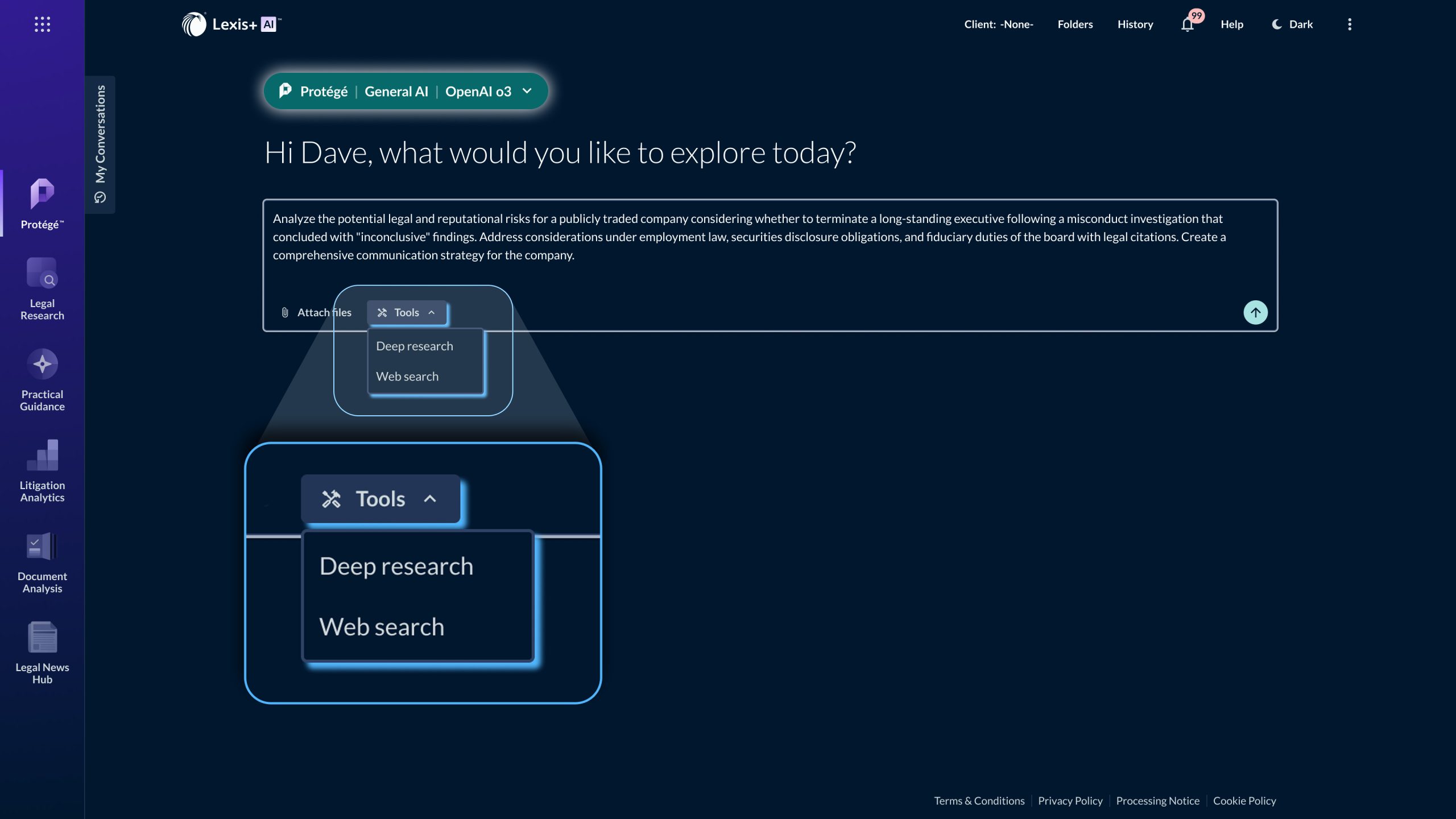
OpenAI
o3
optimizes
for
deep
research,
strategic
decision-making,
and
complex
problem-solving.
Agentic
AI
Framework
Meanwhile,
Protégé
Legal
AI,
built
on
the
proprietary
LexisNexis
agentic
AI
framework,
provides
agentic
workflows
specifically
developed
for
legal
work.
One
of
these,
the
AI
Guided
Research
Workflow,
includes
an
Orchestrator
Agent
that
breaks
down
complex
queries,
a
Legal
Research
Agent
that
allows
real-time
user
guidance,
and
a
Reflection
Agent
that
reviews
final
responses.
Some
agents
function
as
generalists
for
research
and
legal
questions,
while
others
specialize
in
specific
tasks
like
contract
review
and
citation
checking.
The
system
operates
within
LexisNexis’s
encrypted
environment,
which
the
company
says
provides
enhanced
privacy
protections
compared
to
consumer
AI
tools.
Organizations
can
disable
general
AI
access
entirely
for
users,
and
individual
users
can
toggle
the
feature
on
or
off.
Sean
Fitzpatrick,
CEO
of
LexisNexis
North
America,
UK,
&
Ireland,
said
the
development
responds
to
customer
requests
for
secure
access
to
general-purpose
models
while
maintaining
control
over
AI
behavior
within
legal
workflows.
“Our
goal
is
to
support
legal
professionals
with
a
personalized
AI
assistant
that
enables
uninterrupted
workflows
and
access
to
the
full
range
of
LexisNexis
AI
capabilities
in
one
secure
place,”
he
said.
Preview
Program
Approximately
200
law
firms,
corporate
legal
departments,
and
law
schools
are
participating
in
the
customer
preview
program,
which
has
already
begun.
General
availability
is
expected
later
this
year.
The
development
represents
LexisNexis’s
continued
expansion
of
AI
capabilities,
building
on
agentic
AI
innovation
the
company
has
been
developing
since
2024.
The
company
says
that
it
employs
over
2,000
technologists,
data
scientists,
and
legal
experts
in
its
AI
development
efforts.
LexisNexis
partners
with
AWS,
Anthropic,
Microsoft,
Mistral,
and
OpenAI
for
its
multi-model
approach,
which
selects
different
AI
models
based
on
specific
use
cases.