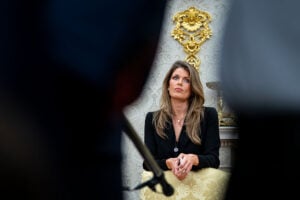
Halligan
(Photo
by
Al
Drago/Getty
Images)
On
Friday,
the
Justice
Department
noticed
its
intent
to
appeal
in
US
v.
Comey
and
US
v.
James.
The
government
will
attempt
to
resuscitate
the
charges
against
Trump’s
enemies
—
despite
the
many,
obvious
defects
in
both
cases!
—
by
arguing
that
it
can,
too
let
Lindsey
Halligan
LARP
as
US
Attorney
for
the
Eastern
District
of
Virginia.
In
some
sense,
the
DOJ
had
no
choice.
The
cases
were
dismissed
on
November
24
when
a
judge
disqualified
Halligan,
a
Florida
insurance
lawyer
previously
tasked
with
de-woke-ifying
the
Smithsonian.
Since
then,
“her”
office
failed
twice
to
re-indict
James
and
got
locked
out
of
the
Comey
evidence
entirely.
With
no
appeal
of
the
disqualification,
judges
in
EDVA
started
to
make
irate
noises
about
Halligan
continuing
to
hold
herself
out
as
the
US
Attorney.
Clearly
the
government
had
to
make
a
move,
or
risk
the
district’s
judges
making
it
for
them.
And
so
they
decided
to
kick
this
dented
can
down
the
road
to
Richmond,
giving
a
fifth
court
the
opportunity
to
explain
that
no,
the
president
cannot
evade
Senate
confirmation
for
US
Attorneys
with
a
series
of
ONE
WEIRD
PROCEDURAL
TRICKS.
The
cosplay
attorneys
Judge
Cameron
Currie
ruled
that
28
USC
§
546
allows
the
president
to
make
one,
and
only
one,
interim
appointment
as
US
Attorney
in
any
given
federal
district,
after
which
the
position
may
only
be
filled
by
a
Senate-confirmed
nominee
or
a
judicially-installed
placeholder.
Trump
effectively
used
up
that
appointment
on
Halligan’s
predecessor
Erik
Seibert,
who
was
pushed
out
for
refusing
to
indict
Comey
and
James,
and
so
Halligan’s
appointment
was
always
a
nullity.
Courts
in
New
Jersey,
Nevada,
and
California,
as
well
as
the
Third
Circuit
have
uniformly
rejected
the
government’s
argument
that
§
546
allows
for
successive
interim
appointments.
In
those
cases,
though,
the
challenged
prosecutions
survived
thanks
to
the
presence
of
other,
duly
appointed
Assistant
US
Attorneys.
Here,
Halligan
secured
the
indictments
on
her
own,
and
so
the
cases
were
dismissed
when
she
was
disqualified.
Judge
Currie
also
rubbished
the
suggestion
that
Attorney
General
Pam
Bondi
could
retroactively
ratify
Halligan’s
actions,
either
by
fiat
or
by
calling
her
a
“special
attorney”
and
purporting
to
backdate
the
appointment.
It’s
not
even
clear
that
Halligan
is
legally
serving
as
a
special
attorney,
since
the
appointment
order
on
Halloween,
which
purported
to
go
into
effect
retroactively
six
weeks
before,
has
been
declared
invalid.
A
rational
attorney
general
would
have
raced
to
sign
a
second
order,
re-appointing
Halligan
prospectively.
But
nothing
about
this
is
rational
so
¯_(ツ)_/¯
Bondi
vowed
to
appeal,
but
that’s
not
what
happened
…
at
least
not
immediately.
Instead,
Halligan’s
office
tried
multiple
times
to
re-indict
James.
Assistant
US
Attorney
Roger
Keller,
seconded
to
EDVA
from
the
Eastern
District
of
Missouri,
got
no-billed
in
both
Norfolk
and
Alexandria
as
he
tried
to
replicate
Halligan’s
success
with
the
original
grand
jury.
Like
the
Comey
case
(where
one
presentation
yielded
three
different,
signed
indictments)
Keller’s
presentment
in
Alexandria
seems
to
have
been
spectacularly
botched.
Somehow
the
no-bill
got
filed
on
the
public
docket,
revealing
that
the
DOJ
had
abandoned
its
theory
that
James
collected
“thousands”
of
dollars
of
rent
on
the
disputed
property.
Keller
has
now
returned
to
Missouri,
a
tacit
admission
that
the
effort
to
bring
new
charges
against
James
hit
a
brick
wall.
In
the
Comey
case,
his
erstwhile
lawyer
Daniel
Richman
boxed
the
government
out
of
the
evidence
by
suing
to
get
his
hard
drives
back.
Deprived
of
the
material
used
in
its
case
in
chief,
the
DOJ
had
little
hope
of
re-indicting
the
former
FBI
director.
And
meanwhile
judges
in
EDVA
were
starting
to
grumble
about
Halligan
continuing
to
sign
documents
as
“US
Attorney,”
even
after
her
disqualification.
Judge
Michael
Nachmanoff,
who
presided
over
the
Comey
case,
refused
to
accept
a
filing
which
described
her
as
US
Attorney,
noting
that
the
Justice
Department
hadn’t
appealed
the
disqualification
and
was
thus
bound
by
Judge
Currie’s
ruling.
The
government
protests
that
it
has
an
advisory
opinion
from
the
Office
of
Legal
Counsel
saying
otherwise,
although
it
declined
to
make
that
opinion
available
to
the
court.
After
the
Third
Circuit
ruled
that
her
appointment
was
illegal,
Habba
finally
tapped
out,
along
with
the
illegally
installed
US
Attorney
for
Delaware.
“That’s
the
proper
position,
in
my
view,”
sniffed
Judge
Leonie
Brinkema
in
EDVA,
confronted
with
yet
another
document
bearing
Halligan’s
signature.
And
so,
with
the
30-day
clock
ticking
to
notice
an
appeal
and
no
realistic
path
to
re-indicting
Trump’s
nemeses,
the
DOJ
opted
to
appeal
Judge
Currie’s
rulings,
if
only
to
provide
Halligan
a
fig
leaf
of
legitimacy
as
she
continues
to
squat
in
the
office.
From
the
power
to
fire
to
the
power
to
hire
Tapping
out
on
the
Comey
and
James
cases
would
be
admitting
defeat,
and
so
Trump
doubled
down,
forwarding
Halligan’s
nomination
to
the
Senate
for
confirmation.
He
knows
this
nomination
is
DOA
thanks
to
the
blue
slip
rule,
since
Virginia’s
Democratic
Senators
Mark
Warner
and
Tim
Kaine
are
never
going
to
give
her
their
blessings.
Notably,
the
government
has
not
yet
petitioned
the
Supreme
Court
for
certiorari
in
the
Third
Circuit’s
Habba
ruling.
But
this
dispute
tees
up
what
may
well
be
a
major
locus
of
conflict
in
the
coming
year.
At
bottom
this
is
a
fight
over
the
limits
of
Trump’s
power
to
remake
the
executive
branch.
This
past
year,
the
Supreme
Court
allowed
the
president
to
fire
literally
anyone
he
liked.
From
career
civil
servants
to
non-partisan
board
members
installed
by
Congress,
no
one
was
spared.
The
Court’s
six
conservative
justices
happily
shredded
laws
and
precedents
that
would
have
impeded
Trump’s
ability
to
fire
every
expert
and
non-partisan
federal
bureaucrat
who
might
have
impeded
his
plot
to
turn
the
executive
branch
into
a
partisan
weapon.
But
hollowing
out
the
federal
bureaucracy
will
only
get
Trump
so
far.
He’ll
need
to
replace
those
fired
officials
with
MAGA
warriors
to
take
revenge
on
his
enemies
and
enact
the
Project
2025
agenda.
So
far,
the
GOP-controlled
Senate
has
confirmed
virtually
every
partisan
ghoul
Trump
put
forward.
But
the
Senate
has
its
limits,
as
Judiciary
Chair
Chuck
Grassley’s
refusal
to
do
away
with
blue
slips
demonstrates.
And
even
with
a
supine
Senate,
Trump’s
still
facing
a
major
backlog
of
nominees.
As
a
result,
administration
officials
routinely
hold
multiple
job
titles
at
once.
Deputy
Attorney
General
Todd
Blanche
is
also
the
Acting
Librarian
of
Congress.
But
he’s
a
mere
piker
compared
to
Marco
Rubio,
who
claims
to
be
Acting
National
Security
Advisor,
Acting
Administrator
of
USAID,
and
Acting
National
Archivist,
along
with
his
day
job
as
Secretary
of
State.
And
while
Trump
may
be
happy
to
let
USAID
wither,
there
are
plenty
of
positions
he
does
care
about
filling.
The
Senate’s
confirmation
math
may
also
change
in
unpredictable
ways
in
2026,
as
the
election
approaches
and
the
president’s
unpopular
policies
continue
to
weigh
down
Republicans.
But
the
dispute
over
blue
state
US
Attorneys
is
a
likely
harbinger
of
the
conflict
to
come.
Just
as
he’s
done
with
tariffs
and
the
budget,
Trump
is
simply
ignoring
the
law
and
stealing
Congress’s
power
when
it
comes
to
installing
US
Attorneys.
It’s
always
possible
that
the
Supreme
Court
will
decline
to
weigh
in
on
this
dispute.
But
given
that
the
conservative
justices
spent
the
past
year
leaping
in
to
ensure
that
Trump
would
never
have
to
follow
the
law,
it
seems
unlikely.
And
so
the
fight
in
2026
will
center
on
who
gets
to
fill
all
those
vacancies
created
when
SCOTUS
let
him
fire
every
board
member,
agency
head,
and
US
Attorney
in
the
country.
Whatever
happens,
relief
will
certainly
come
too
late
for
Lindsey
Halligan.
Section
546
allows
for
one
120-day
appointment.
Halligan
was
installed
on
September
22,
and
so,
even
if
that
appointment
was
legal,
it
would
time
out
on
January
20,
2026.
After
that,
she
may
be
a
special
attorney
or
a
First
Assistant
US
Attorney,
but
she
won’t
be
the
US
Attorney
for
the
Eastern
District
of
Virginia.
Subscribe
to
read
more
at
Law
and
Chaos….
Liz
Dye produces
the
Law
and
Chaos Substack and podcast. You
can
subscribe
by
clicking
the
logo: