
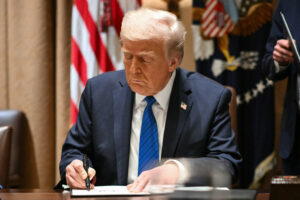
by
MANDEL
NGAN/AFP
via
Getty
Images)
Look
at
the
remarkable
uses
to
which
President
Donald
Trump
has
put
his
apparently
unbridled
power
to
impose
tariffs.
Six
months
ago,
Trump
said
that
he
would
impose
tariffs
on
Canada
for
failure
to
control
the
supposed
flow
of
fentanyl
from
Canada
into
the
United
States.
I
guess
that
problem
is
now
solved,
but
another
one
popped
up:
Trump
just
announced
that
Canada’s
recent
proposal
to
recognize
a
Palestinian
state
would
make
it
“very
hard”
to
reach
a
trade
agreement.
Canada’s
not
alone
in
this
regard.
Back
in
January,
Colombia
said
that
it
wouldn’t accept
flights of
deported
migrants
flown
on
military
planes.
Trump,
in
turn,
said
that
he’d
impose
a
25%
tariff
on
Colombia,
rising
to
50%
after
a
week. Colombia
agreed
to
accept
the
flights.
India
says
that
it
will
import
oil
from
Russia.
Trump
says
that
he’ll
hit
India
with
tariffs.
Russia
hasn’t
agreed
to
peace
in
Ukraine.
Trump
says
that,
if
Russia’s
obstinance
continues,
he’ll
impose
tariffs.
Prosecutors
in
Brazil
are
pursuing
Jair
Bolsonaro
for
having
had
his
supporters
storm
government
buildings
and
having called
for
a
coup. Trump
likes
guys
who
have
their
supporters
storm
government
buildings
and
try
to
engage
in
a
coup;
Trump’s added
40% (to
the
existing
10%)
tariff
on
Brazil
expressly
because
Brazil’s
prosecuting
Bolsonaro.
I
don’t
pretend
to
be
knowledgeable
about
the
laws
governing
American
international
trade.
Generally,
I
thought
that
tariffs
were
supposed
to
be
set
by
Congress,
with
exceptions
permitting
the
president
to
intervene
only
to
protect
against
import
surges,
to
preserve
industries
essential
to
national
security,
to
prevent
unfair
foreign
practices,
and
arguably
to
mitigate
economic
emergencies.
I
understand
that
Trump
can
say
that
Brazil
prosecuting
Bolsonaro
falls
into
one
of
those
categories,
but
I
don’t
understand
why
any
sentient
person
would
think
that
was
true.
If
Trump
really
has
the
power
to
impose
tariffs
for
anything
—
Canada’s
recognition
of
Palestine;
India’s
decision
to
import
oil
from
Russia;
Brazil’s
decision
to
prosecute
Bolsonaro
—
where
does
that
power
stop?
Trump
is
asserting
the
power
to
interfere
both
in
other
countries’
foreign
policy
decisions
and
their
domestic
affairs. Doesn’t
that
seem
a
little
expansive?
Trump
has
said
he
wants
Canada
to
become
the
51st
American
state. Could
Canada’s
unwillingness
to
acquiesce
become
yet
another
stumbling
block
to
trade? Could
we
pick
up
Iceland
and
the
Panama
Canal
simply
by
imposing
crippling
tariffs
on
the
relevant
countries?
What
if
Qatar
were
to
renege
on
its
offer
to
give
Trump
a
used
Boeing
747? Impose
tariffs
until
Qatar
turns
over
the
plane?
What
if,
for
instance,
Serbia
says
that
it
won’t
change
its
zoning
laws
to
permit
the
building
of
a
Trump
Tower
in
Belgrade? A
billion
percent
tariffs
until
the
bastards
comply?
This
is
no
way
to
run
a
country. It’s
remarkably
silly
and
more
than
a
little
bit
dangerous.
I’m
not
intimately
familiar
with
the
legal
issues,
but
last
Thursday,
the
parties argued
a
case before
the
U.S.
Court
of
Appeals
for
the
Federal
Circuit
challenging
Trump’s
unrestrained
ability
to
impose
tariffs
for
damned
near
anything.
Watch
that
case
closely
for
two
reasons. First,
hope
that
the
courts
will
once
again
come
to
America’s
rescue,
limiting
the
power
of
Trump,
and
future
presidents,
to
do
whatever
comes
into
their
heads. Second,
watch
the
stock
markets. Some
people
will
make
a
killing
by
acting
quickly
if
the
court
decides
to
restrict
Trump’s
unilateral
tariff
power.
Mark Herrmann spent
17
years
as
a
partner
at
a
leading
international
law
firm
and
later
oversaw
litigation,
compliance
and
employment
matters
at
a
large
international
company.
He
is
the
author
of The
Curmudgeon’s
Guide
to
Practicing
Law and Drug
and
Device
Product
Liability
Litigation
Strategy (affiliate
links).
You
can
reach
him
by
email
at [email protected].