
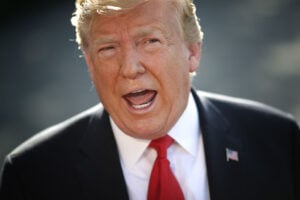
by
Win
McNamee/Getty
Images)
Two
weeks
ago,
the
Department
of
Justice
filed
a
motion
in
the
White
House
ballroom
litigation
that
read
suspiciously
like
the
a
case
of
lawyers
throwing
up
their
hands
and
just
hitting
“file”
on
the
their
client’s
dementia-addled
markup.
And,
but
for
the
fact
that
Donald
Trump
is
not
the
Department
of
Justice’s
client,
that
pretty
much
nails
it.
The
brief
defined
“Trump
Derangement
Syndrome,”
ranted
about
“Barack
Hussein
Obama,”
and
included
a
series
of
nonsense
tangents.
One
might
have
hoped
that
brief
would
prove
an
aberration
and
the
people
with
law
degrees
might
take
over
again
on
reply.
Well,
the
good
news
for
all
of
us
is
that
the
DOJ
seems
to
have
gone
right
back
to
Trump
for
an
encore.
Acting
Attorney
General
Todd
Blanche,
Principal
Associate
Deputy
Attorney
General
R.
Trent
McCotter,
and
Associate
Attorney
General
Stanley
Woodward
signed
a
seven-page
reply
brief
in
the
ballroom
case
that
doubles
down
on
the
Truth
Social
school
of
drafting.
“Trump
Derangement
Syndrome”
is
back,
baby!
The
“National
Trust
for
Historic
Preservation”—which,
again,
is
not
a
government
agency
of
any
type—never
once
denies
that
its
lawsuit
is
motivated
by
an
irrational
desire
to
stop
anything
associated
with
President
Donald
J.
Trump,
which
even
Democrat
elected
officials
have
labeled
as
“Trump
Derangement
Syndrome,”
or
TDS.
This
sets
up
a
footnote
citing
to
Senator
John
Fetterman,
continuing
his
tour
bragging
that
he’s
not
as
liberal
ever
since
he
suffered
a
traumatic
stroke
—
which
is
not
the
flex
conservatives
think
it
is.
If
the
Militarily
Top
Secret
Ballroom
had
been
the
idea
of
any
other
President,
no
lawsuit
would
have
been
filed,
let
alone
given
rise
to
an
injunction.
National
Security
requires
unimpeded
construction
of
the
Presidential
Ballroom,
without
disruption
or
delay.
“Militarily
Top
Secret
Ballroom.”
Note
that
the
lawyers
aren’t
even
able
to
make
line
edits
to
clean
up
Trump’s
made-up
phrases.
The
mainstream
media
spends
more
time
rewriting
Trump’s
quotes
to
sound
coherent
than
his
own
DOJ
does.
The
brief
continues
its
quixotic
effort
to
conflate
an
underground
security
complex
with
an
eyesore
of
a
ballroom
where
the
East
Wing
used
to
be.
“[I]t
is
now
crystal
clear
that
the
entire
cohesive,
integrated,
knitted
and
complex
Project
is
necessary
to
ensure
National
Security
and
Presidential
safety,”
the
brief
asserts,
without
ever
providing
a
reason
why
this
is
crystal
clear.
The
court
issued
an
injunction
because
there
was
never
an
explanation
why
an
underground
bunker
needed
to
have
a
ballroom
over
it
and
—
now
a
full
briefing
cycle
later
—
there
still
isn’t
one.
This
Project
as
a
whole,
with
one
venting
system,
one
electrical
system,
one
plumbing
system,
one
security
system,
one
air
conditioning
and
heating
system
and,
very
importantly,
one
structural
system,
will
ensure
that
events
like
the
assassination
attempt
of
Butler,
PA,
West
Palm
Beach,
FL
and
at
the
Washington
Hilton
on
April
25th
do
not
happen
again.
Except
the
ballroom
wouldn’t
be
much
help
to
a
president
campaigning
in
Pennsylvania.
Or
golfing
in
Florida.
Or
even
choosing
to
attend
the
White
House
Correspondents’
Dinner,
which
—
again
—
could
not
be
held
in
the
new
proposed
ballroom,
because
Trump’s
proposal
is
not
big
enough
to
host
the
WHCD.
The
new
ballroom
has
a
capacity
under
1,000
—
the
WHCD
brings
together
over
2,500
guests.
The
reply
engages
in
some
Freudian
projection,
ripping
the
opposition
as
“Bereft
of
legal
arguments,”
a
vocabulary
decision
that
must
have
worked
its
way
in
while
Trump
nodded
off
like
he
keeps
doing
on
camera.
But
the
opposition’s
argument,
presented
over
a
straightforward
four
pages,
took
the
government
to
task
for
failing
to
even
attempt
a
legal
argument,
relying
instead
on
vague
citations
about
how
injunctions
work.
And
Plaintiff
was
asked
not
to
bring
and
prosecute
this
suit—just
look
at
the
numerous
briefs
where
Defendants
have
strongly
and
convincingly
argued
about
the
National
Security
interests
and
demanded
that
Plaintiff
drop
this
suit,
including
as
recently
as
the
day
after
an
assassin
attempted
to
murder
dozens
of
officials
and
members
of
the
public.
See
Definition
of
“Bring,”
Merriam-Webster
Dictionary
(“to
convey,
lead,
carry,
or
cause
to
come
along
with
one
toward
the
place
from
which
the
action
is
being
regarded”).
They
cited
the
dictionary
definition
of
“bring.”
The
Acting
Attorney
General
of
the
United
States
signed
a
court
filing
with
the
definition
of
“bring.”
Plaintiff
falsely
claims
that
Defendants’
motion
includes
“ad
hominem
attacks,”
ECF
No.
80
at
1,
but
not
one
such
“attack”
is
specifically
identified.
Plaintiff
never
disputes
its
lawsuit
is
motivated
by
Trump
Derangement
Syndrome.
To
the
extent
Plaintiff
means
the
reference
to
Attorney
Craig,
nobody
can
dispute
that
he
served
as
White
House
Counsel
for
“Barack
Hussein
Obama,”
Strunk
v.
U.S.
Dep’t
of
State,
693
F.
Supp.
2d
112,
113
(D.D.C.
2010)
(Leon,
J.).
It
is
interesting
that
Plaintiff
might
consider
that
relationship
to
be
an
“ad
hominem”
attack.
“Plaintiff
never
disputes
its
lawsuit
is
motivated
by
Trump
Derangement
Syndrome,”
is
first-ballot
Litigation
Hall
of
Fame
material.
Nothing
about
this
motion
makes
any
sense.
Judge
Leon’s
preliminary
injunction
is
currently
on
appeal
at
the
D.C.
Circuit.
The
district
court
has
been
divested
of
jurisdiction.
The
DOJ
is
asking
Leon,
under
Rule
62.1,
to
issue
an
“indicative
ruling”
that
he
would
dissolve
his
own
injunction
if
the
Circuit
kicked
the
case
back.
Except
there’s
no
new
evidence
here.
Someone
trying
to
attack
a
different
hotel
ballroom
does
not
give
a
president
the
authority
to
unilaterally
rebuild
a
national
monument.
The
fact
that
the
attack
was
unsuccessful
only
underscores
how
unnecessary
a
new
ballroom
would
be.
But
look,
the
problem
isn’t
the
legal
theory
—
as
frivolous
as
it
may
be.
It’s
that
none
of
this
is
how
Stanley
Woodward
or
Trent
McCotter
or
Todd
Blanche
writes.
This
is
how
one
specific
person
writes,
and
that
person
is
not
admitted
to
any
bar.
When
lawyers
sign
a
brief,
they
certify
under
Rule
11
that
it’s
grounded
in
fact
and
warranted
by
existing
law
or
a
non-frivolous
argument
for
extending
it.
Letting
the
client
vomit
their
social
media
posts
into
a
court
filing
runs
right
up
against
that.
No
wonder
the
DOJ
is
hot
to
block
disciplinary
authorities
from
probing
ethical
violations
by
government
lawyers.
(Check
out
the
brief
on
the
next
page…)
Earlier:
DOJ
Files
Ballroom
Brief
That
Reads
Like
Truth
Social
Post
—
Because
Trump
Probably
Wrote
It
DOJ
Sues
D.C.
Bar
For
Holding
Trump
Lawyers
To
Ethical
Rules
 Joe
Joe
Patrice is
a
senior
editor
at
Above
the
Law
and
co-host
of
Thinking
Like
A
Lawyer.
Feel
free
to email
any
tips,
questions,
or
comments.
Follow
him
on Twitter or
Bluesky
if
you’re
interested
in
law,
politics,
and
a
healthy
dose
of
college
sports
news.
Joe
also
serves
as
a
Managing
Director
at
RPN
Executive
Search.