
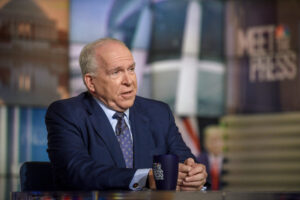
Brennan
(Photo
by:
William
B.
Plowman/NBC/NBC
Newswire/NBCUniversal
via
Getty
Images)
Let’s
talk
about
a
pattern,
because
at
this
point
it’s
too
clear
to
ignore.
You’re
a
career
federal
prosecutor.
You’ve
been
handed
a
politically
charged
case
—
one
the
president
of
the
United
States
has
loudly
demanded
result
in
criminal
charges
against
a
high-profile
political
enemy.
You
review
the
evidence.
You
conclude,
professionally
and
in
good
faith,
that
the
evidence
doesn’t
support
charges.
You
tell
your
superiors.
You
get
fired.
Then
a
loyalist
comes
in
and
charges
the
target
anyway,
which
gets
unraveled
by
the
application
of
basic
legal
standards.
We
have
watched
this
happen
already.
And
now,
it
looks
like
the
Department
of
Justice
wants
to
run
it
back.
CNN
reported
Friday that
Maria
Medetis
Long,
the
career
national
security
prosecutor
in
Miami
who
had
been
leading
the
criminal
investigation
into
former
CIA
Director
John
Brennan,
was
removed
from
the
case.
The
reason? The
Associated
Press
confirmed she
had
told
her
superiors
she
didn’t
believe
there
was
sufficient
evidence
to
support
a
criminal
prosecution.
Her
successor? CNN
reported
Saturday that
the
DOJ
has
brought
in
Joseph
diGenova,
an
81-year-old
attorney,
longtime
Trump
surrogate,
Fox
News
and
Newsmax
regular,
and
member
of
Trump’s
2020
election-overturn
legal
team,
to
take
over
as
“counselor
to
the
attorney
general”
on
the
Brennan
investigation.
He
will
be
working
out
of
Fort
Pierce,
Florida.
If
you’re
wondering
why
Fort
Pierce
specifically…
well,
that’s
where
Judge
Aileen
Cannon
sits.
Yes, that Judge
Cannon.
The
same
judge
who
dismissed
Jack
Smith’s
classified
documents
indictment
of
Trump
on
Appointments
Clause
grounds
—
a
ruling
that,
as
we’ll
discuss,
has
some
uncomfortable
implications
for
the
current
situation.
The
DOJ
spokesperson,
when
asked
about
removing
a
seasoned
career
prosecutor
from
one
of
the
country’s
most
sensitive
political
cases,
described
it
as
“healthy
and
normal.”
That’s…
one
way
to
describe
swapping
out
the
lead
prosecutor
on
a
case
because
she
concluded
there
wasn’t
enough
evidence.
The
investigation
stems
from a
2023
referral
from
the
Republican-led
House
Judiciary
Committee,
specifically,
from
Chairman
Jim
Jordan,
alleging
that
Brennan
lied
to
Congress
about
whether
the
CIA
relied
on
the
so-called
Steele
dossier
when
drafting
the
2017
Intelligence
Community
Assessment
that
found
Russia
interfered
in
the
2016
election
to
help
Trump.
Brennan
denies
it.
The
Steele
dossier,
for
the
uninitiated,
contained
salacious
and
largely
unverified
allegations
against
then-candidate
Trump,
and
conservatives
have
spent
years
arguing
it
was
the
shadowy
engine
that
drove
the
entire
Russia
investigation.
That
claim
is,
to
put
it
mildly,
disputed.
This
is
not
a
new
grievance
for
Trump
—
it’s
one
of
his
longest-standing
political
obsessions.
For
months,
the
DOJ
has
been
pursuing
charges
against
Brennan
with
increasing
urgency,
particularly
after Trump
fired
Pam
Bondi
as
Attorney
General
in
part
because
of
frustration
that
she
hadn’t
successfully
prosecuted
enough
political
enemies.
Running
the
department
now
is
Todd
Blanche,
Trump’s
former
personal
defense
attorney
who,
at
his
first
press
conference
as
acting
AG,
told
reporters
the
DOJ
was
not
focused
on
going
after
Trump’s
political
opponents,
while
literally
overseeing
a
sprawling
set
of
investigations
into
Trump’s
political
opponents. NBC
News
noted that
Blanche
has
publicly
stated
Trump
has
“the
right
to
be
involved
in
seeking
investigations
against
people
he
has
had
issues
with.”
That
framing
alone
drew
sharp
criticism
from
legal
ethics
experts.
So,
who
*is*
diGenova?
DiGenova
represented
Trump’s
campaign
in
its
efforts
to
overturn
the
2020
election
results,
and
has
spent
years
on
cable
news
calling
John
Brennan
a “real
traitor” and
demanding
criminal
charges
against
him,
which
makes
him
a
choice
for
the
prosecutor
overseeing
the
case
against
Brennan.
He
also,
in
2020,
said
on
television
that
Christopher
Krebs
—
the
cybersecurity
official
who
confirmed
the
election
was
secure
—
should
be “drawn
and
quartered”
and
“shot.” He
later
apologized
after
Krebs
alleged
the
comments
inspired
death
threats
against
him.
He
has
not
worked
as
a
prosecutor
in
decades
—
his
last
stint
was
as
U.S.
Attorney
for
D.C.
under
Reagan
in
the
1980s,
and
he
did
a
few
counsel
investigations
in
the
90s.
His
wife,
Victoria
Toensing,
is
also
a
prominent
pro-Trump
legal
commentator,
which
is
very
normal
for
someone
now
heading
a
major
federal
investigation.
The
last
time
Trump
demanded
prosecutions
of
political
enemies,
installed
a
loyalist
to
bring
them,
and
bypassed
the
concerns
of
career
prosecutors,
the
results
were
catastrophic
for
the
administration’s
legal
credibility. Erik
Siebert,
the
(now
former)
U.S.
attorney
for
the
Eastern
District
of
Virginia,
stood
by
his
career
lawyers’
judgment
that
the
cases
against
James
Comey
and
Letitia
James
lacked
sufficient
evidence.
Trump
fired
him.
Lindsey
Halligan,
installed
as
a
loyalist
replacement,
promptly
secured
indictments
against
both.
But
it
wasn’t
a
happy
ending
for
MAGAland.
A
federal
judge
went
on
to
throw
both
cases
out,
concluding
that
Halligan
had
been
unlawfully
appointed. The
result
was
worse
than
no
prosecution
at
all —
a
public
embarrassment
that
handed
critics
a
ready-made
argument
about
politicized
justice,
and
let
both
Comey
and
James
walk
away
looking
like
victims.
The
formal
legal
authority
and
office
structure
for
diGenova’s
title
have
not
been
publicly
detailed. Given
that
Judge
Cannon
herself
—
the
very
judge
in
whose
courthouse
this
grand
jury
sits
—
previously
dismissed
an
indictment
because
she
concluded
the
appointment
of
a
special
prosecutor
violated
the
Appointments
Clause,
defense
lawyers
in
the
Brennan
case
already
have
a
well-lit
roadmap
for
a
constitutional
challenge
that
could
unwind
any
indictment
diGenova
might
produce.
Of
course,
Cannon
is
more
political
hack
than
disciplined
jurist,
should
it
come
to
it,
don’t
hold
your
breath
expecting
her
to
apply
the
made-up
standard
in
a
way
that
hurts
Trump’s
personal
priorities.
Maria
Medetis
Long
was
not
a
political
appointee.
She
was
not
a
“resistance”
figure.
She
was
a
career
national
security
prosecutor
in
Miami
—
someone
who
had
spent
years
working
these
cases
—
and
she
told
her
superiors,
professionally,
that
she
didn’t
think
there
was
enough
evidence
to
bring
charges.
That
judgment
was
not
rewarded
with
a
respectful
disagreement.
It
was
punished
with
removal.
The
message
that
sends
to
every
career
federal
prosecutor
still
at
the
Department
—
and
it’s
not
subtle
—
is
that
the
professional
standard
is
no
longer
“follow
the
evidence.”
It
is
“reach
the
conclusion
leadership
wants,
or
be
replaced
by
someone
who
will.”
Earlier:
The
Courts
Did
Their
Job.
Will
The
State
Bar
Finally
Do
Something
About
Lindsey
Halligan?
Lindsey
Halligan
Resolves
To
Embarrass
Herself
At
SCOTUS
In
2026
Botched
No
Bill
For
Tish
James
Reveals
Halligan’s
Case
Is
Bullshit
Lindsey
Halligan
Humiliated
In
Court.
Again.
Lindsey
Halligan
Manages
To
Lose
Two
Cases
At
Once,
Which
Is
Honestly
Impressive
Lindsey
Halligan’s
Day
In
Court
Lindsey
Halligan’s
Math
Ain’t
Mathin’
Comey
Files
Motions
To
Dismiss
For
MA’AM
DO
YOU
EVEN
LAW?
The
Tish
James
Indictment
Looks
Like
Country-Fried
BS
James
Comey
Taps
Small
Law
To
Defend
Him
Against
Witch
Hunt
 Kathryn
Rubino
is
a
Senior
Editor
at
Above
the
Law,
host
of
The
Jabot
podcast,
and
co-host
of
Thinking
Like
A
Lawyer.
AtL
tipsters
are
the
best,
so
please
connect
with
her.
Feel
free
to
email
her
with
any
tips,
questions,
or
comments
and
follow
her
on
Twitter
@Kathryn1 or
Bluesky
@Kathryn1