
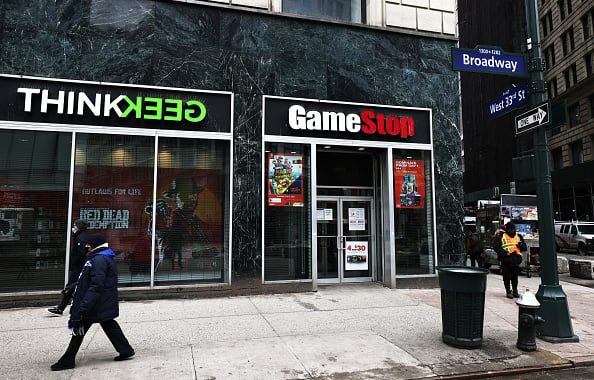

by
Michael
M.
Santiago/Getty
Images)
In
April
2020,
GameStop
(GME)
stock
sank
below
$3
a
share. By
January
2021,
retail
investors
drove
the
stock
to
an
intraday
high
of
$483,
turning
it
into
what
is
now
known
as
a
meme
stock.
Brick-and-mortar
retail
sales
of
electronic
games
declined
as
online
gaming
grew. In
2013,
GME
diversified
by
acquiring
Spring
Mobile,
a
set
of
AT&T
retail
franchises. But
by
2019,
they
had
already
divested
that
business
for
$700
million.
Following
the
sale,
GME
had
substantial
cash
on
the
balance
sheet. Many
investors
were
pessimistic
about
GME’s
management
and
its
future,
and
short
positions
increased.
But
a
smaller
group
saw
an
undervalued
asset.
Later
in
the
summer,
GME
had
more
cash
on
hand
than
the
company
was
worth,
which
is
counter
to
market
fundamentals.
Activist
investors
advocated
stock
buybacks,
and
the
board
repurchased
34.6
million
shares
through
Q3
2019,
removing
roughly
one-third
of
the
shares
from
the
market.
The
short
position
remained
high,
and
a
perfect
storm
was
brewing. Michael
Burry,
known
for
his
bet
against
the
housing
industry,
as
depicted
in
the
film
“The
Big
Short,”
has
recently
launched
a
Substack
newsletter
analyzing
market
bubbles.
He
recently
shared
his
view
on
the
events
that
enabled
retail
investors
to
drive
a
short
squeeze
on
GME. (Burry
was
one
of
those
activist
investors.)
Here
are
some
key
points
about
the
mechanics
of
the
unprecedented
short-squeeze
based
mainly
on
Burry’s
account:
-
GME
was
undervalued,
and
there
was
a
significant
short
position. -
The
Covid
lockdown
afforded
many
young
investors
time
to
research
the
market. -
Stimulus
checks
were
being
issued,
giving
disposable
cash
for
speculative
investing. -
Keith
Gill,
known
by
the
handle
Roaring
Kitty
on
Twitter,
triggered
awareness
that
GME
may
be
undervalued,
and
he
became
a
leader
in
the
GME
retail
movement. -
Retail
investors
flocked
to
apps
like
Robinhood
and
started
buying
the
stock
faster
than
hedge
funds
and
other
short
interests
could
unwind
their
positions.
A
$10,000
Rate
Card?
Some
pundits
assert
that
AI
signals
the
end
of
the
billable
hour,
yet
many
clients
are
still
willing
to
accept
double-digit
rate
increases.
My
view
is
that
it
is
still
easier
for
traditional
firms
to
increase
their
rates
than
to
change
their
business
model.
To
that
point,
earlier
this
year,
news
reports
cited
attorneys
charging
$3,000
an
hour.
Could
there
be
a
perfect
storm
brewing
to
drive
top
rates
upward
to
the
unheard-of
$10,000
rate?
GME
became
a
meme
stock
due
to
seemingly
irrational
market
behavior. Perhaps
there
are
dynamics
that
could
produce
similar
market
behavior
in
law,
too.
Rates
aren’t
going
to
spike
as
GME
did
during
its
run-up,
but
here
are
some
dynamics
that
could
push
some
rates
to
unheard-of
levels.
C-Suite
Views
AI
As
A
Cost
Saver
CEOs
view
AI
as
a
game
changer,
but
more
as
a
lever
to
reduce
headcount
and
to
save
money. This
extends
to
the
law
department. In
general,
AI
is
expected
to
increase
productivity
and
reduce
legal
spend.
This
pressure
is
then
passed
along
to
outside
counsel.
Outside
Counsel
Guidelines
(OCGs)
Clients
provide
OCGs
to
define
what
a
firm
may
and
may
not
charge. They
are
often
managed
with
procurement
and
can
unintentionally
reinforce
the
hourly
billing
model.
Here
are
some
examples
of
restrictions
from
real
OCGs:
-
No
charging
for
first-year
associates -
Pass-through
of
legal
research
expenses,
and
some
research
itself
is
not
allowed -
Clerical
work,
internal
firm
communication,
and
travel
time
is
non-billable
Recently,
I’ve
heard
of
OCGs
that
say
the
client
won’t
pay
for
anything
that
can
be
automated
with
AI.
Low
Overhead
And
Limited
Technology
Investment
Law
firms
already
struggle
with
change
and
technology
investment.
And
OCGs
tend
to
reinforce
those
challenges.
Clients
want
their
firms
to
be
efficient,
embrace
technology,
and
keep
their
staff
trained. But
right
or
wrong,
OCGs
tend
to
run
counter
to
that.
Smart
firms
recognize
they
must
invest
in
technology
and
embrace
automation
to
remain
competitive,
but
how
can
they
do
so
when
they
must
treat
those
expenses
as
nonbillable
overhead?
This
is
the
perfect
storm
for
rate
increases.
The
most
straightforward
answer
is
to
drive
productivity
and
automation,
and
charge
for
the
value
of
the
engagement
by
raising
hourly
rates.
This
is
why
it’s
not
out
of
the
realm
of
possibility
to
see
rates
on
high-value
work
skyrocket,
perhaps
to
$10,000
an
hour
in
a
few
years.
The
US
market
for
legal
services
is
roughly
$400
billion. There
are
diverse
clients
with
differing
legal
needs,
with
litigation,
compliance,
and
transactional
work
required
across
practice
areas.
There
will
be
work
that
moves
in-house,
while
other
tasks
will
be
automated
out
of
existence. ALSPs
and
managed
services
will
grab
more
market
share
in
the
coming
years. AI
will
make
many
tasks
more
predictable,
even
if
they
are
still
billed
by
the
hour.
Market
share
for
the
billable
hour
will
shrink,
but
the
billable
hour
will
still
thrive
in
the
coming
years,
even
as
the
market
evolves.
Look
for
hourly
rates
to
continue
to
rise
for
high-value
work.
I
want
to
hope
the
systemic
issues,
particularly
those
reinforced
by
OCGs,
can
be
addressed
sooner
rather
than
later.
However,
it
may
take
meme-stock
headlines
about
billable
rates
before
there
is
sufficient
awareness
to
drive
real
change.
The
editing
of
this
article
included
the
use
of
AI.
Ken
Crutchfield
has
over
forty
years
of
experience
in
legal,
tax,
and
other
industries.
Throughout
his
career,
he
has
focused
on
growth,
innovation,
and
business
transformation. His
consulting
practice
advises
investors,
legal
tech
startups
and
others.
As
a
strategic
thinker
who
understands
markets
and
creating
products
to
meet
customer
needs,
he
has
worked
in
start-ups
and
large
enterprises.
He
has
served
in
General
Management
capacities
in
six
businesses.
Ken
has
a
pulse
on
the
trends
affecting
the
market.
Whether
it
was
the
Internet
in
the
1980s
or
Generative
AI,
he
understands
technology
and
how
it
can
impact
business.
Crutchfield
started
his
career
as
an
intern
with
LexisNexis
and
has
worked
at
Thomson
Reuters,
Bloomberg,
Dun
&
Bradstreet,
and
Wolters
Kluwer.
Ken
has
an
MBA
and
holds
a
B.S.
in
Electrical
Engineering
from
The
Ohio
State
University.