
by
Stephen
Lam/San
Francisco
Chronicle
via
Getty
Images)
In
Trump
v.
United
States,
the
conservative
majority
of
the
Supreme
Court
considered
the
proposition
that
granting
Donald
Trump
unchecked
presidential
immunity
opened
the
door
to
a
president
sending
commando
units
to
assassinate
political
rivals
without
repercussion
and
said,
“yeah,
we’re
cool
with
that.”
Seemingly
taking
vibe
guidance
from
that
opinion,
a
divided
Ninth
Circuit
panel
fronted
by
Judges
Ryan
D.
Nelson
and
Bridget
S.
Bade
(take
a
guess
who
appointed
them!),
shot
down
District
Judge
Karin
Immergut’s
temporary
restraining
order
blocking
the
Trump
administration
from
deploying
National
Guard
troops
—
over
the
state’s
objection
—
to
perform
law
enforcement
duty
around
the
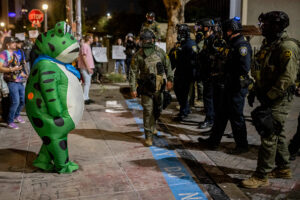
Portland
ICE
office
where
a
handful
of
dancing
inflatable
animals
gathered
in
protest.
The
Ninth
Circuit
will
inevitably
hear
the
case
en
banc
—
the
process
is
apparently
already
underway
—
but
in
the
meantime,
this
decision
becomes
another
collectible
in
the
White
House’s
effort
to
string
together
step-wise
court
victories
toward
laying
the
legal
groundwork
for
unilateral
authoritarianism.
That’s
really
what’s
going
on
here.
The
administration
is
fully
aware
that
they
don’t
need
the
National
Guard
to
secure
ICE
from
eight
hippies.
But
they’re
counting
on
judges
like
Nelson
and
Bade
to
write
opinions
establishing
that
Trump’s
subjective
assessment
of
“danger”
justifies
military
deployment
—
precedent
that
will
be
ready
and
waiting
when
he
wants
troops
at
polling
places
or
outside
state
capitols
during
vote
certification.
Like
the
proverbial
inflatable
frog
in
the
pot.
Judges
Nelson
and
Bade
are
both
Trump
appointees
who
rose
to
their
station
through
the
MAGA
patronage
pipeline,
a
sort
of
judicial
“Alabama
Rush,”
where
the
stakes
are
higher,
the
process
is
just
as
opaque,
and
there’s
somehow
even
more
white
people
involved.
But
it’s
not
fair
to
dismiss
a
court
opinion
just
because
they’re
Trump
judges.
After
all,
many
Trump-appointed
judges
have
stood
on
principle
in
cases
involving
the
government
—
indeed,
Judge
Immergut
(who
had
to
take
over
this
case
because
Judge
Michael
Simon
is
married
to
a
politician
who
spoke
against
the
administration
plan
—
if
that’s
the
standard,
wait
until
people
hear
what
Ginni
Thomas
says!)
is
a
Trump
appointee.
Let’s
just
say
it’s
a
necessary
but
not
sufficient
condition.
Instead,
let’s
dismiss
the
opinion
because
it’s
intellectually
vapid
and
factually
dishonest.
After
considering
the
record
at
this
preliminary
stage,
we
conclude
that
it
is
likely
that
the
President
lawfully
exercised
his
statutory
authority
under
10
U.S.C.
§
12406(3),
which
authorizes
the
federalization
of
the
National
Guard
when
“the
President
is
unable
with
the
regular
forces
to
execute
the
laws
of
the
United
States.”
The
evidence
the
President
relied
on
reflects
a
“colorable
assessment
of
the
facts
and
law
within
a
‘range
of
honest
judgment.’”
This
is
not,
in
fact,
what
the
statute
says.
In
fact,
§12406
authorizes
the
president
to
use
troops
where
the
federal
government
“is
unable
with
the
regular
forces
to
execute
the
laws
of
the
United
States.”
What
does
that
mean?
According
to
Judges
Nelson
and
Bade,
it
means
“whatever
the
president
says.”
After
paying
lip
service
to
recent
Ninth
Circuit
precedent
clarifying
that
the
White
House
can’t
make
unfounded
declarations
to
justify
sending
troops,
the
majority
strung
together
a
series
of
anecdotes
that
amount
to
little
more
than
“there
was
once
a
protest”
—
regardless
of
whether
it
actually
prevented
law
enforcement
from
functioning
—
and
said
that’s
enough
to
make
Trump’s
decision
colorable.
But
the
plural
of
anecdotes
is
not
data
as
they
say,
and,
in
dissent,
Judge
Susan
Graber
pulled
up
the
actual
reports
and
challenged
the
majority
to
explain
how
this
is
colorably…
anything.
The
worst
that
ever
happened
in
Portland
was
all
handled
by
local
law
enforcement,
a
critical
point
since
the
statute
places
an
explicit
caveat
that
the
breakdown
must
be
beyond
the
capacity
of
regular
forces
to
warrant
military
involvement.
In
response,
the
majority
counters:
First,
the
district
court
erred
by
determining
that
the
President’s
“colorable
assessment
of
the
facts”
is
limited
by
undefined
temporal
restrictions
and
by
the
district
court’s
own
evaluation
of
the
level
of
violence
necessary
to
impact
the
execution
of
federal
laws.
Thus,
the
district
court
determined
that
it
would
apply
Newsom’s
deferential
“colorable
basis”
standard
to
the
facts
“as
they
existed
at
the
time
[the
President]
federalized
the
National
Guard.”
These
“undefined
temporal
restrictions”
are
grounded
in
what
the
rest
of
us
would
call
“the
English
language.”
As
much
as
the
country
might
benefit
from
reimposing
Reconstruction
on
the
South
based
on
its
“history”
of
rebellion,
past
administrations
respected
that
their
authority
was
limited
by
the
present
tense.
To
the
extent
Portland’s
ICE
agents
really
are
so
soft
that
they
couldn’t
do
their
jobs
in
July,
it
has
little
bearing
determining
that
it
“IS
UNABLE
with
the
regular
forces
to
execute
the
laws
of
the
United
States”
come
September.
Nor
can
the
president
assert
that
ICE
might
potentially
at
some
undefined
future
point
become
unable.
Congress,
presumably,
knows
how
to
write
forward-looking
language.
It
chose
not
to
do
so.
The
statute
delegates
the
authority
to
make
that
determination
to
the
President
and
does
not
limit
the
facts
and
circumstances
that
the
President
may
consider
in
doing
so.
Indeed,
the
inherently
subjective
nature
of
this
evaluation
demonstrates
that
the
President
has
the
authority
to
identify
and
weigh
the
relevant
facts
under
§
12406(3).
The
President
can,
and
should,
consider
the
totality
of
the
circumstances
when
determining
whether
he
“is
unable
with
the
regular
forces
to
execute
the
laws
of
the
United
States.”
Donald
Trump
has
publicly
claimed
that
Portland
is
a
“war
zone”
that
is
“on
fire.”
The
statute
may
not
explicitly
“limit
the
facts
and
circumstances”
a
president
can
consider,
but
one
presumes
a
limit
excluding
fiction.
Alas,
the
majority
has
an
answer
for
this
and
it
is,
“The
Party
told
you
to
reject
the
evidence
of
your
eyes
and
ears.
It
was
their
final,
most
essential
command.”
While
we’re
on
fake
claims,
the
administration’s
argument
that
“regular
forces”
couldn’t
handle
the
protests
cited
an
unusually
high
number
of
ICE
agents
sent
to
the
Portland
office.
Judge
Graber
pointed
out
that
this
seems
to
be
a
bunch
of
people
cycling
in
and
out
a
handful
at
a
time.
Less
a
surge
than
a
revolving
door
—
probably
put
in
to
set
up
this
argument
for
any
judge
willing
to
treat
it
with
undue
credulity.
Second,
the
district
court
erred
by
placing
too
much
weight
on
statements
the
President
made
on
social
media.
The
district
court
interpreted
President
Trump
characterizing
Portland
as
“War
ravaged,”
as
the
equivalent
of
the
President
“ignoring
the
facts
on
the
ground.”
As
such,
the
district
court
relied
on
these
statements
to
disregard
other
facts
that
do
“reflect[]
a
colorable
assessment
of
the
facts
and
law
within
a
range
of
honest
judgment.”
When
Homer
Simpson
rose
to
lead
the
Stonecutters,
he
once
tried
to
fold
a
losing
poker
hand,
only
for
the
other
cultists
to
jump
in
and
declare
that
he
had
“the
Royal
Sampler.”
Apparently,
Trump’s
judges
on
the
federal
judiciary
now
take
their
cues
from
Lenny
and
Carl.
The
president
—
or
at
least
THIS
president
—
is
owed
such
extreme
deference
that
the
courts
are
allowed
to
substitute
their
own
imagined
justifications
if
the
president’s
own
words
don’t
measure
up
to
“colorable.”
That’s
not
legalism,
it’s
epistemic
control:
the
right
to
define
what
counts
as
a
threat,
what
counts
as
a
rebellion,
and
what
counts
as
the
ability
to
execute
laws.
When
courts
declare
that
even
fantasy
threats
justify
real-world
force,
we’re
no
longer
interpreting
the
Constitution,
we’re
narrating
empire.
The
per
curiam
opinion
rested
its
laurels
on
the
ability
to
execute
the
laws
justification,
but
give
a
special
shout
out
to
Judge
Nelson,
who
added
a
gratuitous
concurrence
to
clarify
that
he’d
also
allow
Trump
to
define
a
gathering
of
furries
outside
a
government
office
as
a
“rebellion”
if
he
wanted.
Citing
the
sort
of
ersatz
history
and
tradition
that
carries
the
day
at
the
Supreme
Court,
Nelson
cites
the
history
of
founding
era
rebellions
like
the
Whiskey
Rebellion
and
Shays’s
Rebellion
and
asserts
with
a
straight
face
that
these
are
more
or
less
the
same
as
Portland.
This
comparison
reflects
“history”
in
the
same
way
Ancient
Aliens
fits
on
the
History
Channel.
And
even
if
they
bore
any
resemblance
to
Portland,
the
government
sent
troops
while
they
were
ongoing.
He
also
spills
ink
on
the
idea
that
Trump’s
judgment
shouldn’t
be
reviewable
at
all.
No
one
has
standing.
Nothing
is
reviewable.
Just
the
whims
of
the
Mad
King
of
Mar-a-Lago
all
the
way
down.
But
you
don’t
move
up
the
Federalist
Society’s
cursus
honorum
for
backing
away
from
an
insane
statement
or
two.
More
or
less
absent
from
this
historical
review
is
the
Posse
Comitatus
Act,
which
frames
the
existing
Insurrection
Act
as
less
empowering
than
limiting.
The
Insurrection
Act
is
classically
understood
as
a
series
of
legal
obstacles
a
president
must
overcome
rather
than
a
grant
of
deferential
power.
This
opinion
attempts
to
flip
this
on
its
head,
continuing
the
baseless
sanewashing
coming
from
the
media,
by
suggesting
the
Insurrection
Act
is
an
unchecked
magic
wand
that
just
never
got
used
like
this
out
because
prior
presidents
lacked
Trump’s
legal
acumen
to
read
the
invisible
ink
between
the
lines
of
the
statute.
Judge
Graber’s
dissent
lays
out
the
stakes:
Given
Portland
protesters’
well-known
penchant
for
wearing
chicken
suits,
inflatable
frog
costumes,
or
nothing
at
all
when
expressing
their
disagreement
with
the
methods
employed
by
ICE,
observers
may
be
tempted
to
view
the
majority’s
ruling,
which
accepts
the
government’s
characterization
of
Portland
as
a
war
zone,
as
merely
absurd.
But
today’s
decision
is
not
merely
absurd.
It
erodes
core
constitutional
principles,
including
sovereign
States’
control
over
their
States’
militias
and
the
people’s
First
Amendment
rights
to
assemble
and
to
object
to
the
government’s
policies
and
actions.
I
strenuously
dissent
The
comparison
to
Trump
v.
United
States
is
apt,
not
just
because
of
its
central
litigant,
but
just
like
the
justices
who
considered
the
possibility
that
their
decision
—
as
written
—
legalized
political
assassination,
the
judges
here
painted
executive
authority
with
a
brush
broad
enough
to
greenlight
any
number
of
abuses.
When
establishing
a
rule,
it’s
not
what
you
do,
it’s
what
you
justify
—
if
the
bar
is
set
at
“streaking
hipsters
three
months
ago
amounts
to
a
total
breakdown
in
law
now,”
what
happens
when
the
White
House
says
election
day
“could
be
violent”
based
on
anonymous
vibes?
Claiming
to
be
governed
by
laws
and
not
men
is
all
well
and
good,
but
rests
on
the
premise
that
courts
don’t
rewrite
the
law
as
“whatever
that
dude
thinks
in
the
moment.”
At
that
point,
it’s
all
theater.
Judge
Graber
concludes
her
opinion,
stressing,
“Above
all,
I
ask
those
who
are
watching
this
case
unfold
to
retain
faith
in
our
judicial
system
for
just
a
little
longer.”
With
all
due
respect,
that
faith
is
getting
harder
to
maintain
when
two
members
of
a
three-judge
panel
can
look
at
people
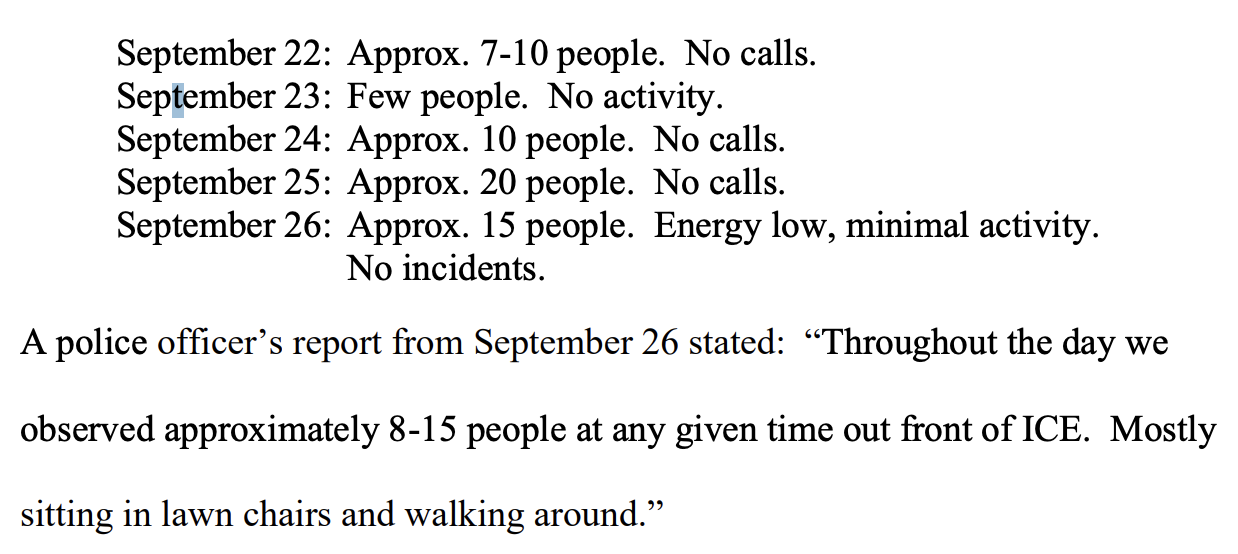
sitting
in
lawn
chairs
and
see
a
war
zone.
(Full
opinion
available
on
the
next
page…)
Earlier:
TV
Legal
Analyst
Begins
Sanewashing
Trump
Declaring
Martial
Law
SCOTUS
Greenlights
SEAL
Team
6
Solution
 Joe
Joe
Patrice is
a
senior
editor
at
Above
the
Law
and
co-host
of
Thinking
Like
A
Lawyer.
Feel
free
to email
any
tips,
questions,
or
comments.
Follow
him
on Twitter or
Bluesky
if
you’re
interested
in
law,
politics,
and
a
healthy
dose
of
college
sports
news.
Joe
also
serves
as
a
Managing
Director
at
RPN
Executive
Search.