

I’m
Nicolas,
COO
at
Juno
and
a
proud
(if
battle-scarred)
grad-school
alum
who
once
signed
on
the
dotted
line
for
nearly
$200,000
in
student
debt.
Living
through
that
experience—and
later
helping
thousands
of
classmates
do
the
same—showed
me
just
how
lopsided
the
loan
market
can
be
for
individual
borrowers.
That’s
why
Juno
was
born:
we
band
students
together,
use
their
collective
buying
power,
and
negotiate
bulk
discounts
on
private-loan
rates
and
perks
that
no
borrower
could
secure
alone.
After
several
years
of
securing
the
best
private
loan
deals
for
students
at
top
MBA
programs,
we
now
bring
the
same
no-cost
leverage
to
law
students.
Below
is
the
playbook
I
wish
someone
had
handed
me
before
orientation
day—a
step-by-step
recipe
for
keeping
your
J.D.
affordable.
Step
1.
Chase
the
Money
You
Never
Repay
School
grants
&
scholarships
Most
law-school
“free
money”
arrives
with
your
admit
letter:
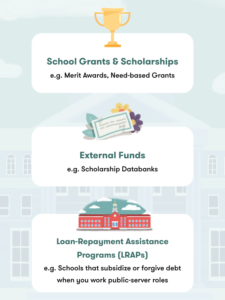
-
Merit
awards
–
driven
by
LSAT
/
GPA,
leadership
résumé,
diversity
fellowships
(e.g.,
ABA
Legal
Opportunity,
AccessLex
MAX),
or
practice-area
tracks
such
as
IP
or
public
interest. -
Need-based
grants
–
at
a
growing
list
of
schools
(Harvard,
Stanford,
Yale,
Berkeley,
Georgetown,
NYU).
External
funds
Check
the
AccessLex
Scholarship
Databank,
state-bar
foundations,
and
affinity-bar
associations
(HNBA,
NAPABA,
NBLSA,
etc.)—many
awards
have
deadlines
as
late
as
July—worth
a
final
sweep.
Loan-Repayment
Assistance
Programs
(LRAPs)
~60
ABA-accredited
schools
may
subsidize
or
forgive
part
of
your
debt
if
you
enter
public-service
or
government
roles.
Run
the
math:
LRAP
+
PSLF
can
slash
your
effective
borrowing
cost.
Step
2.
Decide
How
Much
Cash
to
Use
-
Budget
honestly.
Rely
on
your
law
school’s
published
Cost
of
Attendance
(COA),
but
note
that
summer
housing,
clinics,
moot-court
travel,
and
the
3L
bar-study
gap
often
push
actual
spending
above
that
amount. -
Keep
an
emergency
fund—include
bar-exam
and
bar-review
costs
(typically
~$3–$4k). -
Compare
returns
vs.
borrowing
cost.
Consider
your
opportunity
cost
(e.g.,
potential
investment
gains,
emergency
savings)
against
the
interest
rate
on
your
loans.
If
you
can’t
reliably
out-earn
that
rate,
using
some
savings
may
make
sense.
That
said,
many
graduates
from
T14
schools
begin
their
careers
in
Big
Law,
where
higher
starting
salaries
can
accelerate
loan
repayment
or
qualify
for
refinancing
later
on.
If
that
path
is
likely
for
you,
it
may
justify
holding
onto
more
cash
upfront
and
using
it
for
longer-term
investments.
Step
3.
Know
Your
Loan
Options
After
finishing
exploring
all
the
scholarship
options,
and
assessing
how
much
of
your
savings
you
are
willing/able
to
use,
Student
loans
are
used
to
fill
the
gap.
U.S.
citizens
and
Permanent
Residents
have
access
to
Federal
Loans.
There
are
two
types
for
Law
students:
Direct
Unsubsidized
(more
affordable
but
limited
to
$20.5k
a
year)
and
Grad
PLUS
(more
expensive,
but
can
go
up
to
the
cost
of
attendance)
Those
have
fixed
terms,
independent
of
your
specific
credit
profile.
The
terms
are
as
follows
for
the
academic
year
2025
–
2026

Key
points
-
Federal
loans
carry
IDR
plans
and
PSLF
eligibility—
most
valuable
if
you’ll
stay
in
public
service. -
Grad
PLUS
fees
add
4.228
%
to
your
balance
on
day
one
If
you
are
not
planning
to
take
advantage
of
the
Federal
protections,
it’s
worth
comparing
whether
you
can
get
a
more
affordable
loan
on
the
private
side.
Step
4.
Check
Your
Rates
on
Juno
(without
impacting
your
credit)
We
created
Juno
to
make
it
a
no-brainer
option
if
you
decide
to
take
a
private
loan.
We
negotiate
to
ensure
our
deals
are
better
than
going
directly
to
the
lender,
and
some
of
our
deals
don’t
need
a
cosigner
or
income
for
you
to
qualify.

-
Soft-credit
check
in
~2
minutes
(Does
not
affect
your
credit) -
Fixed
and
variable
APRs
that
beat
Federal
options
for
many
credit
tiers. -
Negotiated
Rates
and/or
Cash
Bonuses
are
available -
Rate
Match
Program:
If
you
find
a
better
rate
from
a
long
list
of
competitors,
we
will
match
it
and
give
you
1%
of
your
loan
amount
as
cash
back
Compare
your
personalized
Juno
quote
against
your
Federal
offers.
Step
5.
Bottom-Line
Playbook
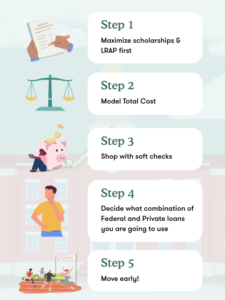
-
Maximize
scholarships
&
LRAP
first.
Every
free
dollar
is
one
you
never
repay. -
Model
total
cost.
Include
origination
fees,
bar-prep
expenses,
and
how
quickly
you’ll
refinance
or
pursue
PSLF. -
Shop
with
soft
checks.
Gather
real
quotes,
then
decide—without
any
impact
on
your
credit. -
Decide
what
combination
of
Federal
and
Private
loans
you
are
going
to
use:
You
can
use
any
combination
of
Federal
and
Private
loans
up
to
your
COA. -
Move
early.
If
you
see
a
rate
you
like,
consider
applying
early
to
lock
it
in.
Remember,
rates
may
move
at
a
moment’s
notice.
Law
school
is
a
major
investment,
but
thoughtful
planning
can
keep
your
debt
in
check
so
you
can
focus
on
contracts,
criminal,
or
con-law
instead
of
compounding
interest.
Juno
helps
law
students
access
discounted
deals
through
collective
bargaining,
so
you
can
borrow
smarter
and
stress
less.
Best
of
luck
in
your
legal
journey!
The
information
provided
in
this
article
is
current
as
of
June
4,
2025,
and
is
intended
for
general
informational
purposes
only.
It
does
not
constitute
legal,
financial,
or
tax
advice.
Readers
should
consult
their
own
advisors
before
making
any
decisions.
Terms
and
conditions
may
apply
to
the
loan
products
discussed.
Federal
student
loans
offer
certain
borrower
protections
and
benefits—such
as
income-driven
repayment
plans
and
potential
forgiveness
options—that
may
be
important
to
consider.
To
learn
more,
visit
studentaid.gov.