
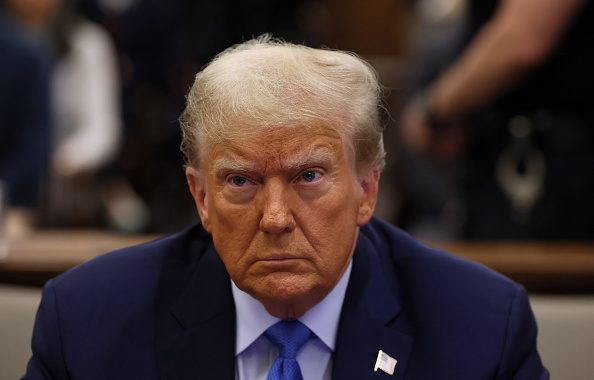
by
Brendan
McDermid-Pool/Getty
Images)
This
morning
a
totally
normal
thing
happened
in
the
Second
Circuit
when
the
judges
brushed
off
a
request
for
en
banc
review
by
a
disappointed
appellant.
Well
…
not
totally
normal.
The
case
did
involve
the
sitting
president’s
effort
to
disappear
the
the
first
E.
Jean
Carroll
verdict
finding
him
liable
for
sexually
assaulting
and
defaming
the
advice
columnist.
The
hope
was
to
persuade
the
wider
court
that
trial
Judge
Lewis
Kaplan
abused
his
discretion
with
respect
to
the
evidence
presented
at
trial.
These
alleged
abuses
included
admitting
testimony
that
Trump
attempted
to
sexually
assault
other
women
and
indeed
bragged
about
it
on
the
infamous
Access
Hollywood
tape,
as
well
as
by
excluding
information
about
who
funded
Carroll’s
litigation.
Trump
was
also
big
mad
that
Judge
Kaplan
didn’t
let
him
tell
the
jury
that
Carroll
named
her
cat
“Vagina.”

In
a
per
curiam
order
in
December,
Judges
Denny
Chin,
Susan
Carney,
and
Myrna
Pérez
affirmed
the
trial
court’s
ruling,
finding
no
abuse
of
discretion,
and,
even
assuming
that
the
panel
might
have
decided
some
minor
issues
differently
than
the
trial
court,
merely
harmless
error.
Also
this
morning,
a
slightly
less
normal
thing
happened,
which
was
that
Judges
Chin
and
Carney
filed
a
concurrence
lambasting
the
dissenters
from
the
denial
of
rehearing
en
banc
for
their
batshit
crazy
opinion.
“The
dissent
fails
to
cite
contrary
binding
authority
or
any
prior
decisions
that,
upon
review,
actually
conflict
with
the
panel’s
decision;
it
fails
to
acknowledge
the
deferential
standard
of
review
that
binds
us;
and
it
fails
to
identify
any
single
question
of
exceptional
importance
that
requires
en
banc
consideration,”
they
wrote
incredulously,
adding
a
terse
reminder
that
“we
do
not
convene
en
banc
to
relitigate
a
case.”
And
finally
this
morning
a
completely
insane
thing
happened
which
is
—
no
surprises
here!
—
Judge
Steven
Menashi
filed
said
batshit
dissent,
which
was
joined
by
Judge
Michael
Park,
the
only
other
Trump
appointee
on
the
Second
Circuit.
The
dissent
starts
out
with
a
footnote
citing
an
unpublished
Third
Circuit
opinion
in
Hill
v.
Cosby
—
yes
that
Cosby.
The
theory
is
that
someone
accused
of
a
crime
can
deny
the
accusation
without
committing
defamation.
Except
in
that
case
it
was
Cosby’s
lawyer
talking
about
pending
litigation,
and
he
confined
himself
to
denying
the
allegations
and
managed
not
to
call
Hill
a
liar
participating
in
a
hoax
who
was
anyway
too
unattractive
to
assault.
The
court
found
that
the
lawyer’s
denial
was
“not
actionable
because
it
includes
the
facts
supporting
that
implication”
and
“adequately
disclosed
the
factual
basis
for
the
attorney’s
opinion.”
Auspicious!
The
dissent
goes
on
to
complain
that
“The
actual
malice
standard
famously
raises
‘the
plaintiff’s
burden
of
proof
to
an
almost
impossible
level’”
and
yet
the
jury
found
it
was
met
here,
supposedly
because
the
trial
judge
erroneously
excluded
evidence
that
some
of
Carroll’s
legal
fees
were
paid
by
LinkedIn
founder
Reid
Hoffman
(although
apparently
without
her
being
fully
aware
of
the
subsidy).
The
theory
is
that
evidence
of
Democrats
rallying
around
Carroll
would
undercut
the
predicate
for
a
finding
of
actual
malice,
since
it
would
go
to
the
defendant’s
state
of
mind.
But,
as
Judge
Chin
and
Carney
point
out,
Trump
never
argued
this
himself
since
it
was
“orthogonal
to
his
basic
position”
that
what
he
said
was
true,
not
just
his
reasonable
if
mistaken
belief.
And,
as
they
point
out,
it’s
emphatically
not
the
province
of
Circuit
Court
judges
to
run
a
simulation
of
what
might
have
happened
in
a
parallel
universe
if
the
parties
had
argued
their
cases
differently.
The
dissent
is
full
of
wild
claims,
but
perhaps
the
most
offensive
is
the
suggestion
that
Trump
can’t
be
liable
for
defamation
because
maybe
he
just
plum
forgot
about
sexually
assaulting
this
woman
in
the
dressing
room
at
Bergdorf’s.
“Because
the
purported
conduct
underlying
the
lawsuit
had
allegedly
occurred
almost
thirty
years
earlier
and
‘lasted
just
a
few
minutes,’
at
the
time
of
his
statement
President
Trump
might
not
have
even
remembered
any
interaction—even
assuming
one
occurred—let
alone
still
regarded
a
lawsuit
based
on
such
long-ago
events
as
a
politically
motivated
hoax,”
they
wrote,
snarking
that
“Normally,
the
statute
of
limitations
would
have
prevented
such
a
suit,
but
New
York
suspended
the
statute
of
limitations
and
Carroll
sued
‘nine
minutes
after
the
[suspension]
became
effective.’”
It’s
gross!
And
not
normal!
And
coming
to
the
Supreme
Court
this
summer.
As
for
Carroll,
she
and
her
attorney’
Roberta
Kaplan
celebrated
the
ruling.
“Although
President
Trump
continues
to
try
every
possible
maneuver
to
challenge
the
findings
of
two
separate
juries,
those
efforts
have
failed,”
they
told
ATL.
“He
remains
liable
for
sexual
assault
and
defamation.”
Carroll
v.
Trump
[Docket
via
Court
Listener]
Liz
Dye lives
in
Baltimore
where
she
produces
the
Law
and
Chaos substack and podcast.