
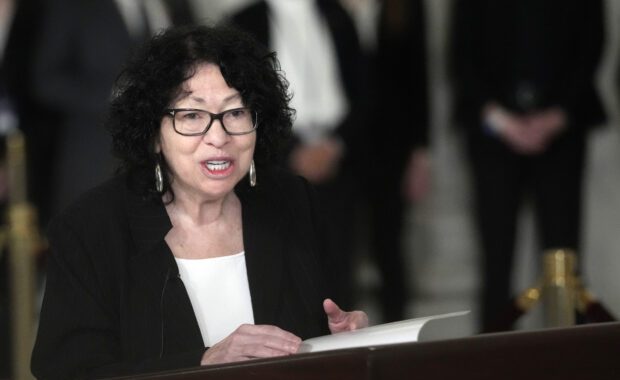
by
Jacquelyn
Martin-Pool/Getty
Images)
For
those
keeping
score
in
the
high-stakes
game
of
Constitutional
Calvinball,
that
is
DVD
v.
DHS,
the
Supreme
Court’s
conservative
majority
just
issued
a
one-paragraph
shadow
docket
ruling
staying
a
preliminary
injunction
entered
by
Judge
Brian
Murphy
of
the
District
of
Massachusetts
(and
blessed
by
the
First
Circuit)
that
had
prohibited
the
Trump
administration
from
deporting
people
to
third
countries
without
affording
them
a
reasonable
opportunity
to
argue
that
maybe
they
shouldn’t
be
dropped
into
the
middle
of
a
civil
war
where
they
don’t
speak
the
language.
And
yet,
as
of
right
now,
the
administration
still
can’t
deport
those
people
to
South
Sudan
—
or
Libya,
or
any
other
flaming
geopolitical
dumpster
the
admin
has
on
speed
dial
for
warehousing
human
lives
—
because
Judge
Murphy
clarified
immediately
after
the
release
of
the
Supreme
Court’s
opinion
that
his
pause
remains
in
effect.
How
is
this
possible?
Thank
Justice
Sotomayor
and
the
dissenting
justices.
The
case
is
one
steaming
hot
ball
of
contemptuous
administrative
action,
with
the
administration
repeatedly
breaching
orders
while
playing
dumb
and
pointing
the
finger
at
hypertechnical
excuses
like,
“oh,
DHS
didn’t
deport
them
in
violation
of
the
order…
we
just
put
them
on
a
DOD
plane
and
we’re
as
shocked
as
you
that
our
personal
Deportation
Uber
then
flew
to
Africa!”
The
Supreme
Court
had
ruled
unanimously
earlier
this
year
in
another
case
that
the
Trump
administration
needed
to
faithfully
respect
due
process
rights
when
it
goes
about
deporting
people.
The
administration
took
that
order
and
made
up
fake
quotes
from
it
to
keep
doing
what
it
wanted.
In
DVD
v.
DHS,
the
administration
decided
to
test
drive
just
how
much
it
can
get
away
with
and
last
night,
the
conservative
majority
decided
that
the
government
can
have
a
little
arbitrary,
unconstitutional
activity
as
a
treat.
For
old-school
Simpsons
fans,
the
conservatives
adopted
Bart
Simpson’s
strategy
for
convincing
the
obedience
school
trainer
that
his
dog
had
passed
and
came
out
just
as
convincing.

But
since
the
shadow
docket’s
whole
appeal
is
allowing
the
Court
to
make
consequential
rulings
without
having
to
explain
itself,
the
liberal
dissenters
took
the
opportunity
to
explain
the
opinion
for
them.
The
majority’s
whole
opinion
reads:
The
application
for
stay
presented
to
JUSTICE
JACKSON
and
by
her
referred
to
the
Court
is
granted.
The
April
18,
2025,
preliminary
injunction
of
the
United
States
District
Court
for
the
District
of
Massachusetts,
case
No.
25–cv–
10676,
is
stayed
pending
the
disposition
of
the
appeal
in
the
United
States
Court
of
Appeals
for
the
First
Circuit
and
disposition
of
a
petition
for
a
writ
of
certiorari,
if
such
writ
is
timely
sought.
Should
certiorari
be
denied,
this
stay
shall
terminate
automatically.
In
the
event
certiorari
is
granted,
the
stay
shall
terminate
upon
the
sending
down
of
the
judgment
of
the
Court.
Maintaining
the
status
quo
is
an
admirable
justification
for
equitable
action.
Avoiding
irreversible
harm
is,
however,
a
much
better
one.
There’s
no
good
reason
given
why
DHS
needs
to
throw
these
people
into
South
Sudan
right
now
as
opposed
to
waiting
until
the
case
concludes,
except
to
the
extent
the
administration
hopes
to
moot
the
case
via
ethnic
cleansing.
And,
yes,
some
of
the
key
players
here
are
objectively
awful
people
but
nonetheless
have
the
right
to
a
real
hearing
on
whether
or
not
they
can
be
sent
into
a
warzone.
There’s
not
really
any
doubt
that
the
administration
expected
the
Supreme
Court
to
open
the
door
to
these
deportations.
What
they
ended
up
with
is
like
a
mechanic
returning
a
car
that
won’t
start
by
announcing
that
they
fixed
the
cigarette
lighter.
Because
while
the
majority
didn’t
want
to
explain
itself,
the
dissenters
did.
Over
the
course
of
19
pages,
Justice
Sonia
Sotomayor,
with
Kagan
and
Jackson
backing
her,
blasted
the
ruling
as
little
more
than
rubberstamping
contempt.
A
“gross
an
abuse
of
the
Court’s
equitable
discretion”
as
she
put
it.
But
she
also
dropped
her
own
invitation
to
play
technicalities.
First,
the
District
Court’s
remedial
orders
are
not
properly
before
this
Court
because
the
Government
has
not
appealed
them,
nor
sought
a
stay
pending
a
forthcoming
appeal.
The
preliminary
injunction
addressed
by
the
majority
is
not
the
only
order.
The
dissent
raises
this
point
as
part
of
its
argument
that
the
government
failed
to
meet
its
burden
to
demonstrate
irreparable
harm,
a
burden
the
majority
didn’t
bother
to
explain
how
the
government
could’ve
met
because
it
can’t.
Sotomayor
cleverly
notes
that
if
the
government
claims
the
harm
is
based
solely
in
the
individuals
it
intended
to
send
to
South
Sudan
(but
have
temporarily
parked
in
Djibouti)
then
the
preliminary
injunction
isn’t
responsible
for
that,
it’s
Judge
Murphy’s
subsequent
remedial
order
that
the
government
never
appealed
to
the
Supreme
Court.
Judge
Murphy
saw
the
opening
and
went
right
for
it.
Judge
Brian
E.
Murphy:
ELECTRONIC
ORDER
ENTERED.
Plaintiffs’
Emergency
Motion,
Dkt.
174,
is
DENIED
as
unnecessary,
subject
to
the
below.
The
Court’s
May
21,
2025
Order
on
Remedy,
Dkt.
119,
remains
in
full
force
and
effect,
notwithstanding
today’s
stay
of
the
Preliminary
Injunction.
DHS
v.
D.V.D.,
No.
24A1153,
slip
op.
at
12
(S.
Ct.
Jun.
23,
2025)
(Sotomayor,
J.,
dissenting)
(“[T]he
District
Court’s
remedial
orders
[were]
not
properly
before
[the
Supreme]
Court
because
the
Government
has
not
appealed
them,
nor
sought
a
stay
pending
a
forthcoming
appeal.”).
For
the
avoidance
of
doubt,
and
to
the
extent
Plaintiffs
N.M.
and
D.D.
are
indeed
subject
to
third-country
removal,
see
Dkt.
175
at
5-7,
N.M.
and
D.D.
are
included
among
the
individuals
referenced
in
the
May
21,
2025
Order.
(BAH)
Modified
on
6/23/2025
(PK).
(Entered:
06/23/2025)
The
remedial
order
—
which,
for
the
record,
requires
only
what
the
government
ASKED
FOR
before
turning
around
and
complaining
that
their
own
request
was
too
onerous
—
is
the
one
that
requires
the
private
“credible-fear
interview”
with
counsel
and
an
interpreter.
This,
Sotomayor’s
dissent
notes
and
Judge
Murphy
agrees,
is
separate
from
the
class-wide
preliminary
injunction
and
the
source
of
all
the
supposed
harms
the
administration
asserts.
While
this
dispute
could’ve
been
avoided
had
the
government
abided
by
the
preliminary
injunction,
now
that
it
chose
not
to,
what
is
to
be
done
with
these
people
in
front
of
this
court
becomes
a
wholly
separate
inquiry
that
no
one
properly
appealed.
Civil
Procedure
for
the
win.
It’s
incredibly
satisfying
to
see
a
justice
finally
stop
bringing
knives
to
the
gun
fight.
Justice
Sotomayor’s
dissent
took
the
deliberate
murky
abyss
that
the
majority
celebrates
with
its
shadow
docket
opinions
and
applied
a
little
meaning
atop
the
empty
signifier.
Throughout
this
case,
the
administration
has
acted
with
utter
contempt
for
the
court,
relying
on
juvenile
semantic
games
to
subvert
the
system.
If
they
want
to
engage
in
technical
readings,
well,
the
justices
read
the
rulebook
sideways
too.
And
they’re
much
smarter.
In
a
sane
system,
none
of
this
would
be
necessary.
Majority
opinions
would
have
to
defend
themselves
and
the
government
wouldn’t
be
a
bad
faith
proto-Eddie
Haskell
every
time
it’s
summoned
before
a
judge.
But
here
we
are
and
the
dissent
acted
accordingly
with
the
hand
it
was
dealt.
 Joe
Joe
Patrice is
a
senior
editor
at
Above
the
Law
and
co-host
of
Thinking
Like
A
Lawyer.
Feel
free
to email
any
tips,
questions,
or
comments.
Follow
him
on Twitter or
Bluesky
if
you’re
interested
in
law,
politics,
and
a
healthy
dose
of
college
sports
news.
Joe
also
serves
as
a
Managing
Director
at
RPN
Executive
Search.