
There
is
a
certain
dark
comedy
in
watching
the
law
firm
that
advises
OpenAI
on
its
“safe
and
ethical
deployment”
of
artificial
intelligence
rush
to
the
federal
bankruptcy
docket
seeking
leniency
after
realizing
they’ve
filed
a
lengthy
brief
riddled
with
AI
hallucinations.
It
doesn’t
matter
where
on
the
Am
Law
100
food
chain
you
are,
the
AI
psychedelic
experience
can
come
for
anyone
who
lets
their
editorial
standards
slip.
In
a
letter
dated
Saturday,
Sullivan
&
Cromwell
partner
Andrew
Dietderich
wrote
Chief
Bankruptcy
Judge
Martin
Glenn
of
the
Southern
District
of
New
York
a
letter
that
will
live
forever
in
the
Biglaw
Hall
of
Hilarity.
Dietderich
informed
the
court
that
he
had
learned
on
Thursday
that
the
firm’s
emergency
motion
in
the
Chapter
15
case
of
Prince
Global
Holdings
—
the
BVI-incorporated
husk
of
a
Cambodian
forced-labor
scam
conglomerate
—
had
gotten
high
on
its
own
supply
of
AI
tools.
The
inaccuracies
and
errors
in
the
Motion
include
artificial
intelligence
(“AI”)
“hallucinations.”
“Hallucinations”
are
instances
in
which
artificial
intelligence
tools
fabricate
case
citations,
misquote
authorities,
or
generate
non-existent
legal
sources.
We
deeply
regret
that
this
has
occurred.
The
Firm
maintains
comprehensive
policies
and
training
requirements
governing
the
use
of
AI
tools
in
legal
work.
These
safeguards
are
designed
to
prevent
exactly
this
situation.
The
Firm’s
policies
on
the
use
of
AI
were
not
followed
in
connection
with
the
preparation
of
the
Motion.
In
addition,
the
Firm
has
general
policies
and
training
requirements
for
the
proper
review
of
legal
citations.
Regrettably,
this
review
process
did
not
identify
the
inaccurate
citations
generated
by
AI,
nor
did
it
identify
other
errors
that
appear
to
have
resulted
in
whole
or
in
part
from
manual
error.
We
hear
a
lot
about
the
“safeguards”
that
lawyers
put
up
around
AI,
but
at
the
end
of
the
day
it
feels
like
empty
PR
talk
for
“we
like
to
think
we’re
editing
what
we
send
out
the
door.”
Which,
in
fairness,
is
the
ultimate
safeguard.
There
are
great
tools
out
there
designed
to
reduce
the
risk
of
a
pernicious
hallucination.
And
these
tools
will
give
lawyers
a
leg
up
when
it
comes
to
tamping
down
errors
early.
But
there’s
no
substitute
for
a
junior
having
to
print
up
the
cases
and
do
the
meticulous
checking…
and
then
the
midlevel
doing
the
exact
same
thing.
That’s
the
manual
review
process
the
letter
references.
It’s
inefficient,
but
perfection
isn’t
intended
to
be
cheap
and
easy.
That
is,
in
fact,
why
someone
hires
Sullivan
&
Cromwell
in
the
first
place.
Dietderich
goes
on
to
explain
at
some
length
—
the
firm
has
a
whole
program.
Two
required
training
modules.
Tracked
completions.
Office
Manual
language
instructing
lawyers
to
“trust
nothing
and
verify
everything.”
Policies!
Mandatory
training!
Verification
requirements!
And
yet.
This
is
what
we’re
talking
about
when
we
say
AI
is
in
the
process
of
making
lawyers
dumber.
In
the
earliest
days
of
AI,
it
was
easy
to
put
all
the
blame
on
the
human
lawyers
failing
to
maintain
best
editing
practices.
But
as
the
technology
advances
and
AI
providers
boast
that
they’ve
automated
more
and
more
steps
in
the
process,
the
human
can
enter
the
workflow
later
in
the
game
and
that
can
subconsciously
undermine
the
editing
approach.
We
don’t
know
how
automated
the
S&C
workflow
is,
but
it’s
all
a
continuum
—
once
AI
joins
the
workflow,
the
clock
starts
ticking
on
someone
looking
at
fully
artificially
generated
work
product
and
taking
a
slightly
lighter
red
pen
to
the
output.
Before
long,
that’s
going
to
miss
something.
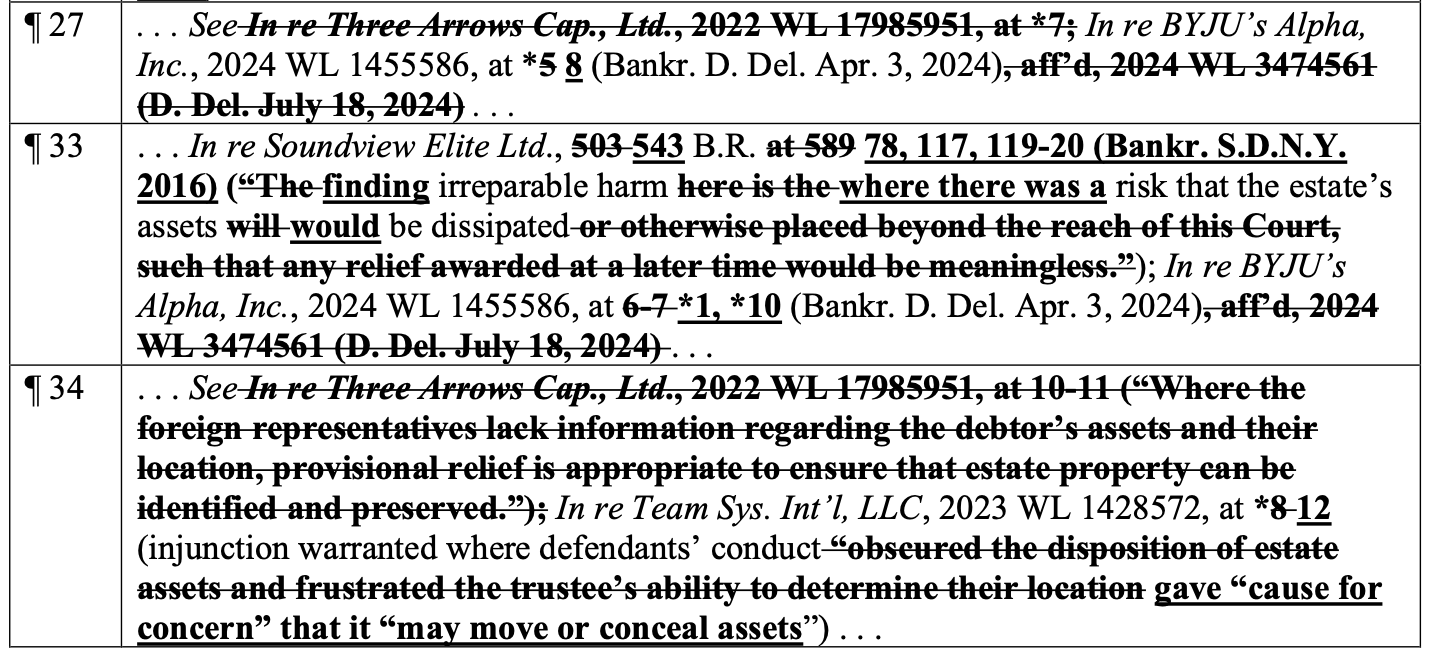
Schedule
A
to
the
letter
catalogs
the
damage
across
the
motion,
the
verified
petition,
the
joint
administration
motion,
the
scheduling
motion,
and
a
couple
of
declarations
—
roughly
40
corrections.
Some
substantive,
some
less
so,
all
embarrassing.
The
fixes
include
wrong
pin
cites,
wrong
volume
numbers,
parenthetical
quotes
that
just…
aren’t
in
the
cases.
Build
all
the
AI
policies
you
want,
but
there
is
no
substitute
for
having
a
human
—
preferably
multiple
humans
—
print
everything
out,
take
a
ruler
and
a
red
pen,
and
go
line
by
line
cross-checking
everything.
It’s
tedious
work
for
the
lawyers
and
expensive
work
for
the
clients,
but
it’s
better
than
having
to
write…
this
letter.
This
is
not
a
Sullivan
&
Cromwell
problem.
This
is
a
profession
problem.
We
have
been
covering
AI
hallucination
sanctions
cases
so
relentlessly
that
Damien
Charlotin
has
now
catalogued
over
a
thousand
of
them.
Tools
like
BriefCatch’s
RealityCheck
exist
specifically
because
firms
can’t
be
trusted
to
run
this
validation
themselves.
The
problem
cuts
across
the
law
firm
equivalent
of
class
lines.
It’s
not
just
overwhelmed
solo
practitioners
or
overeager
mid-tier
firms
looking
to
punch
above
their
weight.
Every
firm
will
deal
with
this
soon
enough.
They
can
either
accept
that
using
AI
on
the
front
end
doesn’t
alleviate
the
back
end
labor
or
they
can
accept
writing
letters
to
judges
after
the
fact.
One
last
thing.
The
errors
in
the
Chissick
Declaration
include
Bluebook-style
corrections
to
citations
of
Amnesty
International
and
UN
human
rights
reports
about
forced
labor
and
trafficking
in
Cambodia.
Those
aren’t
AI
hallucinations,
but
the
simple
human
mistakes
that
arise
from
embracing
the
unhinged
rules
memorialized
in
the
Bluebook.
But
they
are
a
reminder
of
what
this
case
is
actually
about:
people
held
behind
barbed
wire
and
forced
to
run
pig-butchering
scams.
The
JPLs
are
trying
to
trace
billions
of
dollars
in
crypto
to
make
victims
whole.
They
need
a
recognition
order
to
do
it.
And
they
lost
a
couple
of
weeks
of
runway
because
S&C
didn’t
check
its
work.
(Check
out
the
full
letter
on
the
next
page…)
Earlier:
Has
AI
Managed
To
Make
Lawyers
Even
Dumber?
Biglaw
Firm
‘Profoundly
Embarrassed’
After
Submitting
Court
Filing
Riddled
With
AI
Hallucinations
Am
Law
100
Firm
Accused
Of
Filing
Brief
Riddled
With
AI
Hallucinations…
AGAIN!
Prosecutorial
Error:
‘AI
Hallucinations’
Are
Popping
Up
In
Criminal
Cases
New
Tool
Catches
AI
Hallucinations
In
Legal
Briefs
Understanding
AI
Hallucinations:
Making
Sure
You
Don’t
End
Up
At
The
Wrong
Stop
Legal
AI
Might
Be
Accurate…
And
Still
Not
Right
 Joe
Joe
Patrice is
a
senior
editor
at
Above
the
Law
and
co-host
of
Thinking
Like
A
Lawyer.
Feel
free
to email
any
tips,
questions,
or
comments.
Follow
him
on Twitter or
Bluesky
if
you’re
interested
in
law,
politics,
and
a
healthy
dose
of
college
sports
news.
Joe
also
serves
as
a
Managing
Director
at
RPN
Executive
Search.