
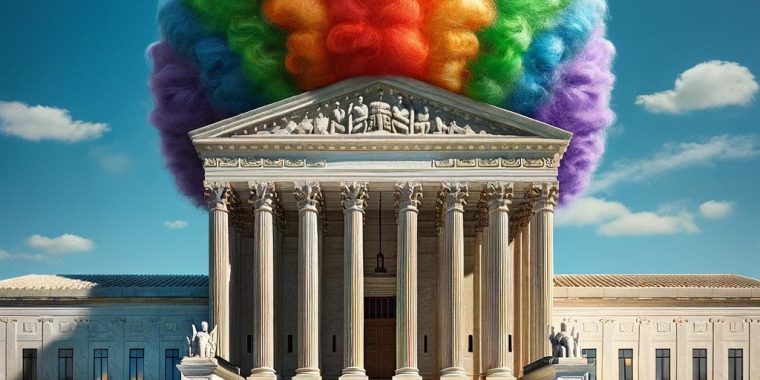

Today,
the
Supreme
Court
discovered
that
district
court
judges
have
no
power
to
issue
nationwide
injunctions.
It’s
a
brand
new
policy
they
unearthed
after
cheerfully
blessing
four
years
of
nationwide
injunctions
issued
by
some
wingnut
in
Amarillo.
Justice
Amy
Coney
Barrett’s
6-3
opinion
cabins
lower
federal
courts
to
issuing
relief
“to
the
plaintiffs
before
the
court.”
So
unless
you’re
willing
to
sue,
the
government
can
violate
your
rights
at
will.
The
six
conservatives
made
this
miraculous
discovery
in
Trump
v.
CASA,
a
challenge
to
President
Trump’s
executive
order
banning
birthright
citizenship.
And
the
president
wasted
no
time
celebrating
his
victory
over
the
Fourteenth
Amendment.
Suck
it,
Wong
Kim
Ark!
The
Supreme
Court
greenlit
the
administration’s
plans
to
deny
social
security
numbers
and
passports
to
thousands
of
American
citizens.
They’ll
decide
whether
that’s
legal
some
time
next
year.
Justice
Barrett
insists
that
plaintiffs
are
no
worse
off
than
they
were
yesterday:
“Here,
prohibiting
enforcement
of
the
Executive
Order
against
the
child
of
an
individual
pregnant
plaintiff
will
give
that
plaintiff
complete
relief:
Her
child
will
not
be
denied
citizenship.”
But
with
respect
to
the
rest
of
the
country,
“[e]xtending
the
injunction
to
cover
all
other
similarly
situated
individuals
would
not
render
her
relief
any
more
complete.”
So,
unless
and
until
each
and
every
undocumented
pregnant
person
in
the
country
files
a
lawsuit
—
conveniently
outing
herself
as
someone
to
be
deported
post
haste
—
federal
courts
are
powerless
to
stop
the
Trump
administration
from
violating
the
Constitution.
The
opinion
is
larded
with
a
waxy
coating
of
originalism,
rhetorical
vaseline
on
the
lens,
softening
the
gross
illegality
and
abject
cruelty
that
is
the
conservative
project.
The
issue
isn’t
un-personing
babies,
but
rather “whether
universal
injunctions
are
sufficiently
‘analogous’
to
the
relief
issued
by
the
High
Court
of
Chancery
in
England”
in
1798.
And
—
oh,
too
bad!
—the
answer
they
came
up
with
was
that
the
“bill
of
peace”
used
by
a
bunch
of
dudes
in
powdered
wigs
in
the
18th
century
to
issue
nationwide
injunctions
isn’t
quite
close
enough
to
count.
Writing
for
the
Court’s
liberal
dissenters,
Justice
Ketanji
Brown
Jackson
ripped
the
majority’s
deliberate
use
of
“legalese”
as
a
“smokescreen”
designed
to
mask
the
“far
more
basic
question
of
enormous
legal
and
practical
significance:
May
a
federal
court
in
the
United
States
of
America
order
the
Executive
to
follow
the
law?”
Apparently
not.
She
also
notes
that
the
majority
was
so
busy
on
its
field
trip
to
Ye
Old
Englande,
that
it
couldn’t
be
bothered
with
the
threshold
question
of
whether
the
government
met
its
burden
to
justify
the
“extraordinary
relief”
of
staying
a
lower
court’s
order:
likelihood
of
success
on
the
merits
and
“irreparable
harm”
in
the
interim
absent
such
relief.
The
majority
devotes
exactly
one
sentence
to
that
question
in
its
30-page
opinion,
asserting
that
universal
injunctions
“improperly
intrude”
on
the
executive
branch
by
preventing
the
government
from
“enforcing
its
policies
against
nonparties.”
As
Justice
Sotomayor
points
out,
the
government
has
no
right
to
enforce
an
unconstitutional
policy
against
anyone,
regardless
as
to
whether
or
not
that
person
is
a
party
before
the
court
or
not.
“Suppose
an
executive
order
barred
women
from
receiving
unemployment
benefits
or
black
citizens
from
voting,”
she
asks.
“Is
the
Government
irreparably
harmed,
and
entitled
to
emergency
relief,
by
a
district
court
order
universally
enjoining
such
policies?
The
majority,
apparently,
would
say
yes.”
The
majority,
in
fact,
said
nothing
at
all,
handwaving
away
the
question
of
whether
the
birthright
citizenship
order
is
unconstitutional
as
“not
before
us,”
and
therefore
“we
take
no
position
on
whether
the
dissent’s
analysis
is
right.”
Indeed,
they
seem
wholly
uninterested
in
ensuring
that
the
president
follow
the
law
at
all.
“No
one
disputes
that
the
Executive
has
a
duty
to
follow
the
law,”
Justice
Barrett
chides
the
dissent.
“But
the
Judiciary
does
not
have
unbridled
authority
to
enforce
this
obligation—in
fact,
sometimes
the
law
prohibits
the
Judiciary
from
doing
so.”
In
support
of
this
proposition,
she
cites
Marbury
v.
Madison.
Oh,
you
thought
the
holding
of
that
case
was
that
“It
is
emphatically
the
province
and
duty
of
the
judicial
department
to
say
what
the
law
is?”
Well,
not
any
more.
Liz
Dye
and
Andrew
Torrez
produce
the
Law
and
Chaos Substack
and podcast.