

courtesy
of
AffiniPay.
Managing
client
funds
is
one
of
the
most
critical
responsibilities
a
law
firm
faces.
Mismanaging
trust
accounts
can
lead
to
ethics
violations,
financial
penalties,
or
even
disbarment.
That’s
why
a
thorough
understanding
of
trust
accounting
and
the
implementation
of
three-way
reconciliation
practices
are
non-negotiable.
In
this
post,
we’ll
walk
through
the
essential
three-way
reconciliation
process
and
explore
how
modern
legal
software
helps
law
firms
stay
compliant,
efficient,
and
audit-ready.
What
Is
Trust
Accounting?
Trust
accounting
refers
to
the
proper
management
of
funds
held
in
trust
on
behalf
of
a
client.
This
typically
occurs
when
a
law
firm
receives
an
advance
retainer
or
settlement
funds
that
don’t
yet
belong
to
the
firm.
These
funds
are
placed
into
a
separate
client
trust
account—often
referred
to
as
an
IOLTA
(Interest
on
Lawyers’
Trust
Accounts)
account.
The
cardinal
rule
of
trust
accounting
is
simple:
no
commingling.
Client
trust
funds
must
always
be
kept
separate
from
the
firm’s
operating
funds.
Any
earned
fees,
expense
reimbursements,
or
withdrawals
must
be
meticulously
documented
and
only
made
when
properly
invoiced
or
authorized.
To
ensure
compliance,
firms
are
expected
to
maintain
detailed
records
for
every
transaction,
including:
-
The
amount
received -
The
client
associated
with
the
funds -
The
purpose
of
the
deposit -
The
dates
and
details
of
any
disbursements
Legal-specific
accounting
software
simplifies
this
process
by
automatically
categorizing
transactions
and
assigning
them
to
individual
client
ledgers.
Why
Trust
Accounting
Matters
The
stakes
for
getting
trust
accounting
wrong
are
high.
Many
state
bars
conduct
random
audits,
and
any
discrepancies
can
result
in
disciplinary
action.
According
to
the
2025
Legal
Industry
Report,
49%
of
firms
cite
trust
accounting
as
a
moderate
or
significant
challenge,
and
61%
report
challenges
with
accounting
overall.
The
complexity
and
compliance
burden
are
real,
especially
for
small
or
solo
practices
juggling
multiple
responsibilities.
The
good
news?
With
the
right
processes
and
tools
in
place,
firms
can
turn
trust
accounting
into
a
strength
rather
than
a
liability.
Three-Way
Reconciliation:
A
Monthly
Must
One
of
the
most
effective
ways
to
maintain
accurate
trust
accounting
is
through
three-way
reconciliation.
This
practice
ensures
the
law
firm’s
trust
records
are
accurate
and
aligned
with
actual
bank
balances.
It
involves
cross-checking
three
key
elements:
-
Trust
Account
Bank
Statement:
What
your
financial
institution
reports -
Firm
Trust
Ledger:
The
internal
accounting
record
of
all
trust
activity -
Client
Trust
Ledger:
Sub-ledgers
showing
individual
client
balances
The
total
of
all
client
sub-ledgers
should
exactly
match
both
the
firm’s
trust
ledger
and
the
adjusted
bank
balance.
Any
discrepancies,
such
as
outstanding
checks
or
bank
fees,
must
be
identified
and
documented.
The
process
should
be
conducted
monthly,
though
some
jurisdictions
allow
quarterly
reconciliation.
It
should
also
be
accompanied
by
clear
documentation
and
sign-offs
to
satisfy
audit
requirements.
How
Software
Simplifies
Reconciliation
Traditionally,
three-way
reconciliation
was
handled
using
spreadsheets
and
manual
calculations,
a
process
that
is
both
time-consuming
and
error-prone.
Today,
legal
accounting
software
like
MyCase
can
automate
much
of
this
work.
With
MyCase
Accounting,
firms
benefit
from:
-
Auto-matched
transactions
to
the
trust
bank
feed -
Real-time
client
and
matter
balances -
Integrated
trust
payment
workflows -
Instant
reconciliation
reports
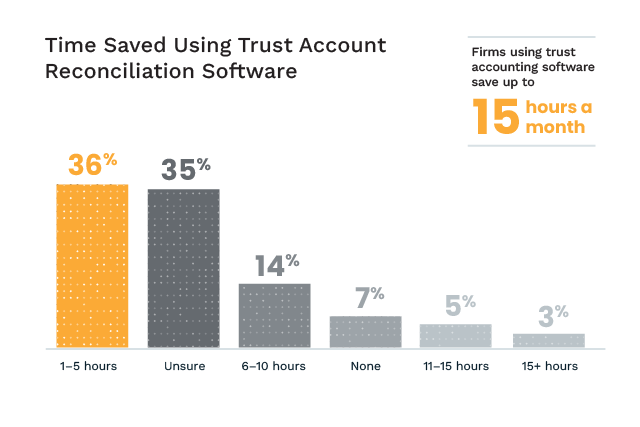
Data
from
the
2025
Legal
Industry
Report
found
that
firms
using
trust
accounting
software
save
up
to
15
hours
per
month.
Specifically,
36%
reported
saving
1
to
5
hours
monthly,
and
14%
saved
6
to
10
hours—a
powerful
endorsement
for
digital
tools
that
reduce
manual
entry
and
improve
compliance.
Best
Practices
for
Trust
Accounting
&
Reconciliation
To
ensure
your
firm
is
compliant
and
efficient,
follow
these
key
trust
accounting
best
practices:
-
Separate
Accounts:
Use
distinct
accounts
for
client
funds
and
operating
expenses.
For
large
or
long-term
matters,
consider
opening
separate
trust
accounts. -
Document
Everything:
Always
include
a
memo
or
reference
for
each
deposit
or
withdrawal.
Save
receipts,
client
instructions,
and
invoices. -
Reconcile
Monthly:
Even
if
not
required
in
your
jurisdiction,
monthly
reconciliation
is
a
best
practice
that
ensures
no
errors
go
unchecked. -
Avoid
Bank
Fees:
Ensure
your
trust
account
agreement
does
not
specify
service
charges,
overdrafts,
or
bounced
check
fees. -
Assign
Responsibility:
Delegate
trust
reconciliation
to
a
specific
person
(or
team),
and
require
dual
review
for
added
oversight. -
Use
Legal-Specific
Software:
Platforms
like
MyCase
help
reduce
human
error,
streamline
workflows,
and
automatically
track
compliance
tasks.
Streamlining
Trust
Management
With
MyCase
Trust
accounting
can
feel
intimidating,
but
it
doesn’t
have
to
be.
By
understanding
the
basics,
embracing
three-way
reconciliation,
and
using
the
right
tools,
firms
can
build
trust
with
clients
and
regulators
alike.
With
software
like
MyCase,
your
firm
can
streamline
compliance,
reduce
risk,
and
save
hours
every
month,
so
you
can
focus
on
what
matters
most:
practicing
law.
Want
to
see
how
you
can
transform
your
trust
accounting
with
MyCase?
Schedule
a
demo
today.