
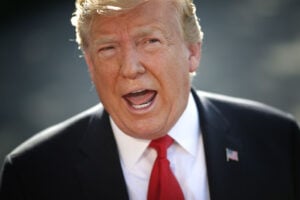
by
Win
McNamee/Getty
Images)
Donald
Trump
signed
an
executive
order
yesterday
purporting
to
block
states
from
artificial
intelligence
regulation.
Can
a
president
unilaterally
invent
new
laws
and
then
assert
that
this
counts
as
occupying
the
field
to
then
preempt
state
laws?
No,
of
course
not.
But
he
issued
the
order
anyway
because
this
administration
is
itself
a
hallucination
engine
stochastically
vomiting
out
orders.
And
the
public
is
troublingly
dumb
enough
to
think
executive
orders
can
create
policy
out
of
thin
air.
Let
us
endeavor
to
redline
this
unlawful
gibberish,
since
there
does
not
appear
to
be
a
competent
attorney
within
the
White
House
orbit
capable
of
doing
so:
Section 1. Purpose.
United
States
leadership
in
Artificial
Intelligence
(AI)
will
promote
United
States
national
and
economic
security
and
dominance
across
many
domains.
This
is
marketing
fluff
that
would
make
Sam
Altman
blush,
but
let’s
give
Trump
credit
where
it’s
due:
introducing
AI
to
national
security
already
successfully
flagged
Pete
Hegseth
as
a
war
criminal
so
maybe
the
technology
does
bring
something
to
the
table.
My
Administration
has
already
done
tremendous
work
to
advance
that
objective,
including
by
updating
existing
Federal
regulatory
frameworks
to
remove
barriers
to
and
encourage
adoption
of
AI
applications
across
sectors.
These
efforts
have
already
delivered
tremendous
benefits
to
the
American
people
and
led
to
trillions
of
dollars
of
investments
across
the
country.
As
a
reminder,
the
“trillions
of
dollars
of
investments”
he’s
talking
about
are
mostly
on
paper
IOUs
passed
around
a
perfect
circle.
At
the
center
of
the
Ouroboros
of
Suck
sits
NVIDIA,
the
company
that
holds
the
entire
U.S.
economy
afloat
right
now.
The
media
covers
it
every
time
NVIDIA
throws
a
life
preserver
to
drowning
AI
companies,
but
rarely
point
out
that
the
money
is
mostly
as
hallucinatory
as
the
AI
results.
As
Ed
Zitron
summed
it
up:
You’ve
likely
seen
a
few
ridiculous
headlines
recently.
One
of
the
most
recent,
and
most
absurd,
is
that
that OpenAI
will
pay
Oracle
$300
billion
over
four
years,
closely
followed
with
the
claim
that NVIDIA
will
“invest”
“$100
billion”
in
OpenAI
to
build
10GW
of
AI
data
centers,
though
the
deal
is
structured
in
a
way
that
means
that
OpenAI
is
paid
“progressively
as
each
gigawatt
is
deployed,”
and OpenAI
will
be
leasing
the
chips
(rather
than
buying
them
outright).
I
must
be
clear
that
these
deals are
intentionally
made
to
continue
the
myth
of
generative
AI,
to
pump
NVIDIA, and
to
make
sure
OpenAI
insiders
can
sell
$10.3
billion
of
shares.OpenAI
cannot
afford
the
$300
billion,
NVIDIA
hasn’t
sent
OpenAI
a
cent
and
won’t
do
so
if
it
can’t
build
the
data
centers, which
OpenAI
most
assuredly
can’t
afford
to
do.
That
said,
if
there’s
anyone
who
understands
claiming
with
conviction
that
something
is
worth
more
than
it
actually
is
on
financial
reports
it’s
Donald
Trump.
Indeed,
Trump
has
multiple
convictions
to
that
effect.
To
win,
United
States
AI
companies
must
be
free
to
innovate
without
cumbersome
regulation.
But
excessive
State
regulation
thwarts
this
imperative.
China
is
a
totalitarian
state
and
they’ve
already
built
a
better
product
in
DeepSeek
—
as
long
as
you
don’t
ask
it
any
questions
about
Tibet
—
so
some
state
guardrails
against
Sora
generating
child
porn
aren’t
going
to
grind
AI
development
to
a
halt.
First,
State-by-State
regulation
by
definition
creates
a
patchwork
of
50
different
regulatory
regimes
that
makes
compliance
more
challenging,
particularly
for
start-ups.
Remember
when
these
guys
couldn’t
shut
up
about
states’
rights?
It’s
almost
as
though
that
was
more
about
pushing
neo-segregation
than
an
honest
commitment
to
federalism.
Weird.
Second,
State
laws
are
increasingly
responsible
for
requiring
entities
to
embed
ideological
bias
within
models.
For
example,
a
new
Colorado
law
banning
“algorithmic
discrimination”
may
even
force
AI
models
to
produce
false
results
in
order
to
avoid
a
“differential
treatment
or
impact”
on
protected
groups.
My
guy,
AI
does
not
need
any
help
producing
false
results.
In
fact,
the
Colorado
law
at
issue
is
about
preventing
false
results
given
that
algorithms
are
uniquely
prone
to
garbage
in/garbage
out
bias.
Third,
State
laws
sometimes
impermissibly
regulate
beyond
State
borders,
impinging
on
interstate
commerce.
That’s…
not
impermissible.
Congress
can
exercise
its
authority
to
regulate
interstate
commerce,
but
that
doesn’t
mean
—
absent
congressional
action
—
that
states
are
barred
from
passing
laws
that
can
have
knock
on
effects
beyond
their
borders.
“Sometimes”
is
carrying
a
lot
of
water
here
and
the
order
isn’t
making
any
effort
to
show
its
work.
My
Administration
must
act
with
the
Congress
to
ensure
that
there
is
a
minimally
burdensome
national
standard
—
not
50
discordant
State
ones.
The
“must
act
with
the
Congress”
part
is
critical.
Because,
you
know,
they
make
laws
and
executive
orders
DO
NOT
MAKE
LAWS.
This
is
Schoolhouse
Rock
shit.
That
said,
there’s
a
certain
symbolic
beauty
to
the
way
this
order
tracks
the
very
problems
with
AI
that
everyone’s
trying
to
regulate.
Christine
Lemmer-Webber
is
credited
with
calling
generative
AI
“mansplaining
as
a
service”
and
here
we
have
an
executive
order
that’s
all
confidence
and
buzzwords
while
managing
to
be
completely
wrong
about
everything.
That
framework
should
also
ensure
that
children
are
protected…
Sure.
censorship
is
prevented…
Sort
of
the
exact
opposite
of
the
last
one.
copyrights
are
respected…
Too
late.
and
communities
are
safeguarded.
What
does
that
even
mean?
Until
such
a
national
standard
exists,
however…
There’s
no
“however”
here.
Until
Congress
sees
fit
to
draft
a
law
setting
this
“national
standard,”
the
president
cannot
do
one
goddamned
thing
about
it.
it
is
imperative
that
my
Administration
takes
action
to
check
the
most
onerous
and
excessive
laws
emerging
from
the
States
that
threaten
to
stymie
innovation.
And
even
if
the
president
could
impose
a
placeholder
law
while
Congress
dithers,
it
absolutely
cannot
cancel
state
laws
in
favor
of
that
new
made-up
law.
Trump
really
should
stick
to
the
white
supremacy
because
this
is
not
how
supremacy
works
in
a
Supremacy
Clause
sense.
It
does
not
read
“this
Constitution,
the
laws
of
the
United
States,
and
whatever
the
President
is
mad
about
on
Truth
Social
shall
be
the
supreme
law
of
the
land.”
He’s
acknowledging
that
there
is
no
existing
law
of
the
United
States
and
just
inventing
one
and
claiming
preemption.
The
Tenth
Amendment
says
the
total
opposite
of
this.
Within
30
days
of
the
date
of
this
order,
the
Attorney
General
shall
establish
an
AI
Litigation
Task
Force
(Task
Force)
whose
sole
responsibility
shall
be
to
challenge
State
AI
laws
inconsistent
with
the
policy
set
forth
in
section
2
of
this
order,
including
on
grounds
that
such
laws
unconstitutionally
regulate
interstate
commerce,
are
preempted
by
existing
Federal
regulations,
or
are
otherwise
unlawful
in
the
Attorney
General’s
judgment,
including,
if
appropriate,
those
laws
identified
pursuant
to
section
4
of
this
order.
No,
the
Attorney
General
cannot
challenge
state
laws
for
being
inconsistent
with
non-existent
federal
laws.
Nor
can
the
administration
withhold
congressionally
allocated
funds
from
states
in
retaliation
over
state
AI
regulations,
which
the
order
also
purports
to
do.
Not
that
the
Supreme
Court
has
shown
anything
to
suggest
they’d
stop
him.
Train
v.
City
of
New
York?
This
Court
ignores
way
bigger
precedents
than
that
on
the
regular!
To
be
clear,
if
this
were
challenged,
the
Court
wouldn’t
rule
in
Trump’s
favor
—
because
that
might
empower
a
future
Democratic
president
—
and
would
just
fire
off
a
shadow
docket
opinion
allowing
Trump
to
do
it
indefinitely.
Nor
can
any
of
the
other
federal
flunkies
he
identifies
in
the
order
—
Commerce,
the
FTC,
or
the
Special
Advisor
for
AI
and
Crypto
and
Unicorn
Farts
—
preempt
state
laws.
The
order
gives
some
lip
service
to
a
creative
executive
agency
concocting
an
argument
for
AI
falling
under
otherwise
existing
regulations,
which
would
be
a
fair
executive
order
power,
but
there’s
not
much
of
an
argument
for
how
a
law
banning
AI
from
being
used
to
deepfake
naked
celebrities
constitutes
the
state
making
the
AI
provider
engage
in
a
deceptive
commercial
practice.
There
just
aren’t
any
existing
hooks
to
credibly
hang
this
preemption
effort.
Tech
policy
researchers
have
already
noted
the
Trump
administration
cannot
restrict
state
regulation
this
way
without
Congress
passing
a
law.
OpenAI
has
acknowledged
that
“federal
preemption
over
existing
or
prospective
state
laws
will
require
an
act
of
Congress.”
Hell,
STEVE
BANNON
says,
“”David
Sacks
having
face-planted
twice
on
jamming
AI
Amnesty
into
must-pass
legislation
now
completely
misleads
the
President
on
preemption.”
So
we’re
all
in
agreement
here
except
the
Dunning-Kruger-in-Chief
occupying
the
White
House.
When
AI
hallucinates,
it
at
least
has
the
decency
to
admit
it’s
wrong
when
called
out.
When
the
executive
branch
does
it,
apparently
we
just
call
it
policy.
 Joe
Joe
Patrice is
a
senior
editor
at
Above
the
Law
and
co-host
of
Thinking
Like
A
Lawyer.
Feel
free
to email
any
tips,
questions,
or
comments.
Follow
him
on Twitter or
Bluesky
if
you’re
interested
in
law,
politics,
and
a
healthy
dose
of
college
sports
news.
Joe
also
serves
as
a
Managing
Director
at
RPN
Executive
Search.