
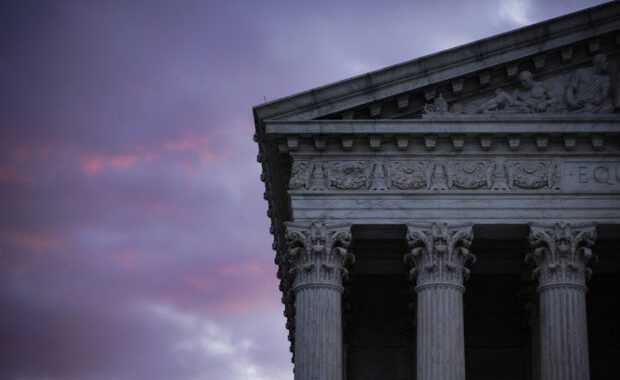
Samuel
Corum/Bloomberg)
Donald
Trump
has
never
been
big
on
the
word
“no.”
Courts
have
taken
judicial
notice
of
this
fact.
So
when
the
Supreme
Court
went
out
of
its
way
to
issue
a
little
“advisory
opinion
dicta,”
informing
the
president
that
even
his
puppet
majority
wouldn’t
go
along
with
him
firing
the
Federal
Reserve
Board,
it
was
only
a
matter
of
time
before
Trump
did
exactly
that
and
dared
the
Court
to
resist.
And
now,
we’re
here.
Earlier
today,
the
Trump
administration
filed
an
application
asking
the
Supreme
Court
to
allow
him
to
issue
an
injunction,
allowing
him
to
fire
Fed
governor
Lisa
Cook.
Back
in
May,
while
deciding
another
stay
boiling
down
to
whether
Trump
can
unilaterally
remove
NLRB
commissioners,
in
spite
of
clear
protections
from
politically
motivated
firings,
the
Court
brushed
off
the
statutory
“for
cause”
provisions,
claiming
that
Article
II
gave
the
president
the
power
to
fire
anyone
exercising
any
executive
power.
But
this
ruling,
taken
to
its
logical
end,
authorized
the
president
to
fire
Federal
Reserve
Board
members,
including
Chair
Jerome
Powell.
This
wasn’t
an
idle
concern,
either,
as
Trump
had
been
whining
incessantly
about
wanting
to
be
rid
of
Powell
and
blasting
the
idiot
who
appointed
him.
Which
was
actually
Trump
himself,
but
this
is
what
happens
when
someone
with
clear
signs
of
dementia
occupies
the
Oval
Office.
To
avoid
watching
their
own
blue
chip
stock
portfolios
turn
into
a
bundle
of
NFTs
—
and
to
a
lesser
extent,
from
their
perspective,
“destroying
the
economy”
—
the
conservatives
threw
in
“out
of
the
blue”
as
Justice
Kagan
noted
in
dissent,
an
advisory
carve
out
for
the
Fed
on
the
grounds
that
“The
Federal
Reserve
is
a
uniquely
structured,
quasi-private
entity
that
follows
in
the
distinct
historical
tradition.”
At
which
point,
the
White
House
began
plotting
how
it
would
grab
the
Court
by
the
proverbial
genitals.
The
administration
found
its
test
case
in
Lisa
Cook.
The
Director
of
the
Federal
Housing
Finance
Agency,
William
Pulte
—
who
has
so
far
done
very
little
“directing
of
federal
housing
finance”
and
a
whole
lot
of
“combing
the
financial
records
of
Trump’s
personal
enemies
looking
for
typos”
—
discovered
what
he
claimed
were
two
mortgage
applications
filled
out
by
Cook
that
listed
two
separate
properties
as
a
primary
residence.
Upon
investigation,
this
accusation
appears
to
be
false,
but
Trump
didn’t
wait
for
any
fact-finding
before
writing
Cook
to
tell
her
he
was
firing
her
“for
cause,”
claiming
that
such
a
financial
screw-up
would
undermine
public
trust
in
an
official
with
power
over
the
economy.
Trump’s
Secretary
of
the
Treasury
also
apparently
filed
contradictory
residence
pledges
on
mortgage
documents.
His
lawyer,
the
ubiquitous
Alex
Spiro,
denies
the
report,
but
given
that
an
unsubstantiated
claim
against
Cook
was
all
it
took
for
Trump
to
claim
an
erosion
of
public
trust,
the
Treasury
Secretary
still
having
a
job
speaks
to
an
arbitrary
and
capricious
executive.
The
lower
courts
have
all
agreed
that
Cook
should
keep
her
job
in
the
interim,
since
Trump’s
argument
that
he
can
fire
a
Fed
governor
over
this
rates
between
flimsy
and
none.
In
a
disingenuous
nod
to
the
earlier
Court
ruling,
the
brief
notes
specifically
that
the
administration
“does
not
contest
the
constitutionality
of
the
Federal
Reserve
Board’s
for-cause
removal
provision.”
Cold
comfort,
to
be
sure.
There’s
an
old
Winston
Churchill
story
that
he
once
asked
a
gentlelady
if
she’d
have
sex
with
him
for
a
million
pounds.
After
she
said,
“yes,”
he
asked
if
she
would
do
it
for
one
pound
and
when
she
asked
if
he
took
her
for
a
whore,
he
replied
that
they’d
already
established
what
she
was
and
were
now
haggling
over
the
price.
Well,
the
Chief
Justice
already
knows
he’s
a
whore,
so
he
should
recognize
this
submission
as
haggling.
The
administration
will
live
with
“for
cause”
provisions
as
long
as
the
Supreme
Court
whittles
the
standard
down
to
allow
any
pretext
—
no
matter
how
minor
or
remote
in
time
—
to
count
as
“for
cause.”
If
the
Court
accedes
to
this
request,
expect
Jay
Powell
to
learn
that
the
administration
thinks
the
Fed’s
office
renovation
“undermines
public
trust
in
the
agency.”
(Fun
fact:
that
renovation
budget
ballooned
because
the
first
Trump
administration
demanded
a
design
with
more
marble
than
the
simple
steel
and
glass
design
the
Federal
Reserve
intended.)
In
addition,
what
type
of
hearing
does
the
Due
Process
Clause
require?
Must
the
President
preside
himself,
or
may
he
delegate
that
task
to
subordinates?
Must
he
hold
a
formal
evidentiary
hearing,
or
does
an
informal
discussion
suffice?
Which
is
all
to
say,
“even
if
we
must
respect
a
‘for
cause’
provision,
we
reject
the
notion
that
the
president
would
be
required
to
defend
the
claim.”
It’s
at
will
employment
with
extra
steps,
exactly
what
the
Supreme
Court
claimed
—
a
few
months
ago
—
the
history
and
tradition
of
the
United
States
did
not
countenance.
But
Article
II
creates
“an
energetic,
independent
Executive,”
Trump
v.
United
States,
603
U.S.
593,
642
(2024)—not
a
subservient
Executive
that
must
follow
judicially
invented
procedures
even
when
exercising
core
executive
power.
It’s
a
glib
way
to
answer
this
claim,
but
there’s
a
reason
it’s
Article
TWO.
The
Framers’
pretty
clearly
understood
the
Constitution
to
create
a
limited,
subservient
Executive
constrained
by
the
power
of
Congress.
There
may
be
good
justification
for
a
modern
society
to
afford
the
Executive
branch
more
power
than
the
Framers
would’ve
envisioned,
but
it’s
a
bald-faced
lie
to
claim
“Article
II”
created
that
spin
on
the
office.
But
this
Supreme
Court
set
that
standard,
and
now
we’re
living
in
the
wake
of
those
vibes.
Anyway,
that’s
what
this
petition
is
about.
Pretending,
with
one
hand,
to
respect
the
“for
cause”
protections
insulating
the
Fed,
while
using
the
other
hand
to
demand
unfettered
executive
power.
To
back
up
this
argument,
Solicitor
General
Sauer
cites…
a
whole
lot
of
dissents.
Indeed,
mostly
the
dissent
written
by
Judge
Gregory
Katsas
in
this
very
case.
When
he
needs
to
find
some
actual
binding
caselaw
to
cite,
he
litters
the
brief
with
a
bunch
of
cases
from
the
1800s
when
Andrew
Jackson
was
still
threatening
to
duel
the
Supreme
Court.
Normally,
someone
intervenes
to
explain
that
a
brief
based
on
dissents
and
19th
century
precedent
(which,
notably
predates
the
Fed
itself)
before
that
lawyer
finishes
their
summer
associate
gig
—
and
in
any
event,
before
they
become
Solicitor
General
of
the
United
States.
But
here
we
are.
This
is
a
crisis
of
the
Court’s
own
making.
Had
it
stuck
to
precedent
and
applied
the
law
as
the
judiciary
had
recognized
it
for
decades
upon
decades,
it
would’ve
shut
down
Trump’s
attempt
to
fire
commissioners
from
all
the
statutorily
established
independent
agencies
and
wouldn’t
have
to
be
worried
about
Trump
taking
over
monetary
policy
and
turning
the
U.S.
economy
into
a
carbon
copy
of
Turkey’s.
Though,
as
Mayor
Eric
Adams
might
say,
in
many
ways,
Washington
D.C.
is
the
Ankara
of
the
America.
But
the
extremists
got
greedy.
They
couldn’t
abide
by
a
world
where
Trump
might
have
to
slow
down
while
bulldozing
labor
rights
or
consumer
protection
laws,
so
they
invented
a
new
standard
of
broad
authority
and
thought
they
could
carve
out
the
one
exception
they
wanted
with
an
aside
buried
in
a
shadow
docket
opinion.
It
turns
out,
that’s
not
how
it
works
when
dealing
with
someone
willing
to
send
a
mob
into
the
Capitol
when
he’s
mad
about
losing
an
election.
They
crafted
a
dubious
exemption,
and
the
administration
intends
to
put
them
to
defending
the
indefensible.
We’re
haggling
over
the
price.
The
Republican
justices
just
received
Donald
Trump’s
one
dollar
bid.
(Check
out
the
petition
on
the
next
page…)
 Joe
Joe
Patrice is
a
senior
editor
at
Above
the
Law
and
co-host
of
Thinking
Like
A
Lawyer.
Feel
free
to email
any
tips,
questions,
or
comments.
Follow
him
on Twitter or
Bluesky
if
you’re
interested
in
law,
politics,
and
a
healthy
dose
of
college
sports
news.
Joe
also
serves
as
a
Managing
Director
at
RPN
Executive
Search.