
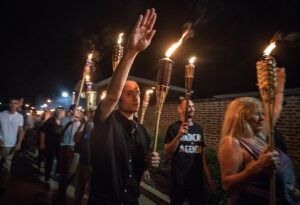
by
Evelyn
Hockstein/For
The
Washington
Post
via
Getty
Images)
Running
a
confidential
informant
program
inside
hate
groups
is
expensive
and
dangerous
work.
For
about
four
decades,
the
Southern
Poverty
Law
Center
has
done
it
anyway.
Its
work
contributed
to
the
dismantling
of
the
Ku
Klux
Klan
as
a
political
force.
The
SPLC’s
work
is
so
important
that
it
routinely
shared
what
it
learned
with
the
FBI.
On
Tuesday,
the
Trump
Justice
Department
indicted
them
for
it.
A
federal
grand
jury
in
the
Middle
District
of
Alabama
returned
an
11-count
indictment
charging
the
SPLC
with
six
counts
of
wire
fraud,
four
counts
of
false
statements
to
a
federally
insured
bank,
and
one
count
of
conspiracy
to
commit
concealment
money
laundering.
Acting
Attorney
General
Todd
Blanche,
taking
a
break
from
shielding
Epstein’s
sex
trafficking
network
from
public
scrutiny,
announced
the
charges
alongside
FBI
Director
Kash
Patel,
whose
flimsy
defamation
lawsuit
against
The
Atlantic
has
earned
him
the
online
nickname
of
“J.
Edgar
Boozer.”
“The
SPLC
is
manufacturing
racism
to
justify
its
existence,”
Blanche
told
the
cameras.
“Using
donor
money
to
allegedly
profit
off
Klansmen
cannot
go
unchecked.”
Of
note,
the
federal
government,
through
the
DOJ
and
FBI
specifically,
have
also
paid
confidential
informants
inside
hate
groups.
Does
the
Trump
administration
manufacture
racism
to
justify
its
existence?
OK,
well,
yeah.
But
they
don’t
do
it
by
investigating
hate
groups.
Indeed,
under
Harmeet
Dhillon’s
leadership
of
the
DOJ’s
Civil
Rights
Division,
its
unclear
whether
the
DOJ
even
keeps
passing
tabs
on
hate
groups
at
this
point.
Ah.
Yes.
Grand
juries
famously
go
out
and
draft
their
own
legal
theories
from
scratch
as
opposed
to
ratify
charges
that
the
DOJ
drafts.
Blanche
is
so
allergic
to
responsibility
he
won’t
even
take
credit
for
a
prosecution
he’s
holding
a
grandstanding
press
conference
to
tout.
Contrary
to
Blanche’s
thesis,
the
Ku
Klux
Klan,
the
National
Socialist
Movement,
the
National
Alliance,
or
the
Aryan
Nations-affiliated
Sadistic
Souls
Motorcycle
Club
—
all
groups
named
in
the
indictment
—
all
got
into
the
white
supremacist
business
with
zero
help
from
a
civil
rights
nonprofit.
It’s
a
beloved
reactionary
fairy
tale
that
all
these
hate
groups
wouldn’t
exist
if
it
weren’t
for
lefty
agitators
like
the
SPLC
propping
them
up
to
keep
the
donations
flowing.
It’s
a
convenient
story
for
conservatives,
because
it
allows
them
to
pawn
off
responsibility
for
the
right-wing
domestic
terrorists
living
comfortably
under
the
Republican
Party
platform
(and
collecting
the
Trump
administration’s
pardons
and
conviction
purges).
When
it
comes
to
the
SPLC,
the
conservative
movement
wants
to
have
its
cake
and
eat
it
too.
The
civil
rights
group
is
supposedly
the
real
mastermind
behind
universally
reviled
hate
groups
like
the
Klan,
but
when
the
SPLC
flags
hate
groups
like
the
Alliance
Defending
Freedom,
the
organization
is
just
“attacking”
innocent
conservatives.
The
group,
we’re
intended
to
believe,
is
simultaneously
nefarious
and
clueless.
But
therein
lies
the
real
motive
behind
this
broadside
against
the
SPLC.
There
was
a
day
when
the
Republican
Party
tried
to
keep
the
most
radical
of
right-wing
bigots
at
arms
length.
Over
the
years,
and
accelerated
by
the
Trump
MAGA
approach,
the
GOP
has
embraced
support
from
more
radical
collections
of
bigots.
Groups
like
the
ADF
don’t
appreciate
the
well-known
“SPLC
designated
hate
group”
brand,
and
the
administration
wants
to
make
the
SPLC
pay
for
it.
The
wire
fraud
statute
—
a
law
with
enough
malleability
to
shame
Reed
Richards
—
is
being
invoked
to
claim
the
SPLC’s
donors
were
defrauded
because
they
gave
money
for
general
civil-rights-y
representations,
but
the
SPLC
spent
some
of
it
on
paid
informants
embedded
in
violent
extremist
groups.
The
DOJ
argues
that
the
SPLC
kept
those
payments
off
the
books,
routed
through
shell
companies,
to
keep
donors
in
the
dark,
as
opposed
to,
for
example,
KEEPING
THOSE
SOURCES
ALIVE.
Grand
Wizard:
Hey,
Cletus,
what’s
that
check
you’ve
got
there?
Cletus:
Oh,
um,
this
one…
it’s
nothing.
Grand
Wizard:
Why
does
it
say
“Southern
Poverty
Law
Center?”
Understanding
why
this
would
be
a
poor
strategy
is
beyond
Kash
Patel’s
crackerjack
sleuthing
skills.
If
you
donated
money
to
the
Southern
Poverty
Law
Center
and
did
not
think
that
it
supported
gathering
inside
intelligence
on
hate
groups,
then
you
are
a
special
kind
of
naive.
The
SPLC’s
dossiers
on
these
groups
establish
that
they’ve
got
more
information
on
these
secretive
groups
than
a
Wikipedia
search
turns
up.
This
“undisclosed
to
donors”
framing
only
works
if
you
assume
a
reasonable
person
donating
to
an
organization
known
for
infiltrating
hate
groups
expects
a
line-item
disclosure
of
how
much
it
spends
every
year
on
confidential
informants
in
each
specific
organization.
Patel
was
pointedly
asked
at
the
presser
about
the
SPLC
sharing
information
with
law
enforcement.
He
shrugged
that
he
was
“not
surprised”
the
SPLC
“never
told
anybody
that
they
were
paying
off
the
Ku
Klux
Klan.”
This
is
not
an
answer
the
actual
question
posed,
and
that
was
almost
certainly
by
design.
Of
course,
as
SPLC’s
interim
CEO
Bryan
Fair
pointed
out,
the
organization
“frequently
shared
what
we
learned
from
informants
with
local
and
federal
law
enforcement,
including
the
FBI.”
In
bringing
this
prosecution,
the
DOJ
is
burning
a
long-standing,
successful
vector
of
actionable
intelligence
into
hate
groups
in
order
to
kneecap
a
civil
rights
organization.
It
fits
perfectly
within
Patel’s
publicly
stated
priority
to
pursue
social
media
buzz
over
terrorists.
In
reality,
Patel
is
well
aware
of
the
SPLC’s
cooperation
with
the
FBI.
He’s
even
got
a
draft
report
—
seen
by
CBS
News
—
laying
the
groundwork
to
claim
that
the
SPLC’s
intel
was
all
false
and
designed
to
hurt
“Christians”:
In
a
draft
report
from
a
task
force
on
“anti-Christian
bias”
that
CBS
News
has
seen,
Patel
accused
the
SPLC
and
the
Anti-Defamation
League
of
providing
the
bureau
with
“false
information.”
He
said
analysts
used
that
information
to
generate
an
internal
intelligence
memo
that
raised
concerns
about
a
possible
link
between
racially
or
ethnically
motivated
violent
extremists
and
radical
Catholic
ideology.
And
yet,
the
indictment
sure
seems
to
be
based
on
information
from
the
SPLC
that
the
DOJ
considers
very
reliable!
The
document
includes
details
about
the
activities
of
several
anonymized
informants
—
presumably
informants
that
the
government
is
leaning
on
to
flip
against
the
SPLC
—
and
it
strains
credulity
to
imagine
the
DOJ
uncovered
these
people
from
anything
but
information
the
SPLC
previously
conveyed
to
the
FBI.
F-9
was
affiliated
with
the
neo-Nazi
organization,
the
National
Alliance
and
served
as
an
F
for
the
SPLC
for
more
than
20
years.
F-9’s
activities
included
fundraising
for
the
National
Alliance.
Between
2014
and
2023,
the
SPLC
secretly
paid
F-9
more
than
$1,000,000.00.
In
2014,
F-9
entered
the
headquarters
of
a
violent
extremist
group
and
stole
25
boxes
of
their
documents.
F-9
coordinated
payment
for
the
copying
of
the
materials
with
a
high-level
SPLC
employee
who
had
knowledge
the
documents
had
been
stolen.
The
original
stolen
materials
were
returned
to
the
violent
extremist
group
in
a
second
illegal
entry
by
F-9.
Thereafter,
the
high-level
SPLC
employee
utilized
the
documents,
in
part,
as
the
basis
for
a
story
published
on
the
SPLC’s
Hatewatch
website
and
authored
by
the
employee.
Another
F,
F-39,
was
blamed
for
the
theft
and
was
paid
approximately
$6,000.00
by
the
SPLC
to
falsely
take
responsibility
for
the
theft.
That
sure
reads
like,
“the
SPLC
gave
the
FBI
these
documents
and
told
us
they’d
secured
them
from
an
informant,
and
that’s
how
we
know
they
have
an
informant
within
the
National
Alliance.”
Even
with
all
the
latitude
the
government
has
under
these
statutes,
the
legal
theory
outlined
in
the
indictment
is
tenuous.
But
this
is
beside
the
point,
because
even
if
this
case
eventually
collapses,
the
DOJ
already
got
what
it
came
for.
The
indictment
explicitly
puts
a
number
of
hate
groups
on
notice
that
they
have
moles
inside
their
organizations,
allowing
them
to
begin
reverse-engineering
the
identities
of
their
leaks.
The
DOJ
materially
improved
the
ability
of
these
hate
groups
to
operate
and
put
any
existing
informants
in
grave
danger.
Any
groups
not
included
in
the
indictment
will
also
take
a
hard
look
at
their
ranks
to
see
if
they’ve
got
informants
that
the
DOJ
missed.
Moreover,
the
indictment
serves
as
a
deterrent.
Anyone
currently
considering
turning
on
their
violent
extremist
group
or
contemplating
joining
a
group
to
help
expose
it
will
now
lack
both
a
financial
incentive
and
face
as
a
serious
disincentive
the
likelihood
that
the
Justice
Department
will
expose
them.
This
chilling
effect
is
a
feature
and
not
a
bug.
The
indictment
severely
curtails
the
SPLC’s
hate-mapping
work,
removing
an
irritant
for
groups
that
the
MAGA
movement
hopes
will
be
prepared
to
run
back
January
6.
But
there
is
one
encouraging
aspect
of
the
indictment:
F-37
was
a
member
of
the
online
leadership
chat
group
that
planned
the
2017
“Unite
the
Right”
event
in
Charlottesville,
Virginia
and
attended
the
event
at
the
direction
of
the
SPLC.
F-37
made
racist
postings
under
the
supervision
of
the
SPLC
and
helped
coordinate
transportation
to
the
event
for
several
attendees.
Between
2015
and
2023,
the
SPLC
secretly
paid
F-37
more
than
$270,000.00.
Oh.
The
administration
considers
the
Unite
the
Right
rally
organizers
a
hate
group
now?
A
little
bit
of
growth
from
“very
fine
people
on
both
sides,”
I
guess!
(Indictment
on
the
next
page…)
 Joe
Joe
Patrice is
a
senior
editor
at
Above
the
Law
and
co-host
of
Thinking
Like
A
Lawyer.
Feel
free
to email
any
tips,
questions,
or
comments.
Follow
him
on Twitter or
Bluesky
if
you’re
interested
in
law,
politics,
and
a
healthy
dose
of
college
sports
news.
Joe
also
serves
as
a
Managing
Director
at
RPN
Executive
Search.