
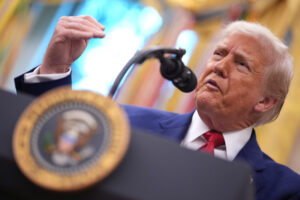
by
Andrew
Harnik/Getty
Images)
Since
the
start
of
the
Trump
II
reign,
and
the
attack
on
the
rule
of
law
that
coincided
with
that,
it’s
been
clear
that
Biglaw
wasn’t
going
to
be
our
savior.
When
directly
confronted
with
unconstitutional
Executive
Orders
targeting
firms
on
Trump’s
list
for
retribution,
more
than
twice
as
many
major
law
firm
were
willing
to
promise
the
president
nearly
a
billion
dollars
in
pro
bono
payola
for
conservative
causes
or
clients
as
were
willing
to
fight
the
EOs
in
court.
Not
a
great
look
for
the
supposed
best
in
the
legal
industry.
Part
of
Biglaw’s
reticence
to
stand
up
for
the
rule
of
law
is
the
tension
between
corporate
lawyers
and
litigators.
Corporate
types
want
to
stay
on
the
good
side
of
the
administration
to
grease
the
wheels
for
deals.
Conversely,
litigators
worried
they
were
signaling
that
if
a
firm
won’t
stand
up
to
the
bullying
of
the
Trump
administration
for
themselves, they
wouldn’t
be
able
to
do
it
for
clients.
So
what
if
the
answer
is
a
firm
that
doesn’t
have
that
inherent
conflict
built
into
its
business
model?
The
Wall
Street
Journal
investigates
the
rise
of
the
litigation
boutique.
Certainly
elite
litigation
boutiques
aren’t
a
new
concept,
but
they’re
getting
increasingly
popular
in
the
Trump
era.
Whether
it’s
the
high-profile
(and
growing)
Dunn
Isaacson
created
by
former
Paul
Weiss
partners
(the
first
firm
to
fold
to
Donald
Trump’s
pressure),
the
Abbe
Lowell
boutique
—
staffed
with
lawyers
who
left
their
capitulating
Biglaw
firm,
Paul
Clement’s
boutique
coming
out
swinging
against
the
Trump
administration
and
defending
Biglaw
against
the
EOs,
or
Roberta
Kaplan’s
boutique
getting
more
talent,
these
small
but
mighty
firms
are
poised
to
take
on
some
of
the
biggest
cases.
As
Karen
Dunn
noted,
“Clients
are
comfortable
with
boutique
firms
handling
their
most
consequential
litigation.”
And
that
smaller
size
is
actually
an
advantage
when
taking
on
clients
with
disputes
with
the
government.
As
former
Skadden
partner
Benjamin
Klubes,
who
started
his
own
firm
after
serving
as
the
top
lawyer
for
the
federal
housing
agency
during
the
Biden
administration,
told
the
Wall
Street
Journal:
But
he
said
he
was
disappointed
by
the
legal
industry’s
reluctance
to
push
back
against
Trump
and
wanted
to
start
a
firm
that
wouldn’t
shy
away
from
representing
clients
adverse
to
the
government.
“A
lot
of
lawyers
are
taking
interest
and
thinking
about
better
ways
to
practice
law
in
the
future,”
he
said.
The
best
in
the
legal
field
is
not
necessarily
found
at
the
biggest
law
firms.
 Kathryn
Rubino
is
a
Senior
Editor
at
Above
the
Law,
host
of
The
Jabot
podcast,
and
co-host
of
Thinking
Like
A
Lawyer.
AtL
tipsters
are
the
best,
so
please
connect
with
her.
Feel
free
to
email
her
with
any
tips,
questions,
or
comments
and
follow
her
on
Twitter
@Kathryn1 or
Mastodon
@[email protected].