
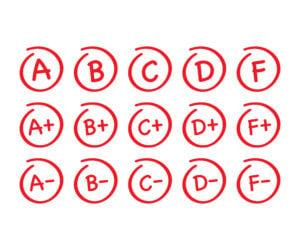

I
give
a
speech
every
semester
to
my
1Ls,
and
I
know
other
professors
do
as
well.
You
are
not
your
grades. I
inform
my
students
that
they
do
not
need
to
pass
by me in
the
hall and
hang
their
head
in
shame
if
they
did
not
get
an
A.
They
are
more
than
their
grade.
They
are
a
whole
person,
and
that
grade,
based
upon
one
data
point,
does
not
draw
a
unique
picture
of
who
that
student
is
as
a
human
being.
I’ve
written
many
letters
of
recommendation to the
point.
Chances
are,
I
don’t
know my
students’ grades.
Unless
the
students
come
to
review
their
exams
with
me,
I
choose
not
to
look.
If
they
do
review
their
exams,
I
focus
on
what
is
important:
Not
the
grade
itself.
Rather,
what
were
the
weaknesses
of
the
exam,
what
can
be
done
to
improve,
and
the
student
knowing
that
this
is
a
single
data
point,
not
their
whole
existence.
So,
let’s
review
some
basics
of
grading
and
what
I
mean
(I
presume
not
to
speak
for
others)
when
I say “you
are
not
your
grades.” TLDR:
Your
grade
is
a
temporary
marker
of
the
information
you
conveyed
from
your
brain
to
the
exam.
That
conveyance
isn’t
necessarily
what
is
in
your
head.
And
what
is
in
your
head
at
the
time
of
exam
may
increase
over
time
as
you
continue
to
learn.
Your
grade
is
one
data
point.
Nothing
more. One
of
my
coauthors
(may
he
rest
in
peace)
expressed
it
as
follows:
“An
exam
is
an
indication
of
how
you
did
that
day.”
There
is
much
noise
to
an
exam
that
has nothing
to
do
with
your
knowledge
as
to
a
body
of
law.
Did
you
have
a
fight
with
your
romantic
partner?
Was
someone
you
care
about
in
the
hospital?
Did
you
have
indigestion?
Did
you
lack
sleep?
Were
you
having
a
panic
attack
for
the
first
hour
of
the
exam?
Were
you
worried
about
money
or
how
to
pay
rent?
Were
you
able
to
afford
to
eat
before
the
exam?
Are
you
a
slow
typist?
There
are
many
factors
that
go
into
exam
writing
that
have
nothing
to
do
with
knowledge.
Even
under
perfect
conditions,
what
you
know
may
not
transfer
to
the
paper.
You
may
have
absorbed
all
that
knowledge
but
are
unable
to
convey
it
in
an
efficient
manner
under
time
constraints.
That
is
an
additional
step
in
learning
that
sometimes
comes
too
late
for
the
exam.
Your
grade
does
not
reflect
your
future
career
trajectory.
I
often
tell
the
stories
of
students
who
did
not
excel
in
law
school
who
turned
out
to
be
excellent
attorneys.
I
have
referred
people
who
I
care
about
to
those
attorneys.
They
work
hard.
They
have
empathy.
In
many
cases,
the
lack
of
a
good
grade
was
an
impetus
to
be
better.
I’m
not
saying
that
students
with
great
grades
are
bad
lawyers.
They
can
be,
just
as
those
with
bad
grades
can
be
bad
lawyers.
I’m
suggesting
that
the
correlation
between
great
grades
and
great
lawyering
isn’t
clear
cut.
Your
grade
does
not
reflect
the purpose
of
the
exam. The
goal
of
any
exam
worth
its
salt,
in
my
opinion, is
to
continue
the learning process.
What has
the
student learned,
and
can the
professor
make
the
student extend
it in
an
exam
format?
An
exam
is
teaching
and
learning.
For
that
reason,
I
encourage
students
to
meet
with
their
professors
about
their
exams,
regardless
of
whether
they
got
an
“A”
or
a
“D+.”
The
exam
is
a
basis
to
learn
and
build
strengths
from
where
you
were
weak.
Meeting
with
your
professors
and
finding
consistent
themes
of
weaknesses
means
remedying
a
problem
going
forward.
Sure,
some professors
actively
discourage
students
from
meeting
with
them
about
exams.
They
hide.
They
reschedule
appointments.
They say “look
at
the
sample
answer
and
figure
it
out.”
Those
are
guaranteed
ways
to
do
great
disservice
when
an
opportunity
exists
to
teach. As
you
pay
the
overhead
for
the
place,
it’s
important
to
acquire
the
knowledge
from
the
exam
experience
you
deserve.
Your
professor
potentially
didn’t
experience
grades
like
you do. It’s
easy
to
say
“you
are
not
your
grades”
if
you’ve
never
actually
received
any.
For
example,
Yale
offers
the
following grading
system.
Honors
and
Pass
are
the
most
common.
In
most
law
schools,
grades
create
invidious
distinctions
based
upon
mandatory
grade
curves
and
caps.
The
difference
between
an
A
and
an
A-
gets
accentuated.
Perhaps
Yale
is
right
and
we
give
too
many
grades,
and
that
creates
fetishism
about
the
difference
between
an
A
and
an
A- and
distorts
the
purpose
of
learning.
Your
grade
does
not
reflect
who
you
are
as
a
human.
There
are
many
more
components
to
being
a
member
of
this
profession
than
your
grade.
Are you kind?
Did
you
help
colleagues
when
they
needed
notes?
Or
were
you
selfish?
Were
you
hiding
resources
from
colleagues
instead
of
sharing?
Did
you
constantly
talk
smack
about
your
colleagues
or
the
professor?
Did
you
blame
the
professor
for
your
grade?
Were
you
more
interested
in
the
grade
than
understanding
and
learning?
The
answers
to
those
questions
say
more
about
you
than
your
grades
ever
will.
LawProfBlawg is
an
anonymous law professor.
Follow
him
on X/Twitter/whatever (@lawprofblawg).
He’s
also
on
BlueSky,
Mastodon,
and
Threads
depending
on
his
mood. Email
him
at [email protected].
The
views
of
this
blog
post
do
not
represent
the
views
of
his
employer,
his
employer’s
government,
his
Dean,
his
colleagues,
his
family,
or
himself.