

25.12.2025
10:17
Analysis
in
English
on
Zimbabwe
about
Agriculture,
Food
and
Nutrition
and
Drought;
published
on
23
Dec
2025
by
FEWS
NET
Key
Messages
-
Crisis
(IPC
Phase
3)
outcomes
are
expected
to
expand
in
early
2026
as
an
increasing
number
of
households
face
difficulty
accessing
food.
Households
in
these
areas
are
expected
to
have
depleted
own
produced
food
stocks.
With
grain
stocks
low
or
unavailable
on
the
market
in
some
areas,
many
poor
households
will
likely
face
challenges
purchasing
staple
cereal,
mainly
maize
meal,
due
to
below-average
purchasing
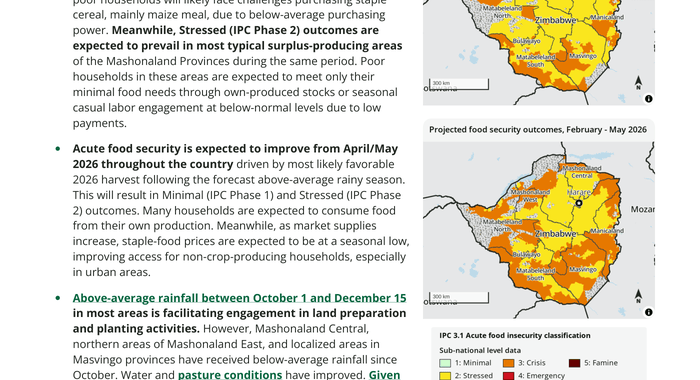
power. Meanwhile, Stressed
(IPC
Phase
2)
outcomes
are
expected
to
prevail
in
most
typical
surplus-producing
areas of
the
Mashonaland
Provinces
during
the
same
period.
Poor
households
in
these
areas
are
expected
to
meet
only
their
minimal
food
needs
through
own-produced
stocks
or
seasonal
casual
labor
engagement
at
below-normal
levels
due
to
low
payments. -
Acute
food
security
is
expected
to
improve
from
April/May
2026
throughout
the
country driven
by
most
likely
favorable
2026
harvest
following
the
forecast
above-average
rainy
season.
This
will
result
in
Minimal
(IPC
Phase
1)
and
Stressed
(IPC
Phase
2)
outcomes.
Many
households
are
expected
to
consume
food
from
their
own
production.
Meanwhile,
as
market
supplies
increase,
staple-food
prices
are
expected
to
be
at
a
seasonal
low,
improving
access
for
non-crop-producing
households,
especially
in
urban
areas. -
Above-average
rainfall
between
October
1
and
December
15 in
most
areas
is
facilitating
engagement
in
land
preparation
and
planting
activities. However,
Mashonaland
Central,
northern
areas
of
Mashonaland
East,
and
localized
areas
in
Masvingo
provinces
have
received
below-average
rainfall
since
October.Water
and pasture
conditions have
improved.Given
sufficient
rainfall
by
early
December, planting
is
ongoing
across
the
country,
and
planted
areas
are
significantly
higher
than
at
the
same
time
last
year. -
Typical
seasonal
income-earning
activities
and
household
income
remain
at
below-normal
levels
across
many
parts
of
the
country. Theseinclude
food
crop
sales
due
to
lack
of
stocks
among
the
poor
in
some
areas,
agricultural
labor,
self-employment,
petty
trade,
remittances,
and
cross-border
trade.
Most
of
these
have
been
reduced
due
to
localized
rainfall
deficits
last
year
and
continued
macroeconomic
constraints.
Post
published
in:
Agriculture