
Nyoka
/
BBC
Zimbabwe
is
Africa’s
biggest
producer
of
tobacco
but
some
farmers
believe
the
country’s
long-term
future
could
lie
in
a
very
different
crop
–
blueberries.
Thanks
to
a
breakthrough
in
trade
talks
with
China,
the
world’s
biggest
importer
of
the
nutrient-rich
fruit,
Zimbabwe
has
taken
a
major
step
towards
achieving
its
ambition
of
becoming
Africa’s
blueberry
capital.
Tobacco
sales
surged
to
a
record
$1.3bn
(£1bn)
last
year,
helped
by
the
rising
number
of
smokers
in
China.
In
contrast,
blueberry
exports
were
worth
a
more
modest
$30m
but
horticulture
specialist
Clarence
Mwale
is
undaunted.
“The
future
is
food,
not
a
bad
habit,”
he
tells
the
BBC
at
his
warehouse
in
Harare.
For
the
first
time,
China
has
agreed
to
import
Zimbabwean
blueberries
and,
crucially,
has
exempted
them
from
tariffs,
in
a
boost
for
the
southern
African
state’s
struggling
economy.
“We
have
to
strike
while
the
iron
is
hot,”
exuberant
blueberry
farmer
Alistair
Campbell
tells
the
BBC.
Currently
exporting
to
Europe,
the
Middle
East
and
South
East
Asia,
farmers
like
Campbell
would
be
gaining
access
to
a
massive
new
market,
once
Zimbabwe
passes
China’s
compliance
tests
on
pest
and
disease
control.
A
former
captain
of
Zimbabwe’s
cricket
team,
53-year-old
Campbell
co-owns
a
high-tech
50
hectare
(123
acres)
blueberry
farm
about
an
hour
from
the
capital,
Harare.
Each
of
the
240,000
plants
on
the
farm
is
grown
in
a
pot
imported
from
the
Netherlands
or
South
Africa.
The
pot
soil
is
also
imported.
The
plants
are
watered
eight
times
a
day,
with
specially
treated
water,
and
the
blueberries
are
kept
in
refrigerators
soon
after
they
are
harvested
to
maintain
freshness.
Campbell
said
that
although
it
was
a
demanding
fruit
to
grow,
the
rewards
are
worth
it,
especially
as
global
demand
is
increasing
for
what
some
describe
as
a
superfood,
with
high
levels
of
vitamins
and
anti-oxidants.
Campbell
believes
Zimbabwe
can
cash
in
on
the
rising
demand,
as
the
fruit
comes
into
season
early,
in
late
March,
hitting
the
market
ahead
of
major
competitors
like
Peru.
“It’s
all
about
Peru
avoidance,”
laughs
Campbell.
Peru
is
both
a
bitter
rival
and
an
inspiration
for
Zimbabwe’s
farmers.
In
the
last
10
to
15
years,
it
has
gone
from
being
responsible
for
less
than
2%
of
global
blueberry
production
to
becoming
the
largest
exporter
of
the
fruit.
Zimbabwe’s
production
this
year
is
expected
to
rise
by
50%
to
12,000
tonnes.
Morocco
currently
leads
Africa’s
production
with
more
than
80,000
tonnes
in
2024.
South
Africa,
Zimbabwe’s
neighbour,
produced
25,000
tonnes.
With
South
Africa
being
severely
hit
by
US
tariffs,
it
is
looking
for
new
markets
for
its
fruit,
with
China
being
an
obvious
one,
especially
as
it
has
promised
zero
tariffs
for
all
African
states,
except
Eswatini
because
of
its
close
ties
with
Taiwan.
 The
TheWashington
Post
via
Getty
Images
have
become
increasingly
popular
because
of
their
health
benefits
China
has
not
yet
agreed
to
take
South
African
blueberries,
raising
hopes
among
farmers
in
Zimbabwe
that
they
will
enter
the
lucrative
market
first.
The
Zimbabwean
and
Chinese
governments
struck
the
deal
earlier
this
month,
offering
what
has
been
described
as
an “unprecedented
opportunity
for
local
producers
to
access
one
of
the
world’s
fastest-growing
blueberry
markets”.
“This
agreement
is
a
milestone
for
Zimbabwe’s
horticultural
sector,”
says
Zimbabwe’s
Horticultural
Development
Council
executive
director
Linda
Nielsen.
“We
now
need
collaboration
to
design
policies
that
increase
investment,
boost
production,
and
ensure
our
blueberries
meet
China’s
strict
quality
and
phytosanitary
standards,”
she
adds.
Zimbabwe
farmers
are
now
looking
for
capital
to
boost
blueberry
production
to
30,000
tonnes
by
2030.
Expressing
caution
about
whether
this
can
be
achieved,
Campbell
tells
the
BBC:
“It’s
all
good
saying
Zimbabwe
is
open
for
business
but
the
underlying
fundamentals
need
to
be
correct.”
Many
analysts
say
that
more
than
20
years
after
the
government’s
controversial
land
reform
programme
led
to
the
seizure
of
many
white-owned
farms,
investors
remain
uncertain
about
the
security
of
their
land,
despite
a
new
law
that
does
away
with
leases
and
offers
full
title
to
resettled
farmers.
With
Zimbabwe
experiencing
a
severe
cash
crisis,
exporters
are
required
to
surrender
almost
a
third
of
their
foreign-currency
earnings
to
the
central
bank
in
exchange
for
local
currency
–
something
that
many
Zimbabweans
are
loathe
to
do,
fearing
it
will
lose
its
value.
Last
year
Zimbabwe
generated
$30m
(£22.5m)
from
blueberry
exports.
The
amount
may
be
modest,
but
with
unemployment
high,
the
jobs
the
industry
creates
are
welcome.
It
employs
about
6,000
people,
mostly
women.
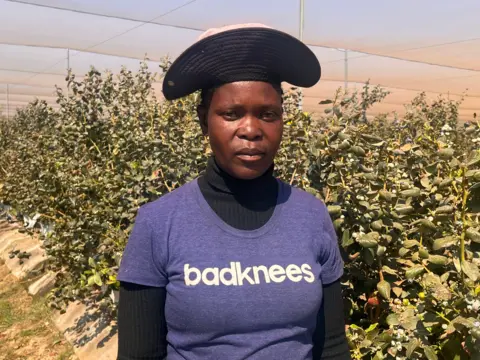 Shingai
Nyoka
/
BBC
Bonzo
says
blueberry
farms
are
a
source
of
employment
for
women
“It’s
delicate
hands
that
are
needed
for
a
delicate
fruit,”
Rebecca
Bonzo,
a
supervisor
at
Campbell’s
farm,
tells
the
BBC
in
the
Shona
language.
“Up
to
300
women
work
during
the
peak
harvesting
season.
Many
are
sole
breadwinners
who
can
now
take
care
of
their
families,”
she
says.
Clarence
Mwale
–
the
founder
of
Kuminda,
which
represents
a
collective
of
small-
and
medium-scale
farmers
–
says
he
is
pushing
more
of
them
to
become
involved
in
blueberry
farming.
He
says
he
has
achieved
this
with
other
crops
–
for
instance,
about
5,000
small-scale
farmers
now
supply
horticultural
products,
mainly
mange
touts
and
sugar
snap
peas,
to
the
UK
and
other
European
markets,
something
that
was
unheard
of
15
to
20
years
ago.
Mwale
says
he
is
now
looking
for
about
100
young
farmers
to
diversify
into
blueberry
farming
and
benefit
from
China’s
decision
to
open
the
market
to
Zimbabweans.
“As
the
Chinese
market
opens
up…it
gives
us
much
more
scope,”
he
tells
the
BBC.
“Where
we
were
scrambling
and
fighting
for
the
European
markets,
which
we
haven’t
been
able
to
fulfil,
now
we
have
a
vast
market
that
we
have
to
fill.
“It
gives
everyone
a
chance
to
get
into
the
blueberry
production.”
Zimbabwe
has
traditionally
been
tobacco
country.
But
having
fuelled
a
bad
habit
in
China,
it
now
wants
to
promote
a
health
food
there,
hoping
in
the
process
to
acquire
the
status
of
Africa’s
blueberry
capital.
Post
published
in:
Agriculture