
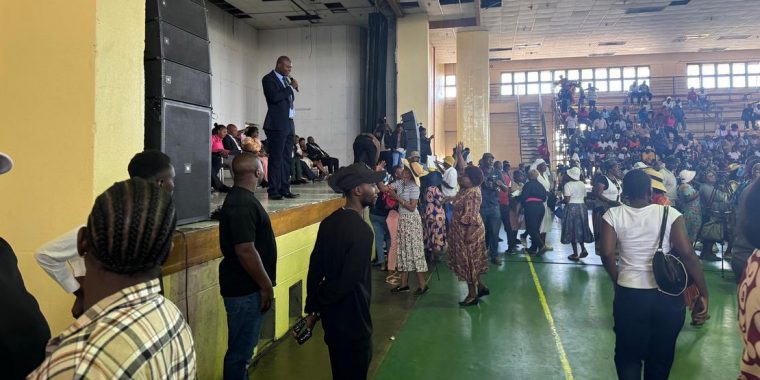
Hundreds
turned
out
as Zimbabwe‘s
parliament
began
nationwide
public
hearings
on
a Constitution
Amendment
Bill drafted
by
the
ruling
ZANU‑PF.
The
proposed
changes,
which
include extending
presidential
terms
and
altering
how
presidents
are
elected,
have
drawn
both
strong
support
and
sharp
criticism.
At
a
rural
gathering
in
Chitungwiza,
25
km
(15
miles)
from
Harare,
most
speakers
supported
the
proposed
bill.
Chitungwiza
—
the
third-largest
urban
center
after
Harare
and
Bulawayo
—
has
historically
voted
for the
opposition.
However,
ZANU-PF
has
made
gains
in
recent
years.

public
hearing
on
the
electoral
reforms
in
Chitungwiza
turned
into
heated
debate
at
some
pointImage:
Columbs
Mavhunga/DW
Shylock
Muyengwa,
a
medical
doctor,
argued
that
passing
the
bill
would
bring
stability
and
savings
to
the
state.
“The
bill
has
been
crafted
with
a
budget
in
mind,”
Muyengwa
said.
“If
you
look
at
changes
around
the Zimbabwe
Electoral
Commission and
the
registrar,
it
saves
us
$15
million
(€13
million).”
He
added
that
the
seven-year
transition
could
save
up
to
36%
of
potential
resources,
amounting
to
about
$20
million
per
year.
From
a
five
to
seven-year
term
limit
One
of
the
key
proposals
is
to extend
the
terms
of
the
presidency
and
parliament. Zimbabwe
holds
presidential
and
parliamentary
elections
every
five
years,
with
presidents
elected
directly
by
voters
under
the
2013
Constitution.
This
amendment
would
extend
the
terms
to
seven
years,
delaying
the
next
election
from
2028
to
2030.
If
enacted,
it
would
extend
President
Emmerson
Mnangagwa’s
tenure
beyond
his
current
and
final
term,
which
ends
in
2028.
Nationwide
hearings,
running
from
March
30
to
April
2,
are
being
held
as
part
of
the
constitutional
consultation
process.
Many
Zimbabweans
had
high
hopes
that
the
country
would
usher
in
a
new
era
of
democracy
following
the
2017
coup
that
ousted
the late
President
Robert
Mugabe.
ZANU‑PF
is
strongly
pushing
for
the
bill
to
pass. Critics
warn that
the
changes
could
entrench
one‑party
dominance
and
weaken
democratic
accountability,
especially
the
proposal
to
hold
a
parliamentary
election
to
choose
the
president,
replacing
direct
national
voting.
Another
key
reform
would
alter
the
role
of
Zimbabwe’s
Electoral
Commission
by
returning
some
powers,
such
as
voter
registration,
to
the
Registrar-General.
Those
proposals
could
reshape
Zimbabwe’s
political
landscape
for
decades
to
come.
Critics
of
the
bill
cry
foul
“I
do
not
have
a
problem
with
amendments
to
the
constitution
if it
is
done
properly,”
Rutendo
Muzirwa
told
DW.
“The
current
constitution
came
through
a
referendum,
so
why
can’t
you
go
through
the
referendum,
if
there
is
no
rigging?
Let’s
go
for
the
referendum,”
she
insisted,
adding
that
a
referendum
gives
everyone
a
chance
to
have
their
say.
“This
bill
is
good
for
others,
but
I
am
against
having
a
president
elected
by
the
parliament.
So
let’s
go
for
the
referendum,”
She
said
to
some
boos
from
the
crowd.
Opponents
began
leaving
the
venue,
saying
Parliament
was
ignoring
their
contributions.
Similar
concerns
about
limited
participation
have
been
raised
nationally,
with
observers
criticizing
the
highly
compressed
four‑day
hearing
schedule.
The
opposition
and civic
organizations say
they
would
do
everything
in
their
power
to
stop
the
bill
from
passing.
Ahead
of
the
consultations,
Amnesty
International
called
on
the
Zimbabwean
government
to
do
everything
in
its
power
to
ensure
a
peaceful,
fair
and
transparent
process.
“Amnesty
International
urges
the
Zimbabwean
authorities
to
guarantee,
without
discrimination,
the
rights
to
freedom
of
expression
and
peaceful
assembly
during
the
upcoming
public
hearings,”
Vongai
Chikwanda,
Amnesty
International’s
deputy
regional
director
for
East
and
Southern
Africa,
said.
Amnesty
calls
for
a
fair
process
Quoting
Article
61
of
Zimbabwe’s
constitution,
which
guarantees
freedom
of
expression
and
the
rights
to
peaceful
assembly
and
association,
key
pillars
of
democratic
participation,
Chikwanda
warned
that restrictions
on
public
debate before,
during,
or
after
public
hearings
could
shut
down
genuine
participation,
accountability,
and the
rule
of
law.

finance
minister
Tendai
Biti
has
been
a
vocal
critic
of
the
Constitution
Amendment
BillImage:
Xinhua/IMAGO
“Given
past
incidents
of
violence
and
suppression
of
dissenting
voices,
authorities
must
take
concrete
measures
to
ensure
all
participants
can
freely
express
their
views
and
assemble
without
fear
of
intimidation,
harassment,
assault,
or
arrest,”
he
added.
Reports
have
also
emerged
in
recent
weeks
of
arrests
and
alleged
assaults
of
some
critics
of
the
bill,
including
lawyers Lovemore
Madhukuand Tendai
Biti,
heightening
concerns
about
shrinking
civic
space.
Once
the
public
hearings
close
on
April
2,
parliamentary
committees
will
compile
public
submissions
before
the
bill
is
debated
and
most
likely
endorsed
in
the
National
Assembly,
where
the
ruling
ZANU
PF
party
enjoys
a
two-thirds
majority.