
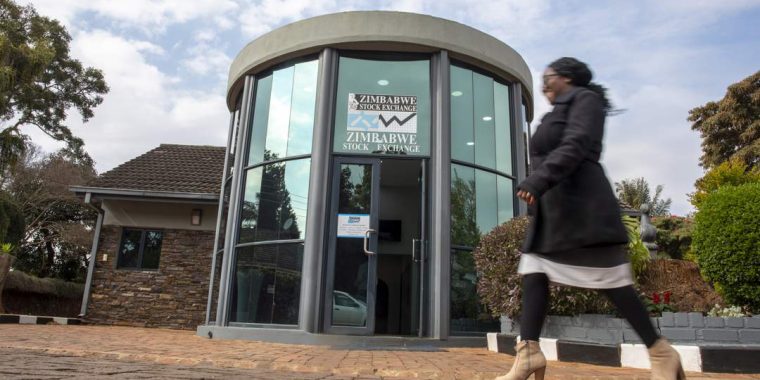

The
Zimbabwe
Stock
Exchange
in
Harare.
Its
competitor,
the
Victoria
Falls
Stock
Exchange,
has
overtaken
the
ZSE
by
market
value
after
tycoon
Strive
Masiyiwa
transfered
telecommunications
infrastructure
firm
Econet
to
the
platform
at
a
$1
billion
(R16.3
billion)
valuation
on
March
31.
Cynthia
R
Matonhodze/Bloomberg
via
Getty
Images
The
Victoria
Falls
Stock
Exchange,
established
during
a
currency
crisis
in
2020,
has
overtaken
the
Zimbabwe
Stock
Exchange
by
market
value
after
tycoon
Strive
Masiyiwa
transfered
telecommunications
infrastructure
firm
Econet
to
the
platform
at
a
$1
billion
(R16.3
billion)
valuation
on
March
31.
The
listing
accounts
for
almost
a
quarter
of
VFEX’s
total
capitalisation.
VFEX’s
19
listings
—
many
of
which,
like
Econet
InfraCo,
migrated
from
the
ZSE
—
were
valued
at
about
$3.79
billion
as
of
Wednesday,
surpassing
the
$3.4
billion
market
capitalisation
of
43
counters
that
trade
in
the
local
ZiG
currency
on
the
Harare-based
stock
exchange.
The
transition
isn’t
a
reflection
of
Zimbabwe’s
economy
suddenly
expanding,
but
rather
a
structural
reordering
of
its
equity
markets,
Mary
Musariri,
an
equities
analyst
at
MMC
Capital,
said
in
response
to
emailed
questions.
“VFEX
has
become
the
anchor
for
liquidity
in
hard
currency,
attracting
foreign
and
institutional
investors
who
value
dollar
stability
and
easier
dividend
repatriation,”
Musariri
said.
That’s
changed
the
investor
base
toward
international
capital,
while
the
ZSE
is
increasingly
dominated
by
retail
and
local-currency
exposure,
she
said.
The
shift
is
unfolding
as
global
shocks
—
from
the
US-Israeli
war
with
Iran
to
persistent
currency
instability
at
home
—
drive
demand
for
dollar-based
assets,
reinforcing
the
appeal
of
offshore-style
platforms
like
VFEX.
“The
broader
implication
is
that
VFEX
is
becoming
the
benchmark
exchange
for
Zimbabwe’s
largest
corporates,
while
the
ZSE
risks
being
relegated
to
a
secondary
role,”
Musariri
said.
This
leaves
it
more
volatile
and
increasingly
tied
to
a
shrinking
pool
of
heavyweight
stocks,
she
said.
The
dollar-denominated
exchange
expects
to
attract
at
least
four
new
listings
this
year,
Chief
Executive
Officer
Justin
Bgoni
said.
“We
are
comfortable”
with
the
pipeline
and
the
new
products
coming
to
market,
he
said.
Still,
Bgoni,
who
is
also
the
CEO
of
the
ZSE,
said
comparing
the
two
stock
exchanges
is
complex.
The
“market
cap
for
VFEX
is
bigger,
but
the
ZSE
has
more
listed
entities,”
he
said.
“We
feel
ZSE
is
undervalued
and
therefore
has
a
strong
upside.
VFEX
is
growing
so
also
has
upside.
We
are
hoping
that
both
happen.”