
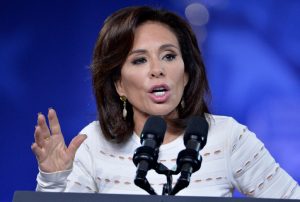
Jeanine
Pirro
(Photo
by
MIKE
THEILER/AFP/Getty
Images)
The
DOJ
got
benchslapped
again
last
night
by
federal
Magistrate
Judge
Zia
Faruqui.
The
beatdown
came
in
the
case
of
Kevontae
Stewart,
a
DC
resident
who
was
sitting
in
his
car
on
September
17,
smoking
a
joint
and
bothering
no
one,
when
ATF
agents
started
hassling
him.
Prosecutors
filed
a
criminal
complaint
alleging
that
Stewart
fled
and
tried
to
get
rid
of
a
gun,
which
he
was
not
permitted
to
possess
due
to
a
prior
criminal
conviction.
But
the
grand
jury
didn’t
buy
it,
and
the
DOJ
got
no-billed,
as
they’ve
done
repeatedly
since
Jeanine
Pirro
got
sworn
in
as
US
Attorney
for
the
District
and
started
charging
every
person
she
could
get
her
hands
on
with
pissant
nonsense.
But
Pirro
was
feeling
fizzy
as
a
box
of
Franzia
left
in
the
sun,
so
on
September
26,
the
same
day
prosecutors
got
no-billed
by
the
federal
grand
jury,
her
office
took
Stewart’s
case
to
a
local
grand
jury
convened
by
DC
Superior
Court.
That
panel
was
more
cooperative,
and
on
September
29,
the
DOJ
tried
to
present
the
local
indictment
to
Magistrate
Faruqui.
And
then
all
hell
broke
loose.
“This
desire
to
just
at
all
costs
get
people
charged
and
arrested
is
losing,
every
day,
credibility
before
the
court,”
Judge
Faruqui
railed,
adding,
“You
can’t
even
get
grand
juries
returned
now,
because
the
public
seems
to
have
lost
all
faith
in
the
process.”
The
court
refused
to
accept
the
indictment
and
ordered
briefing
on
the
legality
of
using
a
DC
Superior
Court
grand
jury
to
return
an
indictment
in
federal
court,
a
process
the
court
described
as
potentially
unlawful
and
at
a
minimum
unseemly.
But
Pirro’s
office
did
not
file
a
response
—
or
at
least
not
immediately.
First
it
demanded
to
speak
to
the
manager,
docketing
an
emergency
motion
to
vacate
Judge
Faruqui’s
briefing
order.
The
government
insisted
that
the
magistrate’s
role
is
purely
ministerial,
and
thus
the
court
had
no
discretion
to
reject
the
indictment.
But
they
got
no
joy
from
Chief
Judge
James
Boasberg,
who
refused
to
countermand
the
briefing
order,
instructing
prosecutors
to
appeal
any
final
order
if
they
were
still
mad
about
it.
The
government’s
position
is
that
D.C.
Code
§
11-1916
empowers
a
local
grand
jury
to
“take
cognizance
of
all
matters
brought
before
it
regardless
of
whether
an
indictment
is
returnable
in
the
Federal
or
District
of
Columbia
courts.”
They
point
to
US
v.
Seals,
a
1997
DC
Circuit
case
in
which
the
court
allowed
federal
prosecution
when
the
grand
jury
indictment
was
procured
by
a
jury
convened
by
the
DC
Superior
Court.
But,
as
Stewart
pointed
out
in
his
own
brief,
that
case
preceded
the
adoption
of
the
Federal
Rules
of
Criminal
Procedure
by
five
years.
FRCrP
6
empowers
“the
court”
—
i.e.,
a
federal
judge
—
to
impanel
a
grand
jury.
And
as
Judge
Faruqui
pointed
out
in
his
order
dropkicking
this
indictment,
FRCrP
1
specifically
states
that
DC
Superior
Court
judges
are
not
federal
judges.
There’s
also
the
minor
matter
that,
unlike
at
the
time
of
Seals,
the
procedures
for
selecting
DC
and
federal
grand
juries
are
not
the
same.
And
…
is
the
DOJ
seriously
arguing
that
a
local
statute
can
bind
the
federal
judiciary?
WTF?????
“This
litigation
and
the
delay
caused
by
it
could
have
been
avoided
if
the
government
had
simply
gone
to
one
of
the
other
federal
grand
juries.
That
escape
hatch
remains
open
today,”
Judge
Faruqui
concluded.
“At
any
time,
the
government
can
short
circuit
this
dispute
by
taking
their
federal
charge
before
a
federal
grand
jury.
The
question
then
is
why
are
they
now
afraid
to
do
so?”
The
government
huffily
announces
that
it
will
appeal
again
to
Chief
Judge
Boasberg.
But
if
they
bet
wrong,
they’re
going
to
be
in
a
wee
spot
of
bother.
They’ve
got
30
days
from
September
18,
the
date
of
the
original
complaint,
to
indict
Stewart,
the
poor
guy
smoking
a
J
in
his
own
car
who
wound
up
in
the
middle
of
this
ridiculous
pissing
match.
Good
thing
he
wasn’t
driving
119
mph
in
a
65,
or
he
might
be
in
real
trouble.
Liz
Dye lives
in
Baltimore
where
she
produces
the
Law
and
Chaos substack and podcast.