

Images
Editor’s
note:
Second
in
a
three-part
series.
Read
the
first
installment
here.
You’ve
gathered
reliable
company
data.
You’ve
determined
the
law
department’s
proper
lane
for
this
transaction.
You’ve
maintained
appropriate
confidentiality
and
applied
sound
organizational
principles.
Now,
the
ink
is
dry
on
your
merger
agreements
—
and
your
GC
is
facing
down
a
new
challenge:
guiding
the
integration
of
a
portfolio
of
companies
into
an
existing
structure.
“Every
company
has
different
internal
dynamics
and
different
ways
of
working,
right?”
says
Kariem
Abdellatif,
the
head
of
Mercator
by
Citco
(Mercator),
a
specialist
entity
management
provider
that
helps
organizations
manage
their
global
entity
portfolios,
including
during
complex
M&A
transactions.
“So
the
system
you
set
up
has
to
be
able
to
accommodate
those
differences,
and
the
entire
governance
framework
for
managing
entities
needs
to
be
flexible
enough
to
handle
not
just
the
current
complexity,
but
also
future
organizational
changes.”
In
this
series,
we’re
providing
a
step-by-step
guide
for
general
counsel
navigating
a
merger
or
other
corporate
transaction.
In
part
one,
we
explored
best
practices
for
corporate
law
departments
in
the
pre-merger
phase.
Here,
we’re
sharing
the
initial
to-do
list
for
a
law
department
once
a
transaction
is
closed.
We’ll
also
be
discussing
these
topics
in
a
webinar
next
month.
You
can
pre-register
here.
Button
Up
Your
Contracts
Law
departments
would
be
well-advised
to
get
a
head
start
on
shoring
up
their
employment
and
intellectual
property
agreements
as
soon
as
a
deal
is
inked.
This
is
particularly
so
when
a
large
company
buys
a
smaller
entity
in
an
equity
deal,
notes
Scott
Naturman,
an
M&A
partner
with
Hughes
Hubbard
&
Reed
LLP.
That’s
because
smaller
companies
often
have
deficient
regulatory
and
internal
compliance
programs,
which
can
lead
to
contracting
problems.
“Almost
every
deal
we
do,
we
find
deficiencies,
and
it’s
not
me
necessarily,
but
it’ll
be
my
HR
and
IP
colleagues
looking
at
employment-related
contracts
and
finding
deficiencies
in
them,”
Naturman
says.
“So
that’s
something
that
often
has
to
be
fixed.”
Problems
can
also
arise
related
to
the
merged
entity’s
commercial
contracts.
Mergers
often
occur
between
companies
in
similar
industries,
of
course.
As
a
result,
the
merged
entity
may
have
contracts
with
the
same
customers
and
suppliers
as
the
acquirer.
If
multiple
contracts
with
the
same
customer
or
supplier
have
differing
terms,
Naturman
notes,
the
merged
business
will
look
to
maintain
the
best
possible
outcome
while
combining
the
contracts.
Some
items
like
“most
favored
nation”
clauses
will
often
be
vetted
and
mitigated
in
the
due
diligence
process,
but
lawyers
will
still
need
to
think
through
how
to
merge
any
overlapping
agreements
once
the
deal
is
closed.
Maximize
the
Interim
Period
Even
if
they
tend
to
be
billed
as
“mergers
of
equals,”
few
mergers
are
actually
created
equal.
One
key
difference
emerges
around
the
closing
structure
—
with
delayed
and
simultaneous
closings
presenting
their
own
challenges
and
opportunities.
When
there’s
a
delayed
closing,
law
departments
must
navigate
an
interim
period,
where
you
protect
the
value
of
the
business
while
awaiting
a
condition
to
be
met
—
regulatory
approval,
for
example,
or
the
greenlight
from
a
lender.
Naturman
notes
that
law
departments
can
make
progress
on
essential
human
resources
and
intellectual
property
tasks
during
this
period.
“You
want
the
in-house
folks
as
soon
as
possible
to
be
speaking
with
key
employees
and
trying
to
lock
them
into
agreements
on
their
own
paper,
but
you
can’t
have
anything
become
effective
until
the
deal
closes,
of
course,”
he
says.
“If
you
have
a
delayed
closing,
you
can
reach
a
wider
audience,
while
if
it’s
simultaneous,
you
don’t
have
that
opportunity.”
Update
—
and
Leverage
—
Your
Org
Chart
Simply
gathering
accurate
data
poses
another
post-merger
challenge
for
law
departments.
All
of
the
documents
related
to
the
acquired
company
must
be
uploaded
into
a
merged
system,
for
example,
and
they
must
be
made
available
to
the
appropriate
employees.
Once
the
information
is
updated,
Mercator’s
Entica
platform
can
create
detailed
and
interactive
corporate
org
charts.
This
allows
users
to
visualize
the
full
organization
—
which
entity
sits
on
top,
what
happens
if
entities’
locations
are
moved,
what
it
would
mean
if
an
entity
were
liquidated.
Law
departments
at
this
stage
should
consider
their
portfolio
of
companies,
looking
for
entities
that
could
be
merged.
Some
may
see
an
opportunity
for
immediate
savings.
“If
you
have
two
of
your
own
entities
in,
say,
France,
and
you
just
acquired
a
portfolio
that
has
three
other
entities
in
France,
there’s
a
case
for
rationalization,”
Mercator’s
Abdellatif
says.
“Ask
yourself:
‘Why
do
I
have
five
entities
in
France?
Do
I
actually
need
all
of
these
for
the
activities
I
perform,
and
what
are
the
cost
and
compliance
implications
of
maintaining
them?”
When
companies
neglect
their
org
chart,
it
can
also
create
long-term
problems,
according
to
Naturman.
“Especially
if
you’re
a
serial
buyer
and
you’re
buying
companies,
you
may
end
up
having
a
web
of
entities,
and
it
just
gets
out
of
control
and
hard
to
manage,”
he
says.
This
type
of
sprawl
can
create
tax
inefficiencies
and
prevent
organizations
from
minimizing
liabilities
by
housing
them
in
carefully
chosen
entities
within
the
organization’s
structure.
“I
don’t
think
enough
of
that
planning
happens,”
Naturman
says.
“It’s
often
we’re
brought
in
five
years
later
to
help,
then
they
say:
‘Help
us.
It’s
a
complete
mess.
How
do
we
reorganize
ourselves?
How
do
we
get
this
under
control?’”
Mercator’s
Abdellatif
adds:
“Dormant
entities
often
become
problematic
when
overlooked
during
transitions
or
treated
as
‘out
of
sight,
out
of
mind.’
We
frequently
see
cases
where
incomplete
records
or
unclear
responsibilities
lead
to
surprise
liabilities.”
“The
solution
is
treating
dormant
entities
with
the
same
discipline
as
active
ones,”
he
says,
“maintaining
accurate
inventories,
assigning
clear
ownership,
conducting
regular
reviews,
and
ensuring
professional
oversight.
This
transforms
them
from
hidden
risks
into
manageable
assets.”
Create
an
Impeccable
Calendar
Onboarding
an
entity
also
means
onboarding
its
deadlines.
Once
a
transaction
is
closed,
detailed
deadline
calendaring
is
a
key
step
for
GCs.
Critically,
this
step
isn’t
limited
to
deadlines
related
to
the
deal
itself.
Staying
on
top
of
deadlines
means
understanding
when,
say,
a
customer
supplier
contract
will
expire,
Naturman
notes.
Maintaining
this
focus
is
a
key
to
successfully
merging
multiple
entities.
“One
thing
I’ve
seen
over
the
course
of
my
career
is
less
diligence
being
done,
or
more
targeted
diligence,”
he
says.
Abdellatif
notes
that
Mercator’s
Entica
system
contains
robust
workflow,
calendaring,
and
compliance
capabilities,
among
its
other
features.
Mergers
are
a
logistical
exercise,
he
says,
and
the
right
technology
can
form
the
organizational
backbone
for
a
transaction
to
progress.
“Technology
functions
differently
within
each
corporate
environment
—
meaning
it
doesn’t
always
get
used
the
same
way,”
he
says.
“To
get
the
most
value
out
of
it,
you
need
to
make
sure
that
its
properly
adapted
to
each
specific
environment.”
He
adds:
“When
implemented
thoughtfully,
technology
becomes
more
than
just
a
system
—
it
becomes
the
foundation
that
helps
standardize
processes,
maintain
compliance,
and
ultimately
drive
successful
integration.”
Stay
tuned
for
the
next
article
in
this
series,
where
we’ll
be
exploring
steps
to
consider
during
the
negotiation
and
closing
of
a
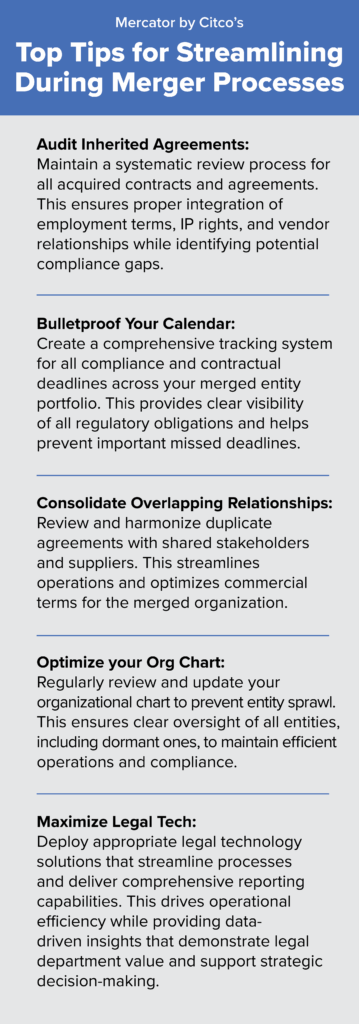
transaction. You
can
register
for
our
webinar
on
these
topics
here.