
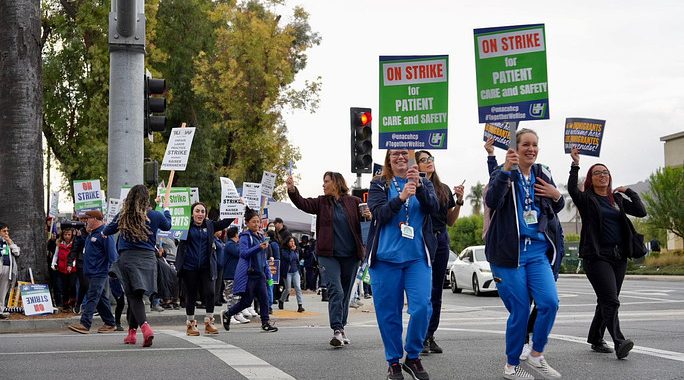
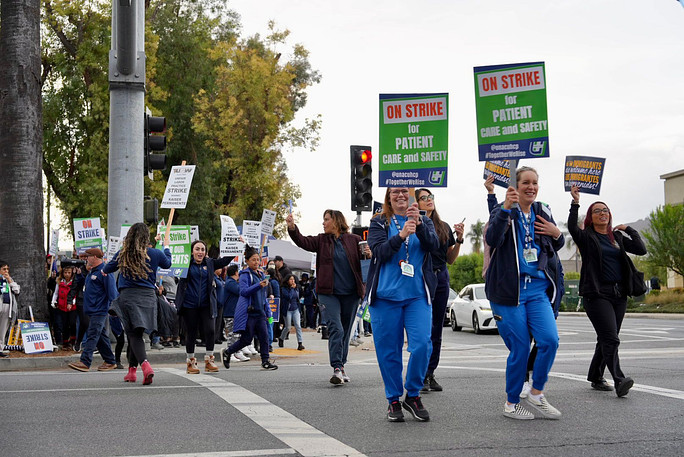
Roughly
31,000
Kaiser
Permanente
healthcare
workers
have
walked
off
the
job
this
week
in
California
and
Hawaii,
protesting
stalled
contract
negotiations
and
what
they
describe
as
unsafe
staffing
levels
that
put
patients
and
employees
at
risk.
Their
strike
began
at
7
a.m.
Tuesday
and
will
go
until
7
a.m.
on
Sunday.
The
workers
on
strike
are
members
of
the
United
Nurses
Associations
of
California/Union
of
Health
Care
Professionals
(UNAC/UHCP).
The
union
said
that
it
has
bargained
in
good
faith
with
Kaiser
since
May
to
try
to
address
dangerous
staffing
levels
and
stagnant
pay,
but
Kaiser
has
failed
to
offer
adequate
solutions.
Kaiser
said
it
has
been
working
with
the
union
for
months
to
reach
a
fair
deal
and
called
the
strike
“unnecessary
and
disruptive.”
Inside
the
dispute
Kaiser
is
one
of
the
largest,
most
well-resourced
health
systems
in
the
country.
It
operates
40
hospitals
and
more
than
600
medical
offices
across
eight
states
and
Washington,
D.C.,
with
a
workforce
of
more
than
200,000
employees.
It
also
runs
a
health
plan
with
12.6
million
members.
Last
year,
the
health
system
made
$115.8
billion
in
operating
revenue
and
generated
a
profit
of
nearly
$13
billion.
It
paid
CEO
Gregory
Adams
a
salary
of
$15.6
million.
Kaiser
also
has
investments
totaling
more
than
$100
billion
—
both
domestically
and
abroad
—
in
areas
such
as
fossil
fuels,
for-profit
prisons,
alcohol
companies,
casinos
and
military
weapons.
In
the
past,
union
leaders
have
pointed
to
these
investments
as
evidence
that
Kaiser
has
ample
resources
to
address
workers’
demands
but
does
not
always
choose
to
prioritize
them.
The
health
system
is
no
stranger
to
labor
disagreements.
In
the
past
five
years,
it
has
faced
multiple
strikes
from
unionized
groups
of
nurses
and
other
healthcare
workers
—
mainly
over
staffing
shortages,
working
conditions
and
wages.
Kaiser
is
currently
negotiating
contracts
with
the
Alliance
of
Health
Care
Unions,
which
is
a
coalition
of
23
unions
representing
about
60,000
Kaiser
employees.
Within
that
broader
negotiation,
UNAC/UHCP
members
are
the
ones
striking
this
week
—
other
unions
in
the
alliance
are
at
various
stages
of
bargaining,
and
most
are
not
striking
yet.
During
these
negotiations,
Kaiser
has
offered
wage
increases
of
21.5%
over
four
years,
but
UNAC/UHCP
is
demanding
“an
excessive
wage
increase”
of
25%
over
the
same
period,
the
health
system
said.
“The
seemingly
small
percentage
difference
between
the
two
proposals
actually
means
significantly
more
because
it
is
multiplied
across
60,000
employees
and
causes
related
benefit
increases
over
four
years.
The
difference
between
a
21.5%
and
a
25%
increase
is
about
$300
million
a
year
in
salary
alone
by
the
end
of
the
contract,”
Kaiser
said
in
a
statement.
Kaiser’s
current
payroll
for
employees
in
the
Alliance
of
Health
Care
Unions
is
$6.3
billion
per
year.
Its
proposed
wage
increase
would
raise
pay
by
a
total
of
$1.9
billion
over
four
years,
and
the
UNAC/UHCP’s
demand
would
increase
pay
by
more
than
$2.2
billion.
This
additional
cost
would
mean
more
rate
increases
for
Kaiser’s
members
and
patients,
the
health
system
stated.
UNAC/UHCP
sees
things
differently
than
Kaiser.
“Kaiser’s
public
messaging
highlights
a
‘21.5%
wage
increase
over
four
years,’
but
what
it
doesn’t
mention
is
years
of
wage
freezes
during
record
inflation,
cuts
for
new
union
members
and
the
real
daily
impact
these
conditions
have
on
patient
care,”
the
group
said
in
a
statement.
The
union
also
pointed
out
that
Kaiser
has
consistently
increased
its
insurance
rates
over
the
years,
regardless
of
the
status
of
its
labor
contracts
—
arguing
that
these
raised
rates
are
caused
by
underlying
cost
pressures
within
the
healthcare
system,
such
as
skyrocketing
drug
prices
and
excessive
coverage
denials.
Additionally,
UNAC/UHCP
highlighted
the
fact
that
Kaiser
holds
$66
billion
in
reserves,
saying
that
it
is
“fighting
for
resources
to
go
to
patient
care,
not
Kaiser
executives
or
company
reserves.”
The
union
says
it’s
not
about
the
money
UNAC/UHCP
said
it
rejects
Kaiser’s
mischaracterization
of
the
dispute
as
one
that
is
just
about
wages.
“The
employer
is
putting
out
these
messages
—
a
false
narrative,
an
untruth
—
about
why
we
are
outside
the
hospital,
outside
the
workplaces,
outside
the
clinics,
when
we
should
be
inside.
They’re
telling
the
public
that
it’s
about
the
money,
it’s
about
the
wages.
That’s
the
farthest
from
the
truth.
This
is
about
respect.
This
is
about
dignity.
This
is
about
ensuring
quality
patient
care,”
Charmaine
Morales,
a
Kaiser
nurse
and
president
of
UNAC/UHCP,
said
on
Tuesday
while
speaking
to
a
crowd
of
healthcare
workers
on
strike
outside
Kaiser’s
hospital
in
Baldwin
Park,
California.
She
acknowledged
that
the
strike
is
a
personal
sacrifice
for
employees
and
their
families,
given
Kaiser
doesn’t
pay
workers
on
strike
—
but
to
her
and
the
others
gathered
outside
the
picket
line,
it
is
a
necessary
step
to
secure
a
better
future
for
healthcare
workers.
Another
employee
—
Cameron
Cook,
a
nurse
anesthetist
at
Kaiser’s
hospital
in
Redwood
City,
California
—
said
that
he
and
the
other
nurses
in
his
unit
can
no
longer
tolerate
the
strain
that
chronic
understaffing
places
on
themselves
and
their
patients.
“We
lost
about
25%
of
our
colleagues
from
the
Kaiser
system
to
other
systems
within
the
Bay
Area.
We
are
now
seeing
more
workloads,
longer
patient
wait
times,
and
we
unionized
two
years
ago
to
elevate
our
voice
to
hopefully
force
Kaiser
to
address
these
issues.
In
response,
they
have
spent
the
last
18
months
at
the
bargaining
table
—
stalling,
delaying
and
essentially
retaliating
against
us
for
organizing,”
Cook
declared
during
a
Wednesday
morning
phone
interview
he
took
from
the
picket
line.
While
the
strike
may
disrupt
patient
care
in
the
short
term,
it
alerts
the
public
that
patient
care
is
already
being
compromised
and
could
continue
to
deteriorate
further
if
staffing
shortages
don’t
get
solved,
he
added.
In
his
view,
the
strike
is
meant
to
push
Kaiser
to
formally
acknowledge
the
staffing
and
patient
care
issues
in
a
contract
rather
than
making
informal
promises.
“Patients
suffer
when
there
are
gaps
in
care,”
Cook
remarked.
“Maybe
we
stay
extra
to
fix
that,
or
we
come
in
extra
tomorrow
to
help
out
our
colleagues.
Kaiser
has
taken
advantage
of
that
compassion.
They
have
taken
advantage
of
our
vigilance,
and
we
simply
have
recognized
over
the
last
two
years
that
we
cannot
continue
to
keep
doing
extra
to
float
Kaiser
so
that
they
can
continue
to
dole
out
million-dollar
bonuses
to
their
executives.”
Post-pandemic
labor
tensions
go
deeper
than
this
This
strike
fits
into
a
broader
post-pandemic
trend
of
labor
unrest
among
healthcare
workers,
driven
primarily
by
understaffing,
burnout
and
uncompensated
administrative
work,
noted
Gerald
Friedman,
a
labor
union
expert
and
economics
professor
at
the
University
of
Massachusetts.
Nurses
and
physicians
are
dealing
with
heavier
workloads
than
ever
before
due
to
increasingly
complex
administrative
requirements
and
a
lack
of
employees,
yet
their
pay
is
failing
to
keep
up
with
inflation.
While
this
is
going
on,
executives’
salaries
are
getting
higher
and
higher
on
both
the
health
system
and
payer
sides.
All
of
this
is
a
sure
recipe
for
a
labor
movement,
Friedman
explained.
He
also
noted
that
Kaiser’s
strike
will
have
a
small
immediate
financial
effect
on
the
health
system.
“Healthcare
often
has
to
be
done
in
time.
For
building
cars
or
something,
before
the
strike,
you
stockpile,
and
after
the
strike,
you
speed
up,
maybe
do
a
little
overtime.
But
healthcare,
if
you
aren’t
taking
patients
in,
they
either
don’t
get
care
or
go
someplace
else,”
Friedman
remarked.
The
financial
impact
won’t
be
very
damaging,
though,
he
pointed
out,
as
the
strike
will
only
last
five
days.
Friedman
said
that
short-term
strikes
like
this
don’t
hurt
the
employer’s
pockets
that
much,
but
they
do
signal
the
seriousness
of
labor
demands.
In
his
eyes,
strikes
like
the
one
happening
across
Kaiser
facilities
this
week
will
continue
to
have
a
ripple
effect
across
the
U.S.
healthcare
system.
“There’s
a
lot
of
unrest
boiling
beneath
the
surface,”
he
declared.
A
signal,
not
a
shutdown
To
one
former
health
system
executive,
the
strike’s
brief
duration
indicates
that
the
union
is
likely
close
to
resolution
but
wants
to
show
how
serious
it
is
about
its
demands
to
both
Kaiser
and
its
own
members.
“When
the
union
announces
a
five
day
strike,
what
does
that
tell
you?
I
think
it
tells
you
that
they’re
probably
pretty
close
to
solving
the
issues,”
said
Chris
Olivia,
retired
former
executive
at
health
systems
including
Bon
Secours
Mercy
Health
and
Allegheny
Health
System.
He
has
been
on
both
sides
of
healthcare
labor
disputes
throughout
his
career
—
as
a
health
system
C-suite
leader
as
well
as
a
physician
and
former
union
member
himself.
He
thinks
a
new
contract
will
be
reached
within
the
next
week
or
so.
While
short-term
strikes
like
this
week’s
tend
to
disrupt
elective
procedures
because
resources
get
shifted
toward
critical
patients,
hospitals
can
typically
manage
these
operational
impacts,
Olivia
noted.
Kaiser
has
been
keeping
its
hospitals
and
medical
offices
open
during
the
strike,
though
it
is
moving
some
appointments
to
virtual
care
and
rescheduling
certain
elective
visits.
The
health
system
said
it
is
onboarding
up
to
7,600
temporary
staff
members
to
work
during
the
strike,
the
majority
of
whom
have
worked
at
Kaiser
before.
Olivia’s
number
one
piece
of
advice
to
health
system
leaders
going
through
contract
negotiations
with
their
workers
is
to
be
honest.
“One
of
the
strategies
I
used
was
to
be
brutally
honest
with
union
leadership
as
to
where
you
are
economically.
And
if
you
have
the
ability
to
give
the
increase,
ultimately,
you
want
to
show
that
you
are
a
good
fiduciary
and
steward
of
the
assets
in
a
hospital.
As
a
hospital
leader,
you
have
to
take
care
of
your
people
in
the
end,”
he
remarked.
He
highlighted
the
importance
of
transparency
and
partnership
with
unions,
including
integrating
union
input
into
some
of
the
health
system’s
leadership
decisions,
to
maintain
trust
and
achieve
outcomes
that
feel
more
fair.
Overall,
Olivia
believes
the
strike
taking
place
at
Kaiser
this
week
is
a
measured
action
to
send
a
signal
—
one
that
reflects
the
larger
struggle
across
the
U.S.
healthcare
system
to
retain
workers
and
ensure
safe,
quality
care.
Photo:
UNAC/UHCP