We
think
2026
is
going
to
be
on
fire,
and
we
have
a
number
of
partners
who
are
just
getting
ready
to
give
notice
and
start
at
their
new
firms
in
the
very,
very
near
future,
and
we’re
seeing
that
all
across
the
country.
Like
the
end
of
2025,
firms
are
going
to
be
extremely
aggressive
in
their
lateral
partner
hiring.
— Jeffrey
Lowe,
market
president
of
Washington
DC
for
legal
recruitment
firm
CenterPeak,
in
comments
given
to
the
National
Law
Journal,
concerning
expected
lateral
activity
in
2026.
Amy
Savage,
a
D.C.-based
recruiter
at
Garrison
&
Sisson,
echoed
Lowe’s
thoughts,
saying,
“2026
might
be
a
record
year
in
terms
of
lateral
hiring.”
Staci
Zaretsky is
the
managing
editor
of
Above
the
Law,
where
she’s
worked
since
2011.
She’d
love
to
hear
from
you,
so
please
feel
free
to email her
with
any
tips,
questions,
comments,
or
critiques.
You
can
follow
her
on Bluesky, X/Twitter,
and Threads, or
connect
with
her
on LinkedIn.
(Photo
by
Alex
Kormann/The
Minnesota
Star
Tribune
via
Getty
Images)
With
polls
showing
more
Americans
now
favor
abolishing
ICE
than
keeping
it,
a
lot
of
people
will
be
disappointed
to
learn
that
the
law
is
set
up
to
make
it
almost
impossible
to
hold
anyone
accountable
for
killing
Renee
Good.
From
sovereign
immunity,
to
the
Federal
Officer
Removal
Statute,
to
the
decline
of
Bivens,
to
qualified
immunity,
the
whole
system
is
arrayed
to
shield
federal
agents
from
legal
redress.
Speaking
of
the
Minnesota
ICE
surge,
we
moved
a
step
closer
to
a
genuine
Third
Amendment
case
after
the
Department
of
Homeland
Security
pressured
Hilton
Hotels
into
dropping
a
franchisee
that
had
refused
to
rent
rooms
to
DHS.
And
finally,
Judge
James
Ho
published
a
broadside
against
fellow
judges
in
his
bid
to
reach
the
top
of
the
Trump
administration’s
Supreme
Court
wishlist.
And
all
he
had
to
do
was
mock
judges
receiving
violent
threats
and
dishonor
a
judge’s
murdered
son.
On
October
27,
2024,
Caitlin
Tracey,
36,
the
wife
of
former
Duane
Morris
tax
partner
Adam
P.
Beckerink,
was
found
dead
in
the
stairwell
of
Beckerink’s
apartment
building
in
Chicago’s
South
Loop.
Her
severed
foot
was
found
nearby.
One
year
later,
he
was
arrested,
with
prosecutors
accusing
him
of
throwing
his
wife
over
the
stairwell
railing,
where
she
fell
24
floors
to
her
death.
Beckerink
was
later
removed
from
the
Biglaw
firm’s
partnership,
and
in
the
interim,
he’s
spent
time
behind
bars
in
Michigan
on
domestic
violence-related
charges
that
he
abused
Tracey.
Earlier
this
week,
Beckerink
was
extradited
from
Michigan
to
Chicago,
Illinois,
where
he
was
formally
charged
with
first-degree
murder
in
his
wife’s
death.
The
ex-Biglaw
partner
is
in
custody
at
the
Cook
County
Jail
as
he
awaits
a
detention
hearing.
The
state
argues
that
Beckerink
poses
a
threat
to
the
community.
Cook
County
State’s
Attorney
Eileen
O’Neill
Burke
offered
the
following
statement
on
the
charges
against
Beckerink:
“Domestic
violence
has
reached
a
crisis
point
in
our
communities,
with
domestic
violence-related
homicides
spiking
to
levels
that
shock
the
conscience.
With
these
charges,
we
are
sending
a
strong
message:
violent
crimes
rooted
in
domestic
abuse
will
be
aggressively
prosecuted
as
we
work
to
bring
justice
to
families
and
protect
survivors.
This
office
will
treat
domestic
violence
cases
with
the
urgency,
seriousness
and
resolve
they
demand.”
Antoinette
Ursitti,
the
Chicago
Police
Department’s
Chief
of
Detectives,
echoed
Burke’s
statement,
saying,
“For
more
than
a
year,
our
Area
3
detectives
fought
to
bring
justice
in
this
case
for
Caitlin
Tracey
and
her
loved
ones.
The
determination
of
our
detectives
to
secure
charges
in
this
case
underscores
our
commitment
to
all
victims and
families
who
have
experienced
domestic
violence.
We
will
always
work
to
hold
the
offenders
accountable
in
partnership
with
the
Cook
County
State’s
Attorney’s
Office.”
Beckerink’s
next
court
date
is
set
for
Friday,
January
16.
If
you’re
a
victim
of
familial
or
domestic
violence,
reach
out
if
you
need
help.
If
you
are
in
immediate
danger,
please
call
the National
Domestic
Violence
Hotline at
1-800-799-SAFE
(7233).
Assistance
is
available
in
English
and
Spanish.
Staci
Zaretsky is
the
managing
editor
of
Above
the
Law,
where
she’s
worked
since
2011.
She’d
love
to
hear
from
you,
so
please
feel
free
to email her
with
any
tips,
questions,
comments,
or
critiques.
You
can
follow
her
on Bluesky, X/Twitter,
and Threads, or
connect
with
her
on LinkedIn.
Remember
when
the
Supreme
Court
was
absolutely
consumed
with
figuring
out
who
leaked
the
Dobbs
draft
opinion?
They
assigned
the
Marshal
to
investigate,
brought
in
outside
help,
and
made
scores
of
employees
sign
affidavits.
The
response
was
immediate,
muscular,
and
deeply
unserious.
The
investigation
did
basically
everything
except
interview
the
justices,
because
why
interview
anyone
with
both
opportunity
AND
motive?
Say,
a
justice
credibly
accused
of
leaking
the
results
of
other
decisions
who
might
have
feared
that
colleagues
would
water
down
the
maximalist
draft
before
the
case
came
down?
No
need
to
check
in
on
anyone
like
that!
Well,
it
turns
out
they
might’ve
spent
less
time
worrying
about
threats
from
inside
the
building
and
more
time
assessing
how
easily
someone
could
waltz
in
through
the
digital
front
door.
A
24-year-old
from
Springfield,
Tennessee,
named
Nicholas
Moore
is
set
to
plead
guilty
to
hacking
the
Supreme
Court’s
electronic
filing
system.
Not
once
or
twice,
but
25
times
over
a
two-month
span.
If
the
Supreme
Court
didn’t
know
he
was
hanging
out
in
the
system
for
two
months,
is
it
still
trespassing?
When
does
adverse
possession
kick
in?
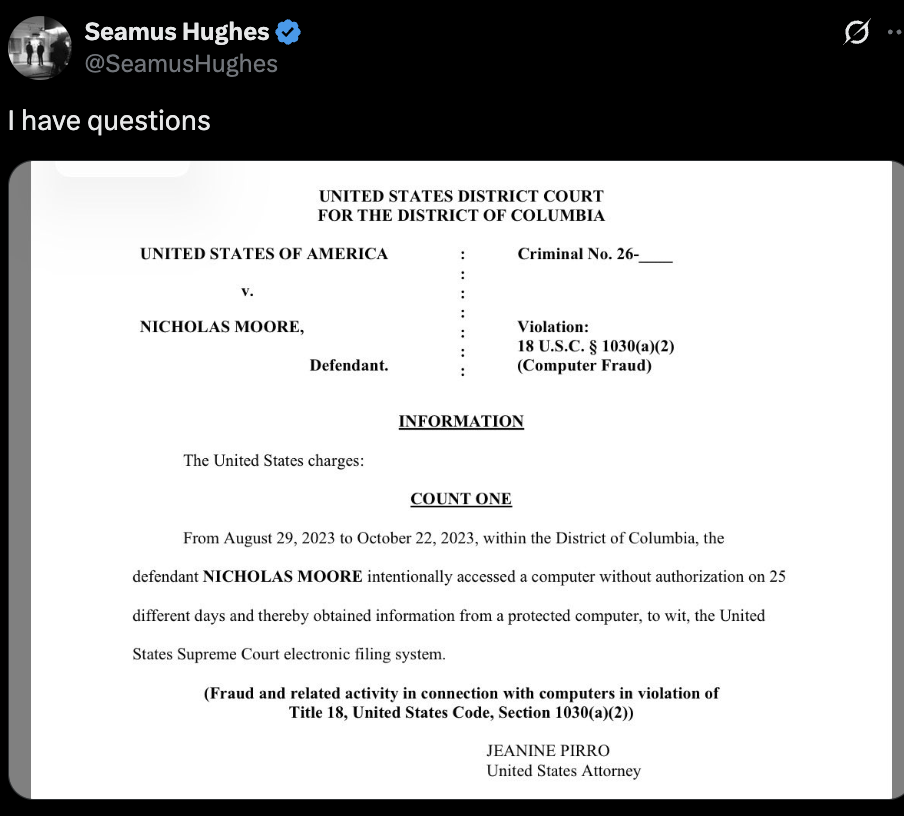
Court
Watch’s
Seamus
Hughes,
who
first
spotted
the
filing,
posted
his
reaction
on
X:
Indeed.
The
filing
is
notably
spare
on
details.
Maybe
Jeanine
Pirro
learned
that
less
is
more
if
she
needed
to
pursue
an
indictment
without
D.C.
grand
jurors
responding
with
a
resounding,
“Are
you
kidding,
lady?”
The
former
Fox
News
personality
who
now
serves
as
U.S.
Attorney
has
had
a
rough
go
of
it
in
D.C.,
between
the
juries
refusing
to
convict
and
judges
openly
questioning
whether
her
office
understands
basic
Fourth
Amendment
principles
—
but
now
she’s
found
a
case
where
the
defendant
is
just
going
to
plead
guilty
and
save
her
the
risk
of
another
embarrassing
fail.
The
charge
itself
rests
on
the
Computer
Fraud
and
Abuse
Act,
a
statute
prosecutors
love
the
way
DIYers
love
duct
tape.
The
CFAA
is
intended
to
put
sophisticated
hackers
in
prison,
but
in
practice,
prosecutors
deploy
it
whenever
a
computer
makes
someone
feel
bad.
Its
vague
“unauthorized
access”
language
has
become
a
hammer
used
against
people
for
logging
into
computers
when
company
policy
should
have
blocked
access.
It’s
a
computer
crime
law
written
for
an
era
where
our
grasp
of
the
technology
came
from
movies
like
The
Net,
with
that
girl
from
the
bus.
Did
Moore
maliciously
hack
into
the
system,
or
did
he
just
walk
blithely
through
an
open
door?
Unfortunately,
it
wouldn’t
matter
much
under
the
CFAA.
Prosecutors
told
TechCrunch
they
“cannot
provide
any
more
information
that
hasn’t
already
been
made
public.”
But
based
on
the
bare-bones
of
the
Information,
the
defendant
only
gained
access
to
the
electronic
filing
system
as
opposed
to
the
Court’s
emails
or
document
management
system.
Moore
presumably
wasn’t
getting
access
to
internal
deliberations
or
Clarence
Thomas’s
next
billionaire-funded
luxury
vacation
through
the
filing
system.
Not
to
downplay
the
seriousness
of
the
breach
—
insider
access
to
the
filing
system
would
afford
access
to
any
sealed
documents
—
but
this
doesn’t
sound
like
the
start
of
a
future
Dobbs
leak.
Are
they
any
better
in
2026?
If
they
approached
cybersecurity
with
the
same
vim
and
vigor
they
brought
to
revamping
the
Court’s
ethical
code,
let’s
say
no.
With
the
Supreme
Court
potentially
poised
to
invalidate
recent
tariffs,
organizations
face
a
confusing
scenario:
the
possibility
of
some
$200B
in
refunds
to
be
sought,
the
specter
of
tariff
reinstatement
through
other
means,
and
general
ongoing
unpredictability
regarding
costs
and
processes
for
global
trade.
Having
clear
visibility
into
contract
terms
—
such
as
price
adjustments
and
renegotiation
provisions
—
is
essential
to
navigating
this
volatility,
while
implementing
favorable
terms
in
supplier,
customer,
and
partner
agreements
can
help
build
resilience.
Tune
in
to
legal
and
technology
leaders
including
Bob
Ambrogi
of
Above
the
Law,
Jonathan
Todd,
Vice
Chair
of
the
Transportation
&
Logistics
Practice
Group
at
Benesch
Law,
and
Hal
Marcus,
Legal
AI
Evangelist
at
Workday
for
a
CLE-approved
webinar
focused
on
practical
solutions
to
help
organizations
thrive
through
uncertainty.
Come
join
us
on
January
27th
at
1
p.m.
ET
and
we’ll
discuss
the
current
state
of
the
tariff
conundrum
and
explore
strategies
for
achieving
contract
visibility
with
the
latest
AI
innovations.
In
this
session,
you’ll
learn
how
to:
How
to
find
the
tariff-related
contractual
answers
you
need
quickly
and
easily
just
by
asking
questions.
How
to
continuously
rank,
classify,
and
summarize
financial
terms
—
without
even
having
to
ask.
Strategies
to
mitigate
supply
chain
disruptions
and
cost
volatility
with
negotiated
terms.
Real-world
examples
of
businesses
leveraging
AI-powered
contract
data
to
overcome
challenges.
Learn
how
contract
intelligence
can
help
you
confidently
navigate
uncertainty
and
protect
your
bottom
line.
Wait,
what?
Some
recent
research
reveals
a
gap:
70%
of
legal
tech
investment
targets
vendors
who
focus
on
the
40%
of
time
lawyers
actually
spend
on
things
like
legal
research?
Why?
Some
research
findings
reported
by
Hwang
Jae
Hyuk
suggest
this
very
thing.
Hyuk
is
the
founder
and
CEO
of
a
company
called
AdminLess.AI
which
appears
to
focus
on
automating
administrative
work
for
law
firms.
I
don’t
know
Hyuk
and
can’t
vouch
for
his
findings.
But
they
sound
consistent
with
what
I
have
observed
and
seen.
I’ll
spell
out
the
why
in
a
moment.
But
first
let’s
look
at
what
he
says
in
a
recent
LinkedIn
post.
The
Findings
Hyuk
says
lawyers
and
legal
professionals
spend
60%
of
their
time
on
administrative
work
like
file
organization,
back-office
stuff,
and
verification
(which
I
assume
means
in
part
verifying
cites
provided
by
GenAI
output).
Much
of
this
stuff
is
nonbillable;
Hyuk’s
findings
are
generally
consistent
in
this
regard
with
what
Clio’s
yearly
Legal
Trends
Reports
have
consistently
found.
Forty
percent
of
lawyer
time
according
to
Hyuk
is
spent
on
the
legal
work
lawyers
really
like
doing:
the
research
and
intellectually
challenging
activities.
Yet,
according
to
Hyuk,
investors
in
legal
tech
vendors
focus
70%
of
their
dollars
on
those
that
provide
the
sexy
stuff:
research
tools,
contract
AI,
and
e-discovery.
Many
of
these
tools
are
based
on
GenAI.
He
notes
that
only
six
well-known
legal
tech
providers
focus
on
the
60%
while
over
15
providers
focus
on
the
40%.
He
asks
the
very
legitimate
question:
“Why
this
massive
gap
between
what
lawyers
do
and
what
the
industry
builds?”
The
gap
is
particularly
surprising
since
it
is
the
60%
work
that
AI
tools
and
automation
can
do
really
well
and
accurately.
The
40%
work,
the
legal
research?
The
focus
of
vendors
here
is
on
using
GenAI
to
do
this
kind
of
work,
which
frankly
it’s
not
all
that
great
at.
It
makes
mistakes.
It
hallucinates.
It’s
inaccurate.
And
as
Hyuk
notes
and
about
which
Melissa
Rogozinski
and
I
have
also
written,
it
requires
constant
verification
and
supervision.
Certainly,
one
could
argue
that
investors
are
following
that
effort
and
pouring
money
into
vendors
that
are
working
hard
to
eliminate
these
problems.
They
are
just
rewarding
vendors
who
are
spending
the
time
and
energy
on
the
GenAI
tools
to
make
them
better
and
eliminate
the
hallucinations
and
inaccuracies.
But
I
tend
to
think
it’s
not
necessarily
that
logical.
First,
the
stuff
that
the
six
companies
Hyuk
references
as
working
on
tools
to
better
and
more
efficiently
deal
with
the
60%
–Docusign,
Filevine,
NetDocuments,
Clio,
Smokeball,
and
8am
(which
he
refers
to
as
MyCase,
which
was
the
company
name
pre-recent
rebranding)
—
are
doing,
well,
boring
stuff.
(My
apologies
to
all.)
It’s
not
sexy
stuff.
It’s
back-office
work:
billing,
collections,
intake,
payments,
etc.
Stuff
that’s
not
billable
but
eats
up
incredible
amounts
of
many
lawyers’
and
legal
professionals’
days.
And
pardon
the
sports
reference
but
since
we
are
in
football
playoff
season
here
in
the
US,
it’s
the
blocking
and
tackling
work
that
has
to
be
done
for
the
quarterbacks
and
wide
receivers
of
the
world
to
shine.
To
enable
the
lawyers
and
legal
professionals
to
do
what
they
are
good
at
and
like
doing.
It’s
the
kind
of
work
in
sports
and
in
the
real
world
that
rarely
gets
the
attention
that
other
work
does.
But
it’s
just
as
important
if
not
more
so.
GenAI
for
GenAI’s
Sake
Another
reason
for
the
gap:
much
of
the
60%
work
is
done
not
by
GenAI
tools
but
by
standard
AI
tools
and
automation.
Granted,
I
know
from
writing
about
and
observing
legal
tech,
that
the
six
companies
Hyuk
names
are
working
on
GenAI
tools
to
build
on
what
they
do
best.
But
it’s
to
achieve
their
mission
to
provide
a
core
product
to
do
the
important
but
often
boring
business
part
of
running
a
law
firm.
Their
view
is
if
a
GenAI
tool
can
make
what
we
offer
better,
we
will
offer
it.
If
not,
we
won’t.
The
15
companies
mentioned
focusing
on
the
40%
of
lawyers’
work
often
narrow
their
focus
to
GenAI
and
GenAI
only,
trying
to
make
it
work
where
it
doesn’t
fit.
To
offer
GenAI
tools
for
GenAI’s
sake
as
opposed
to
solving
real
problems
and
pain
points.
But
because
GenAI
is
all
the
rage
these
days,
investors
flock
to
those
providers
who
are
selling
new
and
shiny
toys.
The
investors
are
betting
that
the
customers
of
these
vendors
will
also
flock
to
the
new
and
shiny
toys
even
though
there
may
still
be
challenges
with
them
and
their
implementation.
And
in
spite
of
the
fact
that
other
tools
that
aren’t
GenAI
can
still
solve
many
law
firm
challenges.
What’s
a
Lawyer
to
Do?
The
fact
that
Hyuk’s
gap
exists
given
the
challenges
with
GenAI
tools
should
in
and
of
itself
give
law
firms
some
pause
when
looking
at
AI
and
GenAI
tools.
It’s
legitimate
to
ask
whether
investors
are
pouring
money
into
GenAI
firms
because
it’s
the
thing
to
do
or
do
these
tools
offer
real
solutions
to
lawyers’
and
legal
professionals’
problems?
The
bottom
line:
law
firms
would
do
well
to
take
GenAI
vendor
claims
with
a
grain
of
salt.
They
need
to
ask
if
the
shiny
new
toy
will
solve
their
real
pain
points
or
will
just
add
work
to
check
and
verify
outputs.
This
requires
research
and
something
that
lawyers
and
legal
professionals
are
good
at:
skepticism.
Questioning.
Not
accepting
claims
at
face
value.
Lawyers
and
legal
professionals
have
the
analytical
tools
to
cut
through
vendor
hype.
So
use
them.
Stephen
Embry
is
a
lawyer,
speaker,
blogger,
and
writer.
He
publishes TechLaw
Crossroads,
a
blog
devoted
to
the
examination
of
the
tension
between
technology,
the
law,
and
the
practice
of
law.
I
was
in
Ukraine
this
fall.
While
I
was
there,
I
happened
to
be
in
Lviv
while
it
was
being
bombed
by
the
Russians
in
the
worst
assault
on
the
city
since
World
War
II.
Hundreds
of
explosions
rocked
the
city
for
hours.
Machine
guns
churned
in
the
distance.
Some
locals,
particularly
those
with
children,
heeded
the
air
raid
sirens
and
took
refuge
in
the
nearest
bomb
shelter,
these
provided
by
the
Ukrainian
government
and
the
owners
of
any
structures
sturdy
enough
to
withstand
a
cruise
missile
strike.
My
cousin
and
I,
probably
foolishly,
did
not
join
the
others
in
relative
safety.
We
watched,
awed,
senses
heightened,
adrenaline
coursing
through
our
veins.
I
felt
no
fear.
A
few
months
after
arriving
back
in
the
United
States,
I
had
the
misfortune
of
being
in
a
city
here
as
an
army
of
masked,
seemingly
unaccountable
ICE
agents
descended
upon
it.
Traffic,
the
crunch
of
snow
and
ice
beneath
my
boots,
the
occasional
distant
siren;
everything
sounded
normal.
It
did
not
feel
normal
though.
People
were
on
edge.
Lines
of
palpable
anxiety
were
etched
into
every
face.
The
recognition
of
distress
in
another
was
married
to
suspicion:
was
this
one
worried
that
ICE
would
kidnap
and
shoot
more
people,
or
worried
that
ICE
was
not
kidnapping
and
shooting
enough
people?
There
was
desperation,
hopelessness.
Five
innocent
people
were
killed
in
this
Russian
attack
on
Lviv.
Many
more
lost
their
homes.
These
losses
were
felt
universally,
even
by
relative
newcomers
like
me.
Still,
that
day
—
the
bombing
took
place
early
in
the
morning
—
was
the
most
collectively
joyous
one
I’ve
ever
been
a
part
of.
Lviv’s
coffee
shops
were
abuzz
in
the
morning.
Later,
crowds
of
people
packed
themselves
into
bars
and
restaurants,
drinking
toasts
to
the
fallen,
shouting
with
eyes
ablaze,
“Slava
Ukraini!”
Teens
gathered
around
boomboxes
in
public
spaces
and
danced.
Everyone
shared
unity
of
purpose.
We
were
alive.
We
gazed
upon
the
horrors
together,
and
didn’t
blink.
The
Russians
lost.
Their
dark
purpose
was
futile.
The
dead,
the
heroes,
the
victims
of
an
unfeeling
violence:
their
sacrifice
meant
something.
We
all
made
our
own
small
contributions
in
our
own
small
ways,
and
felt
honored
for
it.
Moreover,
we
were
assured
by
our
certainty
that
Russia
would
eventually
be
repaid
for
its
cruelty.
Bombing
campaigns
by
one
nation
against
the
civilian
population
of
another
in
order
to
break
the
spirit
of
the
people
never
work.
On
the
contrary,
they
have
the
exact
opposite
effect.
From
the
Blitz
against
Britain
in
WWII
to
our
own
misadventures
in
Vietnam,
the
survivors
are
only
galvanized.
It
feels
good
to
be
galvanized
against
a
great
external
evil.
I
felt
fantastic
in
Lviv.
Meanwhile,
as
the
largest
army
of
immigration
agents
ever
assembled
laid
siege
to
Minnesota,
fear
and
despair
were
rampant.
Fear,
because
these
masked
men
could
suddenly
appear
and
seemingly
murder
with
impunity.
Despair,
because
it
was
our
own
federal
government
waging
a
terror
campaign
against
its
people
and
there
wasn’t
anything
anyone
could
do
about
it.
Fighting
back
in
any
way
would
subject
you
to
arrest
or
worse.
Being
in
a
city
under
attack
by
your
own
government
is
chilling.
When
the
president
and
vice
president
of
your
country
label
the
slightest
act
of
defiance
“domestic
terrorism,”
and
make
clear
that
anything
they
assess
as
such
is
to
be
punishable
by
death,
even
as
they
lie
through
their
teeth
about
their
assessments
in
the
face
of
overwhelming
video
evidence
to
the
contrary,
that
is
very
demoralizing.
You
feel
powerless
when
the
only
thing
you
can
do
to
stem
the
violence
is
vote
in
the
next
election
and
pray
those
in
power
fail
in
their
next
attempt
to
storm
the
Capitol
or
send
fake
electors
or
whatever
other
devilish
evolution
their
designs
on
depravity
take.
You
can
expose
yourself
to
risk
through
protest
(and
I
did)
though
even
as
you
do
you
know
your
leaders
will
only
double
and
triple
down
in
response.
I
didn’t
even
see
ICE
agents
myself.
But
knowing
they’re
out
there
unseen,
lurking
somewhere,
perhaps
coming
to
your
neighborhood
next,
is
frightening.
This
is
why
Spielberg
didn’t
show
the
shark
for
the
first
half
of
“Jaws”
(well,
that
and
the
mechanical
shark
prop
was
on
the
fritz).
I
was
probably
at
more
risk
of
death
as
explosions
rocked
Lviv
than
I
was
as
agents
of
my
own
government
shoved
brown
people
into
vans.
Mentally,
however,
going
through
the
former
was
incredibly
uplifting
whereas
going
through
the
latter
has
proven
incredibly
depressing.
I
would
return
to
Ukraine
in
a
heartbeat.
I’d
happily
shake
my
fist
at
the
sky
and
curse
the
Russian
war
machine
as
drones
rained
down.
Being
in
a
city
selected
for
one
of
Trump’s
reprisals
against
his
own
constituents
is
unquestionably,
unequivocally,
unambiguously
worse.
Jonathan
Wolf
is
a
civil
litigator
and
author
of Your
Debt-Free
JD (affiliate
link).
He
has
taught
legal
writing,
written
for
a
wide
variety
of
publications,
and
made
it
both
his
business
and
his
pleasure
to
be
financially
and
scientifically
literate.
Any
views
he
expresses
are
probably
pure
gold,
but
are
nonetheless
solely
his
own
and
should
not
be
attributed
to
any
organization
with
which
he
is
affiliated.
He
wouldn’t
want
to
share
the
credit
anyway.
He
can
be
reached
at [email protected].
EHR
giant
Epic,
together
with
a
handful
of
healthcare
providers,
has
filed
a
federal
lawsuit
aimed
at
stopping
what
it
calls
a
scheme
to
exploit
and
monetize
patient
medical
records
without
consent.
The
complaint,
filed
January
13,
claimed
that
certain
companies
improperly
accessed
sensitive
health
information
and
then
sold
or
marketed
that
data
for
profit,
rather
than
using
it
for
legitimate
medical
care.
The
plaintiffs
are
Epic,
Trinity
Health,
UMass
Memorial
Health,
Reid
Health
and
OCHIN.
They
alleged
that
health
data
network
Health
Gorilla
enabled
other
companies
to
inappropriately
access
and
monetize
nearly
300,000
patient
medical
records.
Health
Gorilla
is
denying
the
allegations.
The
complaint
said
that
Health
Gorilla
and
a
network
of
other
companies
set
up
fictitious
healthcare
providers,
shell
websites
and
fake
provider
IDs
to
make
it
look
like
records
requests
were
for
real
treatment
purposes.
Instead,
the
data
was
allegedly
diverted
for
non-treatment
uses
—
such
as
marketing
to
lawyers
seeking
potential
claimants
for
lawsuits.
The
lawsuit
also
claimed
that
the
defendants
inserted
“junk”
information
into
records
to
hide
their
activity
and
give
the
appearance
of
genuine
care,
which
in
turn
risked
patient
safety
and
wasted
clinician
time.
When
one
fraudulent
entity
was
exposed,
the
same
actors
allegedly
created
new
companies
to
continue
the
same
conduct,
operating
“like
a
Hydra,”
according
to
the
complaint.
The
lawsuit
alleged
violations
of
HIPAA,
as
well
as
other
federal
and
state
privacy
protections.
It
also
framed
the
scheme
as
threatening
both
patient
privacy
and
the
integrity
of
interoperable
health
data
sharing
systems.
“At
stake
are
both
the
protection
of
patient
records
that
contain
some
of
a
person’s
most
sensitive
data,
such
as
genetic,
mental
wellbeing,
and
reproductive
information,
and
the
ability
of
physicians
to
keep
their
promises
to
patients
that
their
information
will
be
kept
private,”
the
complaint
read.
The
plaintiffs
argued
that
this
kind
of
misuse
undermines
trust
in
nationwide
interoperability
frameworks
by
turning
systems
designed
for
care
coordination
into
vehicles
for
data
harvesting.
The
plaintiffs
are
seeking
injunctive
relief
to
immediately
put
an
end
to
the
alleged
misconduct.
In
a
statement
sent
to
MedCity
News,
Health
Gorilla
said
that
this
litigation
is
“yet
another
example”
of
Epic
limiting
competition
and
restricting
data
access.
“These
actions
reflect
broader,
ongoing
concerns
raised
by
others
in
the
industry
and
by
government
actors
about
monopolistic
practices
in
health
information
exchange
by
Epic.
Health
Gorilla
supports
efforts
to
promote
competition,
patient
choice,
and
fair
access
to
healthcare
data,”
the
company
stated.
*
Supreme
Court
heard
challenges
to
laws
targeting
trans
athletes
and
the
argument
went
about
as
you’d
expect.
[Balls
and
Strikes]
*
Senior
federal
prosecutors
resign
in
response
to
the
Justice
Department’s
efforts
to
paper
over
the
murder
of
Renee
Good.
[CBS
News]
*
Tom
Goldstein
trial
could
feature
celebrity
witnesses.
[Law360]
*
School
voids
exam
—
that
students
already
took
—
after
similarities
to
past
exams
came
out.
[Legal
Cheek]
*
Supreme
Court
tariff
decision
looms
large.
Don’t
plan
on
that
$2000
rebate
check
that
Trump
promised
and
promptly
forgot
about.
[Reuters]
*
Judges
ask
defense
attorneys
to
either
challenge
the
new
prosecutorial
leadership
team
that
the
DOJ
imposed
or
waive
the
challenge.
You
know,
the
government
could
resolve
this
if
they
just
legally
appointed
someone
to
the
job.
[New
Jersey
Law
Journal]
*
Eli
Manning
announced
as
keynote
speaker
for
Legalweek.
Another
job
stolen
from
Danny
DeVito.
[ABA
Journal]
Pillsbury
Associates
Are
Eating
This
Bonus
Season!:
You
can
go
back
for
a
4th
plate
of
cash
if
you’ve
worked
hard
enough!
Lindsey
Halligan
Doubles
Down
On
Her
U.S.
Attorney
Acting
Role:
Asked
to
justify
themselves,
the
DOJ
threw
a
temper
tantrum.
Not
All
Money
Is
Earned
The
Right
Way:
Former
attorney
pleads
guilty
to
defrauding
clients
out
of
over
$4M.
It
Really
Is
A
Boston
Market!:
Haynes
&
Boone
opens
their
office
doors
in
Boston.
Charlotte
Gets
Another
Change
To
Make
Good:
Elon
University
plans
to
open
on
the
Queens
University
of
Charlotte
campus.