Mliswa claims ZDF commander PV Sibanda salutes Tagwirei in leaked audio

HARARE

Businessman
Bopela
Masiyakurima
on
Thursday
leaked
an
audio
recording
of
a
private
conversation
with
former
Zanu
PF
MP
Temba
Mliswa,
in
which
the
outspoken
politician
is
heard
claiming
that
fuel
magnate
Kudakwashe
Tagwirei
has
captured
Zimbabwe’s
military
and
is
being
positioned
as
President
Emmerson
Mnangagwa’s
successor.

In
the
recording,
Mliswa
alleges
that
Mnangagwa
has
secured
the
loyalty
of
the
armed
forces
through
Tagwirei’s
financial
muscle,
claiming
that
hundreds
of
vehicles
handed
to
the
Zimbabwe
Defence
Forces
last
week
did
not
come
from
the
government,
as
Mnangagwa
suggested,
but
from
the
Sakunda
Holdings
boss.

“Mnangagwa
will
leave
someone
he
trusts
to
look
after
his
interests,
and
that’s
Kuda.
There
is
no
coup
that
will
ever
happen
in
Zimbabwe.
Just
check,
military
bosses
were
given
100
cars.
Those
are
Kuda’s
cars,”
Mliswa
is
heard
saying.

He
goes
further
to
allege
that
ZDF
commander
General
Philip
Valerio
Sibanda
“salutes
Tagwirei”
when
he
passes
by,
underscoring
the
businessman’s
influence
over
the
military
hierarchy.


Mliswa
claimed
that
at
least
500
vehicles
would
be
distributed
not
only
to
top
commanders
but
also
to
colonels,
captains
and
majors,
calling
it
“good
politics”
as
mid-ranking
officers
are
the
ones
who
fight
wars.
He
also
revealed
he
was
travelling
the
country
distributing
bicycles
donated
by
Tagwirei
to
village
heads.

Masiyakurima
said
he
decided
to
record
the
conversation
after
rejecting
what
he
described
as
Mliswa’s
offer
to
join
a
campaign
backing
Tagwirei,
which
allegedly
came
with
promises
of
cash,
vehicles
and
support
for
his
business.

“When
I
realised
the
money
was
coming
with
conditions,
I
refused.
My
morals
and
principles
would
not
allow
me
to
be
a
sell-out,”
Masiyakurima
said.
“I
just
wanted
to
show
Zimbabweans
that
Temba
goes
to
the
highest
bidder.
He
has
been
recruited
by
Tagwirei
to
do
smear
campaigns
against
VP
Chiwenga.”

Reacting
to
the
leak,
Mliswa
accused
Masiyakurima
of
betrayal.

“As
for
you
Bopela,
I
considered
you
a
brother
and
friend
and
tried
to
help.
We
ate
and
took
children
to
school
together.
Unfortunately
you
had
other
ideas
to
please
who
I
don’t
know,”
Mliswa
wrote
on
X.

“Next
time,
leak
the
whole
conversation,
not
what
you
think
are
favourable
portions.”

Mliswa
has
in
recent
weeks
stepped
up
attacks
on
Chiwenga,
whom
he
accuses
of
double
standards
in
his
condemnation
of
corruption
by
a
group
of
business
elites
with
links
to
Mnangagwa.

Outspoken
war
veteran
Blessed
Geza
has
previously
alleged
that
the
former
Norton
MP’s
crusade
against
Chiwenga
was
sponsored
by
Mnangagwa
and
Tagwirei.

ZimLive
has
reached
out
to
the
ZDF
for
a
comment.

Robert Mugabe Jnr spends second night in custody after drug arrest

HARARE

Robert
Tinotenda
Mugabe,
the
33-year-old
son
of
the
late
former
president
Robert
Mugabe,
appeared
in
court
on
Thursday
facing
drug
possession
charges
following
his
arrest
in
central
Harare.

Mugabe,
of
Budleigh
Close
in
Helensview,
was
taken
into
custody
on
Wednesday
morning
after
police
allegedly
caught
him
driving
the
wrong
way
along
2nd
Street
Extension.

Prosecutor
Mandirasa
Chigumira
told
the
Harare
Magistrates
Court
that
when
officers
stopped
his
silver
Honda
Fit,
they
conducted
a
search
and
discovered
two
sachets
of
cannabis
weighing
two
grams
and
with
a
street
value
of
US$30
inside
a
sling
bag
he
was
carrying.

The
officers
also
allegedly
recovered
a
packet
of
rizla
papers
and
a
small
grinder.

Dressed
casually
in
a
track
bottom,
jacket
and
a
red
cap,
Mugabe
was
not
handcuffed
as
he
arrived
at
the
Harare
Magistrates’
Court,
where
he
walked
slowly
while
speaking
on
his
phone.

He
was
charged
with
possession
of
dangerous
drugs
and
remanded
in
custody
by
magistrate
Lisa
Mutendereki,
who
set
Friday
for
his
bail
hearing.

This
is
not
Mugabe
Jnr’s
first
brush
with
the
law.
In
February
2023
he
was
arrested
during
a
drunken
rampage
at
a
house
party
after
smashing
vehicle
windscreens
and
destroying
household
property.
The
case
was
withdrawn
after
he
paid
compensation.

If You Thought Rowdy Students Were Bad, Imagine Being Forced To Be A Mom – See Also – Above the Law

Justice
Thomas
Explains
That
He
Jumped
Ship
From
Comfy
Teaching
Gig
Because
The

Dobbs

Backlash
Amounted
To
“Unpleasantness”:
He
taught
students
at
a
GWU
law
school
who
all
volunteered
for
his
class.
How
much
backlash
was
there

really
?
Utah
Bets
On
The
Bar
Being
Optional:
Check
out
their
alternate
licensing
path!
Harvey
To
Your
Left,
Harvey
To
Your
Right:
The
LLM
is
taking
over
the
T14.
The
Chilling
Effect
Is
Real:
Firms
back
down
from
representing
the
ABA
on
Trump
matters.

Tough Crowd At Marquette Law School – Above the Law

Garbage…
like
this
complaint.
(Photo
by
Chip
Somodevilla/Getty
Images)


Learning
the
law
is
hard
enough
without
having
a
rule
of
law
crisis
happening
around
you.
Unsurprisingly,
being
the
figurehead
of
that
crisis
can
net
you
your
fair
share
of
ire.
Marquette
Law
School
recently
ran
a
poll
of
their
students

what
percentage
of
the
polled
students
view
Trump
favorably?


Hint:
The
actual
number
isn’t
too
far
off
of
45
and
47.


See the
answer
on
the
next
page.

Exclusive: Altorney Launches MARC; Gen AI-Powered System Automates First-Pass Review, Targeting Major Savings In E-Discovery

The
legal
technology
company

Altorney

today
announced
the
general
availability
of
MARC,
a
generative
AI-powered
document
review
system
designed
to
automate
first-pass
review
decisions
before
documents
enter
traditional
review
platforms.

After

first
announcing
MARC

last
March
and
going
through
a
pilot
period
with
corporate
legal
departments,
the
company
is
now
releasing
the
product
for
general
availability
to
corporate
legal
teams,
litigation
service
providers
and
law
firms.


The
Problem
MARC
Addresses

The
product
tackles
a
core
inefficiency
in
e-discovery
workflows:
organizations
typically
load
entire
document
sets
into
expensive
review
platforms,
only
to
cull
large
portions
as
non-responsive.

Shimmy
Messing
,
Altorney’s
CEO
and
co-founder,
says
this
approach
creates
unnecessary
costs
and
security
risks.

“If
you’re
loading
your
million
documents
into
a
review
platform,
as
an
example,
and
then
immediately
culling
out
800,000
of
them
for
not
hitting
keywords
or
not
being
part
of
TAR
or
whatever,
you
still
have
these
800,000
documents
sitting
there
in
your
database
that
you’re
paying
for
and
that
are
exposed
from
a
risk
factor
after
leaving
your
corporate
environment,”
Messing
said
during
a
demonstration
of
the
product
for
LawSites.

MARC’s
approach
is
to
automate
the
culling
and
initial
review
decisions
before
documents
reach
the
review
platform,
ideally
within
the
organization’s
own
environment.
This
means
only
relevant
documents

already
tagged
with
first-pass
decisions
on
issues
like
privilege,
confidentiality
and
responsiveness

are
loaded
into
expensive
hosting
platforms.


How
MARC
Works

MARC
operates
as
a
text
analytics
tool
that
sits
between
data
collection
and
the
review
platform.
The
system
is
agnostic
about
which
large
language
model
(LLM)
it
uses.
Organizations
can
deploy
MARC
with
Altorney’s
provided
Llama
model
installed
locally,
or
integrate
it
with
their
preferred
approved
models,
including
those
from
Azure
or
OpenAI.

MARC
can
operate
entirely
within
an
organization’s
firewall,
with
no
data
transmitted
externally.
“All
the
data
can
stay
there,”
Messing
said.
“Nothing
has
to
go
out
to
OpenAI
or
Azure
AI

it
can
all
be
contained
in
a
local
environment.”

This
approach
provides
security
while
also
reducing
costs,
as
local
LLMs
avoid
the
per-token
charges
associated
with
cloud-based
AI
services.


Rachi
Messing
,
Altorney’s
co-founder,
said
that
installation
typically
requires
just
30-40
minutes
of
IT
time,
after
which
the
system
is
largely
self-managing.


Protocol
Analysis,
Not
Prompt
Engineering

Among
MARC’s
distinguishing
features
is
its
deliberate
avoidance
of
requiring
prompt
engineering
by
users.

Rather
than
requiring
users
to
craft
precise
prompts

a
skill
Rachi
Messing
described
as
“really
hard
to
master”
and
prone
to
inconsistency

MARC
uses
what
it
calls
a
“protocol
analysis”
approach.


Creating
the
MARC
relevancy
protocol
from
the
background
materials.

With
this
approach,
users
upload
background
materials
about
a
case
into
a
folder.
These
materials
might
include
complaints,
subpoenas,
counterclaims,
pleadings,
or
even
informal
documents
like
an
email
from
in-house
counsel
outlining
a
new
matter
or
an
HR
complaint
in
an
internal
investigation.

MARC
then
generates
a
comprehensive
protocol
document
in
Microsoft
Word
format.
This
protocol
includes:

  • Identification
    of
    all
    parties
    involved.
  • Relevant
    date
    ranges.
  • An
    overview
    of
    the
    matter.
  • Key
    individuals
    and
    their
    roles.
  • Relevant
    technologies
    and
    products.
  • Different
    themes
    of
    the
    case.
  • Specific
    issues
    to
    identify
    within
    the
    dataset.

Attorneys
can
then
edit
this
Word
document
directly,
adding
missing
individuals,
removing
irrelevant
parties,
narrowing
overly
broad
themes,
or
adjusting
other
parameters.
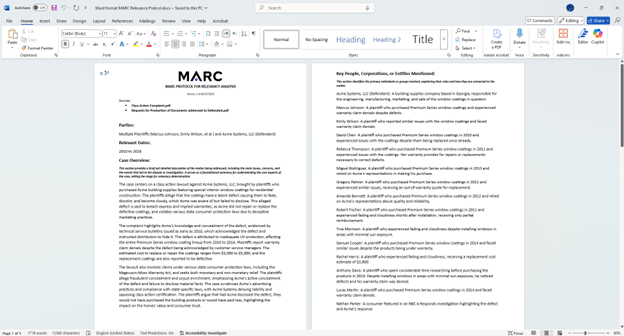


Example
of
the
protocol
created
by
MARC,
which
the
attorney
can
edit
and
resubmit.

The
edited
protocol
is
uploaded
back
into
MARC,
which
then
uses
it
as
the
foundation
for
all
subsequent
analysis.

This
approach
keeps
the
workflow
in
familiar
territory
for
legal
professionals,
Rachi
Messing
said.
“There’s
no
reason
we
need
attorneys
to
become
prompt
engineers,
but
they
love
editing
Word
docs.”


Processing
and
Validation

Once
the
protocol
is
finalized,
MARC
can
ingest
data
from
multiple
sources:
text
files
on
a
file
system,
Microsoft
Purview
exports
from
M365,
or
directly
from
Relativity
databases.
The
system
includes
an
integration
that
allows
users
to
point
MARC
at
specific
saved
searches
within
Relativity
without
actually
moving
the
data.



Integration
with
Relativity
to
analyze
docs
based
on
saved
search.

MARC’s
results
can
be
verified
through
a
sampling
and
validation
workflow.
The
system
automatically
determines
the
statistically
valid
sample
size
needed,
analyzes
those
documents
according
to
the
protocol,
and
tags
them
as
relevant
or
not
relevant
at
a
low
per-document
cost.
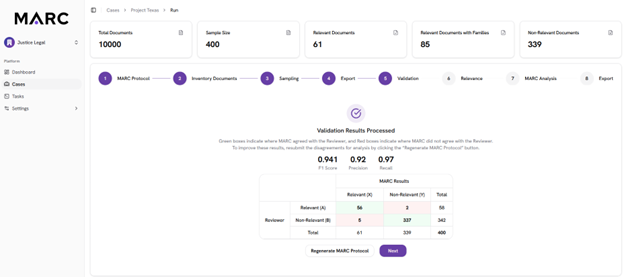


Statistical
sampling
and
validation.

These
sampled
documents
can
be
pushed
to
Relativity
or
exported
via
load
file
for
attorney
review.
Once
attorneys
validate
the
sample,
their
decisions
are
compared
against
MARC’s
determinations.
If
discrepancies
exist,
the
system
can
regenerate
the
protocol,
analyzing
what
needs
to
change
to
correctly
classify
the
disputed
documents
without
affecting
already
correct
decisions.
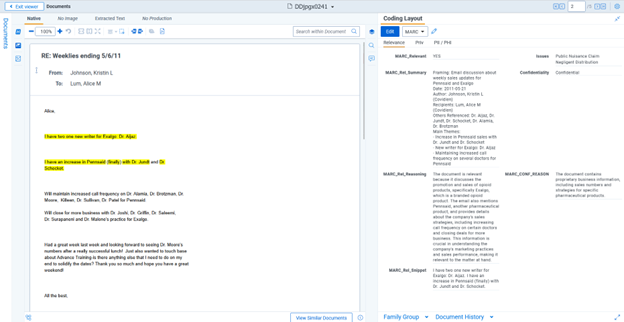


Viewing
a
relevant
result
in
Relativity.

This
iterative
process
continues
until
the
legal
team
is
satisfied
with
MARC’s
performance.
Then
the
full
dataset
is
processed,
at
a
rate
of
over
one
million
documents
per
24
hours.


Deep
Analysis
Capabilities

Beyond
simple
relevance
determinations,
MARC
can
perform
multiple
types
of
analysis
in
a
single
pass,
all
included
in
a
single
additional
cost.
These
analyses
include:


Privilege
Review
:
MARC
analyzes
documents
for
attorney-client
privilege
and
work
product
protection,
providing
reasoning
for
each
determination,
identifying
parties
involved,
noting
whether
privilege
was
potentially
waived
by
third-party
involvement,
assigning
confidence
levels,
and
automatically
generating
privilege
descriptions
suitable
for
privilege
logs.
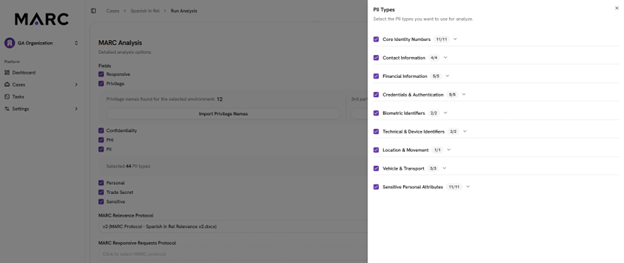


PII
analysis.


PII
and
PHI
Detection
:
The
system
identifies
personally
identifiable
information
and
protected
health
information
with
granular
control
over
what
types
to
flag.
Users
can
specify,
for
example,
that
they
only
want
to
identify
financial
information
and
health
information
while
ignoring
personal
email
addresses
or
phone
numbers.
MARC
performs
entity
analysis,
associating
information
across
a
document
even
when,
for
instance,
a
person’s
name
appears
on
page
two
and
their
Social
Security
number
on
page
seven.


Issue
Coding
:
The
system
can
tag
documents
according
to
case-specific
issues
defined
in
the
protocol.


Confidentiality
Analysis
:
MARC
evaluates
documents
for
confidentiality
designations,
including
trade
secrets
and
other
sensitive
business
information.


Hot
Document
Identification
:
The
system
can
flag
potentially
significant
documents
requiring
priority
review.


Foreign
Language
Processing
:
MARC
automatically
translates
and
summarizes
documents
in
foreign
languages,
allowing
English-language
protocols
to
analyze
non-English
documents
and
providing
summaries
in
English
for
reviewers.


Output
and
Transparency

For
every
document
it
processes,
MARC
provides
not
just
a
decision
but
also
its
reasoning.
In
the
demonstration,
one
example
showed
MARC
tagging
a
document
as
not
relevant.
Its
explanation
detailed
that,
although
the
document
mentioned
UV
protection
technology,
which
could
potentially
make
it
relevant,
it
concerned
exterior
paint
rather
than
interior
window
coatings,
making
it
irrelevant
to
the
specific
case.

This
transparency
serves
multiple
purposes.
It
allows
legal
teams
to
understand
and
validate
the
AI’s
decision-making
process,
provides
documentation
for
defensibility,
and
helps
identify
where
the
system
might
need
refinement
through
protocol
adjustments.



Export
using
Relativity
integration.

Documents
are
also
enriched
with
summaries
and,
for
relevant
documents,
snippets
highlighting
the
most
pertinent
portions.
All
this
information
can
be
exported
or
integrated
directly
back
into
Relativity.


Cost
Savings
and
Predictability

Altorney
says
that
in
the
pilot
program
testing
of
MARC,
users
saw
significant
efficiency
gains.

The
company
highlighted
one
Fortune
500
company
case
involving
more
than
200,000
documents
where
MARC
achieved
62%
review
cost
savings
and
78%
hosting
cost
savings.
The
company
claims
an
80%
reduction
in
documents
transferred
to
hosted
review
platforms
and
an
86%
reduction
in
cycle
time
compared
to
traditional
review.

Its
costs
are
also
predictable
with
a
high
degree
of
precision,
the
company
says.
In
one
proof-of-concept
with
30,000
documents,
Altorney
provided
the
customer
with
a
budget
estimate
of
$2,500.
The
actual
cost
came
in
at
$2,506

a
level
of
budget
predictability
the
customer’s
AI
team
said
they
had
never
before
had
with
an
AI-based
product.
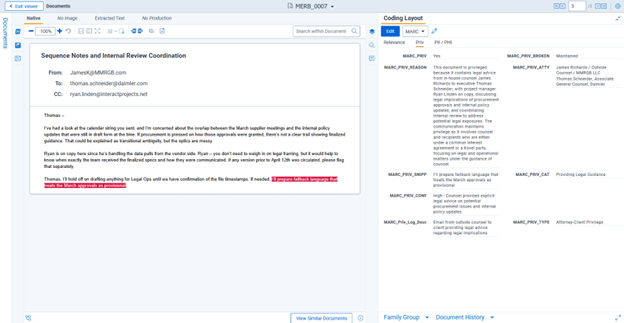


Viewing
a
privilege
result
in
Relativity.

Rachi
Messing
emphasized
that
beyond
cost
savings,
the
technology
addresses
human
inconsistency
in
review.
“You
give
the
same
document
to
four
different
attorneys
and
you’ll
come
out
with
four
different
decisions.”

In
tests
comparing
MARC’s
decisions
to
completed
human
reviews,
customers
found
that
discrepancies
often
revealed
human
reviewers
had
been
either
over
broad
or
over
narrow,
allowing
them
to
tune
MARC
to
find
what
they
actually
needed.


An
Expanding
Market

When
Altorney
initially
launched
MARC
in
March,
it
focused
exclusively
on
corporate
legal
departments
for
behind-the-firewall
deployment.

The
reasoning
for
that
limited
focus
was
both
technical
and
strategic.
The
company
believed
that
culling
should
happen
within
the
corporate
environment
before
data
leaves
for
external
review
platforms,
reducing
both
costs
and
security
risks.

However,
the
market
quickly
pushed
the
company
to
expand
its
approach.
Some
corporate
customers
expressed
strong
interest
in
using
the
product
but
indicated
that
internal
security
and
IT
approval
processes
could
take
up
to
two
years.

These
customers
asked
to
host
MARC
at
their
preferred
litigation
service
providers,
which
would
enable
them
to
accelerate
deployment
while
still
achieving
cost
savings
from
reduced
data
volumes.

Once
the
LSPs
were
on
board
and
began
using
the
product,
they
wanted
to
also
be
able
to
use
it
with
their
law
firm
customers.
That
led
Altorney
to
open
the
platform
to
law
firms.

“We’ve
now
opened
it
up
and
a
lot
of
LSPs
and
law
firms
are
hopping
on
board
and
have
it
installed
in
their
environments
as
well,”
Shimmy
Messing
said.


Pricing
Model

MARC
uses
volume-based
pricing
with
two
tiers.
The
initial
relevance
determination
costs
just
pennies
per
document
or
less.

Additional
analysis

including
privilege,
confidentiality,
issue
coding,
PII,
PHI
and
other
determinations

is
also
priced
at
a
single
per-document
rate
of
just
a
few
cents,
depending
on
volume.

Notably,
organizations
can
rerun
analyses
without
additional
charges
if
requirements
change,
such
as
modifications
to
a
confidentiality
order.


Humans
in
the
Loop

Despite
the
automation,
Altorney
emphasizes
that
MARC
is
designed
to
keep
humans
involved
in
the
review
process.

“GenAI
doesn’t
eliminate
the
need
for
human
oversight

but
it
enables
the
right
human
to
be
in
the
right
place
at
the
right
time
to
optimize
their
value,”
said

Stephen
Goldstein
,
the
company’s
chief
product
officer.

Rather
than
replacing
human
reviewers
entirely,
Altorney’s
vision
for
MARC
is
to
transform
first-pass
review
into
quality
control
review,
allowing
reviewers
to
then
work
two
to
three
times
faster
on
a
smaller
set
of
more
important
documents.

Shimmy
Messing
acknowledged
that
while
some
users
might
eventually
feel
comfortable
producing
documents
straight
from
MARC
without
human
review,
most
currently
prefer
having
“eyes
on
everything,”
using
MARC’s
determinations
to
accelerate
rather
than
replace
human
judgment.


‘The
Ultimate
Truth
Seeker’

Altorney
was
founded
by
brothers
Shimmy
and
Rachi
Messing
in
late
2021.
The
company
initially
focused
on
its
Altorney
platform,
a
marketplace
for
document
reviewers
and
legal
talent,
which
launched
at
Legalweek
in
2022.

MARC
emerged
from
a
collaboration
with
Goldstein,
now
the
chief
product
officer
and
formerly
global
director
of
practice
support
at
Squire
Patton
Boggs.
Last
year,
he
approached
the
Messings
with
work
he’d
been
doing
on
using
gen
AI
for
first-pass
review.

After
evaluating
his
technology,
they
decided
to
productize
it,
spending
the
latter
half
of
2024
and
early
2025
developing
MARC
into
a
commercial
product.

The
product
name
honors
the
founders’
late
father,
Marc
Messing,
an
attorney,
rabbi
and
educator
who
died
of
pancreatic
cancer
in
2021.
Shimmy
Messing
described
him
as
“the
ultimate
truth
seeker,”
making
the
name
appropriate
for
a
tool
designed
to
find
truth
in
document
sets.

Both
founders
have
extensive
backgrounds
in
the
e-discovery
industry,
having
both
started
their
careers
at
Merrill
Corporation
in
the
early
2000s.

With
MARC
now
generally
available,
Shimmy
Messing
told
me,
Altorney
positions
itself
as
a
“boutique
coding
shop”
creating
“elegant,
unconventional
legal
software”
that
addresses
persistent
pain
points
in
legal
work

first
with
legal
talent
sourcing
through
its
Altorney
platform,
and
now
with
AI-powered
document
review
through
MARC.


Justice That Said Abortion Is Unconstitutional Fails To Carry Semester To Term – Above the Law

(Photo
by
Drew
Angerer/Getty
Images)

Prepare
the
world’s
tiniest
violin,
my
friends.
At
a
recent
Catholic
University
Law
School
event,
while
sharing
his
thoughts
on
life,
the
universe,
and
everything
with
his
former
clerk
Jenn
Mascott
(currently
nominated
to
the
Third
Circuit

despite
a
complete
lack
of
connections
to
the
state
of
Delaware
),
Justice
Clarence
Thomas
explained
that
he

put
the
brakes
on
his
George
Washington
Law
teaching
gig

after
Dobbs
because
of
“unpleasantness.”

Oh
no!
The
horror.
Unpleasantness,
you
say?

What
an
absolute
snowflake.

He
didn’t
want
to
keep
teaching
a
class…
where
he
had
all
the
power,
controlled
the
syllabus,
the
grading,
and
the
air
conditioning.
A
class
populated
by
students
who,
almost
certainly,
skewed
mostly
his
way
(who
else
is
taking
a
Thomas
class?).
Come
on,
man!
I
know
you
prefer
hanging
out
with
fawning
admirers

willing
to
pay
for
your
luxury
vacations
,
but
if
you’re
going
to
do
this
job,
you’ve
got
to
be
able
to
handle
a
couple
side-eyes
in
a
seminar
room.

You
know
what’s
unpleasant?
People
having
forced
births
because

a
witchhunter
from
the
1600s

said
so.
It’s
the
same
thing
with

Amy
Coney
Barrett’s
recent
lament

that
her
family
forced
her
to
make
some
coherent
legal
justification
for
her
superlegislature
cosplay
to
overturn
longstanding
Constitutional
rights.
Sorry
gang,
you
don’t
get
to
run
away
because
someone
points
out
that
your
“deeply
rooted
in
history
and
tradition”
arguments
are
about
as
historical
as
the
History
Channel.
And
even

Ancient
Aliens

is

better
sourced
than
these
Second
Amendment
opinions
.

Honestly,
the

Ancient
Aliens

comparison
is
more
apropos
than
it
might
seem
at
first
blush.
You
know
how
every
episode
involves
the
same
rotating
panel
of
talking
heads
whether
they’re
explaining
how
Egyptians
and
Mesoamericans
couldn’t
possibly
have
independently
come
up
with
the
idea
for
a
pyramid
despite
being
the
most
intuitive
design
imaginable
or
how
angels
look
like
astronauts?
That’s
because
the
conspiracy
theory
world
is
a
big
circle
jerk
of
pseudo-academics.
Now,
for
a
fun
experiment,
check
out
the
“history”
the
conservative
legal
movement
cites
in
their
opinions.
Notice
how
it’s
mostly
secondary
law
review
articles
published
by
former
clerks
turned
academics
slapping
together
shoddy,
cherry-picked
research
to
paper
up
the
thesis
that
the
Fourteenth
Amendment
was
a
scrivener’s
error?
Idea
laundering
in
action,
all
to
prevent
the
judges
from
having
to
stand
behind
the
history
directly…
it’s
been
vetted
(by
3L
law
review
editors,
anyway)!

But
that’s
the
thing.
These
people
are
just
too
chickenshit
to
stand
behind
their
principles
in
the
face
of
vague
disdain.
During
the
civil
rights
era,
judges
faced
actual
terroristic
threats

the
Chief
Justice
highlighted
this
in
his
annual
report,

before
comparing
those
threats
to
being
criticized
by
law
bloggers


but
stood
by
their
decisions.
That’s
not
where
this
movement
is.
They’ve
got
two
modes:
shocked
pearl-clutching
that
anyone
would
be
so
impolitic
to
question
their
delicate
genius
and

active
troll
.
And
both
flavors
rest
on
the
cloistered,
unaccountable
perch
they’ve
fashioned
for
themselves
to
enact
policy
from
the
bench
well
beyond
anything
imagined
by
the
Framers.
The
throughline
of
the
conservative
legal
movement
is
taking
reckless,
unaccountable
fiat
and
equating
it
with
jurisprudential
bravery.

If
it’s
unpleasant
to
hear
a
few
students
question
your
historical
fan
fiction,
maybe
don’t
reshape
the
lives
of
millions
based
on
it.


Earlier
:

Clarence
Thomas
Quits
Law
School
Class,
Depriving
Students
Of
BOTH
Sides
Of
The
‘Do
Gay
People
Have
Human
Rights?’
Debate


Amy
Coney
Barrett’s
Fetish
For
Phony
Reluctance


Chief
Justice
John
Roberts
Thinks
You’re
Stupid
And
He’s
Probably
Right


HeadshotJoe
Patrice
 is
a
senior
editor
at
Above
the
Law
and
co-host
of

Thinking
Like
A
Lawyer
.
Feel
free
to email
any
tips,
questions,
or
comments.
Follow
him
on Twitter or

Bluesky

if
you’re
interested
in
law,
politics,
and
a
healthy
dose
of
college
sports
news.
Joe
also
serves
as
a

Managing
Director
at
RPN
Executive
Search
.

Harvey Snags Even More Seats In The T14! – Above the Law

If
you
thought
it
was
hard
to
get
in
to
a
T14
as
a
student,
imagine
the
uphill
battle
you’d
be
facing
if
you
were
selling
them
software!
Most
law
schools
are
so
conservative
in
their
approach
to
teaching
devices
that
their
only
student-focused
large
language
model
is
the
Bluebook.
Despite
the
challenges,
Harvey
convinced
Stanford,
UCLA,
NYU
and
Notre
Dame
to
adopt
the
AI
in
order
to

experiment
with
their
students

keep
generations
of
future
lawyers
on
the
cutting
edge
of
legal
tech.
That
was
back
in
August.
Since
then,
Harvey
boosted
their
presence
in
several
additional
prestigious
law
schools.
According
to
their
website,
the
new
law
schools
welcomed
to
the
fold
are:
WashU,
Penn,
UChicago,
Boston
University,
Fordham,
BYU,
UGA,
Villanova,
Baylor,
SMU,
and
Vanderbilt.
This
list
isn’t
in
order
of
acquisition
of
course

just
personal
preference.

For
anyone
wondering
about
the
score,
Harvey
landed
8
of
the
17
top
14
law
schools
in
the
country!

That
isn’t
a
typo
by
the
way
.
Maybe
the
inclusion
of
Harvey
will
be
the
thumb
on
the
scale
the
schools
need
to
bring
us
back
to
a
list
of
14
that
actually
makes
sense.
That
said,
if
the
schools
that
added
Harvey
to
their
repertoire
fall
in
rank
while
the
ones
that
abstained
go
up,
it
might
not
be
the
best
look
for
the
LLM
specifically
catered
to
law.
A
word
to
the
students:
no
matter
how
good
the
AI
is,
remember
that
you’re
ultimately
the
one
that
has
to
do
the
learning.
You
shouldn’t
need
to
be
humbled
by
a
closed
book
written
exam
before
you
take
that
to
heart.


UChicago,
Penn,
Vanderbilt,
WashU,
Boston
University,
Fordham,
BYU,
UGA,
Villanova,
Baylor,
SMU
Join
:Harvey:
Law
School
Program

[Harvey.ai]

Earlier:

Harvey
Begins
Law
School
Program
To
Get
Students
Hooked


Chris
Williams
became
a
social
media
manager
and
assistant
editor
for
Above
the
Law
in
June
2021.
Prior
to
joining
the
staff,
he
moonlighted
as
a
minor
Memelord™
in
the
Facebook
group Law
School
Memes
for
Edgy
T14s
.
 He
endured
Missouri
long
enough
to
graduate
from
Washington
University
in
St.
Louis
School
of
Law.
He
is
a
former
boatbuilder
who
is
learning
to
swim, is
interested
in
critical
race
theory,
philosophy,
and
humor,
and
has
a
love
for
cycling
that
occasionally
annoys
his
peers.
You
can
reach
him
by
email
at [email protected]
and
by
tweet
at @WritesForRent.

Work The Workflows: Creating And Relying On Flowcharts, Decision Trees, Processes, And To-Do Lists For Your Cases – Above the Law

Maybe
it’s
my
OCD,
or
being
a
nerd
(I
know,
shocking),
or
being
a
control
freak
(did
I
mention
my
OCD),
but
I
am
a
massive
proponent
of
reducing
the
types
of
cases
you
handle
to
a
series
of
checklists
and
workflows.
No
matter
how
complex
or
varied
your
cases
are,
or
their
quantity,
creating
a
written,
step-by-step
process
for
handling
each
type
of
case
will
increase
efficiency,
quality
control,
and
outcomes.

This
approach

reducing
your
caseload
to
a
set
of
processes
that
serve
as
a
tool
to
ensure
you
consider
all
the
various
methods
and
steps
in
your
cases

is
often
overlooked
because
it
is
time-consuming,
non-billable,
and
requires
regular
review
and
updates
(these
checklists
must
be
reviewed
and
updated
periodically).
Additionally,
some
lawyers
believe
their
cases
are
too
complex
to
be
reduced
to
step-by-step
processes. 
What
they
do
is
so
unique,
so
intellectual,
that
it
cannot
possibly
be
reduced
to
checklists. 
And
yes,
we
are
not
automatons,
and
we
cannot
simply
follow
decision
trees
automatically.
However,
I
would
argue
that,
regardless
of
complexity,
50-90%
of
every
case
can
be
reduced
to
checklists. 
And
that
merely
the
effort
to
look
at
your
cases
and
write
out
how
you
handle
them
from
beginning
to
end
will
make
you
a
better
lawyer.

I
handle
a
variety
of
litigation-based
matters. 
Throughout
my
career,
I
have
litigated
a
wide
range
of
cases,
from
asbestos
to
zoning,
and
everything
in
between. 
And
early
in
my
career,
I
looked
at
my
cases
from
the
vantage
point
of

what
is
every
possible
thing
I
can
do
in
the
case
and
what
makes
sense
under
different
sets
of
circumstances.
And
I
wrote
out
checklists. 
Not
just
for
me,
but
for
everyone
on
the
team,
to
ensure
we
were
all
moving
in
the
right
direction,
pursuing
the
proper
goals,
and
advancing
the
client’s
objectives.
As
I
handled
more
of
the
same
matters,
I
refined
my
checklists
to
accommodate
my
increasing
experience
and
knowledge.

If
you
can
see
your
whole
cases,
from
pre-suit
through
trial,
you
are
taking
those
actions
that
advance
your
goals
(and
refraining
from
those
that
don’t).
If,
conversely,
you
are
relying
on
what’s
in
your
head
about
tactics,
steps,
and
approaches,
you
will
likely
miss
one
or
more
crucial
aspects
of
your
case.

So,
how
do
you
reduce
your
matters
to
a
series
of
checklists?

First,
define
the
different
matters
you
handle.
If
all
you
handle
is
litigation,
then
there
will
be
a
lot
of
transferable
to-do
lists
from
one
type
of
matter
to
another
(serving
discovery
and
third-party
subpoenas,
retaining
experts,
deposing
parties,
etc.).
For
me,
my
list
would
include,
among
other
items,
commercial
litigation
(breach
of
contract,
non-competes,
IP,
etc.),
personal
injury
(trucking,
auto,
premises,
negligent
security),
products
(one-off
products,
drug
&
medical
device,
toxic
tort,
etc.),
and
so
on. 

Second,
I
would
then
take
my
categories
and
create
a
workflow
for
each,
writing
out
each
step,
aspect,
and
off-ramp
of
that
case.
I
would
literally
type
every
little
and
big
thing
I
can
do
when
handling
that
type
of
matter
into
a
Word
document

the
more
steps,
the
more
to-dos,
the
more
checklists,
the
more
detail,
the
better.
  

Third,
I
would
share
it
with
my
team
for
their
input,
and
ask
them
to
add,
revise,
and
augment
these
lists. 

Fourth,
whenever
I
started
on
a
new
matter,
I
would
share
the
appropriate
list
for
the
proper
case
and
have
everyone
type
their
notes
into
this
document
about
the
steps
being
followed,
taken,
or,
for
that
matter,
avoided.
This
document
will
serve
as
a
single
source
of
information,
helping
everyone
keep
track
of
what
has
been
done
and
what
remains
to
be
done.
This
works
whatever
side
of
the
“V”
you’re
on.

Fifth,
the
way
we
handle
cases
evolves,
and
these
checklists
will
be
updated
during
the
litigation
process
to
reflect
that.

Is
this
a
lot
of
work?
Yes.
A
lot
of
non-billable
work?
Yes.
But
these
checklists
will
keep
you
and
your
team
focused
on
what
needs
to
be
done,
when,
and
how.
Without
such
controls,
you
are
constantly
reminding
yourself
and
your
team
what
to
do
next.
This
reduces
unnecessary
control
and
micro
supervision
of
your
matters.

Consider
this
approach
not
just
for
your
matters,
but
for
all
your
firm’s
matters,
to
improve
efficiency,
avoid
mistakes,
and
enhance
outcomes.


Frank
Ramos
is
a
partner
at
Goldberg
Segalla
in
Miami,
where
he
practices
commercial
litigation,
products,
and
catastrophic
personal
injury. You
can
follow
him
on LinkedIn,
where
he
has
about
80,000
followers
.

From AI Tools To AI Orchestration: How Law Firms Can Take The Next Steps – Above the Law

When
it
comes
to
artificial
intelligence,
law
firms
that
take
an
early
implementation
lead
are
positioning
themselves
for
compounding
advantages
in
the
years
to
come.

So
how
can
you
beat
your
competitors
in
advancing
from
“tool
mode”

where
individual
applications
solve
problems
in
isolation

to
more
holistic
AI
adoption?

Join
us

October
21st
at
1
p.m.
ET

for
this
discussion
about
effective
and
ethical
AI
implementation
in
midsize
and
large
law
firms.

We’ll
explore
how
your
firm
can:

Drive
value
through
customization

Maintain
effective
governance
and
data
security

Reach
the
next
stage
of
maturity
in
AI
adoption

From Fly-By-Night To Looking Fly: Starting A Law Firm On The Fly In 2025 – Above the Law

In
today’s
volatile
political
climate,
many
lawyers
are
finding
themselves
forced
to
start
a
firm
on
the
fly

either
due
to
a

clash
of
values
with
Biglaw
 or termination
from
government
service
 or
possibly
even
displacement
by
AI.
 Regardless
of
the
reason,
these
suddenly
solos
don’t
have
the
luxury
of
months
of
planning
to
get
a
law
firm
up
and
running.

But
the
good
news
is
that
starting
a
firm
on
the
fly
doesn’t
mean
it
has
to
look
fly-by-night.
 In
addition
to
a
computer
and
Internet
access,
here
are
six
indispensable
technology
tools,
that
cost
$20/month
or
less,
that
can
help
you
start
a
sleek
and
streamlined
practice
in
a
weekend.


1.
Self-Scheduling
Tools:
End
the
Email
Tennis
Match
Forever

Starting
out,
there’s
nothing
more
mission-critical
than
getting
the
word
out
to
as
many
contacts
as
possible.
And
while
a
bulk
email
announcement
is
a
good
start,
one-on-one
Zoom
calls
or
in-person
coffee
dates
are
more
likely
to
result
in
real
conversation
and
yield
real
business.

Yet
nothing
screams
“amateur
hour”
quite
like
the
coordination
email
dance:
“How
about
Tuesday
at
2?”
“Tuesday
doesn’t
work,
what
about
Wednesday
at
3?”
“Wednesday
I’m
in
court,
maybe
Thursday
morning?”
 That’s
why
you
should
invest
in
a
calendaring
tool
like Calendly.com (free

$16/month)
or
AcuityScheduling.com
($16

$49/month).
 These
products
let
you
set
your
availability
and
link
your
calendar
everywhere
(e.g., email
signature,
LinkedIn
profile,
website
footer)
so
contacts
book
themselves
without
a
single
coordination
email.
 And
as
an
added
bonus,
you
look
like
you
have
your
act
together.
 Down
the
line,
when
you’re
ready,
you
can
even
use
these
tools
for
paid
consultations
with
prospective
clients.
 (Here’s
video on
how
to
set
up
Calendly
for
free
and
paid
consults.)


2.
Payment
Processing:
Make
It
Stupid-Easy
for
Clients
to
Pay

Without
a
mechanism
for
accepting
payment,
your
new
firm
is
nothing
more
than
a
hobby
or
a
charity
(and
even
charities
have
GoFundMe
sites).
 And
the
ability
to
accept
paper
checks
won’t
cut
it
in
an
age
where
the
vast
majority
of
clients
pay
bills
online.
 Practice
management
platforms
like
Clio
or
MyCase
offer
integrated
payment
processors

but
if
you’re
too
overwhelmed
to
figure
out
which
one
to
pick,
you
can
opt
for LawPay.com as
a
stand-alone
product
but
Freshbooks,
Stripe,
Zelle,
or
even
Venmo
in
a
pinch
will
get
the
job
done.
 As
for
processing
fees,
some
jurisdictions
allow
you
to
pass
these
costs
on
to
clients
but
starting
out,
you’re
better
off
eating
the
charges
as
a
cost
of
doing
business.


3.
Online
Presence:
Stop
Hiding
Behind
“Professional
Tradition”

These
days,
an
online
presence

more
so
than
a
brick
and
mortar
office

confirms
that
you’re
real.
 But
you
don’t
need a
$10,000
website
as
proof.
 Starting
out,
any
social
media
site,
whether
on
LinkedIn,
Instagram,
or
even
TikTok
will
suffice
if
you
can
stock
it
with
some
useful
content.
 If
your
target
clients
favor
something
more
traditional,
you
can
throw
up
a
one-page
website
for
free
using Carrd.co.
 The
site
is
easy
to
use
but
if
you
can’t
get
the
results
you
want,
you
can
enlist
a
contractor
from Fiverr.co to design
a
site
with
Carrd
for
under
$20.


4.
 Communications
Tools:
Call
Me,
Maybe

Out
of
the
gate,
you’ll
need
a
way
to
communicate
with
clients.
 But
in
today’s
world,
communicatons
aren’t
limited
to
the
phone.
 You
can
opt
for
VOIP
(Voice
Over
IP)
platforms
like
Dialpad
or
RingCentral,
combined
voice
and
video
like
Zoom
or
GoogleMeet, CaseStatus.com for
texting,
and of
course,
good
old-fashioned
email.
So
long
as
your
engagement
agreement
makes
clear
to
clients
how
you’ll
communicate
with
them,
there’s
no
need
to
make
yourself
available
by
phone
24-7.


5.
E-Signature
Capability:
Kill
the
Print-Sign-Scan
Cycle
Forever

Nothing
kills
momentum
like
administrative
friction.
Your
client
is
ready
to
hire
you,
excited
about
moving
forward,
and
then
you
email
them
a
PDF
with
instructions
to
“print,
sign,
scan,
and
return.”
Half
won’t
have
access
to
a
printer.
The
other
half
will
let
the
document
sit
on
their
desk
for
a
week
while
they
figure
out
how
to
scan
it
back.
 That’s
why
an
e-signature
platform
is
imperative.
 You
can
start
with
the
e-signature
functions
baked
into
tools
you
already
use
like
Google
workspace,
Microsoft
365,
Adobe,
or
a
law
practice
management
platform.


6.
AI
Platform:
Your
Cyber
Workhorse

Perhaps
the
most
indispensable
tool
for
starting
a
law
firm
on
the
fly
is
one
that
wasn’t
available
even
three
short
years
ago:
generative
AI.
 A
paid
version
of
a
general-purpose
AI
platform

ChatGPT,
Claude,
Gemini,
Perplexity, or NotebookLM

can
serve
as
your
cyber-paralegal,
marketing
assistant,
design
intern,
and
business
coach
rolled
into
one.
With
AI
at
your
fingertips,
you
can:

● Generate
marketing
content
(LinkedIn
posts,
press
releases,
client
alerts)
in
minutes.

● Draft
contracts,
engagement
agreements,
and
intake
forms
customized
to
your
practice.

● Create
placeholder
logos,
slogans,
or
website
copy
so
you
look
polished
from
day
one.

● Troubleshoot
tech
problems,
brainstorm
strategy,
and
even
role-play
client
interactions.

● Summarize
cases,
statutes,
or
regulatory
filings
while
you
handle
client
outreach.

Think
of
AI
not
as
a
gimmick
but
as
your
first
hire

your
proverbial
chef-cook-bottlewasher
that
works
24/7
that
never
sleeps,
never
bills
overtime,
and
never
complains
about
working
weekends.

Starting
a
law
firm
on
the
fly
is
never
ideal.
 But
with
today’s
tech
tools,
you
can
launch
a
firm
that
looks
fly
right
out
of
the
gate
and
is
well
positioned
to
soar.


Carolyn
Elefant
is
one
of
the
country’s
most
recognized
advocates
for
solo
and
small
firm
lawyers.
She
founded
MyShingle.com
in
2002,
the
longest-running
blog
for
solo
practitioners,
where
she
has
published
thousands
of
articles,
resources,
and
guides
on
starting,
running,
and
growing
independent
law
practices.
She
is
the
author
of
Solo
by
Choice,
widely
regarded
as
the
definitive
handbook
for
launching
and
sustaining
a
law
practice,
and
has
spoken
at
countless
bar
events
and
legal
conferences
on
technology,
innovation,
and
regulatory
reform
that
impacts
solos
and
smalls.
Elefant
also
develops
practical
tools
like
the

AI
Teach-In

to
help
small
firms
adopt
AI
and
she
consistently
champions
reforms
to
level
the
playing
field
for
independent
lawyers.
Alongside
this
work,
she
runs
the
Law
Offices
of
Carolyn
Elefant,
a
national
energy
and
regulatory
practice
that
handles
selective
complex,
high-stakes
matters.