Warren/Sanders On Criminal Justice Reform Is The Antidote To Joe Biden’s Weaksauce

(image via Getty)

I understand that Joe Biden’s magic whiteness has a grip on older black voters. Black folks know exactly how dangerous Donald Trump is, AND exactly how racist America is. Biden’s support among older black voters is their indictment of white folks.

But if these older voters could just see that ANY Democrat is likely to defeat the unpopular, corrupt, unstable narcissist in the White House, then maybe they would bother to vote for who they want to win, as opposed to who Joe Biden’s wife says people should hold their noses and vote for.

If you care about criminal justice reform, if you care about how the cops hunt and murder young black people, if you care about the fact that an NYPD officer choked a man to death in broad daylight and it took them five years to merely fire him, then you should care that Joe Biden’s criminal justice reform proposal is weak and basic. Bernie Sanders and Elizabeth Warren (as well as Cory Booker and Julian Castro) have come out with proposals that are detailed and strong. If you care about blunting the street-level enforcement of white supremacy as practiced by this nation’s police officers, then you should really vote for someone who is willing to address the problem.

I’m going to talk about the Warren plan and the Sanders plan as if they are the same plan. I know this pisses off some in the media who just want to see Sanders and Warren fight for their amusement. But their plans are broadly similar. Even though some people are trying to make hay out of the fact that Warren calls for the “repeal” of the 1994 Crime Bill, while Bernie Sanders voted for it, those people miss the point. Both Warren and Sanders oppose the results of the bill, while Joe Biden, the bill’s author, offers little to ameliorate the bill’s disastrous effects.

The Sanders/Warren plan includes all of the obvious reforms any modern Democrat needs to support: legalizing marijuana at the federal level, ending cash bail, ending private prisons, yada yada. These reforms should be viewed as the price of admission in a Democratic administration, and really they are things Democrats should have been advocating for back when they actually had political power.

But, as a person raising two black boys, “cash bail” is not really my primary concern about justice reform. I can afford bail; I’m primarily concerned that my children survive their encounter with police long enough to make it to a bail hearing. Here’s the paragraph that can enhance the survivability outcomes of black youth, from Sanders’s version:

Establish national standards for use of force by police that emphasize de-escalation.

Require and fund police officer training on implicit bias (to include biases based on race, gender, sexual orientation and identity, religion, ethnicity and class), cultural competency, de-escalation, crisis intervention, adolescent development, and how to interact with people with mental and physical disabilities. We will ensure that training is conducted in a meaningful way with strict independent oversight and enforceable guidelines.

If you are not talking about changing use of force protocols, then you are not talking to me about the things I need to feel safe in my life. Use of force is everything. Establishing federal guidelines is how you make the chokehold used by Daniel Pantaleo to murder Eric Garner a federal crime, as opposed to the unfortunate mishap that cops would have you believe. We know, we have all SEEN that the police are entirely able to capture and arrest white domestic terrorists without violence. But we’re supposed to believe that the police cannot safely arrest an unarmed black man without drawing their weapon and shooting? Warren’s plan specifically talks about ending “pursuit” protocols that allow cops to do disastrous things like shoot at moving vehicles like they’re in some kind of action movie, or shoot fleeing suspects in the back like they did to Walter Scott.

However, if you’re going to make use-of-force changes stick, you are going to have to strip police officers of their qualified immunity. Qualified immunity is what allows police to commit crimes “in the line of duty,” and face no personal, civil punishment for those actions. It needs to end. Here’s Warren’s version:

Restrict qualified immunity to hold police officers accountable. When an officer abuses the law, that’s bad for law enforcement, bad for victims, and bad for communities. Without access to justice and accountability for those abuses, we cannot make constitutional due process protections real. But today, police officers who violate someone’s constitutional rights are typically shielded from civil rights lawsuits by qualified immunity — a legal rule invented by the courts that blocks lawsuits against government officials for misconduct unless a court has previously decided that the same conduct in the same context was unconstitutional. Qualified immunity has shielded egregious police misconduct from accountability and drawn criticism from across the political spectrum. Last month, for example, a federal appeals court in Atlanta granted qualified immunity to a police officer who, while aiming at a family’s dog, shot a 10-year-old boy while the child was lying on the ground 18 inches away from the officer. Just two weeks ago, another federal court used qualified immunity to dismiss a lawsuit against a school police officer who handcuffed a sobbing seven-year-old boy for refusing to go to the principal’s office. This makes no sense. I support limiting qualified immunity for law enforcement officials who are found to have violated the Constitution, and allowing victims to sue police departments directly for negligently hiring officers despite prior misconduct.

This is key. Warren’s intention to allow people to sue police departments directly for negligent hiring practices IS HOW YOU START to break the “blue wall of silence.” The police need to be told that their protection racket for murderous and brutal cops will result in costly civil penalties. Police commissioners need to know. Mayors need to know. The saying is “one bad apple SPOILS the bunch,” not “one bad apple should be shined up and given to black people and if they don’t like it they can go choke to death.”

Of course, cops are only the street-level participants in the terror the criminal justice system authorizes towards black and brown communities. They’ve got friends in suits, and you know them as prosecutors. Warren and Sanders have something for them too. From Warren:

Rein in prosecutorial abuses. Prosecutors are enormously powerful and often not subject to scrutiny or accountability. I will support a set of reforms that would rein in the most egregious prosecutorial abuses and make the system fairer, including reducing the use of coercive plea bargaining by DOJ prosecutors at the federal level, establishing open-file discovery, and putting in place responsible standards for evidence gathering. I’ll establish a Commission on Prosecutorial Conduct to make additional recommendations for best practices and monitor adoption of those recommendations. And I’ll create an independent prosecutorial integrity unit to hold accountable prosecutors who abuse their power.

Expand access to justice for people wrongfully imprisoned. Defendants who are wrongfully imprisoned have the right to challenge their detention in court through a procedure known as habeas corpus. The Framers believed this right was so important to achieving justice that they guaranteed it specifically in the Constitution. It’s particularly important for minority defendants — Black Americans, for example, make up only 13% of the population but a plurality of wrongful convictions. In 1996, at the height of harsh federal policies that drove mass incarceration, Congress made it absurdly difficult for wrongfully imprisoned individuals to bring these cases in federal court. Since then, conservative Supreme Court Justices have built on those restrictions — making it nearly impossible for defendants to receive habeas relief even when they have actual proof of innocence. We should repeal these overly restrictive habeas rules, make it harder for courts to dismiss these claims on procedural technicalities, and make it easier to apply new rules that emerge from these cases to people who were wrongfully imprisoned before those rules came into effect.

In our system, prosecutors have entirely too much power that they wield with entirely too little accountability. Any serious criminal justice reform package needs to address this.

But even if we right-size prosecutorial power, prosecutors will still make mistakes, sometimes even in good faith. Right now, our legal system favors finality. We put most of our systemic protections on the side of pre-trial process. But once a conviction (or plea) has been secured, the system does everything it can to make that verdict the end of the process.

Instead, we need a federal government and legal system committed to innocence. Your rights to process and fairness should not end with a judgment against you. We have seen too many examples where that judgment is wrong to ignore.

It all works together: Less powerful prosecutors will convict fewer innocent people and be held more accountable for the innocent people they do convict, which will make prosecutors less willing to abuse the processes that allow them to convict innocent people.

Those are the parts of their plans that are most important to me, but Warren and Sanders most likely have a solution for whichever part of the criminal justice system offends you most. They’re both talking about ending the death penalty; they’re both talking about raising the age of “adult” criminal liability; and they’re both talking about ending solitary confinement.

These are the issues that will make a difference in our criminal justice system. These are the policies that will make a difference for black and brown people who are just trying to go about their lives without being harassed and threatened by law enforcement. This are the issues that will earn my vote. Beating Trump also must mean defeating the policies of white supremacy he has put in place.


Elie Mystal is the Executive Editor of Above the Law and a contributor at The Nation. He can be reached @ElieNYC on Twitter, or at elie@abovethelaw.com. He will resist.


Lawyer Told Clients It Was Legal In Their State To Grow Pot… It, Um, Wasn’t

Marijuana is increasingly available legally — or through medical marijuana licenses — throughout the United States. This is not, however, the same as saying that marijuana is currently legal throughout the United States. This fine point of distinction is what tripped up Florida attorney Ian Christensen, who has been disbarred and ordered to pay $370K in damages for telling his clients they could go ahead and grow pot legally when they very, very much could not.

Florida now has a medical marijuana law, but back in 2015 when Scott and Marsha Yandell were growing cannabis in their backyard — a fact that they were advertising because their attorney, Christensen, had given them a “grow sign” to put out announcing their hobby — the state did not. You’ll absolutely believe what happens next…

A SWAT team raided the home a month later, and the Yandells were arrested on charges of possession of cannabis with intent to sell, manufacture of cannabis, possession of a place or structure for trafficking or manufacturing a controlled substance and trafficking in cannabis in excess of 25 pounds. Their landlord also sued them in excess of $25,000 for lost rent and damages to the couple’s rented home during the raid.

After their arrest, the couple dropped Christensen, hired a new attorney and pleaded guilty to three years’ probation, a $15,000 fine and 100 hours of community service.

For his part, Christensen blames his youth and inexperience for all this, which feels like a reasonable excuse for missing the nuances of some common law interpretation, but a patently unreasonable one when it comes to clearly enumerated criminal statutes.

Apparently the legal system agreed.

Lawyer who told clients marijuana use was legal ordered to pay $370,000 [Fox News]


HeadshotJoe Patrice is a senior editor at Above the Law and co-host of Thinking Like A Lawyer. Feel free to email any tips, questions, or comments. Follow him on Twitter if you’re interested in law, politics, and a healthy dose of college sports news. Joe also serves as a Managing Director at RPN Executive Search.

The Curse of the Bond-King-O

PIMCO is paying for the way it sent off Bill Gross.

The Latest Advancements From Everlaw: How One Company Continues To Revolutionize The eDiscovery Game

There’s no question that advanced technology, and machine learning in particular, has revolutionized the way attorneys handle discovery and trial prep. Few legal tech companies have made greater advances in this area than the folks at Everlaw.

As always, Everlaw is committed to providing attorneys with a quick and easy-to-use experience that allows them to get the most value out of their time, while at the same time ensuring security and understanding the vital importance of keeping confidential data confidential. Everlaw has always kept the end user in mind when developing its tools, and it shows in their latest enhancements and features.

From making core discovery even easier, to implementing more machine learning capabilities, to adding a number of features to ease the burden of managing large eDiscovery projects, Everlaw has been busy making their sophisticated platform better than ever.

Enhancements to Core Discovery Functions

Everlaw shines when it comes to the basics of eDiscovery, perfecting the tasks that lawyers and discovery professionals have been doing for years — uploading files, getting them in useable formats, finding the relevant information within them, and producing them. By incorporating the power of machine learning, Everlaw allows attorneys to create ideal workflows from early document searching and review all the way through trial prep.

Maintaining its focus on simplicity of design, Everlaw has reimagined the way attorneys find relevant information, creating visual results out of intuitive drag-and-drop searches. Searches follow the logic you use to determine the documents you want to see, which makes it easy to craft even complex searches and get quick results.

What really sets Everlaw’s results apart from the competition is its customizable dashboards that offer visualizations of your searches broken down by factors like custodians, dates, coding parameters, or document types.

Click image to enlarge

 You can select and order the visualizations you most want to see in order to obtain a quick understanding of any given set of documents with just a glance. From within the visualizations you can run filters or make changes to the documents making up your search set. 

Users can also customize their full-screen document review page, choosing what information or tools are most relevant to their workflows for a given matter. Even better, Everlaw has rebuilt its PDF viewer to decrease load time and make it easy to scroll through documents rather than having to click page by page.

Predictive Coding Through Machine Learning

Recognizing that most eDiscovery tasks are still performed by people, Everlaw aims to provide the best tools to help those people get the most out of their review within limited time constraints. This is where machine learning plays a vital role. 

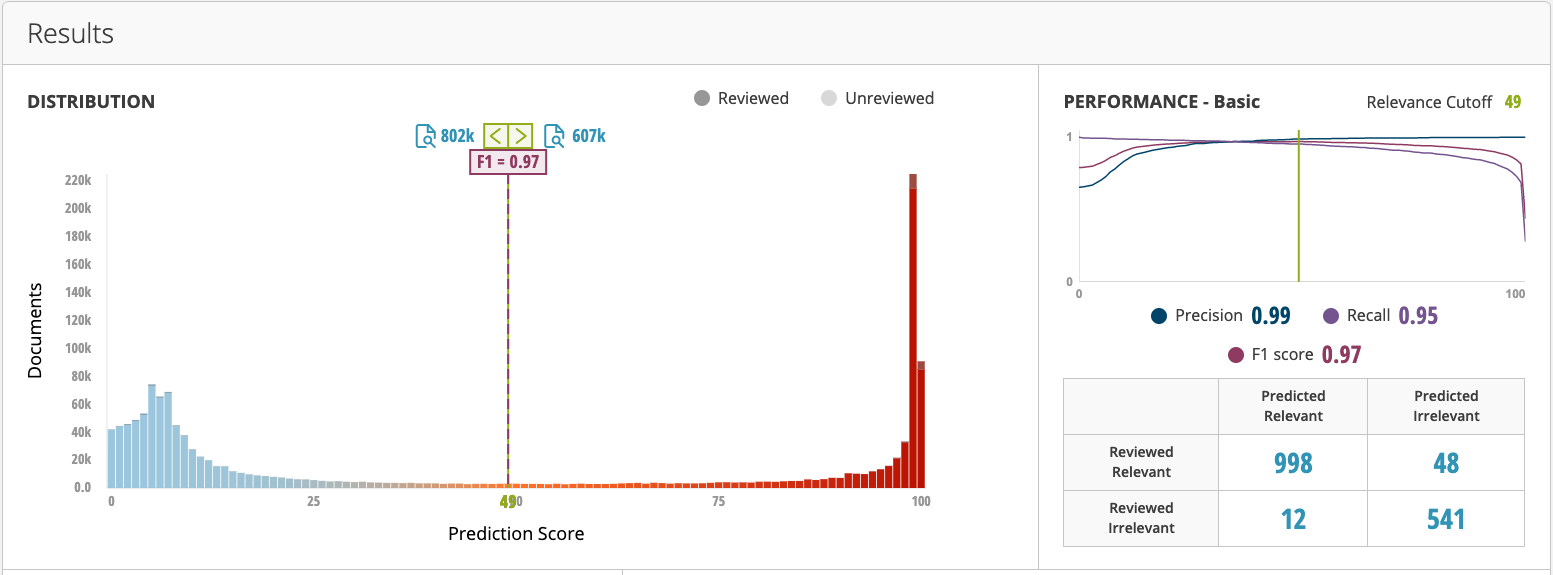
It’s often cost-prohibitive to review every single possible document, particularly in complex cases, so Everlaw uses predictive coding derived from models that use active learning to help identify the documents that are most likely to be responsive.

Click image to enlarge

Users don’t need a background in data analytics to effectively use the predictive coding tool. The tool automatically prioritizes documents so users see first the ones that are most likely to be relevant but have not yet been reviewed. Through a combination of statistics that show how well the tool is working in terms of accuracy and how many relevant documents may have been missed due to the thresholds you set, you can determine with confidence whether your review is complete.

In order to approach opposing counsel or the court with that determination, you need the most rigorous statistics possible. That’s why Everlaw has introduced a new Rigorous Mode, which automatically enforces a particular ordering on your document set that requires you to have viewed all the documents necessary to make sound decisions about your review.

Building Your Case

Everlaw continues to offer users the most effective tools for building a case once review is complete. With the game-changing StoryBuilder tool, your team can collaborate to use your documents to tell the best story of your case.

Click image to enlarge

StoryBuilder starts with a chronology and overlays key events, so you can see exactly where your documents fall in relation to those particular events. You can organize your documents, add descriptions, retitle them, and export them to deposition, cross-examination, or other outlines. There’s no easier way to collaborate with colleagues and co-counsel to use your documents to actually argue your case, all in one easy place.

New Features that Make eDiscovery Management Even Easier

Many of Everlaw’s newest developments revolve around the goal of making the management of eDiscovery easier. Particularly for those at larger organizations, coordinating multiple projects and large review teams can quickly become an administrative hassle. Everlaw has introduced a number of new features to help alleviate those burdens and ensure consistency across reviews and teams.

Everlaw’s new administrative view gives users who are managing projects and overseeing teams better tools for all aspects of a review — the ability to manage lists of users and projects, project sizes, and uploads, as well as seeing reviewer activity and access history.

Click image to enlarge

The platform now also includes project templating, which allows administrators to copy settings from previous projects or from pre-set templates when creating the parameters for a new review database. This not only saves time, it ensures consistency from project to project.

Click image to enlarge

What you want to copy is up to you — users, project settings, user groups, permission settings, coding sheets, or production protocols.

With respect to permission settings, Everlaw has overhauled those, too. Administrators now have granular control over the access permissions given to users or groups, allowing them to tailor different permissions for internal employees, contract employees, outside counsel, or even individual users.

Finally, Everlaw has removed one of the major roadblocks to coding consistency by adding new auto-code settings that apply conditional coding based on how certain documents relate to other documents. 

Click image to enlarge

Now, administrators can ensure that reviewers code consistently across document families or attachment groups by setting rules that will automatically code all documents in such groups the same way. These auto-coding rules are also an invaluable tool for protecting privilege, as the settings can be used to automatically code duplicate documents as privileged as soon as the first document receives that tag.

Everlaw’s newest features and enhancements are game-changers for clients with large teams and several concurrent matters, including sensitive Data Subject Access Request (DSAR) matters that require quick, accurate, and consistent treatment of PII for GDPR compliance.

Everlaw was already making it easier to handle your eDiscovery and build your case. Now they’ve made it possible to be even more confident in the accuracy, efficiency, and consistency of your review. When you want the most cutting-edge eDiscovery suite on the market, you want Everlaw.

AOP: The Biggest POS Of All Them

(Image via Getty)

You know what I never heard squat about during my Biglaw days? Annual Operation Planning, aka AOP. Oh sure, I heard plenty about boosting my billable hours while simultaneously being expected to keep the tab down on fixed-fee matters, but AOP was not a thing. Which in retrospect, was great, because I’m now convinced that AOP is a special circle of hell reserved for betrayers, heretics, and in-house counsel.

Look, I’m not anti-planning. I’m a huge advocate of it. And I can see why it would be useful to plan for events that need to happen in order to achieve goals and objectives (in other words, set in motion certain actions that will ultimately determine my bonus. Cool, cool, cool). I’ll even go as far to say that I can appreciate why Finance feels the need to spend so much time analyzing each variance and miss during AOP. And then discussing it with us. Months later.

And even though I know it’s coming and what to expect, each year I dread the pre-AOP pep talk and the expression that I can only describe as “cat butt face” that Jake, my counterpart in Finance, will don when he comes to talk to me about how much I suck at AOP and how I need to do better.

Never mind that my AOP budget is impeccable in terms of my ability to plan for all of my known expenses: bar and professional membership fees, legal subscriptions, and conferences. Check, check, check. Why? Because all of those expenses are easily calculated and predictable. I need a license to practice. There is a fee associated with it. Ergo, bar fees line item.

But you know what’s not easily calculated or predictable? And makes Jake pull out his cat butt face?

MY OUTSIDE COUNSEL AND LITIGATION SPEND.

And why is that, Jake asks? Because I have no idea what hot mess my business partners are going to get into this year. And let me tell you, every year they are getting more and more creative with their hot messes. Maybe this is the year Stan the Man is finally going to see if that vendor means business about that MFN. Or maybe we’re headed for a courtroom brawl because Engineering just can’t resist the forbidden fruit and keeps hiring people subject to non-competes.

Of course, that’s just the hot messes my business partners get into. Then there’s the shit storms that the outside world visits upon us. I’m not entirely sure Jake is aware of this fact, but we do make products that we sell to the general public. And while those products are labeled with clear and coherent warnings (if I do say so myself), no one actually expects the general public to read them or behave in a clear and coherent manner. Inevitably, some goober will decide to put our METAL product into a microwave and press on. Or submerge our NOT AT ALL WATERPROOF product in liquid and then press on. And as one can imagine, bad, expensive things follow.

Products liability aside, there’s also the issue of that enterprising and opportunistic crew (I’m not calling out patent trolls here…no wait, I’m totally calling out patent trolls here) that pick the issue du jour and hit us up for stupid gotcha money. For the umpteenth year in a row, I explain to Jake that frivolous lawsuits do not just go away like a bad Tinder swipe. It takes time, eDiscovery, and vaguely threatening letters to make these bottom feeders go away. And sometimes you still have to shell out, not because these bottom feeders could find a legal argument with two hands and a flashlight, but because it’s cheaper to just pay them to go away.

So when I tell Jake I’m doing my best to look at the past trends of our legal spend and trying to make smart guesses about where future suits will come from, I mean, I am in fact doing my effing best to put a number on the unknown. I don’t just pick this number out of a hat. It’s not like I’m in Sales. Okay, maybe it’s a little like Sales. I do pick out a semi-reasonable number … and then inflate it by a factor of three. But that’s only to protect us in the event that this is the year for bet-the-company litigation, as in, all bets are off, I have no idea how much it would cost to pull us out of whatever hole we’re in.

Jake calls this puffing up the numbers. When he says this, he puts on his cat butt face to make sure I understand that we cannot puff up the numbers. But I also cannot be under on my estimates either, Jake informs me. Because then I’ll be over my imaginary AOP number. And let’s be serious, it’s imaginary, a guideline at best, because if we do find ourselves in bet-the-company territory, you better believe our board will greenlight every dollar we need to right the ship.

But I don’t say any of that last bit to Jake. Because gloating about a potential company disaster isn’t a good look on anyone. No, that’s not it. It’s that I can accept that as a denizen of Finance, Jake deals in black-and-white absolutes, while I live squarely in the mists of the ever-shifting gray. And although AOP will always be this imperfect, unsatisfying process for both of us, it does somehow reflect the reality of the situation by providing for not only those black-and-white items we know about, but the gray unknown we can’t predict. Of course, if I try and point that out to Jake, you know the face he’s going to make.

It might be worth it.


Kay Thrace (not her real name) is a harried in-house counsel at a well-known company that everyone loves to hate. When not scuffing dirt on the sacrosanct line between business and the law, Kay enjoys pub trivia domination and eradicating incorrect usage of the Oxford comma. You can contact her by email at KayThraceATL@gmail.com or follow her on Twitter @KayThrace.

GC Wants Justice After Lawyer Who Allegedly Groped Her In Court Gets Plea Deal

What happens when a female general counsel in Texas allegedly has her buttocks grabbed in a courthouse? Unfortunately, the answer is not much, and the woman in question is understandably upset about it.

Michelle Acosta is the general counsel of a Houston vegetation management company, but it was following an appearance on behalf of her brother in a child custody matter when family law solo practitioner Allan Manka allegedly touched Acosta without her consent. “He gets a handful of my rear end and squeezed. It wasn’t like a pat: It was a grab and squeeze,” she said. “It really caught me off-guard.”

Here’s a relevant excerpt from the criminal complaint Acosta filed against Manka:

Manka pleaded not guilty, but leader accepted a plea deal under which he will pay a $400 fine and donate $100 to a children’s services nonprofit. He must also complete 90 days of deferred disposition, refrain from all criminal conduct to avoid the charge appearing on his record. Acosta is completely unsatisfied with how the situation was resolved, and posted at length about her experience with Manka on Facebook:

Texas Lawyer has more information on why Manka was offered the plea deal:

Wilson County Attorney Tom Caldwell said Manka’s charge was a Class C misdemeanor, the same level as a traffic ticket, which carries a maximum fine of $500 and no jail time. It’s normal for first-time offenders to receive deferred disposition, he added.

“From a criminal standpoint, from what I’ve seen, it was simple assault. It definitely wasn’t going to rise to something we could charge more severely,” Caldwell said.

“I want a conviction,” Acosta said in an interview with Texas Lawyer. “Giving him deferred adjudication is a small slap on the wrist.”

Female GC Fuming After Plea Deal for Lawyer Who Allegedly Grabbed Her Buttocks [Texas Lawyer]


Staci ZaretskyStaci Zaretsky is a senior editor at Above the Law, where she’s worked since 2011. She’d love to hear from you, so please feel free to email her with any tips, questions, comments, or critiques. You can follow her on Twitter or connect with her on LinkedIn.

3 Lessons From A David v. Goliath IP Victory

When it comes to discussion of interesting IP cases, The Fashion Law blog is hard to top. Rarely do I visit the blog without finding at least one recent article well worth the time to read. Last week, I saw an article on the $100mm+ verdict in Liqwd Inc. v. L’Oreal USA Inc., 1:17-cv-00014 (D. Del.), one of the biggest IP verdicts of the year so far. I will commend you to the article for the factual background of the case, as well as the case docket for more details on the verdict. For purposes of this column, however, I want to focus on what we can learn from Olaplex’s “David v. Goliath win (as characterized by the Fashion Law)” over cosmetics giant L’Oreal. Yes, the decision will be appealed and the case can settle at anytime. In the meantime, it is good for us to think about how Olaplex navigated its way to a huge jury verdict, and what lessons other IP “David’s” can learn going forward from Olaplex’s experience.

First, the decision illustrates the importance of monitoring companies that were once counterparties to a non-disclosure agreement. Such agreements are commonplace where actual or prospective IP issues are discussed between companies. Post-discussion monitoring, however, can lean towards the sporadic. Which can lead to missed opportunities, or at least delay, in bringing viable claims for breach when such claims arise. It is a good practice, therefore, for at least someone at the client (or at the law firm that handled drafting of the NDA) to set a reminder to monitor any counterparties for any breaches down the road. Best to keep in mind that any such breach may take some time to develop — sometimes years later — further putting a premium on someone (whether the client or lawyer) taking responsibility for this important task. 

It is important to keep in mind that the difficulty of monitoring NDA compliance can vary widely. Olaplex, for example, had a relatively easy time noticing L’Oreal’s breach. It met with L’Oreal in May 2015 and saw talks break off relatively quickly, followed by L’Oreal allegedly breaching the NDA by releasing copycat products less than a year later. (As the verdict shows, despite L’Oreal’s protestations, the jury found found in Olaplex’s favor.) Keep in mind that a single product line company like Olaplex will have an easier time policing breaches than a company with a more varied lineup of product offerings. On the flip side, if the disclosed technology relates to only one function or feature of a competitor’s product, it may be harder to police NDA breaches without careful monitoring. Either way, it is well worth it for companies and their lawyers to recommit to checking up with companies that have been a counterparty to an NDA. For Olaplex, demonstrating the NDA breach was worth over $20mm in the jury’s verdict, just as much as L’Oreal’s damages for trade secret misappropriation — and breach of contract is usually easier to prove than IP claims, to boot.

Second, Olaplex’s win should remind us of the value of “layering” IP claims, especially when a case has compelling facts that also have jury appeal. Here, Olaplex was able to successfully integrate its claims for trade secret misappropriation, breach of contract, and patent infringement into a cohesive whole at trial — benefiting from a larger overall verdict as a result. In particular, the marrying of a breach of contract claim into the narrative of L’Oreal acting badly was likely a powerful addition to the IP infringement claims. Trials are morality plays — the more substantiated claims of improper behavior by a defendant, the more likely a jury is to administer a comprehensive punishment. “Davids” like Olaplex would always do well to consider including as many different types of claims as possible when confronting a larger adversary. You never know which claims are going to resonate with a jury, for one. And considering how difficult it is to win on even simple IP claims, if you can find a more general non-IP claim to layer in, all the better.

Third, this case is a poster child for the value of seeking patent protection as early as possible in a company’s life cycle. Here, Olaplex was able to parlay its unpublished patent application into entering an NDA with L’Oreal, leading to the chain of events culminating in the jury verdict. Had Olaplex not had an application on file, it is reasonable to assume that L’Oreal may have balked at entering into an NDA before discussions — common practice among large corporations, which often leverage their size into demanding either no NDA (or one-sided NDA terms) before talking to startups. Olaplex’s patent application helped shift that balance of power at the critical early moment of the company’s first contact with L’Oreal. Furthermore, Olaplex’s commitment to seeing that application and others to patent issuance helped give rise to its future patent infringement claim — a claim that led to significant portion of the verdict it received at trial. At bottom, investing in IP is critical for would-be “Davids,” irrespective of how difficult the patent environment is reported as being at any given point in time.

Ultimately, verdicts like the one in Liqwd are potent reminders of the power of IP rights to give a fighting chance to upstart innovators forced to take on a larger adversary in a court of law. It also reminds would-be infringers, especially willful ones, that there are consequences to disrespecting the rights of smaller innovators. Whether this verdict stands up on appeal is an open question. But it has already provided some strategies for litigation success that erstwhile IP “Davids” can think about, while hoping that their own IP victories remain in slingshot range.

Please feel free to send comments or questions to me at gkroub@kskiplaw.com or via Twitter: @gkroub. Any topic suggestions or thoughts are most welcome.


Gaston Kroub lives in Brooklyn and is a founding partner of Kroub, Silbersher & Kolmykov PLLC, an intellectual property litigation boutique, and Markman Advisors LLC, a leading consultancy on patent issues for the investment community. Gaston’s practice focuses on intellectual property litigation and related counseling, with a strong focus on patent matters. You can reach him at gkroub@kskiplaw.com or follow him on Twitter: @gkroub.

Morning Docket: 08.20.19

* Law firm expenses outpaced revenue for the first half of 2019 and there’s no way that’s going to come back and haunt us. [American Lawyer]

* The DOJ is siding with Led Zeppelin in the Stairway to Heaven copyright fight. Good to know this DOJ has everything else under control. [Rolling Stone]

* California has a new law that says police should only kill when “necessary” and consider the kind of dystopian world we live in where this needed to be spelled out in a law. [NPR]

* Barr announces new BOP head to exploit Epstein’s death for the sake of some boondoggle in prison spending. [Courthouse News Service]

* The NRA tried to insert itself into Oliver North’s deposition in an act of stunning chutzpah. They got denied. [Law360]

* A follow-up on law student’s suicide and his family’s efforts to help others. [Good Men Project]

* CFTC faces scrutiny for “being honest.” [National Law Journal]

Political reform hopes dim in Zimbabwe as police block another protest – The Zimbabwean

Riot police officers stand guard in the streets of Bulawayo, Zimbabwe August 20, 2019. REUTERS/Philimon Bulawayo

President Emmerson Mnangagwa was elected a year ago on a pro-reform ticket, promising a break with the political repression that characterised Robert Mugabe’s 37-year rule and an economic upturn.

But the economy is mired in its worst crisis in a decade, and security forces have used strong-arm tactics to snuff out three attempts by the main opposition Movement for Democratic Change (MDC) to hold street demonstrations since Friday.

“There is a determined effort by the regime to ensure that there is no more democratic space,” MDC national spokesman Daniel Molokele said.

“They are also deploying a lot of military and police in the streets… It clearly shows that the new government is even worse than that of Robert Mugabe.”

Tuesday’s heavy security deployment was in the central city of Gweru, where police – who had banned the march on Monday night – patrolled on foot and in lorries and cordoned off a university, a local journalist told Reuters.

The MDC said it would challenge the ban in court on Tuesday. The party failed to overturn two previous bans on marches in the capital Harare on Friday – where police rounded up MDC followers and dispersed them with batons and water cannon and tear gas – and in the second city Bulawayo on Monday.

In the days before the planned Harare demonstration, six political activists were abducted from their homes at night and beaten by armed men, rights groups say.

They also say the government has this year levied subversion charges against at least 24 activists and opposition leaders, the highest number in a single year.

The MDC says the protest bans are unconstitutional, while police said they have had evidence the protests would turn violent and did not have enough manpower to monitor them.

Bulawayo saw massive looting and destruction of property in January as protests against a steep rise in the price of fuel turned violent, triggering an army crackdown that killed more than a dozen people.

Those deaths set a question mark against the 76-year-old president’s pledge to end the Mugabe-era repression – which the bans of recent days have further undermined.

“The move to ban demonstrations predicated on a spurious assertion that the opposition is plotting violent regime change, is not sustainable,” said analyst Piers Pigou, Crisis Group’s senior consultant for southern Africa.

“…This is contrary to the precepts of a “new administration” that President Mnangagwa and his team want to sell to the world.

The president, who served as a Mugabe aide over four decades, is also struggling to make good on promises that austerity-driven reforms will revive the economy, as popular anger mounts over triple-digit inflation, rolling power cuts and shortages of U.S. dollars, fuel and bread.

The crisis has revived memories of the hyperinflation of a decade ago that forced Zimbabwe to ditch its currency.

Zim to issue cash notes soon, says Finance Minister

Post published in: Featured