Bloomberg: Deutsche Bank’s US Headquarters Is A Half-Empty Sadness Factory Fueled By Weltschmerz And Day Drinking

A fun peek inside 60 Wall Street!

The Largest Law Firms With The Most Women Lawyers (2019)

Earlier this week, thanks to the recently released National Law Journal 500 ranking, we found out which U.S.-centric Biglaw firms were the biggest of them all in terms of headcount. As a companion piece to the NLJ 500, today we’ve got the NLJ Women’s Scorecard, a ranking of the percentage of female attorneys and percentage of female partners at the largest 350 firms in the country.

For this ranking, both equity and nonequity partners were counted as partners, while nonpartner or “other” figures include special counsel, of counsel, and other staff attorneys. Temporary and contract attorneys aren’t included in the count. In the event of a tie, the higher rank is awarded to the firm with more female equity partners.

This year, 271 of the nation’s 350 largest law firms by head count answered the survey for the Women in Law Scorecard, which ranks the nation’s largest law firms by representation of women attorneys. Among all 271 firms surveyed, women comprised 36.5% of 141,466 attorneys in 2018. But the equity partnership ranks were only 23.5% women, out of 59,000 total partners. Women comprised 47% of the 67,166 associates at all 271 firms.

Without further ado, here is the NLJ Women’s Scorecard Top 10 for 2019:

  1. Berry Appleman & Leiden
  2. Fragomen
  3. Kubicki Draper
  4. Kaufman Borgeest & Ryan
  5. FordHarrison
  6. Constangy Brooks Smith & Prophete
  7. Littler Mendelson
  8. Foley & Mansfield
  9. Hanson Bridgett
  10. Kelley Kronenberg

You may be wondering where the largest, namebrand Biglaw firms appear on this list. While the majority of the top 30 firms on the scorecard have a head count of fewer than 300, there were some exceptions, with Littler, Ogletree, Jackson Lewis, and Lewis Brisbois all making an appearance in the top 30. Other firms, like Ropes & Gray, O’Melveny, and Thompson Coburn made major strides in the right direction when it came to “not just about bringing women into the firm, but keeping them.”

Congratulations to all of the firms that succeeded in boosting their ranks in this year’s Women’s Scorecard by placing women in leadership roles and fostering a pipeline of female and diverse attorneys.

You can check out the rest of the rankings here.

The NLJ 500: Women’s Scorecard Chart 2019 [National Law Journal]
The NLJ 500: Climbing Mountains, Cracking Ceilings [National Law Journal]


Staci ZaretskyStaci Zaretsky is a senior editor at Above the Law, where she’s worked since 2011. She’d love to hear from you, so please feel free to email her with any tips, questions, comments, or critiques. You can follow her on Twitter or connect with her on LinkedIn.

Kavanaugh’s Clerkship Quid Pro Quo Continues

(Photo By Michael Reynolds-Pool/Getty Images)

Last month, we learned that Brett Kavanaugh was hiring Amy Chua’s daughter as a Supreme Court clerk. That came as no surprise to regular readers of Above the Law. It was, potentially, a surprise if you made the critical mistake of believing Amy Chua, who promised that Amy Chua’s op-ed defense of Kavanaugh had nothing at all to do with her daughter’s career prospects. It might have come as a surprise if you made the critical mistake of believing Amy Chua’s daughter, who assured people on Twitter that she would not be clerking for Kavanaugh “anytime soon” because of her Army commitments. But hopefully, you were neither ignorant nor gullible enough to believe either of those things.

But, Amy Chua was not the only person who led a spirited defense of the ethically challenged Kavanaugh after he was nominated to the Supreme Court. And it turns out, Amy Chua’s daughter is not the only person who will professionally benefit from “early adoption” of a man who would go on to be credibly accused of attempted rape. A tipster brought this to our attention:

ATL has already posted about Kavanaugh’s 2021-2022 hires, but with respect to one hire in particular, you might be interested in the unseemly fact that Kavanaugh hired Athie Livas, the very YLS student who spearheaded (and is listed as the very first name in the particularly vapid YLS pro-Kavanaugh open letter prior to his confirmation. It’s unusually convenient and blatantly un-meritocratic that many of Kavanaugh’s first clerk hires (Chua-Rubenfeld, and now Livas) appear to be quid pro quo exchanges for their public displays of support rendered during his confirmation.

To refresh your memory, here’s the referred to Kavanaugh support letter. You can pull it up on whitehouse.gov, because remember, these are the kinds of letters Trump and the Republicans used to defend Kavanaugh, who would later go on to have 83 ethics complaints lodged against him and then dismissed because nobody but Congress can hold a Supreme Court justice accountable. Here’s part of that letter, which is indeed “particularly vapid.”

Judge Kavanaugh is eminently qualified to serve as a Supreme Court justice. Judge Kavanaugh, a graduate of Yale College and Yale Law School, is one of our nation’s most distinguished jurists. In his twelve years of service on the United States Court of Appeals for the D.C. Circuit, he has demonstrated a principled approach to interpreting the law. He has reached legal conclusions free of political partisanship. Judge Kavanaugh has devoted his professional life to upholding the rule of law and our Constitution.

The Brett Kavanaugh confirmation process is a stain upon Yale Law School. To be sure, it’s a stain upon the United States Senate — Lindsey Graham and Susan Collins especially — and a terrible reminder of what this country will let privileged white boys do to women. But Yale Law School’s reflexive support for this guy and defense of his career-long partisan hackery on the theory “he went to Yale, tho,” is really shameful.

Yale, I’m sure, would like people to forget its role, and there are a lot of people out there who would gladly oblige them. But they can’t get away from it, because Kavanaugh keeps handing out clerkships to Yale students who stood for him like he’s trying to quickly pay off some “baseball ticket” debt. The man is unethical to his core, and Yale students keeps benefiting from that.

In five years, in 10 years, Yale will get its wish. Kavanaugh will be a well-established nightmare, but most people will forget how Yale helped him get over. Most people will forget the name of Amy Chua’s daughter or this vapid Kavanaugh stan, and they will go on to have successful careers in law or politics. And maybe one day a future generation of Yale faculty will have the opportunity to shamelessly support their nominations to the federal bench. And the only person who will remember the ethically challenged way these two got their start will be me, only I’ll be old and washed-out and trying to shove “literature” in your hands as you wait at the crosswalk for the light to change.

But I will remember.


Elie Mystal is the Executive Editor of Above the Law and a contributor at The Nation. He can be reached @ElieNYC on Twitter, or at elie@abovethelaw.com. He will resist.

Guy Accused Of Molestation Takes Polygraph… Might Have Failed… Still Running For Senate!

(Photo by Scott Olson/Getty Images)

Roy Moore, who got tossed from the Alabama Supreme Court twice and then managed to lose a statewide election to a Democrat — an accomplishment that rates right between cold fusion and enjoying a transcontinental flight in coach — is running for Senate again because he terrifyingly believes Alabama might just give him another shot. Unfortunately for Moore, all those allegations that range from harassment to molestation of underaged girls are still out there even though he’s assured the public that he’s cleared it all up.

The crux of Moore’s claimed exoneration is a polygraph test that he passed when he was trying to prevent the state from certifying the election he had already lost to Doug Jones. He could have taken the test, you know, before he lost and maybe waved it around in an effort to get people to not abandon his candidacy like vegans from a pig roast, but no one’s accusing Roy of strategic brilliance.

But now that test is potentially coming back to haunt him because attorneys for Leigh Corfman, a woman who claims Moore molested her when she was 14 and he was 32, say they weren’t given the test results when they deposed Moore in a defamation suit Corfman brought against Moore… but now they have some serious questions to ask about it.

“To the extent that the results of the polygraph examination administered on him are reliable, Mr. Moore likely failed,” the motion filed Monday stated.

The motion further argues that the test itself was used as the basis for more defamatory claims against the woman.

For his part, Moore says he passed:

In an email statement Monday to AL.com, Moore said, “According to the deposition taken of my polygraph examiner, his findings that I was telling the truth about never knowing Ms. Corfman are backed up by two qualified examiners of this state. My examiner was the only examiner to administer the test. This is another way of delaying her testimony which they have avoided thus far. To our knowledge, Ms. Corfman has not taken a polygraph and has not submitted to testimony under oath before a court reporter. This comes about after my announcement to run for the US Senate after a year’s delay in court. Why doesn’t the press ask her if she has taken a polygraph and why she won’t testify?”

This is where we’re obligated to point out that polygraph tests are pretty much junk science. Yet the mystique remains and now we have Moore boasting his test results and challenging Corfman to take one, Corfman’s lawyers pointing out that Moore failed, yet not putting Corfman up for one, and the Alabama courts — correctly — not letting any of this trumped up Magic 8-Ball stuff get into court.

Amidst all this, Moore is still running for the GOP Senate nod against Tommy Tuberville. Oh my, he’s going to win, isn’t he?

Roy Moore ‘likely failed’ polygraph test, Corfman says [Al.com]

Earlier: Remember That Time Brett Kavanaugh Said Polygraphs Are Important In Making Hiring Decisions?
Polygraphs Are Dumb But Chuck Grassley’s Going To Drag Us Down This Rabbit Hole Anyway

Zimbabwe conference urges cooperation to fight human trafficking – The Zimbabwean

The conference was held in Harare at Arrupe Jesuit University. It was put on by the university’s Africa Forum for Catholic Social Teaching (AFCAST), in partnership with Nottingham University of the United Kingdom.

At the conference, survivors of human trafficking gave their testimonies and challenged participants to spread awareness of trafficking, Vatican News reported. Participants also discussed the various criminal aspects that accompany human trafficking, including coercion, abduction, and fraud.

Speakers included Anna Medeiros, the Migration and Development Coordinator of the International Organisation on Migration (IOM); Chiedza Bindu of the Zimbabwe Trafficking in Persons (TIP) Secretariat; and Dadirai Chikwekwete, administrator for the Africa Forum for Catholic Social Teaching.

Zimbabwe police officers were also in attendance. Maria Phiri of the Zimbabwe Republic Police encouraged everyone to collaborate to “detect and report cases of human trafficking,” according to Vatican News.

“Let us work as a team, let us not point any fingers at anyone – we can address human trafficking together,” said Phiri.

Sister Theresa Nyadombo, education secretary for the Zimbabwe Catholic Bishops Conference, said a collaborative effort is needed to raise human trafficking awareness.

“Everyone must break the culture of silence. We must have human trafficking awareness, a network of everyone playing their part in ending this and the key weapon is education where we can promote the values of peace, love and accountability,” she said, according to Vatican News.

The Sellers’ Guide to Biglaw Firms

Biglaw firms are increasingly buying software from a variety of sources, including start-ups and early-stage companies. A new software solution becoming the product of choice for law firms would be a game-changing win for an emerging company. Today, Evolve the Law is proud to release the Sellers’ Guide to Biglaw Firms, in which legal technologist Dera Nevin takes us behind-the-scenes to show how Biglaw evaluates, decides to purchase, and implements technology. The Guide is based both on her robust experience in the field and on interviews with other Biglaw professionals who know a thing or two about evaluating, buying, and implementing tech. We know you want to make sure your product is being considered. This is what this guide is for. Download the Guide here and better understand the market context and how to optimize and target your pitch.

Failing The Bar, And Then Owning It: A Nonconventional Guide

(Image via Getty)

One of the annoying things about the bar exam (and there are many) is what happens to you if you do not pass.  Your name isn’t listed.  Others look for your name and don’t find it.  An entire quarter of a year might seem wasted.  Time.  Money.

But the worst thing that happens is the self-inflicted blow to your self-esteem.  No matter how many times people try to cheer you up with “but Hillary Clinton failed the bar,” you realize you aren’t Hillary.  And if you’re conservative, you might even be okay with that.

Regardless, the advice comes in droves:  Pull yourself up by your bootstraps! Just study harder! Quit life and live in a cave to study!  Give yourself a day to recover and then sing something like “Fight Song” as you start studying the next day!  The problem with advice like this is that it fails to take into account that you do need to process your loss.  So that it doesn’t sit in the back of your mind.  The biggest obstacle to tack with retaking the bar exam isn’t your lack of knowledge in Subject X: It’s you.

With that in mind, here are some non-traditional tips to overcoming this temporary life obstacle, and perhaps learning something in the process about yourself.

Start with positive self-talk.  And end with positive self-talk.  The problem of failure is it creates a false narrative that you will forever be that exam score.  Instead, remember things are temporary.  Your loss is temporary.  It is not a permanent state of you.  It can be changed.   Your mind will play tricks on you.  Rather than say, “I failed the bar,” it will say, “I’m a failure.”  No you’re not.  But your self-esteem has taken a beating.  It needs to be nourished.

The trick is to believe that you are successful, that you will be so again.  Any time your inner voice says, “I’m going to fail,” stop.  Literally say the word “stop.”  It is quite empowering.  You can tell yourself to stop saying negative things about yourself, and reframe it: “I’m going to win.”  Start by saying that.  And, believing it.  There’s science behind this.

Next, remember that you are a whole person.  That means recognizing there are things about you that are not bar-related.  In your time of stress is the perfect time to practice gratitude.  Thinking and writing out things for which you are grateful will actually improve your mood.  And happy studying is good studying.

Avoid toxic people who say they are supporting you.  Got a relative who means well but causes hell?  One of those “well, why don’t you try med school” kind of people?  Anyone who doesn’t want you to win (consciously or subsconsciously) has no place near you while you are studying for the bar exam.  For your mental health, avoid toxic people.  You don’t need to try to climb a mountain while you have a drama llama trying to pull you down from it.  That includes the “first-timer boasters,” who offer you advice, but at the cost of them reminding you they passed the first time.  Don’t get me wrong, some very sincere friends are trying to be helpful.  But others may be there to elevate their own ego at the expense of yours.

Remember studying is not homogenous.  An hour of studying is not a uniform unit of measurement.  Certain types of study are more active and require more effort.  The results will be greater understanding of your subject matter the greater your focus and the more active your participation.  Distracted studying is the worst kind of studying.  It is exhausting and unrewarding.  Better to plan a time of happy distractions later in the day and focus on the task at hand.

The body disciplines the mind.   If you aren’t exercising, if you are staying up all hours of the night, if you are burning the candle at both ends, or if you are just staring at books the entire day, understand you are engaged in behavior that will limit your chances of success.  Sleeping is one of the most important studying techniques.  Exercise primes the brain.  I’m not suggesting you do a hard-core workout every morning and afternoon, but physical activity helps you stay on track.

Be honest with yourself.  If you are avoiding a subject like the plague, it is probably your weakest subject.  If you would rather watch videos than take a practice test, it is probably your fear guiding you down what appears to be the easy path. You’ve probably gotten some feedback as to where your weaknesses are, and your brain might seek to trick you into thinking you shouldn’t focus effort there.  As I’ve said before, don’t be your own worst enemy.

Not that I agree with everything the Dalai Lama says, but this is true:  “There is a saying in Tibetan, ‘Tragedy should be utilized as a source of strength.’”  That means that you have a great opportunity here to learn.  I don’t just mean about the bar exam.  I am talking about learning something about perseverance, patience, and your own inner strength.

You can do this.  You will.


LawProfBlawg is an anonymous professor at a top 100 law school. You can see more of his musings hereHe is way funnier on social media, he claims. Please follow him on Twitter (@lawprofblawg) or Facebook. Email him at lawprofblawg@gmail.com.

Taking Alice For A Ride…

(Photo by ROBERTO SCHMIDT/AFP/Getty Images)

Another holiday approaches, bringing with it the typical pre-holiday apocalyptic traffic report. The one where the newscaster intones how the roads will be swarmed with vehicles heading off for holiday fun, while hinting that only some of those revelers will actually reach their destination. The rest? Stuck in traffic until it is time to head back to work. While traffic is no fun, it is also more true than ever that today’s cars are in effect rolling computers, full of technology trying to make the driver or passenger experience more enjoyable. Luxury cars and SUVs in particular are stuffed with all manner of driving or leisure aids, from navigation systems that show real-time traffic and require a PhD to operate, to all manner of gizmos designed to keep your phone charged and able to entertain you on the road. Some cars even handle the driving themselves for the most part, even as news of the occasional horrible accident keeps us fearing the days of fully automated automotive transportation.

The software and hardware that makes this all possible was invented or coded by someone of course. And because the automotive industry is a supremely competitive one, it is no surprise that auto companies and their suppliers continue to turn to obtaining patents to help protect their innovations — even if those innovations seem to add more complexity to the car than they are worth. Either way, we know that once companies have patents, they are often willing to assert them against competitors. Perhaps more so than usual in the rarefied world of premium car brands, where creating and maintaining the perception that a brand is symbolic of luxury and innovation is paramount. 

In a column from just about a year ago, I wrote about one such case, while noting that we could potentially see an uptick in patent infringement lawsuits between competing car makers. Whether or not that soft prediction comes to fruition remains unclear. It is still interesting, however, to check in on how that case — where Jaguar Land Rover (maker of Range Rovers) sued Bentley over adaptive terrain response selection systems — has developed over the past year. As I noted in my prior column, the case was filed in the rocket docket of the Eastern District of Virginia, where the trial date for a case is typically set around the first anniversary of its filing.

Here, the case did not progress quite that far. But there was still a recently released substantive decision worth parsing. There, Chief Judge Mark Davis denied Bentley’s motion to dismiss (brought on 101 or Alice grounds) Jaguar’s amended complaint. As an initial matter, it should no longer be surprising to any reader that because of the nature (software-based) of the patented technology a motion to dismiss under Alice was filed. Here, the terrain response feature allows drivers to select how the vehicle will respond to different driving conditions, such as driving on sand or other off-road conditions. We can set aside for now how often the purchaser of a $100k+ SUV will decide to take it for a spin in the Sahara. The point is that the functionality exists and is the subject of a patent suit. Moreover, Bentley’s chosen response confirms yet again that Alice motions persist as a first-line defense in a wide range of patent disputes.

So how did the court deal with Bentley’s motion? In a pretty straightforward matter, actually, via application of Alice’s now familiar two-part test. In part one, the erstwhile search for a nebulous “abstract idea,” the court’s analysis centered on finding analogous technology in the automotive sphere. To that end, the court determined that the closest analogy was to cruise control technology, where the user’s input actually leads to the car’s programming physically changing the car’s behavior. Put another way, the court found that the terrain response selection system was a particular way of changing the vehicle’s physical characteristics, rather than an abstract process that simply mimics a driver’s driving approach under certain conditions.

Even though a finding of no abstract idea resolves the Alice inquiry in the patentee’s favor, the opinion also addresses step two (inventive concept) — perhaps as a way to bulletproof the decision for appeal. Here too the court found that the patented technology “improves efficiency” and is therefore eligible subject matter. In doing so, the court credited the numerous submissions provided by Jaguar showing industry praise for the Range Rover technology, thereby establishing that the patent claims were patent eligible. While the court acknowledged that its proto-103 (validity) analysis was not dispositive on the issue of validity, for purposes of the motion to dismiss, Jaguar’s evidence was sufficient to defeat Alice on step two grounds as well.

Ultimately, this case illustrates how real-world machines, even expensive ones like super-luxury SUVs, can contain technologies that raise Alice issues. It also confirms how overcoming the Alice hurdle is just the first step a patentee must take towards achieving its litigation aims. There is no doubt that Alice, therefore, has made the patent litigation landscape more slippery for patent owners. In this case Jaguar had the right response to ensure a smooth ride past Bentley’s motion to dismiss. For other patentees, however, the ride has proven much bumpier.

Please feel free to send comments or questions to me at gkroub@kskiplaw.com or via Twitter: @gkroub. Any topic suggestions or thoughts are most welcome. 


Gaston Kroub lives in Brooklyn and is a founding partner of Kroub, Silbersher & Kolmykov PLLC, an intellectual property litigation boutique, and Markman Advisors LLC, a leading consultancy on patent issues for the investment community. Gaston’s practice focuses on intellectual property litigation and related counseling, with a strong focus on patent matters. You can reach him at gkroub@kskiplaw.com or follow him on Twitter: @gkroub.

Three Planes Go Missing At Air Zimbabwe – The Zimbabwean

2.7.2019 13:41

Three planes have gone missing at Air Zimbabwe, this is according to the Daily News on Sunday which stated that three MA60 planes purchased from China had “vanished into thin air”.

Auditor General Ms. Mildred Chiri told the publication that there is no paper trail to establish what happened to the 3 birds.

Chiri said that there were 3 MA60 Aircrafts that were not accounted for in the company’s Financial Statements. There was no lease agreement and there was no agreement of sale for the planes hence the AG didn’t know how to properly account for them.

The national airline bought the aircrafts for a whopping $48 Million (apparently between 2005 and 2006). The some of the money was used to pay for ground support equipment and personnel training.

This is just one account of the rot that is marring the parastatals as of today.

Zimbabwe conference urges cooperation to fight human trafficking
ZZim energy minister posts R139 million proof of payment to Eskom on Twitter

Post published in: Business

Even Passports Are Scarce as Zimbabwe Runs Out of Everything – The Zimbabwean

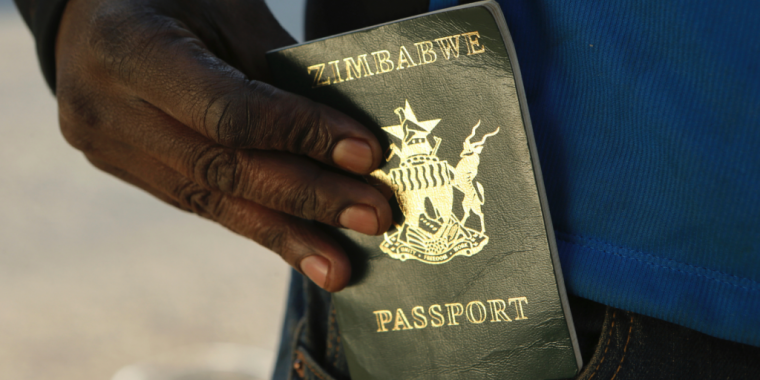
Tendai Mpofu applied for new passports for his sons more than two months ago. Their current ones expire this month, just when they’re due to travel to South Africa for a school sports event. It may be a long wait before they get new documents.

With inflation at almost 100% and an acute lack of foreign currency, Zimbabwe is facing its worst economic crisis in more than a decade. While President Emmerson Mnangagwa has said that the passport company is refusing to print anything until the government has cleared its debts, others say Zimbabwe is simply too broke to import the ink and paper needed.

An official at the passport office said the situation is “dire” and passports were only being issued for emergencies. Identity cards are also hard to come by – metal cards were replaced with plastic ones but now plastic is in short supply.

Home Affairs Minister Cain Mathema told the state-run Herald newspaper recently that things will improve and that the government was “working on it.”