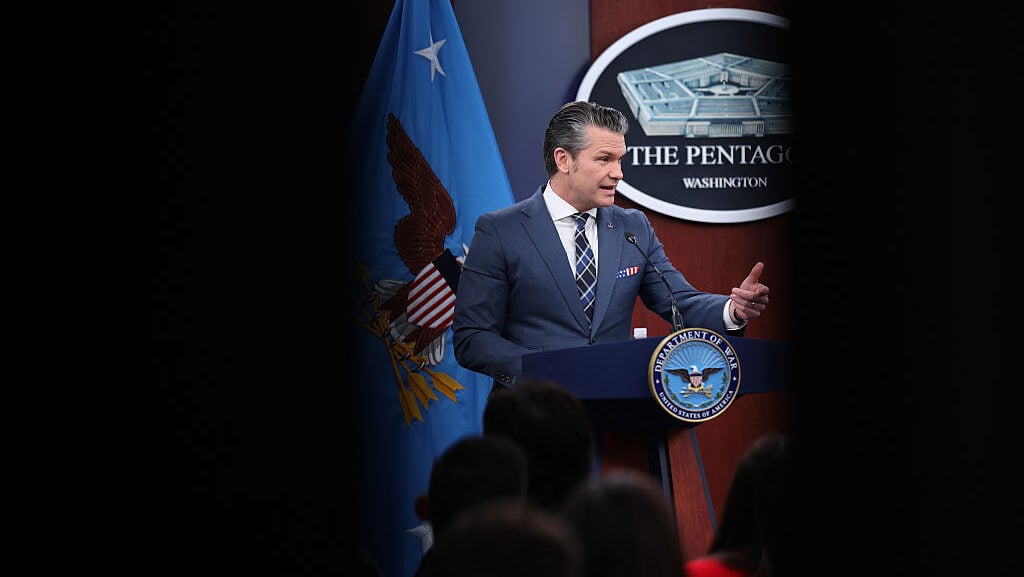
Hegseth confirms potential $200 billion request for Iran operations, but figure ‘could move’ – Breaking Defense

WASHINGTON

The
Pentagon
plans
to
ask
lawmakers
for
some
$200
billion
in
supplemental
funds
to
pay
for
operations
in
Iran
and
refill
American
munition
stockpiles,
Defense
Secretary
Pete
Hegseth
said
today. 

However
that
figure,

first
reported

by
The
Washington
Post,
“could
move,”
he
said.

“Obviously
it
takes

money
to
kill
bad
guys,
so
we’re
going
back
to
Congress
and
folks
there
to
ensure
that
we’re
properly
funded
for
what’s
been
done,
for
what
we
may
have
to
do
in
the
future,
[to]
ensure
that
our
ammunition
is

refilled,
and
not
just
refilled,
but
above
and
beyond,”
the
defense
secretary
told
reporters
in
a
briefing
this
morning.

Lawmakers

have
been
awaiting

a
supplemental
spending
request
designed
to
fund
Operation
Epic
Fury,
though

previous
reporting
suggested

the
DoD
would
request
around
$50
billion,
a
quarter
of
the
new
potential
ask.
It
is
not
clear
if
the
supplemental
funding
will
count
towards
the

$1.5
trillion
defense
spending

pledge
by
Trump
administration
for
fiscal
2027,
or
if
it
will
be
additive.

“Our
objectives
[are]
unchanged,
on
target
and
on
plan,”
Hegseth
said.

That
said,
Hegseth
did
not
disclose
just
how
much
of
that
possible
$200
billion
request
was
directly
tied
to
operations
inside
Iran
and
how
much
would
be
needed
to
more
generally
boost
US
defense
production.
In
his
remarks,
Hegseth
took
a
shot
at
the
Biden
administration
for
sending
weapons
to
Ukraine
for
its
defense
against
Russia
and
said
the
Trump
administration
believes
“these
munitions
are
better
spent
in
our
own
interests
at
this
point.”

“An
investment
like
this
is
meant
to
say,
‘Hey,
we’ll
replace
anything
that
was
spent,”
Hegseth
added.
“And
now
that
we’re
reviving
our
defense
industrial
base
and
rebuilding
the
arsenal
of
freedom
and
cutting
deals

[on]
long-lead
times
on
exquisite
munitions,
we’re
going
to
be
refilled
faster
than
anyone
imagined.”

Also
not
clear
is
the
true
cost
of
Operation
Epic
Fury
as
it
enters
week
four
this
weekend.
The
Pentagon
has
not
yet
released
a
comprehensive
cost
breakdown,
though
officials
have
confirmed

reports

that
the
department
spent
$5.6
billion
worth
of
munitions
in
the
first
few
days.
The
​​Center
for
Strategic
and
International
Studies
has

estimated

$16.5
billion
total
price
tag
at
the
day
12
mark
on
things
like
manpower
and
damage
to
bases.

The
expenditures
include
spent
munitions,
with
Hegseth
saying
today
that
the
US
has
now
struck
7,000
targets
across
Iran.
Chairman
of
the
Joint
Chiefs
of
Staff
Gen.
Dan
Caine
said
that
figure
includes
120
maritime
vessels
and
44
minelayers.

“We’re
flying
further
to
the
east
now
and
penetrating
deeper
into
Iranian
airspace
to
hunt
and
kill
one-way
attack
garrisons,
destroying
Iran’s
ability
to
project
power
outside
of
its
borders,”
the-four
star
general
said.


Stat(s) Of The Week: Is FOMO Fueling Layoffs? – Above the Law

Over
the
last
year,
several
major
employers

including
at
least

one
Biglaw
firm

and

one
corporate
legal
department


have

announced
large-scale
layoffs
,
citing
AI-driven
efficiency
as
a
rationale.

In
some
cases,
AI
may
be
merely
a

pretext
for
routine
cutbacks
.
In
others,
AI
is
a
real
factor,
but
the
layoffs
are
driven
more
by
the
technology’s
potential
rather
than
by
its
reality.

According
to
a

recent
study

in
Harvard
Business
Review,
60%
of
more
than
1,000
global
executives
surveyed
said
they
had
reduced
headcount
in
anticipation
of
AI
efficiency
gains,
while
just
2%
said
they’d
made
large
reductions
based
on
actual
AI
results.

One
likely
result
of
decisions
based
on
wishful
thinking
is
that
many
people
who
were
fired
will
end
up
being
rehired.
As

reported
in
Law.com
,
both
the
advisory
firm
Gartner
and
Forrester
Research
predict
that
half
of
AI-attributed
layoffs
will
be
reversed.

Legal
recruiter
Daniel
Vahab
told
Law.com
that
some
employers
have
been
acting
out
of
“FOMO.”
“They
went
with
the
trend
and
the
hype,
and
it’s
sort
of
backfired,”
he
noted,
“and
now
a
lot
of
firms
are
scrambling
to
bring
people
back
and
fill
those
roles.”


The
‘Layoff
Boomerang’:
Why
Firms
Are
Scrambling
to
Rehire
Talent
in
the
AI
Era

[Law.com]

People Often Confuse One Attorney For Another – Above the Law

It
can
sometimes
be
difficult
for
lawyers
to
distinguish themselves
in
the
legal
marketplace,
especially
if
lawyers
have
a
common
name. Because
there
is
a
finite
number
of
names
lawyers
can
call
their
law
offices,
and
due
to
other
mistakes,
clients
and
prospective
clients
commonly
mistake
one
lawyer
for
another. Lawyers
can
handle
such
mistaken
identifications
in
a
certain
way
to
minimize
confusion
about
the
identity
of
counsel.

In
my
own
experience,
the
most
common
example
of
mistaken
identity
is
when
people
mistake
me
for
my
partner
and
brother,
who
has
a
name
that
begins
with
the
same
letter
as
mine. I
am
usually
flattered
by
such
a
mistake,
since
my
partner/brother
is
an
excellent
lawyer
I
look
up
to.

However,
about
a
third
of
all
the
calls
I
answer
involve
people
looking
for
lawyers
who
are
not
part
of
my
law
practice. Sometimes,
clients
could
do
the
bare
minimum of
due
diligence
to
discover
that
I
am
not
the
appropriate
lawyer
they
are
trying
to
contact. For
instance,
I
only
practice
law
in
the
northeast,
but
I
often
get
phone
calls
from
people
across the
country
looking
for
lawyers
with
the
same
last
name
as
me. 

I
usually
handle
such
situations
by
asking
the
person
where
they
are
calling
from. If
they
are
calling
outside
of
the
few
states
in
which
I
practice
law,
I
tell
them
that
there
must
be
an
identification
issue
since
I
could
not
be
the
lawyer
they
are
looking
for
in
whatever
part
of
the
country
they
are
calling
from. Usually,
I
know
from
the
caller
ID
that
someone
is
calling
me
from
outside
my
area,
and
I
am
immediately alerted
that
there
may
be
a
mistaken
identity
issue.

An
interesting
problem
occurs
when
a
prospective
client
calls
me
looking
for
another
lawyer
with
a
similar
name,
and
I
am
actually
interested
in
taking
the
work. This
has
only
happened
a
few
times,
and
in
one
instance,
the
person
said
that
she
saw
my
name
on
advertisements
even
though
my
practice
does
not
pay
for
advertising. In
these
types
of
instances,
it
often
pays
to
be
honest,
and
I
always
tell
the
person
that
they
might
be
confused
about
my
identity.

However,
sometimes
I
will
try
to
build
rapport
with
the
prospective
client
and
inform
them
of
the
offerings
of
my
law
firm.
So
long
as
truthful
statements
were
made,
I
do
not
think
there
is
anything
wrong
with
a
client
using
my
firm
even
though
they
initially
inquired
into
another
practice.

In
some
instances,
we
have
even
received
mail
that
seems
like
it
was
intended
for
another
lawyer
of
the
same
last
name. In
such
rare
instances,
we
usually
reach
out
to
the
lawyer
for
whom
the
mail
was
intended
to
see
what
they
want
us
to
do
with
it. I
would
like
to
hope
that
someone
would
do
this
for
me
if
my
mail
was
delivered
to
another
lawyer
with
a
similar
name,
as
this
just
seems
like
basic
professional
courtesy.

Some
lawyers
must
have
more
issues
with
mistaken
identity
than
others
since
some
names
are
more
common
than
other
kinds
of
names. 
I’d
love
to
hear
stories
from
readers
about
mistaken
identity
and
how
this
was
handled
in
your
own
lives. 
However,
with
some
strategies
in
mind,
mistaken
identities
among
lawyers
can
be
an
easy
issue
to
resolve.


Jordan
Rothman
is
a
partner
of 
The
Rothman
Law
Firm
,
a
full-service
New
York
and
New
Jersey
law
firm.
He
is
also
the
founder
of 
Student
Debt
Diaries
,
a
website
discussing
how
he
paid
off
his
student
loans.
You
can
reach
Jordan
through
email
at 
jordan@rothman.law.

Trump Sues Harvard, Blames The Jews – Above the Law

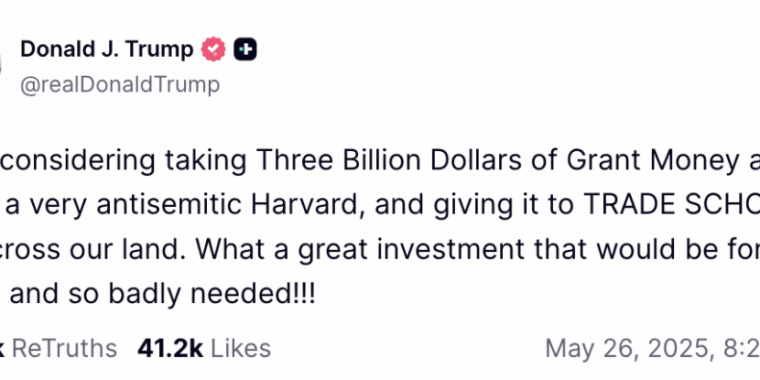
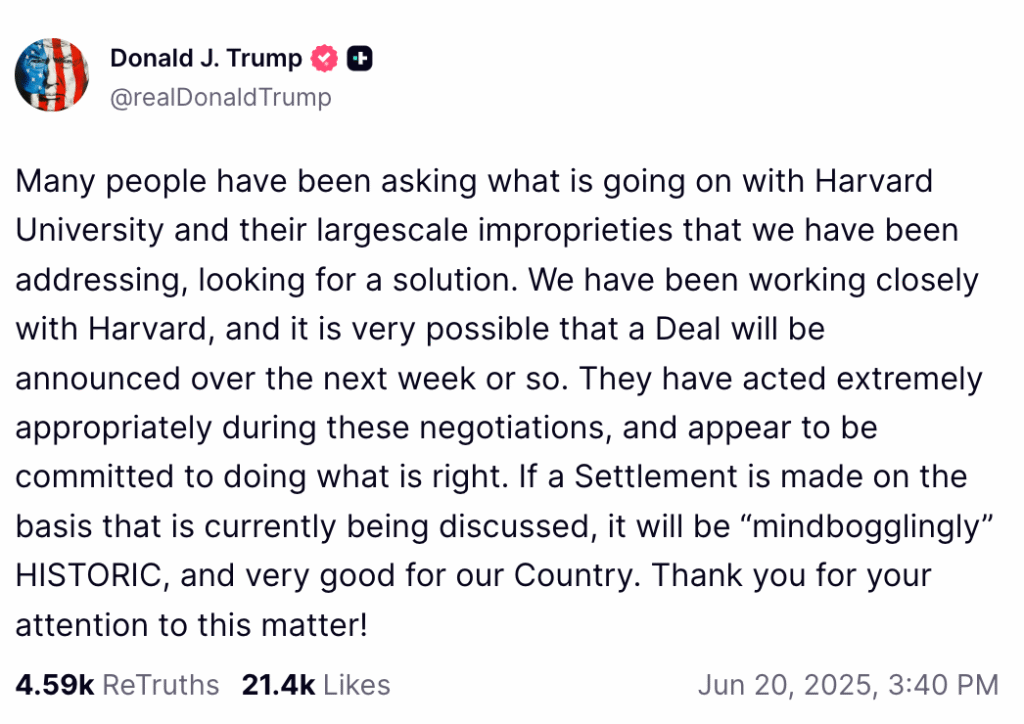
President
Trump
talks
more
about
Harvard
than
people
who
actually
went
there

which
is
to
say

a
lot
.

After
several
universities
made
like
Paul
Weiss
and
rolled
over
and
showed
the
Trump
administration
their
belly,
the
president
figured
that
Harvard
would
fold
eventually.
Columbia
paid
a
$200
million
settlement
to
restore
its
funding.
Brown
paid
$50
million
to
Rhode
Island
workforce
programs.
Cornell
agreed
to
$30
million
over
three
years.
Surely
those
dorks
in
Cambridge
would
cough
up
soon!

But
a
“settlement”
remained
elusive,
and
so
Trump
ramped
up
the
pressure.

He
tried
to
cancel
$2
billion
in
federal
grant
funding,
alleging
the
school
violated
Title
VI
by
discriminating
against
Jewish
students.
Judge
Allison
Burroughs
blocked
it
in
September
and
made
it
permanent
in
October.
He
tried
to
kick
Harvard
out
of
the
Student
and
Exchange
Visitor
Program,
effectively
banning
international
students.
Judge
Burroughs
blocked
that
too.

So
today,
the
Justice
Department
filed
a
brand
new
Title
VI

lawsuit

alleging
that
Harvard
“defied
federal
law
and
violated
Title
VI
repeatedly
by
discriminating
against
Jewish
and
Israeli
students
without
remorse.”
Third
time’s
the
charm?

The
44-page
complaint,
filed
in
the
District
of
Massachusetts,
alleges
that
Harvard
maintained
a
campus
so
hostile
to
Jewish
and
Israeli
students
after
Hamas’s
October
7
attack
on
Israel
that
it
violated
Title
VI
of
the
Civil
Rights
Act
of
1964.
Most
of
what
it
documents
are
protests
against
Israel’s
war
in
Gaza,
which
are
protected
by
the
First
Amendment.
But
clearly
Jewish
members
of
the
community
did
feel
marginalized
and
endangered.
The
complaint
points
to
students
concealing
yarmulkes
under
baseball
caps,
a
mezuzah
stolen
from
a
dorm
room,
“Heil
Hitler”
screamed
at
students
waiting
for
campus
transportation,
and
calls
to
“gas
all
the
Jews”
getting
upvotes
on
the
Harvard-only
Sidechat
platform.

Virtually
every
one
of
these
allegations
is
sourced
to
a

report

produced
in
April
of
2025
by
Harvard’s
own
Presidential
Task
Force
on
Combating
Antisemitism
and
Anti-Israeli
Bias.
In
fact,
the
school
spent
months
documenting
the
problem
in
excruciating
detail
and
settled
two
private
Title
VI
lawsuits


Kestenbaum
v.
Harvard

and

Brandeis
Center
v.
Harvard


by
adopting
the
International
Holocaust
Remembrance
Alliance’s
definition
of
antisemitism,
explicitly
extending
its
nondiscrimination
policies
to
Jewish
and
Israeli
students,
committing
to
annual
antisemitism
training,
and
establishing
a
partnership
with
an
Israeli
university.
That
certainly
undercuts
the
government’s
claim
that
Harvard
was
“indifferent”
to
the
problem
or
that
the
violation
is
systemic
and
ongoing.

The
proposed
remedy
for
this
“violation”
is
functionally
a
death
penalty
for
the
school.
The
DOJ
wants
the
court
to
declare
Harvard
to
have
been
in
violation
of
Title
VI
since
October
7,
2023,
forcing
it
to
return
billions
of
dollars
in
federal
grants
made
since
that
date,
and
cutting
it
off
from
all
federal
funds
going
forward.
How
this
will
help
Jewish
students

many
of
whom
participated
in
the
protests
themselves

is
left
as
an
exercise
for
the
reader,
although
the
complaint
gestures
vaguely
in
the
direction
of
an
outside
monitor
to
ensure
that
the
school
enforces
its
policies
against
protesters,
up
to
and
including
calling
the
cops
on
them.

This
would
a
be
a
highly
novel
application
of
Title
VI,
and
the
government
didn’t
want
to
risk
winding
up
in
front
of
Judge
Burroughs,
who
called
the
funding
freeze
a
“targeted,
ideologically-motivated
assault”
and
the
SEVP
revocation
“retaliation.”
And
so
the
DOJ

designated

the
new
case
as
related
to

Kestenbaum

and

Brandeis
Center
,
so
as
to
get
in
front
of
Judge
Richard
Stearns.

Judge
Stearns
dismissed
much
those
prior
complaints,
but
he
didn’t
dismiss
them
entirely.
He
also
characterized
Harvard’s
response
to
antisemitism
as
“at
best,
indecisive,
vacillating,
and
at
times
internally
contradictory,”
finding
that
“the
facts
as
pled
show
that
Harvard
failed
its
Jewish
students.”
But
he
never
adjudicated
the
claims,
since
both
cases
settled
in
early
2025,
and
it’s
not
clear
whether
he’ll
agree
that
this
new
cause
of
action
by
the
government
is
related

enough

to
automatically
wind
up
on
his
docket.

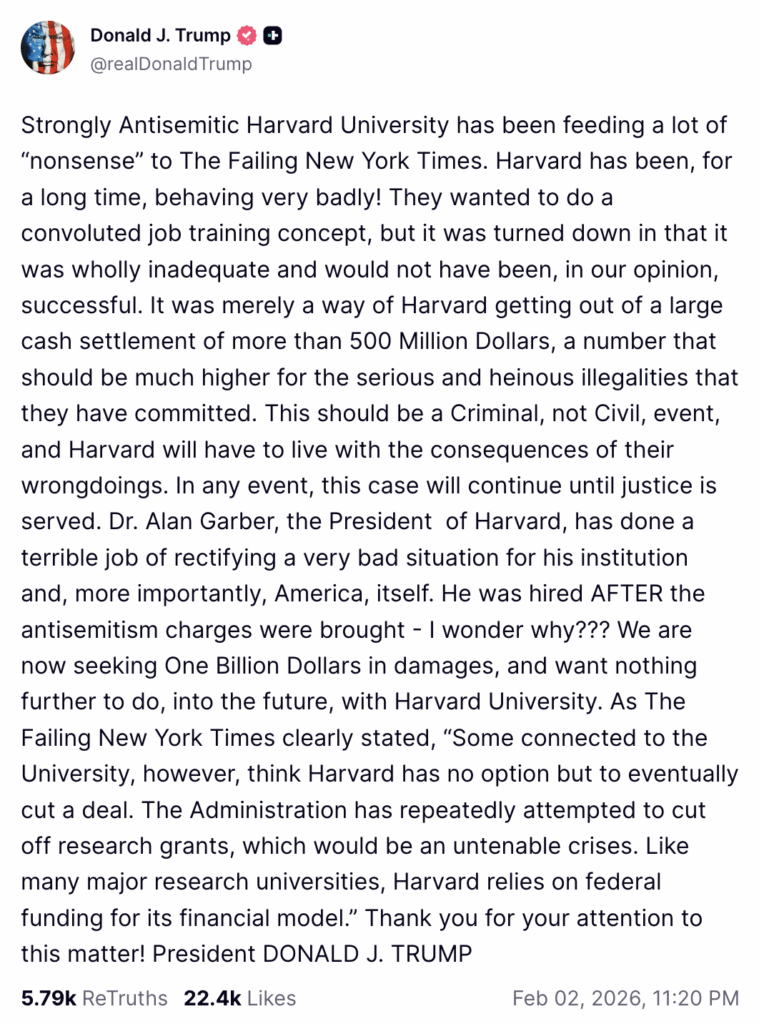
Meanwhile,
the
president
continues
to
make
clear,
that
he’s
trying
to
precipitate
an
“untenable
crisis”
in
higher
education.

Dammit,
now
we
have
to
side
with
Harvard.
Ughhh,
well

GO
CRIMSON!


Liz
Dye
 produces
the
Law
and
Chaos Substack and podcast.
 You
can
subscribe
by
clicking
the
logo:


‘I’ll Put A Bullet In Your Head’: The Disturbing Reality Of Being A Judge In America – Above the Law


Ed.
note
:
Welcome
to
our
daily
feature, Quote
of
the
Day
.


I
don’t
think
being
a
federal
judge
is
a
job
for
the
fainthearted…
What
I
probably
did
not
expect
to
quite
this
degree
is
the
level
of
vitriol
and
the
types
of
violent
threats
that
have
come
across
my
desk
over
the
years.


Here’s
one
that
resulted
in
an
indictment
against
the
person
who
sent
the
message:
‘You’re
dead,
or
I’ll
put
a
bullet
in
your
head
in
the
middle
of
your
kitchen
without
you
seeing
it
coming,
or
expecting
it.
Casket
coming
soon.
Don’t
go
home.
You’ll
never
know
when
I’ll
pop
up.
I’ll
guarantee,
I
will
kill
you.
Think
I’m
playing?
Casket
dreams,
sweetheart.


— Chief
Judge

Dolly
M.
Gee
 of
the
Central
District
of
California, the
first
Chinese
American
woman
to
serve
as
an
Article
III
judge,
in
comments
given
during
a
panel
hosted
by Speak
Up
for
Justice
,
a
nonpartisan
organization
dedicated
to
the
defense
of
the
rule
of
law
and
judicial
independence.
During
the
panel,
Judges
Gee,

Ana
Reyes

(D.D.C.),

Michelle
Williams
Court

(C.D.
Cal.),
and

Mark
S.
Norris

(W.D.
Tenn.)
went
on
the
record
to
describe
the
death
threats,
doxing,
and
intimidation
they’ve
faced
on
the
bench.
Watch
their
discussion,
below.


Staci
Zaretsky
 is
the
managing
editor
of
Above
the
Law,
where
she’s
worked
since
2011.
She’d
love
to
hear
from
you,
so
please
feel
free
to email her
with
any
tips,
questions,
comments,
or
critiques.
You
can
follow
her
on BlueskyX/Twitter,
and Threads, or
connect
with
her
on LinkedIn.

Saving The Worst For Last: Which Trump Administration Lawyer Most Deserves To Lose Their License? – Above the Law

Now
we
come
to
the
final
region
in
our
bracket
challenge.
If
you
missed
the
prior
regions,
they’re
still
waiting
for
your
votes
here,
here
and
here.

Voting
is
open
until
Monday
at
7:59
p.m.
Eastern.

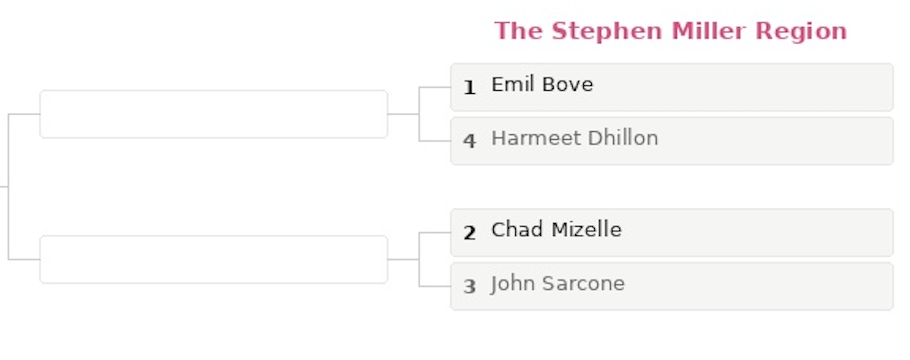
THE
STEPHEN
MILLER
REGION

Stephen
Miller
is
not
a
lawyer.
He
is,
however,
arguably
the
most
powerful
person
directing
the
administration’s
legal
strategy

a
non-lawyer
with
extraordinary
influence
over
the
Attorney
General
and
the
Justice
Department’s
priorities.
He
can’t
be
disciplined
by
any
bar
because
he
doesn’t
belong
to
one.
Which
means
we
can
only
honor
him
by
making
him
the
namesake
for
this
region.


(1)
Emil
Bove
vs.
(4)
HARMEET
DHILLON


1.
Emil
Bove,
former
Principal
Associate
Deputy
AG,
now
Third
Circuit
Judge
(Georgetown
University
Law
Center)

It’s
really
a
whiff
on
our
part
that
Bove
isn’t
headlining
the
Roy
Cohn
region
since
he
even
looks
like
Cohn.

Emil
Bove

then
the
number
three
official
at
the
DOJ

reportedly
told
senior
lawyers
at
a
key
meeting
that
deportation
planes
under
the
Alien
Enemies
Act
would
be
leaving
for
El
Salvador
“no
matter
what”
and
if
any
court
enjoined
the
administration
and
purported
to
block
the
flights,
DOJ
lawyers
should
tell
the
courts
“f***
you.”

The
Campaign
for
Accountability
filed
a
bar
complaint,
citing
Bove’s
apparent
role
in
dropping
the
Mayor
Eric
Adams
corruption
investigation

a
move
that
resulted
in
tons
of
career
lawyers
leaving
the
DOJ
in
protest.
New
York’s
disciplinary
body
declined
to
investigate.
And
in
a
development
that
captures
everything
you
need
to
know
about
accountability
in
this
era,
Bove
was
subsequently
confirmed
to
a
lifetime
appointment
on
the
federal
appellate
bench.


4.
Harmeet
Dhillon,
Assistant
Attorney
General
for
Civil
Rights
(University
of
Virginia)

The
DOJ’s
Civil
Rights
Division,
under
Dhillon’s
leadership,
has
transformed
into
something
closer
to
the
Civil
Rights
Demolition
Division,
with
more
than
half
the
division’s
roughly
380
attorneys
departing
since
she
arrived.

While
she’s
taken
a
sledgehammer
to
the
Justice
Department’s
statutorily
mandated
role
in
enforcing
civil
rights,
there’s
honestly
not
been
a
ton
of
ethical
issues
coming
out
of
her
office.
Being
maliciously
bad
at
one’s
job
is
not,

per
se
,
a
disciplinary
event.
She
did
amplify
a

false
identification
of
a
shooting
suspect

after
the
Brown
University
shooting,
which
is
an
explicit
no-no
for
a
prosecutor.

She
does
get
in

hilariously
catty
Twitter
fights

as
part
of
upholding
the
dignity
of
her
office.


VOTE
HERE


(2)
Chad
Mizelle
vs.
(3)
John
Sarcone


2.
Chad
Mizelle,
former
DOJ
Chief
of
Staff
(Cornell)

Chad
Mizelle
left
the
DOJ
in
September
2025
to
begin
a
career
of
glazing
Pam
Bondi
from
the
private
sector.
But
his
legacy
at
the
department
is
secure.

Beyond
the
recruiting
stunt,

Mizelle
had
up
to
$250,000
in
undisclosed
conflicts
of
interest

with
companies
the
DOJ
was
actively
suing
or
investigating,
including
Apple,
Meta,
and
Visa.
He
didn’t
file
his
required
financial
disclosure
until
after
leaving
government.
A
Revolving
Door
Project
investigation
found
that
his
entanglements
posed
clear
conflicts
with
his
broad
leadership
role

and
that
for
nine
months,
the
public
had
no
way
to
know
about
them.
He
was,
in
the
group’s
words,
“reminded
of
recusal
obligations”
by
an
ethics
official.

He
also
put
out

a
call
to
recruit
AUSAs
lawyers
over
Twitter
,
which
probably
isn’t
cause
for
discipline,
but
is
an
embarrassment
for
the
profession.


3.
John
Sarcone,
Pretend
U.S.
Attorney,
N.D.
NY
(Pace)

Sarcone
rounds
out
the
bracket
as
another
variation
on
the
theme
of
installing
loyalist
hacks
as
U.S.
Attorneys
even
if
they
aren’t,
in
fact,
legally
allowed
to
be
U.S.
Attorneys.
The
Campaign
for
Accountability
filed
a
bar
complaint
against
Sarcone
alongside
complaints
against
Habba
and
Halligan.

Sarcone
has
a
lower
profile
than
the
other
two
phony
U.S.
Attorneys
in
the
bracket,
but
he
makes
the
list
as
a
reminder
that
for
every
Halligan
and
Habba
making
splashy
incompetent
decisions,
there’s
a
Sarcone
quietly
occupying
positions
across
the
federal
system,
carrying
out
the
agenda
without
making
as
much
noise.


VOTE
HERE


Voting
is
open
until
Monday
at
7:59
p.m.
Eastern.

ITC, ZimTrade launch SheTrades Zimbabwe Hub, marking eighth Hub in Africa


The
SheTrades
Zimbabwe
Hub,
hosted
by
the
national
trade
development
and
promotion
organization
ZimTrade,
forms
part
of
ITC’s
global
SheTrades
Initiative,
under
the
United
Kingdom-funded
SheTrades
Commonwealth+
Programme.

This
is
the
22nd
SheTrades
Hub
worldwide
and
the
8th
in
Africa,
and
its
launch
comes
at
a
time
when
Zimbabwe’s
exports
are
rising.
Cumulative
export
earnings
for
January–December
2025
reached
$9.71
billion,
marking
a
30%
increase
year-on-year,
according
to government
data
.
Yet
women
remain
largely
excluded
from
these
gains.
Despite
making
up
over 60%
of
the
labour
force
only
2%
of
women-led
businesses
engage
in
exports
,
reflecting
persistent
barriers
such
as
limited
market
access,
complex
procedures
and
high
trade
costs,
including
related
to
transport
and
logistics.

The
SheTrades
Zimbabwe
Hub
targets
this
gap
directly
by
serving
as
a
resource
centre
to
equip
women-led
businesses
to
access
practical
tools,
market
intelligence,
market
access
and
export-focused
training,
while
building
a
network
of
partners
across
national,
regional
and
global
markets.

With
the
launch
of
this
SheTrades
Hub,
ZimTrade
joins
a
global
network
of
now
22
institutions
across
Asia,
Africa,
Latin
America,
the
Middle
East
and
North
Africa
as
well
as
Caribbean
regions,
creating
new
pathways
for
collaboration,
including
South-South
trade
and
cross-market
linkages.

The
launch
of
this
SheTrades
Hub
builds
on
two
years
of
targeted
interventions.
Since
2024,
this
partnership
has
delivered
targeted
support
to
women-led
businesses
in
the
essential
oils
and
beauty
sector,
including
training
on
market
compliance
and
certifications,
export
logistics
and
market
information,
alongside
trade
promotion
initiatives
such
as
inward
and
outward
trade
missions
connecting
Zimbabwean
women
entrepreneurs
directly
with
international
buyers
in
target
markets
including
the
United
Kingdom
and
the
African
continental
markets.

The
launch
event
follows
a
half-day
training
for
50
women-led
businesses
on
market-related
soft
skills.
It
features
a
panel
discussion
on “Celebrating
women-led
businesses:
What
should
we
expect
from
the
SheTrades
Zimbabwe
Hub?”
 and
brings
together
senior
government
officials,
development
partners
and
private
sector
leaders.
Speakers
include
Hon.
Dr.
Evelyn
Ndlovu,
Minister
of
Environment,
Climate
and
Wildlife,
Republic
of
Zimbabwe;
Hon.
Kiven
Mutimbanyoka,
Deputy
Minister
of
Women
Affairs,
Community,
Small
and
Medium
Enterprises
Development,
Republic
of
Zimbabwe;
Ambassador
Albert
R.
Chimbindi,
Permanent
Secretary,
Ministry
of
Foreign
Affairs
and
International
Trade,
Zimbabwe;
H.E.
Pete
Vowles,
British
Ambassador
to
Zimbabwe;
Mr.
Allan
Majuru,
CEO
of
ZimTrade;
and
Mrs.
Dorothy
Tembo,
Deputy
Executive
Director
of
ITC.

Mr.
Allan
Majuru,
CEO
of
ZimTrade,
said
the
initiative
reflects
a
deliberate
national
effort
to
ensure
women
play
a
more
active
role
in
export
growth
and
benefit
meaningfully
from
trade
opportunities:
“Integrating
women
into
mainstream
export
value
chains
is
key
to
building
a
more
inclusive
and
competitive
national
trade
ecosystem.
Increasing
women’s
participation
in
exports
expands
Zimbabwe’s
productive
base
and
strengthens
value
addition,
innovation
and
resilience
across
sectors.
At
the
same
time,
there
is
a
need
to
address
the
structural
barriers
that
have
limited
women’s
access
to
markets
so
that
export
growth
delivers
real
improvements
in
household
incomes
and
community
wellbeing.
The
SheTrades
Zimbabwe
Hub
is
a
practical
step
towards
supporting
more
women
to
enter
and
compete
in
export
markets,
contributing
to
national
growth
while
improving
livelihoods
in
a
meaningful
and
sustainable
way.”

ITC
Deputy
Executive
Director Dorothy
Tembo
 said:
‘With
the
launch
of
the
SheTrades
Zimbabwe
Hub,
we
are
working
with
ZimTrade
to
open
doors
for
women
who
have
the
talent
and
determination
to
compete
in
global
markets
but
too
often
lack
the
opportunities.
Women-led
businesses
in
Zimbabwe
will
gain
the
tools
and
connections
they
need
to
reach
new
markets.’

H.E.
Pete
Vowles,
British
Ambassador
to
Zimbabwe,
said:
“The
United
Kingdom
is
proud
to
partner
with
ITC
and
ZimTrade
in
launching
the
SheTrades
Zimbabwe
Hub.
When
women
entrepreneurs
thrive,
economies
grow,
communities
strengthen
and
opportunities
multiply.
This
Hub
will
equip
Zimbabwean
women-led
businesses
with
the
skills,
connections
and
confidence
they
need
to
compete
in
global
markets

including
with
UK
buyers.
Today’s
launch
is
not
just
an
investment
in
trade;
it
is
an
investment
in
women’s
economic
power
and
in
Zimbabwe’s
future.”

Post
published
in:

Business

AI, Automation, And The Modern Law Firm: How Smart Systems Create Leverage – Above the Law

In
this
session,
I
speak
with
Sarah
Persich,
known
as
“The
Automation
Lady,”
about
how
law
firms
can
use
AI
and
automation
to
create
operational
clarity
and
scalable
growth.

With
nearly
a
decade
inside
a
small
law
firm
and
experience
as
an
integrator
overseeing
systems
and
technology,
Sarah
understands
exactly
where
inefficiencies
hide
and
how
to
eliminate
them.

The
conversation
focuses
on
documenting
processes,
connecting
systems,
and
leveraging
AI
as
a
strategic
assistant
rather
than
a
gimmick.


AI
&
Loom:
Document
Your
Processes
Instantly

Sarah
emphasizes
that
every
growing
law
firm
must
document
its
processes.
Standard
operating
procedures
are
not
optional
if
you
want
consistency,
training
efficiency,
and
delegation.
The
challenge
is
that
most
firms
delay
documentation
because
it
feels
time
consuming.

Her
solution
is
simple
and
practical.
Record
yourself
completing
the
task
using
Loom.
Speak
through
what
you
are
doing
as
you
perform
the
process.
Then
take
the
transcript
from
that
recording
and
use
AI
tools
such
as
ChatGPT
or
Claude
to
convert
it
into
a
written
procedure.

In
minutes,
you
have
both
a
video
tutorial
and
a
structured
written
process.

This
approach
eliminates
the
friction
that
keeps
firms
from
documenting
workflows.
It
ensures
the
team
always
has
a
resource
for
how
to
find
information
and
complete
tasks.
More
importantly,
it
transforms
tribal
knowledge
into
institutional
knowledge.


Automate
Your
Law
Firm:
CRM
&
Practice
Management
Secrets

Steve
and
Sarah
then
shift
to
automation
and
integration.
A
CRM
is
not
just
a
contact
database.

It
is
the
command
center
for
pipeline
tracking,
follow
up,
and
relationship
management.

Automated
emails
can
be
personalized
at
scale,
allowing
firms
to
nurture
hundreds
of
contacts
without
sacrificing
authenticity.
Sarah
stresses
that
the
key
is
integration.
Tools
must
communicate
with
one
another.
Platforms
like
Zapier
allow
different
systems
to
speak
to
each
other,
reducing
manual
entry
and
human
error.

Practice
management
software
should
also
offer
an
open
API,
which
makes
deeper
automation
possible.

When
systems
are
connected
properly,
intake
flows
smoothly,
follow
up
happens
consistently,
and
lawyers
spend
more
time
on
strategic
work
rather
than
repetitive
tasks.
Automation
does
not
replace
judgment.
It
protects
it
by
eliminating
noise.


Unlock
Custom
GPTs:
Your
AI
Marketing
Assistant

Sarah
also
explains
how
custom
GPTs
can
function
as
tailored
AI
assistants
for
marketing
and
content
creation.
Instead
of
prompting
AI
from
scratch
each
time,
firms
can
build
customized
frameworks
that
reflect
their
voice,
goals,
and
audience.

For
example,
a
custom
GPT
can
draft
a
blog
post
and
simultaneously
generate
social
media
ideas
that
align
with
that
content.
It
becomes
a
structured
system
rather
than
a
one
off
experiment.
By
feeding
it
firm
specific
information,
lawyers
receive
consistent
outputs
that
support
branding
and
visibility.

Used
responsibly,
AI
becomes
a
multiplier.
It
accelerates
content
production,
enhances
marketing
consistency,
and
frees
up
time
for
higher
level
strategy.
The
goal
is
not
automation
for
its
own
sake.
The
goal
is
clarity,
efficiency,
and
leverage.

Law
firms
do
not
need
more
complexity.
They
need
better
systems.
When
processes
are
documented,
software
is
integrated,
and
AI
is
implemented
intentionally,
firms
move
from
reactive
management
to
strategic
growth.
Automation
is
not
about
replacing
people.
It
is
about
empowering
them
to
focus
on
what
truly
drives
value.


Watch
the
full
video
here.


Steve
Fretzin
is
a
bestselling
author,
host
of
the
“Be
That
Lawyer”
podcast,
and
business
development
coach
exclusively
for
attorneys.
Steve
has
committed
his
career
to
helping
lawyers
learn
key
growth
skills
not
currently
taught
in
law
school.
His
clients
soon
become
top
rainmakers
and
credit
Steve’s
program
and
coaching
for
their
success.
He
can
be
reached
directly
by
email
at 
[email protected].
Or
you
can
easily
find
him
on
his
website
at 
www.fretzin.com or
LinkedIn
at 
https://www.linkedin.com/in/stevefretzin.

Biglaw Executive Order Fight Heads To D.C. Circuit (For Real This Time) – Above the Law

The
federal
government’s
defense
of
the
Executive
Orders
targeting
Jenner
&
Block,
WilmerHale,
Perkins
Coie,
and
Susman
Godfrey
is,
officially,
back
on.

After
first

dropping
the
appeals
,
then

un-dropping
the
appeals

in
what
can
only
be
described
as
litigation
whiplash,
the
U.S.
Court
of
Appeals
for
the
D.C.
Circuit
has
now
officially
greenlit
the
government’s
change
of
heart.
In
a
brief
order
Monday,
the

court
granted

DOJ’s
motion
to
keep
the
appeals
alive
and
ensures
this
mess
is
heading
for
a
full
appellate
airing.
In
a
follow-up
order
Thursday,
it
set
oral
argument
for
May
14,
meaning
the
administration

will
soon
have
to
defend,
with
a
straight
face
,
why
issuing
retaliatory
Executive
Orders
targeting
major
Biglaw
firms
is
totally
normal
presidential
behavior.

You’ll
recall
last
year
Donald
Trump
went
on
an
EO
bender,
issuing
orders
targeting
Biglaw
firms
for
a
hodgepodge
of
perceived
sins
like
representing
disfavored
clients,
supporting
diversity
initiatives,
and
not
sufficiently
genuflecting
before
MAGA
orthodoxy.
Four
firms
stood
up
to
the
bullying
and
fought
the
EOs,
and
were
rewarded
with
decisions
from
judges

across
ideological
lines

all
finding
that
the
EOs
were
retaliatory
and
unconstitutional.
That
led
to
the
will
they/won’t
they
moment
of
appellate
litigation
where
the
government
filed
a
voluntary
motion
notifying
the
court
it
was
not
pursuing
the
appeal…
and
24
hours
later
calling
a
backsies.

The
DOJ
filed
a

full-throated
defense

of
the
EOs,
pointing
to
the
yellow-bellied
nine
Biglaw
firms
(A&
O
Shearman;
Cadwalader;
Kirkland
&
Ellis;
Latham
&
Watkins;
Milbank;
Paul,
Weiss;
Simpson
Thacher;
Skadden;
and
Wilkie
Farr)
as
evidence
the
EOs
were
totally
constitutional.
The
fighting
four
firms
are
expected
to
file
their
briefs
by
March
27
(the
DOJ
will
then
have
until
April
10
to
respond).
And
then
oral
arguments
are
on
for
May
and
the
appellate
court
will
weigh
in
on
whether
retaliation
against
law
firms
is
somehow
a
“core
presidential
power.”


Kathryn
Rubino
is
a
Senior
Editor
at
Above
the
Law,
host
of

The
Jabot
podcast
,
and
co-host
of

Thinking
Like
A
Lawyer
.
AtL
tipsters
are
the
best,
so
please
connect
with
her.
Feel
free
to
email

her

with
any
tips,
questions,
or
comments
and
follow
her
on
Twitter

@Kathryn1
 or
Mastodon

@[email protected].

The Best Law Schools For Trial Advocacy (2026) – Above the Law

Law
schools
love
to
talk
about
“practice-ready”
graduates,
but
that
promise
rings
hollow
if
students
aren’t
getting
meaningful
opportunities
to
stand
up,
speak
up,
and
actually
“try”
a
case

before
their
clients’
fates
are
on
the
line.
Programs
that
prioritize
hands-on
experience
in
mock
trials
and
clinics
are
the
ones
producing
graduates
who
can
do
more
on
their
feet
when
the
time
is
right.
That’s
because
trial
advocacy
isn’t
theoretical;
it’s
a
learned
skill
built
on
doing,
not
just
knowing.
In
a
profession
where
persuasion
is
the
currency,
the
students
who
get
those
reps
early
aren’t
just
better
prepared

they’re
already
a
step
ahead.

The National
Jurist’s
preLaw
magazine
 recently
released
its
specialty
ranking
of
the
best
law
schools
for
trial
advocacy
on
its
Trial
Advocacy
Honor
Roll,
highlighting
schools
for
the
strength
of
their
programs.
Here’s
the
methodology
that
was
used:

preLaw
magazine
grades
law
schools
based
on
the
breadth
of
their
curricular
offerings.
The
scores
are
figured
as
follows:
30%
for
a
concentration,
24%
for
a
clinic,
12%
for
a
center,
12%
for
an
externship,
9%
for
a
journal,
8%
for
a
student
group,
5%
for
a
certificate
and
added
value
for
additional
offerings.

Without
further
ado,
according
to
preLaw
magazine,
these
are
the
law
schools
that
earned
A+
and
A
grades
for
their
trial
advocacy
programs:

  • Cardozo
    School
    of
    Law
    (A+)
  • American
    University
    (A)
  • Drexel
    University
    (A)
  • Lewis
    &
    Clark
    Law
    School
    (A)
  • Loyola
    University
    New
    Orleans
    (A)
  • Suffolk
    University
    (A)
  • UC
    Law
    SF
    (A)
  • UCLA
    School
    of
    Law
    (A)
  • University
    of
    Arizona
    (A)
  • University
    of
    Kansas
    (A)
  • Washburn
    University
    (A)

Click here to
see
the
rest
of
the
Honor
Roll.

Congratulations
to
all
of
the
law
schools
that
made
the
cut
for
this
important
ranking.


Top
law
schools
for
trial
advocacy

[preLaw
Magazine
/
National
Jurist]


Staci
Zaretsky
 is
the
managing
editor
of
Above
the
Law,
where
she’s
worked
since
2011.
She’d
love
to
hear
from
you,
so
please
feel
free
to email her
with
any
tips,
questions,
comments,
or
critiques.
You
can
follow
her
on BlueskyX/Twitter,
and Threads, or
connect
with
her
on LinkedIn.