

Last
week,
Suffolk
Law
School
became
the
latest
venue
for
the
American
Legal
Tech
Awards
ceremony,
an
event
informally
called
“Legal
Tech
Prom”
as
the
legal
technology
world’s
best
and
brightest
trade
the
corporate-branded
quarter
zips
for
evening
formal
wear.
While
the
red
carpet
may
lack
custom
Versace
gowns,
it
does
feature
a
bunch
of
people
who
just
spent
45
minutes
watching
YouTubers
explain
how
to
tie
a
bow
tie.
For
what
it’s
worth,
this
is
a
good
one
and
only
required
two
viewings.
With
its
strong
tech
and
innovation
bona
fides,
Suffolk
Law
was
the
obvious
choice
to
host
the
event
in
Boston.
Home
to
the
Suffolk
Legal
Innovation
&
Technology
Center
and
the
associated
LIT
Lab,
Suffolk
takes
a
tech-forward
approach
to
training
its
students,
embracing
the
innovation
and
change
that
the
rest
of
the
profession
grumbles
about
“the
kids
watching
TickerToks”
while
dictating
their
email
responses
to
an
admin.
LawDroid’s
Tom
Martin
serves
as
an
adjunct
professor
at
Suffolk
and
is
also
one
of
the
Awards’
founders
along
with
Vanderbilt’s
Cat
Moon
and
attorney
Patrick
Palace.
Palace
is
also
the
current
President
of
the
National
Conference
of
Bar
Presidents,
and
“President
of
Presidents
Palace”
has
a
real
“we’re
all
about
to
be
expendable
extras
in
300”
feel
to
it.
Damien
Riehl
returned
for
another
year
as
the
event’s
host,
offering
a
new
round
of
legally
themed
song
parodies.
Like
a
number,
performed
with
Jackie
Schafer
of
Clearbrief,
about
artificial
intelligence
inspired
by
Little
Shop
of
Horrors,
a
musical
about
a
nerd
who
falls
under
the
thrall
of
an
unholy
creation
that
eventually
tries
to
kill
him.
At
least
no
one
called
Seymour
“agentic
plant
life.”
In
any
event,
it’s
proof
again
that
our
annual
Law
Revue
competitors
don’t
need
to
give
up
on
their
passion
after
law
school.
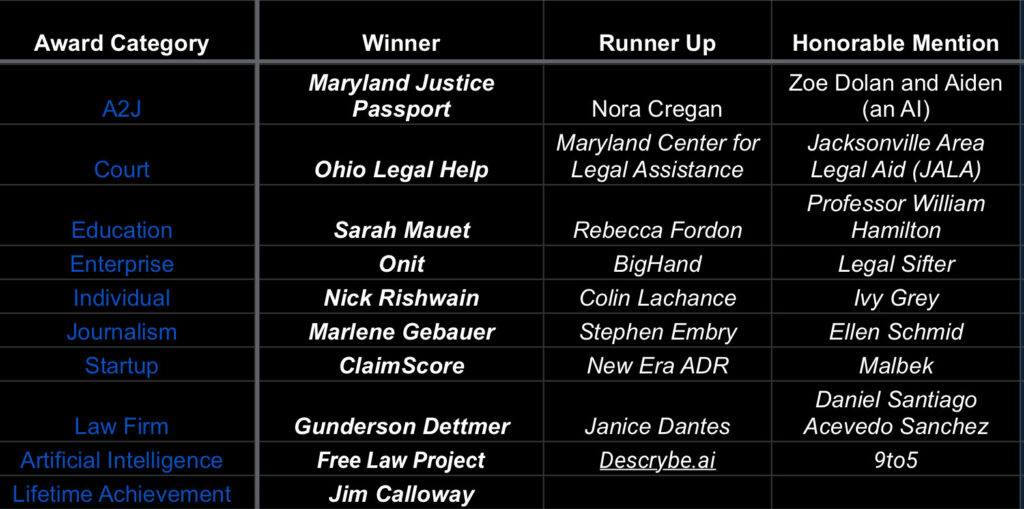
The
full
list
of
nominees
and
winners
showcases
the
breadth
of
what
“legal
technology”
means.
There’s
more
happening
out
there
beyond
the
now
reliably
consistent
conveyor
belt
of
AI
hallucination
briefs
ripe
for
our
ridicule
and
occasional
sanctions.
Like
the
Maryland
Justice
Passport,
which
compiled
scattered
resources
into
a
single,
user-friendly
digital
interface
for
litigants
navigating
the
Kafkaesque
nightmare
of
the
courts.
Or
Onit,
who
took
home
the
enterprise
award
for
“democratizing
access
to
legal
expertise
through
AI-powered
tools.”
Across
10
categories,
the
ALTA
honored
the
people
out
there
doing
the
hard
work
of
making
the
profession
suck
less
through
technology.
And
while
we’re
talking
about
people
who
make
the
profession
suck
less,
the
Lifetime
Achievement
Award
went
to
Jim
Calloway,
the
recently
retired
Director
of
Management
Assistance
Program
at
the
Oklahoma
Bar
Association,
who
spent
his
career
helping
lawyers
serve
clients
better.
In
an
industry
with
its
share
of
vapid
buzzwords
and
bloated
venture
capital
debts,
the
ALTA
ceremony
is
a
yearly
reminder
that
there’s
a
lot
of
room
for
combining
law
and
technology
to
improve
the
profession.
Some
of
the
law
students
out
there
might
also
see
that
there’s
a
path
to
using
their
degrees
on
something
potentially
more
rewarding
than
billing
2400
hours
to
ClubbingBabySealCorp’s
IPO.
While
the
rest
of
the
profession
keeps
threatening
to
collapse
under
the
weight
of
its
own
dysfunction,
the
American
Legal
Tech
Awards
confirm
that
there
are
people
out
here
making
the
law
actually
work.
And
that
legal
tech
geeks
own
an
iron.
 Joe
Joe
Patrice is
a
senior
editor
at
Above
the
Law
and
co-host
of
Thinking
Like
A
Lawyer.
Feel
free
to email
any
tips,
questions,
or
comments.
Follow
him
on Twitter or
Bluesky
if
you’re
interested
in
law,
politics,
and
a
healthy
dose
of
college
sports
news.
Joe
also
serves
as
a
Managing
Director
at
RPN
Executive
Search.