
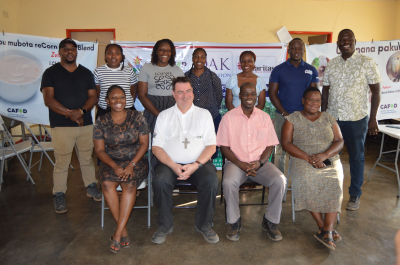

Source: CBCEW,
CAFOD
After
the
bishops’
autumn
plenary
meeting,
in
a
short
video
interview,
Bishop
Wright
reflected
on
what
he
described
as
profound
and
life-changing
experiences:
“I
was
privileged
to
go
and
visit
the
CAFOD
projects
in
a
very
remote
and
poor
part
of
Zimbabwe,
in
the
northeast
part
of
the
country.”
After
a
six-hour
drive,
half
of
which
was
on
rough
dirt
tracks,
Bishop
Wright
arrived
at
his
destination.
“It’s
a
very
rural
area
–
there
are
no
towns
–
and
the
first
thing
that
strikes
you
is
the
level
of
poverty
that
people
are
living.
For
example,
women
and
children
will
walk
up
to
seven
kilometres
to
get
water.
Children
will
walk
up
to
10
kilometres
to
go
to
school,
and
it
truly
breaks
your
heart
to
see
them
making
their
way
to
and
from
school
–
children
as
young
as
four.”
Bishop
Wright
continued:
“It
was
a
great
privilege
to
see
the
CAFOD
projects
there,
they
were
truly
inspiring.
I
had
the
joy
of
visiting
three
primary
schools
and
a
maternity
unit.”
CAFOD
is
working
with
the
local
Caritas
agencies
in
Rushinga
District
to
provide
schools
and
communities
with
the
amenities
which
will
allow
them
to
flourish.
Bishop
Wright
explained:
“The
first
of
those,
and
by
far
the
most
important,
is
access
to
water.
Bores
are
drilled
down
to
the
water
table,
and
with
simple
water
pumps,
the
community
has
access
to
water,
and
that
is
life-changing
for
so
many
people.
The
second
is
to
provide
solar
panels
for
electricity,
and
the
children
can
even
have
basic
computers.
The
third
part
of
the
programme
is
to
provide
the
children,
and
indeed
the
staff,
with
a
healthy
meal
each
day,
a
very
basic
porridge,
which
is
made
of
millet
and
is
very
nutritious.”
An
important
element
of
the
work
which
CAFOD
and
Caritas
are
doing
in
the
local
communities
is
to
increase
education
and
awareness
about
safeguarding.
When
women
and
children
make
these
long
journeys
on
foot,
their
already
high
vulnerability
increases,
and
so
there
is
a
great
emphasis
placed
on
their
understanding
about
what
is
appropriate
behaviour
towards
them
and
what
is
not,
raising
that
awareness.
Bishop
Wright
described
how
children
are
told
to
share
information
“both
with
the
teachers
and
also
with
the
local
chief,
who
I
was
privileged
to
meet,
and
who
really
is
a
safeguarding
champion
in
his
district.
The
chief
gave
the
children
and
gave
me,
too,
the
assurances
that
he
would
pass
on
any
information
to
the
local
authorities
and
indeed
the
police.
You
can
see
that
that
is
taking
place.”
The
local
Church
is
also
playing
an
important
role
alongside
Caritas
in
the
empowerment
of
local
communities.
Describing
his
stay
with
the
local
parish
priest,
Bishop
Wright
said,
“They
are
committed
to
serving
the
poor.
It
is
inspiring.
Jesus
said
we
would
find
him
in
the
poorest
of
the
poor,
and
so
we
do.
CAFOD
speaks
about
nobody
being
beyond
reach,
and
truly
in
that
remote
part
of
Zimbabwe,
they
are
not
beyond
reach.”
Recalling
the
mission
of
Caritas
to
serve
the
poor
regardless
of
their
age,
belief
or
background,
Bishop
Wright
said,
“What
you
can
see
is
the
love
of
the
Lord
being
shared
with
others
and
you
can
see
in
those
small
steps
the
huge
impact
that
it
has
on
the
life
of
others.”
As
well
as
learning
about
the
work
of
CAFOD
and
Caritas
at
the
grassroots,
Bishop
Wright
described
the
visit
as
a
profound
and
life-changing
experience.
“I’ve
never
experienced
poverty
in
a
developing
country
like
I
experienced
in
Rushinga.
It
was
simultaneously
heart-breaking
to
see
the
poverty
that
these
people
live
with,
but
also
full
of
hope.
The
dignity
of
the
people
is
extraordinary.
The
welcome
and
the
joy
of
these
people
is
extraordinary.
Hope
–
real
hope
–
is
given
to
them
with
water,
with
electricity,
with
a
good
meal
each
day,
and
with
the
education
programmes…
you
can
see
how
these
communities
flourish.
The
Chief
Nurse
at
the
maternity
unit
that
I
went
to
took
me
aside
and
said,
‘Bishop
Stephen,
thank
you
for
CAFOD’s
work.
I
can
now
truly
do
my
work
as
I
should
be
able
to
do
it.’
And
that
will
stay
with
me
forever.”
Watch
Bishop
Wright’s
report
here: www.youtube.com/watch?v=5c_SWLxFZLM
Post
published
in:
Featured