Law
school
name
changes
can
be
a
big
deal.
Donate
to
a
prestigious
school
to
get
the
name
changed
and
you
risk
nobody
taking
it
seriously.
Sorry
Penn
Carey.
If
you
really
want
to
make
the
most
of
it,
you’ve
got
to
be
there
at
the
inception.
When
Serranus
Clinton
Hastings
put
down
some
cash
to
have
a
law
school
named
after
himself
for
the
duration
of
forever,
it
seemed
like
a
pretty
good
investment.
And
it
was!
For
about
145
years.
At
that
point
UC
Law
School
San
Francisco
decided
to
ditch
its
previous
name
to
shake
off
being
associated
with
indigenous
genocide.
Surviving
Hastings
were
so
tilted
by
the
name
change
that
they
took
the
school
to
court
over
it.
And
after
run
ins
and
losses
with
court
cases,
they’ve
been
handed
another
L.
Law.com
has
coverage:
California’s
Supreme
Court
on
Wednesday
declined
to
review
a
state
law
renaming
the
San
Francisco
law
school
known
for
more
than
a
century
as
the
University
of
California
Hastings
College
of
the
Law.
The
court
without
comment
let
stand
a
First
District
Court
of
Appeal
ruling
last
year
that
rejected
claims
by
alumni
and
descendants
of
namesake
Serranus
Hastings
that
the
Legislature
and
the
school’s
board
of
directors
had
no
authority
to
remove
Hastings’
name.
The
unanimous
appellate
panel
also
found
that
the
state
was
not
bound
by
an
1878
law
requiring
the
school
to
provide
a
seat
on
the
board
to
the
Hastings
family
in
perpetuity.
Womp
Womp.
Quite
a
heavy
loss
for
a
family
expecting
$1.7B
in
breach
of
contract
damages.
Legacy
and
huge
windfall
on
the
line,
the
losing
party
is
hoping
that
the
Supreme
Court
will
give
them
the
ruling
they’re
looking
for.
Chris
Williams
became
a
social
media
manager
and
assistant
editor
for
Above
the
Law
in
June
2021.
Prior
to
joining
the
staff,
he
moonlighted
as
a
minor
Memelord™
in
the
Facebook
group Law
School
Memes
for
Edgy
T14s
.
He
endured
Missouri
long
enough
to
graduate
from
Washington
University
in
St.
Louis
School
of
Law.
He
is
a
former
boatbuilder
who
is
learning
to
swim, is
interested
in
critical
race
theory,
philosophy,
and
humor,
and
has
a
love
for
cycling
that
occasionally
annoys
his
peers.
You
can
reach
him
by
email
at [email protected]
and
by
tweet
at @WritesForRent.
A
long-time
client
has
asked
Kinney
to
help
identify
a
private
equity/finance
attorney
to
join
as
a
partner
in
the
firm’s
lucrative
group.
No
book
required.
The
client
is
a
top
Am
Law
firm.
The
partner
leading
the
charge
is
well-liked
and
admired
by
colleagues
and
clients
alike
and
has
an
impressive
and
growing
portfolio
of
private
equity
clients
whose
work
entails
a
variety
of
complex
transactions
including
acquisition/debt
financings
and
more.
The
names
of
enslaved
people
who
lived
in
the
President’s
House
(Photo
by
Matthew
Hatcher/Getty
Images)
The
Trump
administration
is
trying
to
memory-hole
slavery,
and
a
federal
judge
is
running
out
of
patience
with
their
shenanigans.
At
a
hearing
last
week
over
the
Trump
administration’s
decision
to
rip
out
materials
discussing
slavery
at
George
Washington’s
former
Philadelphia
residence
Senior
U.S.
District
Judge
Cynthia
Rufe
—
a
George
W.
Bush
appointee!
—
delivered
a
sharp
rebuke
to
the
DOJ
lawyers
defending
the
government’s
actions.
The
exhibit
in
question,
located
on
Independence
Mall,
was
created
by
the
City
of
Philadelphia
in
partnership
with
the
National
Park
Service
and
tells
the
story
of
the
nine
enslaved
people
who
lived
and
labored
in
Washington’s
home.
Earlier
this
year,
federal
workers
reportedly
took
a
crowbar
to
the
plaques,
citing
President
Donald
Trump’s
executive
order
purporting
to
“restore
truth
and
sanity
to
American
history.”
But
let’s
be
so
fucking
for
real
right
now,
it’s
a
literal
whitewashing
of
it.
Judge
Rufe
was
not
impressed.
“You
can’t
erase
history
once
you’ve
learned
it,”
she
said.
“It
doesn’t
work
that
way.”
That
theme
only
sharpened
as
the
hearing
went
on.
Assistant
U.S.
Attorney
Gregory
in
den
Berken
attempted
to
defend
the
removals
by
gesturing
vaguely
at
disagreement
and
discretion.
“Although
many
people
feel
strongly
about
this
one
way,
other
people
may
disagree
or
feel
strongly
another
way,”
he
said,
adding,
“Ultimately,
the
government
gets
to
choose
the
message
it
wants
to
convey.”
Danger,
Will
Robinson.
Though
appearing
before
a
Republican-appointed
judge,
it
does
NOT
mean
they’re
cool
with
the
current
administration’s
we-get-to-rewrite-history
plan.
Judge
Rufe
cut
off
the
AUSA,
according
to
reports,
saying,
“That
is
a
dangerous
statement
you
are
making.
It
is
horrifying
to
listen
to,”
she
said.
“It
changes
on
the
whims
of
someone
in
charge?
I’m
sorry,
that
is
not
what
we
elected
anybody
for.”
“Dangerous.”
“Horrifying.”
A
federal
judge
is
characterizing
statements
made
by
the
DOJ
with
this
language.
That’s
what
it
is
like
to
be
an
AUSA
in
the
year
of
our
lord
2026.
No
wonder
they’re
taking
to
social
media
to
recruit
saps
like
fraudulent
telemarketers.
At
present,
the
government
has
stripped
the
site
of
all
substantive
discussion
of
the
enslaved
people
who
lived
there,
leaving
only
their
names
—
Austin,
Paris,
Hercules,
Christopher
Sheels,
Richmond,
Giles,
Oney
Judge,
Moll,
and
Joe
—
engraved
into
a
cement
wall.
Plaintiffs
are
asking
the
court
to
order
the
exhibit
restored,
and
Judge
Rufe
instructed
DOJ
to
ensure
that
the
remaining
materials
are
not
damaged
any
further,
and
she
intends
to
personally
inspect
the
removed
materials.
She
also
indicated
she
intends
to
rule
swiftly,
particularly
with
the
nation’s
250th
birthday
celebration
looming
and
a
surge
of
visitors
expected
at
Independence
Mall.
Kathryn
Rubino
is
a
Senior
Editor
at
Above
the
Law,
host
of
The
Jabot
podcast,
and
co-host
of
Thinking
Like
A
Lawyer.
AtL
tipsters
are
the
best,
so
please
connect
with
her.
Feel
free
to
email
her
with
any
tips,
questions,
or
comments
and
follow
her
on
Twitter
@Kathryn1 or
Mastodon
@[email protected].
Ed.
note:
Please
welcome
Renee
Knake
Jefferson
back
to
the
pages
of
Above
the
Law.
Subscribe
to
her
Substack,
Legal
Ethics
Roundup,here.
Welcome
to
what
captivates,
haunts,
inspires,
and
surprises
me
every
week
in
the
world
of
legal
ethics.
Hello
First
Monday!
Welcome
to
February.
Watching
the
streets
of
Minneapolis
in
recent
days
leaves
me
wondering
whether
what
I’m
writing
here
at
the
LER
can
make
a
difference
in
the
world
right
now.
I’m
not
sure,
but
since
you’re
still
reading,
I’ll
keep
publishing.
I
was
reminded
listening
to
the
new Bruce
Springsteen ballad Streets
of
Minneapoliswhy
law
needs
music.
He
wrote
it
in
a
day,
and
performed
it
less
than
a
week
later
at
a
Minneapolis
rally.
It’s
now
the #1
downloadon
iTunes
in
at
least
19
countries.
Have
you
listened
to
it
yet?
Here’s
a
headline
from The
New
York
Times: “Springsteen
Takes
the
Stage
as
Minneapolis
Residents
Take
to
the
Streets.”The
article
begins:
”Thousands
of
Minneapolis
residents
surged
into
the
streets
again
Friday,
a
spasm
of
fury
at
a
violent
immigration
crackdown
that
has
killed
two
of
their
own.
It
was
a
day
of
action
driven
by
Bruce
Springsteen,
who
made
a
surprise
appearance
at
a
rowdy
benefit
concert
in
the
city.”
Read
more here (gift
link).
Fifteen
years
ago
I
wrote
an
essay
analyzing
how
music
can
empower
social
change
in
the
wake
of
the
law’s
failure
— When
the
Law
Needs
Music,
published
as
part
of
a
Fordham
Urban
Law
Journal
symposium
on
the
music
of
Bob
Dylan.
My
focus
there
was
on
a
case
called NAACP
v.
Button,
where
the
Supreme
Court
held
that
the
First
Amendment
protected
the
NAACP’s
legal
assistance
to
individuals
for
the
enforcement
of
constitutional
and
civil
rights.
The
decision
was
a
victory
for
the
NAACP,
yet
success
in
the
courtroom
did
not
translate
entirely
to
success
on
the
ground.
Indeed,
in
the
same
year,
NAACP
Mississippi
Field
Secretary
Medgar
Evers
was
assassinated,
and
the
Birmingham
Sixteenth
Street
Baptist
Church
was
bombed.
These
events
serve
as
reminders
of
law’s
inadequacies,
in
that
the
constitutional
protection
of
legal
services
in
the
Button
case
did
little
to
stop
the
needless
loss
of
life
and
violence
that
was
characteristic
of
racial
desegregation
efforts.
Music
of
the
1960s
captured
struggles
when
the
law
proved
impotent.
Springsteen’s
Streets
of
Minneapolis
is
meeting
the
moment
today.
Now
for
your
headlines.
Highlights
from
Last
Week –
Top
Ten
Headlines
#1
“US
Justice
Department’s
Misconduct
Complaint
Against
Judge
Boasberg
Gets
Tossed.” From Reuters: “A
federal
appeals
court
judge
has
dismissed
a
judicial
misconduct
complaint
by
U.S.
Justice
Department
against
a
judge
who
clashed
with President
Donald
Trump’s administration
over
its
move
to
deport
several
Venezuelans
to
El
Salvador. U.S.
Attorney
General
Pam
Bondi took
the
rare
step
in
July
of
announcing
the
complaint
against Chief
U.S.
District
Judge
James
Boasberg in
Washington,
D.C.,
alleging
he
made
improper
comments
about
Trump
during
a
meeting
of
the
judiciary’s
policymaking
body,
the
Judicial
Conference.”
Read
more here.
#2
“Ethics
Watch:
Fantasy
Football
OK
for
New
York
Judge.” From Wisconsin
Bar
Inside
Track
Weekly: “Judges
face
critical
scrutiny
to
maintain
their
reputation
for
impartiality,
a
challenge
so
all-encompassing
that
a
New
York
judge
asked
for
an
opinion
if
it
was
OK
to
participate
in
an
online
fantasy
football
league.
In
New
York
Judicial
Advisory
Opinion
25-122,
the
New
York
Advisory
Committee
on
Judicial
Ethics
considered
fantasy
football
with
lawyer
friends
acceptable
as
long
as
the
lawyers
playing
in
the
league
remain
no
more
than
acquaintances
–
and
the
judge
stays
impartial.”
Read
more here.
#3
“As
AI-Generated
Fake
Content
Mars
Legal
Cases,
States
Want
Guardrails.” From Stateline: “As
more
false
quotes,
fake
court
cases
and
incorrect
information
appear
in
legal
documents
generated
by
AI,
state
bar
associations,
state
court
systems
and
national
law
organizations
are
issuing
guidance
on
its
use
in
the
legal
field.
A
handful
of
states
are
considering
or
enacting
legislation
to
address
the
issue,
and
many
courts
and
professional
associations
are
focused
on
education
for
attorneys.”
Read
more here.
#4
“As
Lawyer
Rates
Surge,
US
Firm
Charges
$4,000
an
Hour
for
Top
Partners.” From Reuters: “The
topmost
hourly
billing
rates
at
U.S.
law
firm
Susman
Godfrey
have
reached
$4,000
an
hour
for
2026,
surpassing
already
sky-high
fees
charged
by
the
priciest
lawyers
last
year.
Susman
partner Neal
Mannesaid
the
new
rates
apply
to
him
and
fellow
litigator Bill
Carmody.”
Read
more here.
#5
“Florida
Bar
Will
Not
Reprimand
Matt
Gaetz
for
Alleged
Sexual
Misbehavior.” From
the Orlando
Sentinel: “Matt
Gaetz,
who
faced
allegations
of
sexual
misconduct
and
illegal
drug
use,
can
continue
practicing
law
after
the
Florida
Bar
decided
last
week.”
Read
more here.
#6
“Lawsuit
Against
Northwestern
Law
Alleging
Anti-White
Discrimination
Dismissed.” From
the ABA
Journal: “A
federal
judge
has
dismissed
a
lawsuit
alleging
Northwestern
University
Pritzker
School
of
Law
discriminates
against
white
men
in
faculty
hiring,
Reuters
reports.
The
suit
was
brought
by
a
nonprofit
organization
called
Faculty,
Alumni
and
Students
Opposed
to
Racial
Preferences,
represented
by
prominent
conservative
attorney Jonathan
Mitchell and
by
America
First
Legal,
co-founded
by Donald
Trump adviser Stephen
Miller,
the
story
states.
Filed
in
July
2024,
the
suit
alleged
the
law
school
did
not
consider
hiring
white
male
faculty
candidates
with
‘stellar
credentials’
and
instead
hired
‘mediocre’
candidates
from
diverse
racial
and
gender
backgrounds,
according
to
Reuters.
The
decision
by U.S.
District
Judge
Sara
Ellis to
dismiss
the
suit
last
week
follows
other
unsuccessful
moves
by
conservative
legal
groups
targeting
law
schools,
including
discrimination
cases
against
the
Harvard
Law
Review
in
2018
and
the
NYU
Law
Review
in
2023,
the
story
says.
In
addition,
Faculty,
Alumni
and
Students
Opposed
to
Racial
Preferences
voluntarily
dismissed
a
suit
against
the
Michigan
Law
Review
for
discrimination
in
October.”
Read
more here.
#7
“Legal
Tech
Leaders
Join
Other
Legal
Professionals
In
Open
Letter
Supporting
the
Rule
of
Law.” From Lawsites: “A
number
of
leaders
from
the
legal
technology
community
are
joining
other
legal
professionals
in
an
open
letter
supporting
the
rule
of
law.
‘Lawyers,
judges,
and
government
officials
all
take
an
oath
to
support
and
defend
the
constitution,’
the
letter
says.
‘We
write
at
a
moment
when
constitutional
rights
and
legal
norms,
long
considered
stable,
are
being
challenged.
Today,
our
profession
must
speak
clearly
and
firmly.’”
Read
more here.
#8
“Florida
Bar
Appeals
Discipline
Report
for
Lawyer
Who
Sued
Gov.
DeSantis.” From
the ABA
Journal: “The
Florida
Bar
will
appeal
a
judge’s
disciplinary
report
in
the
case
of
an
attorney
who
filed
a
lawsuit
against Florida
Gov.
Ron
DeSantis.
Last
month,
the
judge
overseeing
the
discipline
case
recommended
that
Florida
lawyer Daniel
Uhlfelder be
admonished
by
the
Florida
Supreme
Court,
the
most
lenient
form
of
discipline
that
he
could
receive,
according
to
a
story
by
the
Tampa
Bay
Times.”
Read
more here.
#9
“Special
Masters
and
Silent
Battles:
The
Ethics
of
Settlement
Allocations.” From Law.com: “Among
the
most
underestimated
risks
in
modern
plaintiff
practice
is
allocating
settlement
proceeds
among
multiple
clients.”
Read
more here.
#10
“Interest
in
Law
School
Is
Surging.
A.I.
Makes
the
Payoff
Less
Certain.” From The
New
York
Times: “The
number
of
applicants
has
risen
more
than
40
percent
over
the
last
two
years,
despite
new
limits
on
student
loans
and
uncertainty
over
how
artificial
intelligence
will
affect
legal
work.”
Read
more here (gift
link).
Recommended
Reading
So
much
great
reading
in
legal
ethics
is
out
in
the
world
right
now.
I
have
a
stockpile
of
recommendations
to
share
in
the
coming
months.
For
now
you
get
three
law
review
articles.
“Renewing
Our
Vows:
The
Lawyer’s
Oath
and
Our
Pledge
to
Democracy” by Colin
Black (Suffolk).
From
the
abstract:
For
centuries,
lawyers
have
sworn
to
an
oath
as
a
prerequisite
to
admission.
The
oath,
barely
evolved
from
their
historical
roots,
represents
the
guiding
commitment
lawyers
make
to
democratic
principles
of
honesty,
integrity,
fairness,
and
the
rule
of
law.
This
commitment
is
in
exchange
for
the
power
and
privilege
of
belonging
to
the
legal
profession.
However,
the
ethical
landscape
for
legal
practitioners
has
evolved,
particularly
in
response
to
the
alarming
events
of
the
2020
U.S.
presidential
election.
These
events
revealed
significant
lapses
in
the
judgment
and
conduct
among
some
lawyers,
exposing
the
need
for
a
recommitment
to
the
democratic
principles
embedded
in
the
oath.
This
article
critically
examines
the
historical
development
of
the
lawyer’s
oath
and
argues
for
its
modernization
to
better
reflect
the
ethical
challenges
of
contemporary
legal
practice.
It
highlights
the
need
for
the
oath
to
include
explicit
commitments
to
democratic
principles,
the
rejection
of
bias,
and
the
reinforcement
of
ethical
responsibility.
The
article
further
explores
how
these
modernized
principles
can
be
integrated
into
legal
education
and
professional
conduct
to
help
avoid
future
lapses.
In
advocating
for
these
reforms,
the
article
asserts
that
a
renewed
and
modernized
oath
is
essential
for
the
legal
profession
to
reclaim
its
role
as
a
defender
of
justice
and
public
trust.
“NYU
Law
Review
Institute
of
Judicial
Administration
Brennan
Lecture:
Law
Schools
and
State
Supreme
Courts
Must
Consider
Creative
Change
to
Meet
the
Legal
Needs
of
Underserved
Populations” by Melissa
Hart and Kirsten
Winek.
From
the
introduction:
The
gap
in
access
to
justice
in
the
United
States
has
remained
at
a
crisis
level
for
too
long.
Statistics
from
recent
national
surveys
are
alarming.
A
2020
survey
of
a
representative
sample
of
people
in
the
United
States
reported
that
66%
of
individuals
had
faced
one
or
more
civil
legal
issues
in
the
preceding
four
years
and
that
only
49%
of
those
legal
issues
were
resolved.
…
These
challenges
have
not
gone
unnoticed.
On
August
2,
2023,
during
the
joint
Annual
Meeting
of
the
Conference
of
Chief
Justices
(CCJ)
and
the
Conference
of
State
Court
Administrators
(COSCA),
members
of
these
two
organizations
adopted
Resolution
1,
which
created
the
Working
Committee
on
Legal
Education
and
Admissions
Reform,
known
as
the
‘CLEAR’
Committee.
In
March
2024,
CLEAR
released
a
Landscape
Brief
that
set
out
its
ambitious
goal
of
‘work[ing]
to
catalyze
high-impact
reforms
from
state
supreme
courts
aimed
at
further
aligning
bar
admissions
and
legal
education
around
bringing
practice-ready,
competent
attorneys
to
meet
the
legal
needs
of
communities
across
the
country.’
CLEAR
also
planned
to
create
a
final
report
and
recommendations
and
present
it
to
the
CCJ
and
COSCA
in
July
2025—less
than
two
years
after
CLEAR’s
creation.
CLEAR’s
report
and
recommendations
would
be
informed
in
part
by
interactions
with
and
feedback
from
relevant
stakeholders,
including
individuals
and
groups
from
the
bench
and
bar,
legal
education,
and
bar
admissions.
This
Article
is
organized
around
CLEAR’s
three
areas
of
inquiry
and
related
questions
that
must
be
answered
to
drive
reform.
Part
I
considers
the
purposes
of
legal
education
and
potential
changes
to
its
structure
and
curriculum.
Part
II
questions
whether
the
bar
exam
truly
tests
minimum
competence,
and
if
it
does
not,
whether
better
alternatives
exist
or
can
be
created.
Part
III
explores
how
states
are
addressing
the
justice
gap—both
by
encouraging
lawyers
to
fill
it
and
by
looking
elsewhere
if
lawyers
won’t
meet
the
urgent
need.
“The
Inside
Track” by Tracey
George (Vanderbilt), Mitu
Gulati (Virginia),
and Albert
Yoon (Toronto).
From
the
abstract:
Roughly
1%
of
all
petitions
to
be
heard
are
taken
by
the
Supreme
Court
each
year;
5%,
if
one
limits
analysis
to
paid
petitions.
Getting
certiorari,
in
other
words,
is
highly
competitive.
But
little
is
known
about
the
lawyers
who,
year
in
and
year
out,
win
the
competition
for
cert.
In
this
Essay,
we
unpack
twenty-four
years
of
data
on
petitions
and
the
lawyers
who
bring
them.
Who
are
the
superstars
of
the
cert
process
and
where
do
they
come
from?
Legal
Ethics
Lessons
from
a
Melbourne-Based
Television
Show
“Fisk”
Professors Catherine
Krueger and Benjamin
Richards (both
of
the
University
of
Tasmania)
bring
our
attention
to
a
terrific
show
for
teaching
about
legal
ethics.
Here’s
an
excerpt
from
their
essay “Fisk:
Television
Legal
Dramas
for
Educating
Lawyers.”
This
working
paper
examines
the
importance
of
television
legal
dramas
as
a
pedagogical
tool
for
law
students
and
practising
lawyers.
It
focuses
on
the
hugely
popular
Australian
legal
drama
“Fisk”,
which
is
set
in
a
fictitious
wills-and-estate
legal
practice
in
Melbourne.
Given
that
the
general
public
does
not
frequently
engage
with
lawyers,
much
of
their
perception
of
the
profession
is
shaped
by
media
portrayals
including
film
and
television.
Although
television
legal
dramas
often
present
exaggerated
versions
of
their
subjects,
they
can
nonetheless
convey
significant
cultural
truths.
Such
dramas
can
be
particularly
valuable
for
fostering
a
deeper
understanding
of
lawyers’
ethics,
competencies,
and
professional
identities.
Kitty
Flanagan cocreated
and
stars
in
this
Australian
comedy
about
a
lawyer
whose
life
collapses,
so
she
finds
herself
working
in
a
dinky
suburban
law
firm.
“Fisk”
has
a
fun
and
offbeat
style,
not
quite
as
strange
as
“Stath
Lets
Flats”
but
set
in
a
similarly
askew
world
populated
by
enchanting
oddballs.
It’s
also
the
rare
comedy
to
operate
largely
as
a
procedural,
with
new
clients
each
episode.
If
you
wish
you
could
mash
up
“Boston
Legal”
and
“The
Office,”
with
an
emphasis
on
Dwight
and
Angela,
try
this.
Screenshot
from
Fisk,
Australian
Broadcasting
Corporation
Get
Hired
Did
you
miss
the
400+
job
postings
from
previous
weeks?
Find
them
all here.
Business
Intake
and
Conflicts
Attorney,
Goodwin
—
Multiple
Locations. From
the
posting:
”The
Business
Intake
and
Conflicts
Attorney’s
primarily
responsibility
is
to
review,
analysis
and
management
of
client
engagement
and
waiver
documentation
to
ensure
compliance
with
required
firm
policies
and
procedures.
Work
closely
with
Department
administrators
and
Office
of
General
Counsel
to
flag,
escalate
and
resolve
issues
as
necessary.
Communicate
with
partners
and
secretaries
on
a
regular
basis
to
identify
issues,
train
and
ensure
compliance
with
firm
policies
and
procedures.
Manage
the
coding
and
filing
of
engagement
documentation
in
preparation
for
firm
audits.
Also
responsible
for
conflicts
clearance
review
and
analysis
for
firm-wide
legal
hires
and
new
business,
working
directly
with
the
Department
administrators,
as
well
as
with
Office
of
General
Counsel,
to
identify
and
resolve
potential
ethics
and
business
conflict
issues.”
Salary
range
$116,900-$182,900
annually
depending
on
location.
Learn
more
and
apply here.
Conflicts
Attorney,
Wilson
Sonsini
—
Remote. From
the
posting:
”This
role
works
closely
with
attorneys
and
business
stakeholders
to
ensure
timely
conflicts
clearance
and
efficient
matter
progression.
The
Conflicts
Attorney
will
conduct
daily
reviews
of
firm
conflicts
reports,
identify
and
resolve
issues
using
sound
legal
judgment,
and
provide
practical,
solutions-oriented
guidance
consistent
with
professional
responsibility
rules
and
Firm
policies.”
Salary
range
$116,875
–
$158,125
annually.
Learn
more
and
apply here.
Ethics
Office
Program
Manager,
TikTok
—
Los
Angeles. From
the
posting:
”We
are
looking
for
an
individual
with
a
Legal,
Ethics,
or
Compliance
background
to
support
our
employees
in
North
and
South
America.
The
new
hire
will
assist
with
Ethics
Office
initiatives,
including
general
project
management,
assessing
policy
and
procedure
needs,
developing
and
implementing
policies
and
procedures,
reviewing
policy
queries
from
employees,
reviewing
and
remediating
conflict
of
interest
declarations,
and
collecting
and
analyzing
ethics
and
compliance
data.
”
Salary
range
$98,800
–
$177,333
annually.
Learn
more
and
apply here.
Ethics
Unit
–
Deputy
Attorney
General
IV,
California
Department
of
Justice
—
Hybrid. From
the
posting:
”Within
the
Office
of
General
Counsel,
a
specialized
group
of
attorneys
advises
the
Department
and
its
clients
on
California
laws,
regulations,
and
standards
governing
financial
and
non-financial
conflicts
of
interest,
government
ethics,
misuse
of
public
funds,
open
meetings,
professional
responsibility,
and
related
topics.”
Salary
range
$11,993.00
–
$16,096.00
per
month.
Learn
more
and
apply here.
Senior
Ethics
Attorney,
Department
of
Defense
—
Springfield,
VA. From
the
posting:
”Attorneys
provide
legal
advice
and
representation
to
ensure
that
NGA
accomplishes
its
mission
in
compliance
with
applicable
laws.
They
ascertain
facts,
analyze
issues,
apply
legal
authorities,
render
opinions,
and
advocate
Agency
positions.”
Salary
range
$167,603
to
–
$195,200
annually.
Learn
more
and
apply here.
VP,
Legal,
Ethics
&
Compliance,
Warner
Brothers
Discovery
—
Atlanta,
New
York,
or
Silver
Spring. From
the
posting:
”This
role
has
a
broad
remit,
and
responsibilities
and
skills
include:
•
Understanding
and
maintaining
a
deep
knowledge
of
ethics
and
compliance
requirements
specific
to
WBD’s
CNN,
DTC/Streaming,
Content
Distribution,
Technology,
&
Ad
Sales
businesses,
working
collaboratively
to
set
the
strategic
direction
for
the
Ethics
&
Compliance
function
in
these
businesses.
•
Developing,
implementing,
and
providing
training
on
laws,
regulations
and
policies
relating
to
ethics
and
compliance
obligations.”
Salary
range
$221,480.00
–
$411,320.00
annually.
Learn
more
and
apply here.
Upcoming
Ethics
Events
&
Other
Announcements
️
Did
you
miss
an
announcement
from
previous
weeks?
Find
them
all here.
February
7-9.
Association
of
Professional
Responsibility
Lawyers,
Midyear
Meeting,
San
Antonio. Learn
more
and
register here.
February
12,
9AM-Noon
EST.
What
Taylor
Swift
and
Tom
Cruise
Teach
About
Attorney
Ethics,
Online. “Join
the
CLE
Performer, Stuart
Teicher,
as
he
explains
the
ethics
lessons
that
a
titan
of
music
and
a
titan
of
Hollywood
teach
to
lawyers.
He
will
use
clips
from
some
of
Cruise’s
biggest
movies
and
a
few
snippets
of
Swift’s
biggest
songs
to
compare,
contrast
and
illustrate
points
of
CLE.
You
don’t
have
to
be
a
Swiftie
or
a
Tom
Cruise
fan
to
watch
the
program…but
you
might
end
up
one
when
you’re
done!”
Learn
more
and
register here.
April
22-24.
American
Bar
AssociationSpring
2026
National
Legal
Malpractice
Conference,
Coral
Gables. Learn
more
and
register here.
May
27-29.ABA
51st
Conference
on
Professional
Responsibility,
UCLA
Meyer
and
Renee
Luskin
Conference
Center,
Los
Angeles.
Learn
more here.
May
29-30.
ABA
41st
National
Forum
on
Client
Protection,
UCLA
Meyer
and
Renee
Luskin
Conference
Center,
Los
Angeles.
Learn
more here.
October
15-16.
Complex
Litigation
Ethics
Conference,
UC
Law
San
Francisco. The
conference
is
the
fourth
annual
event
addressing
Complex
Litigation
Ethics.
It
will
bring
together
luminaries
in
the
field—judges,
scholars,
lawyers,
and
others—to
discuss
a
cutting-edge
topic
that
is
of
critical
importance
to
our
justice
system.
Learn
more here.
December
9-11.
International
Legal
Ethics
Conference,
National
University
of
Singapore,
Faculty
of
Law. Learn
more here.
Keep
in
Touch
News
tips?
Announcements?
Events?A
job
to
post?Reading
recommendations? Email [email protected] –
but
be
sure
to
subscribe
first,
otherwise
the
email
won’t
be
delivered.
Do
you
have
colleagues
who
care
about
legal
ethics? Please
share
the
Roundup
with
them.
I’d
love
to
see
our
community
continue
to
grow!
Renee
Knake
Jefferson
holds
the
endowed
Doherty
Chair
in
Legal
Ethics
and
is
a
Professor
of
Law
at
the
University
of
Houston.
Check
out
more
of
her
writing
at
the Legal
Ethics
Roundup.
Find
her
on
X
(formerly
Twitter)
at @reneeknake or
Bluesky
at legalethics.bsky.social.
I’ve
decided
there’s
no
reason
to
watch
a
politician
on
television.
Forget Meet
the
Press
or This
Week
With
George
Stephanopoulos. The
talking
heads
on
those
shows
are
generally
politicians,
and
I
just
don’t
care
any
more.
So,
too,
for
the
politicians
who
appear
on
a
nightly
news
programs
or
one
of
the
evening
opinion
shows.
I
think
I’ll
boycott.
It’s
not
that
I
loathe
all
politicians
—
although
that’s
increasingly
becoming
true. It’s
more
that what
politicians
say
is
so
entirely
predictable. In
fact,
I
could
play
all
politicians
—
Democrats
and
Republicans
alike
—
on
television,
and
save
a
lot
of
effort.
“Hey,
Mark. Now
you’re
a
Democratic
senator. What
do
you
have
to
say
about
the
attacks
on
fishing
boats
and
capture
of
Nicolas
Maduro
in
Venezuela?”
“It’s
a
sin. There’s
no
war. There’s
no
justification
for
the
military
to
kill
people
whose
boats
could
be
interdicted. And
the
military
operation
against
Maduro
was
an
impressive
military
display,
but
what
are
we
going
to
achieve
by
it,
and
shouldn’t
Trump
have
consulted
Congress?”
Right?
Wait! Someone’s
calling
me.
“Hey,
Mark. Now
you’re
a
Republican
senator. What
do
you
have
to
say
about
Venezuela?”
“Can
you
believe
those
crazy
Democrats
are
taking
the
side
of
narcoterrorists? The
guys
in
the
boats
are
bringing
drugs
into
the
United
States,
killing
tens
of
thousands
of
Americans,
and
the
Democrats
want
it
to
happen! Trump
taught
the
Venezuelan
drug
traffickers
a
lesson,
and
he
had
the
guts
to
take
out
a
vicious
and
dangerous
ruler. Three
cheers
for
Trump!”
What
do
I
need
politicians
for?
It’s
not
just
politicians.
I
don’t
want
to
hear
from
the
heads
of
the
Democratic
or
Republican
National
Committees
any
more,
either.
Same
problem. I
know
what
they’re
going
to
say
before
they
open
their
mouths. When
backed
into
a
logical
corner,
partisans
just
repeat
the
talking
points,
refuse
to
give
direct
answers
to
questions,
and
filibuster
for
a
while. Who
needs
’em?
Now
that
I’m
at
it,
let’s
stop
all
of
the
televised
interview
of
lawyers
who
represent
parties
to
a
lawsuit.
“Hey,
Mark. Pretend
you’re
the
lawyer
who
represents
the
plaintiff
in
a
high-profile
lawsuit. What
do
you
have
to
say?”
“The
plaintiff
is
entirely
correct. The
other
side
is
talking
nonsense. All
of
their
arguments
are
stupid! It’s
an
outrage,
and
we’re
looking
forward
to
our
day
in
court!”
“Hey,
Mark. Do
the
defendant.”
“The
defendant
is
entirely
correct. The
other
side
is
talking
nonsense. All
of
their
arguments
are
stupid. It’s
an
outrage,
and
we’re
looking
forward
to
our
day
in
court!”
It’s
not
that
the
people
being
interviewed
are
necessarily
stupid
(although
many
of
them
are). It’s
that
they’re
entirely
predictable. Folks
know
the
side
on
which
their
bread
is
buttered. Their
future,
in
the
case
of
politicians,
or
their
paychecks,
in
the
case
of
counsel,
depend
on
them
speaking
particular
words. They
can’t
veer
from
the
script,
so
they
won’t.
Instead
of
partisans,
interview
a
couple
of
academics,
who
may
really
know
something
about
a
subject
and
could
be
convinced
to
change
their
minds. Let
the
academics
debate. They’ll
probably
be
able
to
have
a
discussion
without
talking
over
each
other,
and
maybe
one
could
convince
the
other
of
a
compromise
position.
Or
give
me
honest
reporters,
who
will
tell
you
what
their
reporting
shows
and
also
explain
where
the
gaps
in
knowledge
are.
But
politicians?
I
guess
we
need
’em
in
office,
but
I
can’t
be
forced
to
listen
to
’em.
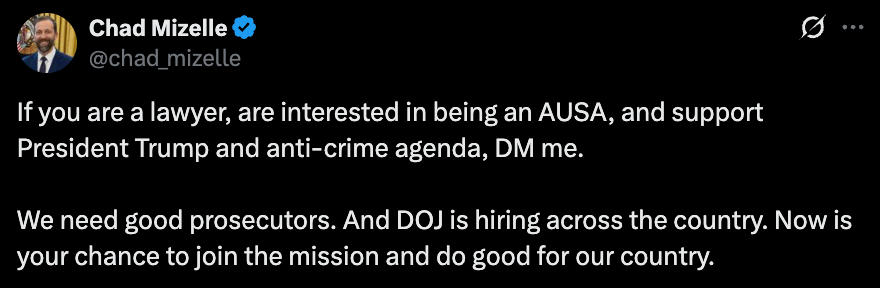
As
the
Department
of
Justice
continues
hemorrhaging
Assistant
U.S.
Attorneys,
the
administration
has
put
out
a
call
for
new
recruits.
And
it’s
one
step
above
scribbling
on
the
bathroom
wall.
It’s
been
a
rough
year
for
the
DOJ.
Having
kicked
off
the
Trump
administration
by
reorienting
the
venerable
institution
as
Trump’s
personal
law
firm,
morale
cratered
and
attrition
began
taking
a
toll.
Whether
it’s
asking
dedicated
public
servants
to
drop
corruption
cases
as
part
of
a
corrupt
political
bargain
or
sign
off
on
baseless
prosecutions
of
Trump’s
enemies,
AUSAs
across
the
country
keep
deciding
enough
is
enough.
Historically,
the
Department
of
Justice
sits
on
a
mile
high
stack
of
resumes
submitted
by
eager
young
lawyers
hoping
to
nab
one
of
the
most
prestigious
jobs
in
law.
Apparently
that
pipeline
has
run
dry,
because
the
DOJ
is
now
begging
for
help
on
social
media.
Elon
Musk’s
X…
it’s
not
just
for
AI-generated
sexual
exploitation
anymore!
They’re
trying
to
staff
the
Department
of
Justice
like
they’re
putting
together
an
adult
kickball
team.
Just
slide
into
Mizelle’s
DMs
with
a
quick
“feeling
cute,
might
lie
to
a
tribunal
later”
and
see
where
it
takes
you!
For
what
its
worth,
Mizelle
left
his
job
as
the
Justice
Department’s
Chief
of
Staff
in
the
fall,
so
it’s
not
clear
why
he’d
have
the
authority
to
hire
anyone.
Maybe
using
a
former
DOJ
leader
for
this
ask
is
a
way
for
the
Department
to
maintain
plausible
deniability.
On
that
note
“plausible
deniability”
might
be
refrain
we
hear
a
lot
from
this
DOJ
in
coming
years.
In
a
fitting
touch
of
competence,
Mizelle’s
DMs
weren’t
even
open
when
he
posted
this.
A
user
pointed
this
out
and
Mizelle
responded
with
a
brisk
“Fixed!”
It’s
a
level
of
attention
to
detail
that
sums
up
exactly
why
the
DOJ
is
hurting
for
recruits.
Fun
fact:
this
desperate
social
media
recruitment
drive
landed
immediately
after
Mizelle’s
ethics
complaint
against
Judge
James
Boasberg
collapsed
spectacularly.
Chief
Judge
Jeffrey
Sutton
of
the
Sixth
Circuit
dismissed
the
misconduct
complaint
in
part
because
Mizelle
based
it
on
an
alleged
non-public
statement
by
Judge
Boasberg
that
he
never
bothered
to
provide
the
Court.
When
Judge
Sutton
gave
him
an
opportunity
to
correct
the
oversight…
Mizelle
just
ghosted.
Crackerjack
lawyering!
So
now
Mizelle
is
bypassing
Craigslist
and
heading
straight
to
Twitter,
seeking
out
the
next
generation
of
legal
minds
who
will
presumably
also
struggle
with
the
whole
“attaching
evidence
to
filings”
thing.
The
brain
drain
at
DOJ
has
gotten
so
severe
that
the
administration
is
now
sending
military
lawyers
to
serve
as
federal
prosecutors.
Posse
Comitatus
never
really
contemplated
the
domestic
deployment
of
the
JAG
corps.
Military
lawyers
practice
under
their
own
bespoke
code,
which
doesn’t
necessarily
translate
to
enforcing
federal
criminal
law.
It’s
like
your
estranged
uncle
calling
and
asking,
“you’re
a
lawyer,
right?”
but
with
the
highest
stakes
imaginable.
This
is
what
happens
when
you
try
to
“flood
the
zone.”
It’s
the
same
mentality
that’s
got
the
administration
using
AI
to
write
transportation
regulations
and
arresting
journalists
under
the
KKK
Act.
At
some
point,
“flooding
the
zone”
just
means
drowning
yourself.
You
can
only
spread
so
thin
before
you
run
out
of
people
willing
to
do
your
bidding.
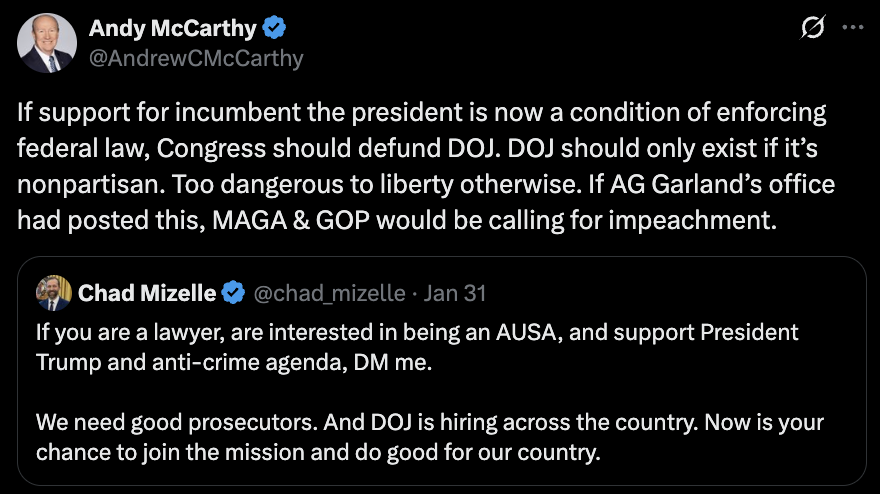
McCarthy
is
a
conservative
talking
head
exhibiting
a
level
of
“principle
over
politics”
that
Jonathan
Turley
could
never.
Still,
one
must
ask,
“where
was
he
before
this?”
One
could
have
issued
this
call,
for
instance,
WHEN
THE
ATTORNEY
GENERAL
STARTED
CALLING
THE
DOJ
TRUMP’S
PERSONAL
LAWYERS.
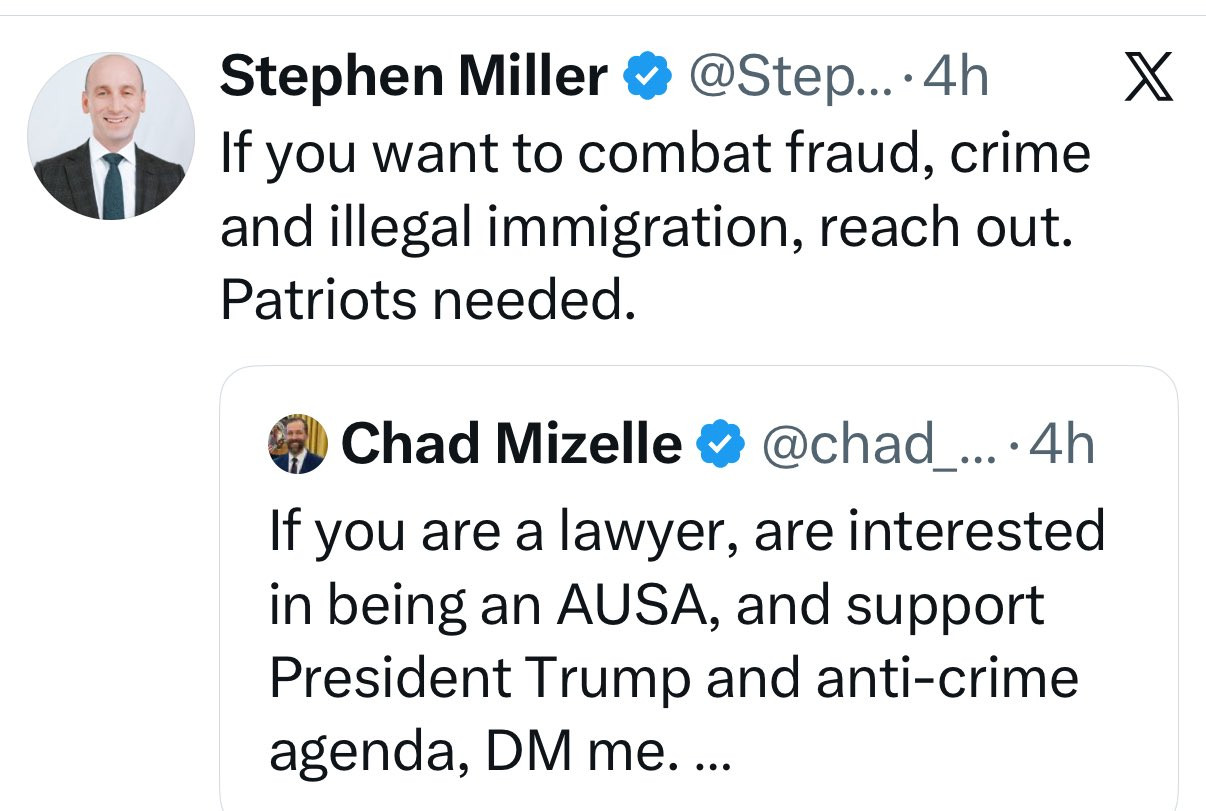
That
was
a
whole
year
ago.
Shouldn’t
that
have
been
enough
to
sound
this
warning?
Somewhere
out
there,
there’s
an
unemployed
Federalist
Society
alum
sitting
in
a
pile
of
empty
Chick-fil-A
wrappers
and
Antonin
Scalia
prayer
candles
who
will
leap
at
the
opportunity
to
be
a
right-wing
DEI
hire,
filling
a
job
they
couldn’t
sniff
under
normal
circumstances.
They’ll
put
in
their
time,
collect
the
LinkedIn
line
item,
and
carry
it
with
them
going
forward.
If
they’re
lucky,
enough
time
will
pass
that
everyone
will
assume
their
time
at
the
Department
reflects
their
credentials
as
an
attorney
and
not
their
reputation
as
a
“needed
Patriot.”
Before
the
No
Surprises
Act,
patients
often
got
stuck
in
the
middle
of
billing
disputes.
For
instance,
when
they
went
to
an
in-network
hospital
but
were
treated
by
an
out-of-network
provider
or
when
they
needed
emergency
care
but
couldn’t
choose
who
treated
them.
This
often
led
to
them
receiving
huge
surprise
bills.
The
No
Surprises
Act,
which
went
into
effect
in
2022,
changed
this.
But
new
issues
arose,
particularly
relating
to
the
Independent
Dispute
Resolution
process.
At
the
heart
of
this
is
a
recent
lawsuit
Anthem
filed
against
Prime
Healthcare.
The
No
Surprises
Act
protects
patients
from
unexpected
bills
and
removes
them
from
insurer-provider
payment
friction.
The
act
requires
insurers
and
providers
to
enter
into
30
days
of
open
negotiation
to
determine
how
much
providers
are
paid.
If
they
can’t
come
to
an
agreement,
either
side
can
use
the
Independent
Dispute
Resolution
(IDR)
process,
in
which
a
provider
submits
a
payment
offer
and
an
insurer
submits
a
payment
offer
and
then
a
neutral
arbitrator
picks
one.
This
Independent
Dispute
Resolution
process
was
intended
to
be
used
as
a
last
resort.
But
some
in
the
industry
now
argue
that
the
IDR
process
is
being
misused
by
providers
leading
to
an
explosion
of
cases
using
this
mechanism.
Anthem
Blue
Cross
Life
and
Health
Insurance
Company,
an
Elevance
affiliate,
filed
a
lawsuit
earlier
in
January
against
11
Prime
Healthcare
facilities
in
California.
Anthem
is
accusing
these
facilities
of
“knowingly
flooding”
the
IDR
process
with
more
than
6,000
ineligible
disputes
and
“extracting
millions
of
dollars
in
wrongfully
obtained
awards.”
Aside
from
this
lawsuit,
Elevance
has
cases
against
other
companies
in
other
states
including
in
Georgia
and
Ohio.
“When
this
bill
was
passed,
the
federal
government
expected
17,000
of
these
cases
to
come
through
in
any
particular
year,”
said
Dr.
Catherine
Gaffigan,
president
of
Elevance’s
health
solutions
business,
in
an
interview.
“Instead,
what
we
have
seen
is
millions
of
cases
actually
going
through.
And
Elevance
actually
sees
17,000
of
these
a
month.
So
clearly
this
has
been
exploited
in
ways
that
were
never
intended.”
Elevance
isn’t
the
only
insurer
up
in
arms
about
alleged
IDR
misuse.
UnitedHealthcare
sued
Radiology
Partners
in
August
and
BCBS
Texas
went
after
Zotec
Partners
in
December.
One
industry
expert
equated
the
issue
to
the
340B
Drug
Pricing
Program,
which
allows
hospitals
and
clinics
that
treat
a
large
population
of
low-income
and
uninsured
patients
to
buy
outpatient
prescription
drugs
at
a
discount.
It
was
intended
to
support
safety-net
providers,
but
has
since
grown
exponentially.
Between
2000
and
2020,
the
number
of
covered
entity
sites
participating
in
the
program
grew
from
8,100
to
50,000.
The
IDR
process
“was
invented
for
good
reasons.
…
That’s
similar
to
the
good
intentions
behind
340B.
But
I
think
there’s
a
chance
that
in
this
situation,
the
IDR
process,
like
the
340B
process,
is
being
repurposed
to
serve
as
a
revenue
stream
for
hospitals
that
find
justification
for
doing
so,”
said
Michael
Abrams,
managing
partner
of
Numerof
&
Associates.
Elevance
is
calling
for
lawmakers
to
reform
the
IDR
process
to
ensure
that
it
is
used
in
the
way
they
intended.
Anthem
v.
Prime
Healthcare
In
the
complaint,
Anthem
claimed
that
the
defendants
used
the
IDR
process
as
an
“an
extractive
tool
to
gouge
the
healthcare
system,”
versus
a
forum
for
resolving
good
faith
payment
disputes.
Anthem
declared
that
Prime
Healthcare
began
flooding
the
IDR
process
in
January
2024.
The
facilities
received
roughly
$15
million
greater
than
what
Anthem
had
originally
paid
for
services,
and
the
typical
reward
was
more
than
six
times
greater
than
what
a
contracted
provider
would
be
paid
for
the
same
service.
Anthem
added
that
this
fits
Prime’s
reputation.
“Defendants,
and
Prime
generally,
have
developed
a
reputation
for
prioritizing
profits
over
patients,”
the
complaint
stated.
“Many
hospitals
acquired
by
Prime
have
canceled
longstanding
network
contracts
to
extract
higher
reimbursement
for
the
same
services.
Historically,
out-of-network
Prime
hospitals
aggressively
pursued
collection
from
their
patients
and
routinely
filed
litigation
against
health
plans
like
Anthem
to
recover
ever-greater
payments.
And
Prime
hospitals
who
do
contract
with
health
plans
will
publicly
threaten
to
cancel
those
contracts
if
they
do
not
receive
higher
reimbursement
rates,
putting
patients
in
limbo.”
Although
the
No
Surprises
Act
protects
patients,
Anthem
is
alleging
Prime
exploited
the
IDR
process
by
routinely
pushing
emergency
claims
—
eligible
or
not
—
into
arbitration
to
maximize
payments.
The
defendants
even
initiate
IDR
against
Anthem
for
patients
who
aren’t
Anthem
members,
the
insurer
alleges.
Anthem
added
that
Prime
knowingly
files
hundreds
of
IDR
disputes
each
month.
“When
these
disputes
proceed
to
an
IDR
payment
determination—and
they
often
do—Defendants
perfunctorily
demand
80%
of
their
original
billed
charges,
ignoring
any
individual
circumstances
of
the
episode
of
care
or
market
realities
regarding
its
value,”
the
complaint
stated.
Anthem
also
alleges
that
Prime
repeatedly
falsified
information
throughout
the
IDR
process
to
bypass
eligibility
rules
and
push
ineligible
disputes
to
payment
determinations.
Making
issues
worse,
Prime
only
sends
IDR-related
communications
to
Anthem
through
an
“unnecessarily
restrictive
and
cumbersome
online
portal,”
which
makes
it
“impossible”
for
Anthem
to
respond.
Prime
Healthcare
called
Anthem’s
lawsuit
“meritless.”
The
organization
stated
that
its
facilities
acted
in
compliance
with
the
No
Surprises
Act
and
the
IDR
process
and
did
not
balance
bill
any
patients.
“Anthem’s
lawsuit
ignores
the
reality
that
certain
large
health
plans,
including
Anthem,
amass
record
profits
by
underpaying
providers,
delaying
or
denying
care,
and
burdening
patients
with
administrative
barriers,
practices
that
have
eroded
the
public
trust,”
a
spokesperson
told
MedCity
News.
Beyond
its
initial
intent
According
to
one
healthcare
expert,
what
was
supposed
to
be
a
“narrow,
last-resort
pressure
valve”
has
instead
become
a
“fire
hose.”
And
providers
are
winning
the
majority
of
the
payment
determinations
(about
85%
in
2024),
with
median
determinations
in
late
2024
reported
to
be
around
459%
of
the
qualifying
payment
amount.
“Very
few
people
anticipated
just
how
far
the
No
Surprises
Act
would
drift
from
its
original
intent.
While
the
law
has
protected
patients
from
‘being
in
the
middle’
of
negotiations
between
providers
and
payers,
Congress
did
not
envision
the
volume
of
arbitrations
and
a
system
where
provider
groups
would
prevail
in
arbitration
more
than
80%
of
the
time.
What
was
designed
as
a
narrow
patient-protection
backstop
has
instead
become
a
parallel
payment
system
—
one
with
enormous
financial
consequences,”
said
Dr.
Adam
Brown,
an
emergency
physician
and
founder
of
healthcare
advisory
firm
ABIG
Health.
He
added
that
what
was
intended
to
protect
patients
has
just
morphed
into
a
“high-stakes
battlefield
between
providers
and
payers.”
Why
are
providers
winning
more
often?
According
to
Brown,
the
simple
answer
is
that
they
are
making
a
better
case
in
front
of
the
arbitrator.
However,
when
you
look
at
who
is
winning
the
cases,
they’re
often
private
equity-backed
who
have
“spent
time
and
capital
to
increase
the
volume
of
IDR
and
built
administrative
and
automated
processes
around
the
IDR
submissions,”
he
said.
Abrams
of
Numerof
&
Associates
echoed
these
comments.
“I
think
one
of
the
consequences
of
these
cases
may
be
to
accelerate
reexamination
of
the
IDR
process,
raise
questions
about
whether
it’s
really
functioning
the
way
it
was
meant
to,”
he
said.
Gaffigan
said
Elevance
is
in
conversation
with
lawmakers
and
the
Centers
for
Medicare
and
Medicaid
Services
about
changing
the
IDR
process,
including
requiring
arbiters
to
justify
unusually
high
rewards
and
providing
clarity
on
what
elective
services
are
eligible
for
IDR.
In
the
meantime,
Anthem
has
taken
its
own
steps
to
fix
the
issue.
For
example,
in
the
Fall,
it
announced
plans
to
deduct
10%
of
payments
to
hospitals
every
time
a
doctor
not
in
their
network
treats
a
patient
enrolled
in
one
of
their
plans.
Many
provider
organizations
have
pushed
back
against
this
new
policy,
including
the
American
Hospital
Association,
arguing
that
it
would
limit
patients’
choice
of
provider.
“The
core
objectives
of
the
NSA
were
to
protect
patients
and
to
incentivize
network
participation,”
the
AHA
said
in
a
statement
in
December.
“Anthem
undermines
this
landmark
legislation
by
introducing
new
patient
harms
and
targeting
the
very
hospitals
that
have
worked
in
good
faith
to
participate
in
the
plan’s
network.
The
AHA
calls
on
Elevance
Health
to
do
right
by
its
Anthem
enrollees
and
ensure
it
is
a
credible
partner
to
its
network
hospitals
and
health
systems
and
rescind
this
deeply
flawed
policy.”
When
asked
about
the
pushback
this
policy
has
received,
Gaffigan
noted
that
it
is
only
for
elective
surgeries
and
when
there
are
appropriate
in-network
providers
available.
In
addition,
critical
access,
rural
and
safety
net
hospitals
are
exempt.
“It
really
is
like
in
these
situations
where
there
are
lots
of
options,
and
yet
somehow
this
patient
is
ending
up
with
an
out-of-network
provider
in
an
in-network
hospital,
and
that
out-of-network
provider
is
then
taking
advantage
of
the
IDR,”
Gaffigan
said.
“We
would
prefer
to
never
actually
apply
this
penalty.
We
really
just
want
our
hospitals,
which
are
in-network
and
important
partners
for
us,
to
be
part
of
the
solution
here.”
She
added
that
while
the
No
Surprises
Act
protects
patients
from
surprise
billing,
they’re
ultimately
harmed
on
the
back-end.
“The
way
that
the
independent
dispute
resolution
process
is
being
abused
is
driving
up
cost,
and
that
ends
up
in
patients’
premiums,”
she
argued.
“It
ends
up
in
employers’
costs,
and
it
drives
up
the
cost
of
health
insurance,
and
unfortunately,
it’s
doing
that
and
not
driving
any
improvements
in
quality,
differences
in
care,
etc.
It’s
purely
inflationary.”
*
Biglaw
grapples
with
Epstein
list
cameos.
[NY
Post]
*
Delaware
Supreme
Court
rewrites
settlement
to
give
Elon
Musk
the
kind
of
personal
party
he
desperately
kept
asking
Jeffrey
Epstein
for.
[Delaware
Business
Court
Insider]
*
Oh,
right,
here’s
the
background
on
that
quip.
[Daily
Beast]
Next
Vigil
meeting
outside
the
Zimbabwe
Embassy. Saturday
7th February
2026
from
2
–
5
pm.
We
meet
on
the
first
and
third
Saturdays
of
every
month.
On
other
Saturdays
the
virtual
Vigil
will
run.
The
Restoration
of
Human
Rights
in
Zimbabwe
(ROHR) is
the
Vigil’s
partner
organisation
based
in
Zimbabwe.
ROHR
grew
out
of
the
need
for
the
Vigil
to
have
an
organisation
on
the
ground
in
Zimbabwe
which
reflected
the
Vigil’s
mission
statement
in
a
practical
way.
ROHR
in
the
UK
actively
fundraises
through
membership
subscriptions,
events,
sales
etc
to
support
the
activities
of
ROHR
in
Zimbabwe.
The
Vigil’s
book
‘Zimbabwe
Emergency’ is
based
on
our
weekly
diaries.
It
records
how
events
in
Zimbabwe
have
unfolded
as
seen
by
the
diaspora
in
the
UK.
It
chronicles
the
economic
disintegration,
violence,
growing
oppression
and
political
manoeuvring
–
and
the
tragic
human
cost
involved. It
is
available
at
the
Vigil.
All
proceeds
go
to
the
Vigil
and
our
sister
organisation
the
Restoration
of
Human
Rights
in
Zimbabwe’s
work
in
Zimbabwe.
The
book
is
also
available
from
Amazon.
The
Vigil,
outside
the
Zimbabwe
Embassy,
429
Strand,
London
meets
regularly
on
Saturdays
from
14.00
to
17.00
to
protest
against
gross
violations
of
human
rights
in
Zimbabwe.
The
Vigil
which started
in
October
2002
will
continue
until
internationally-monitored,
free
and
fair
elections
are
held
in
Zimbabwe.
Judge
Learns
Handcuffing
Lawyers
Is
Frowned
Upon:
Texas
judge
charged
after
allegedly
cuffing
an
attorney
mid-hearing.
Disbar
Them
All:
Lawyers
have
to
come
together
as
a
profession
and
make
sure
the
Trump
administration’s
lawyers
never
practice
again.
Judge
Skeptical
That
Trump
Can
Unilaterally
Blow
Up
Historic
Buildings:
The
East
Wing
is
gone,
but
the
legal
fight
continues.
Tip
For
Professor
Richard
Epstein…
Shutting
Up
Is
Still
Free:
Law
professor
who
faceplanted
on
COVID
insists
now
declares
he’s
figured
out
that
everyone
has
been
wrong
about
the
Fourteenth
Amendment
for
a
century
or
so.
He
is
incorrect.
Law
School
Merger
Mania:
Regional
institution
is
exploring
long-distance
merger.
Stroock
Calls
It
After
150
Years:
The
storied
firm
dissolves,
reminding
everyone
that
nothing
is
forever.
Law
Firm
Jet
Crash
Leaves
No
Survivors:
Tragically,
a
firm-owned
plane
went
down
with
no
survivors.








 Kathryn