Advice From ‘Marty Supreme,’ Getting A Handle On A Fast-Growing Nonlegal Career Path, And Paris Checking In – Above the Law

Neil,
here. 
When
I
was
a
teenager
growing
up
in
NYC,
I
frequented
a
place
called
the

Table
Tennis
Center

on
96th
Street
off
Broadway. 
You
didn’t
wander
in
accidentally. 
You
went
because
you

knew

Street
level,
thick
with
smoke,
always
noisy,
it
featured
a
bunch
of
beaten-up
tables,
metal
chairs
and
a
mix
of
old-school
hustlers
playing
for
cash,
petty
criminals,
competition-level
players,
kids
like
me,
and
the
curious
who
almost
always
left
having
lost
whatever
money
they
had
on
them. 

The
place
was
owned/run
by
Marty
Reisman,
a
trash-talking,
expert
player
and
hustler. 
But
he
had
a
soft
spot
for
the
kids. 
He
gave
us
ping-pong
lessons
and
enjoyed
showing
off
for
us
playing
what
he
referred
to
as
“pigeons”
for
money,
often
with
an
extreme
handicap
like
using
a
sneaker
or
just
his
elbow
as
a
paddle.

Every
so
often,
before
there
was
a
lot
of
action
in
the
place,
he’d
speak
with
us
about
things
other
than
ping-pong
or
money. 
I
remember
distinctly
one
conversation
where
Marty
asked
me
what
I
wanted
to
do
for
a
living. 
I
said
“lawyer.”
He
looked
at
me
and
smiled:
“Now,
why
would
a
smart
kid
like
you
want
to
do
that?” 
It
turned
out
he
was
right.

It
came
to
mind
when,
to
my
absolute
shock,
I
read
about
a
movie
being
made
based
loosely
on
his
life
starring
the
most
bankable
young
movie
star
in
the
world,
Timothy
Chalamet. 
I
would
have
sooner
believed
Martians
were
landing
on
earth. 
The
movie
is
in
theatres.


One
of
the
things
we
monitor
closely
at
Ex
Judicata
is

trending
nonlegal
jobs


for
JDs
.
One
that
keeps
crossing
our
screens
is
“Practice
Group
Director”
or
“Practice
Manager.” 
Essentially,
this
is
someone
who
assists
the
Practice
Group
Leader
(PGL)
in
running
the
particular
practice
(litigation,
capital
markets,
IP,
etc.)
at
a
law
firm
like
a
business
unit
so
the
PGL
who
is
a
partner
can
focus
on
client
development
and
legal
work. 
We
have
found
that
the
role
is
often
misunderstood.

“They’re
administrative
staff.” 
They
are
not.

“They
tell
lawyers
what
to
do.” 
They
do
not.

“They
are
lawyers
by
training.” 
They
do
not
have
to
be.

“It’s
a
cost
center.”
Enlightened
firms
view
it
as
helping
drive
revenue.

For
clarification,
we
turned
to
Susan
Lambreth,
a
Co-Founding
Principal
at

LawVision
,
a
top
legal
project
management,
practice
group
management,
and
law
firm
leadership
consulting
firm. 
An
attorney
by
background,
Susan
told
us:

These
roles
are
like
“mini”
COOs
of
the
practice
group
or
department. 
The
roles
have
been
around
for
30
years
and
there
are
well
over
500
people
with
these
roles
in
US
law
firms.
The
responsibilities
vary
widely
from
firm
to
firm
but
can
include
the
day-to-day
operations
of
the
group,
financial
management,
talent
management
(like
workload
assignment),
group
business
planning,
lateral
onboarding,
partner
progression
recommendations,
and
more.

The
department
chairs
and
practice
group
leaders
need
business
professionals
who
are
full-time
helping
them
so
they,
as
the
partner
leaders,
can
maintain
their
busy
legal
practice. 
Much
like
Office
Managing
Partners
have
an
office
administrator
and
other
roles
supporting
them,
when
law
firms
evolved
from
geographic
management
of
the
firm
to
“business
unit”
driven
management,
they
needed
to
add
professionals
to
help
the
department
chairs
and/or
practice
group
leaders
manage
their
groups.

Practice
Group
Professionals
belongs
to
the
category
“law
adjacent”
jobs. 
Essentially
positions
where
one
maintains
some
connection
to
law
without
practicing
law. 
Many
former
practicing
lawyers
love
these
jobs
because
they
are
deeply
involved
in
a
firm’s
practices

but
helping
to
run
the
business
of
the
group
and
without
the
pressure
of
billable
hours
or
making
partner.
These
roles
are
also
sometimes
known
by
the
more
antiquated
phrase,
“JD
Advantage”
jobs.
Compliance
and
legal
recruiting
are
probably
the
two
most
common
“law
adjacent”
paths. 

For
many,
there
is
comfort
in
retaining
a
connection
to
law
having
spent
three
years
of
one’s
life
in
law
school. 
We
understand. 
But
counsel,
do
not
be
held
back
by
the
belief
that
if
you
leave
law
your
career
still
has
to
have,
at
least,
a
tangential
connection
to
law. 
It
does
not. 
Follow
your
passion. 
And
always
remember
that
your
JD
is
a
degree
in
complex
problem-solving,
a
skill
which
is
valued
by
pretty
much
every
career
in
the
universe.


Ex
Judicata
was
in
Paris
over
the
holidays. 
We
had
the
opportunity
to
sit
down
over
dinner
with
an
assortment
of
law
firm
partners,
associates,
and
one
COO
of
an
Am
Law
20
firm. 
The
place
was
L’Arret,
which
had
recently
opened. 
The
chef
is
Mashama
Bailey,
who
has
had
one
other
restaurant,
The
Grey,
in
Savannah,
Georgia,
for
15
years. 
Not
a
common
nexus
from
Savannah
to
Paris,
which
we
thought
was
kind
of
cool.

The
main
takeaways?
Lawyers
in
France
are
no
different
than
lawyers
in
the
US
in
the
sense
of
so
many
being
interested
in
exploring
nonlegal
careers. 
The
world
of
work
has
never
been
more
transparent
in
human
history
with
sites
like
exjudicata.com
helping
to
show
the
breadth
of
opportunities
for
non-practicing
lawyers.

The
difference? 
Désespoir
or
desperation.
There
wasn’t
the
same
sense
of
panic
or
hitting
the
wall
or
feeling
trapped
that
we
have
encountered
so
often
among
practicing
lawyers
on
exjudicata.com. 
A
lot
of
it
we
would
chalk
up
to
lifestyle.
The
pace
is
a
lot
slower
in
Paris
than
in,
say,
New
York
City. 
Even
if
one
is
working
on
global
deals.

We’d
love
to
know
what
you
think.


The
authors
of The
Great
Escape column, Neil
Handwerker
and Kimberly
Fine, are
the
founders
of
exjudicata.com,
a
platform
designed
to
help
lawyers
move
to
nonlegal
careers.
 They
just
launched a
new
related
platform,
the
EXJ
Community,
the
first
ever
peer-to-peer
network
of
non-practicing
lawyers.


Think You Are Covered? Better Read Your Cybersecurity Policy – Carefully – Above the Law


Never
assume
your
organization
is
fully
covered.
Cyber
insurance
policy
language
is
fraught
with
exclusions,
limitations
of
coverage,
and
conditions
that
will
void
a
policy.”


Delinea
2025
Cyber
Insurance
Research
Report

As
I
have

written
before
,
law
firms
and
cybersecurity:
it’s
a
subject
that
often
makes
managing
partners’
eyes
glaze
over.
They
don’t
understand
it,
it’s
expensive,
and
frankly,
it’s
boring.
They
assume
cybersecurity
events
won’t
happen
to
their
firm
and
when
they
do,
the
only
question
they
ask
is
“do
we
have
insurance?”
Increasingly,
the
answer
is:
yes,
maybe,
and
sort
of.

That’s
why
a
recent
survey
by
the
cybersecurity
company

Delinea

is
significant
and
lends
credence
to
my
concerns.
At
the
very
least,
it
should
serve
as
a
wake-up
call
for
firm
leadership.
Delinea is
a
cybersecurity
consulting
company
that
focuses
on
securing
privileged
access
and
identity
security
for
organizations. Delinea
partnered
with

Censuswide

and
surveyed
more
than
750
security
leaders
about
cyber
insurance
and
claims
practices.

While
you
often
have
to
take
with
a
grain
of
salt
what
consultants
find
in
their
surveys
since
they
often
strengthen
their
case
for
being
hired,
the
Delinea
survey
reveals
some
potentially
troubling
gaps
between
what
insureds
think
they
have
and
what
their
policies
actually
cover.
Those
gaps
apply
just
as
well
to
law
firms.


It’s
a
Question
of
When,
Not
If

First
things
first,
if
a
law
firm
doesn’t
think
a
cybersecurity
event
is
going
to
happen,
think
again.
Seventy-seven
percent
of
those
surveyed
by
Delinea
revealed
they
suffered
a
cybersecurity
incident
in
the
last
year.

While
the
survey
didn’t
focus
on
law
firms,
there’s
little
reason
to
think
firms
are
any
different.
In
fact,
law
firms
may
be
more
at
risk
since
they
hold
highly
confidential
client
material
that,
frankly,
is
valuable
to
the
bad
guys.
But
all
too
often
firms
think
a
cybersecurity
event
isn’t
going
to
happen
to
them.
It’s
sort
of
the
security
through
obscurity
notion
about
which
I
have

written
before
.


Cyber
Insurance:
It
May
Not
Be
What
You
Think

According
to
the
Delinea
report,
often
cyber
insurance
policies
don’t
cover
what
you
expect.
Only
33%
of
policies
of
those
responding
covered
a
critical
loss
component:
lost
revenue.
Only
45%
of
the
policies
covered
ransomware
(where
a
bad
guy
demands
the
payment
of
ransom
to
return
stolen
data)
despite
the
fact
that
1
in
5
surveyed
reported
a
ransomware
incident.

That’s
an
important
limitation
since
often
management
concludes
the
payment
of
the
ransom
offers
the
quickest
return
of
needed
data
and
the
return
to
business
operations,
which
may
or
may
not
be
true.
Forty
percent
of
the
policies
don’t
cover
costs
to
recover
data. 
Less
than
half
covered
incident
response
services
or
additional
remedial
security
controls.

What
all
this
means
is
that
a
firm
may
end
up
not
being
covered
for
a
significant
loss.
I

recently
wrote

about
a
company
that
sadly
had
to
go
out
of
business
because
it
did
not
have
sufficient
coverage
for
a
ransomware
claim.

Years
ago,
I
attended
a
cybersecurity
conference.
I
had
lunch
with
a
bunch
of
insurance
marketing
guys
licking
their
chops
over
the
huge
market
for
cyber
insurance.
I
asked
what
would
happen
when
the
claims
pour
in
as
they
most
certainly
would.
I
was
met
with
stone
silence.
We
now
know
what
will
happen:
as
the
report
puts
it,
“Insurance
adjusters
are
on
the
lookout
for
a
range
of
controls
lapses
that
could
get
their
companies
off
the
hook
for
paying
a
claim.”

And
it’s
not
just
coverage
issues
that
can
trip
up
a
claim.
The
lack
of
security
controls
can
do
the
same
thing.


Security
Controls

Not
taking
cybersecurity
seriously
and
having
robust
protections
in
place
not
only
means
an
increased
threat
of
an
incident,
it
also
could
mean
that
appropriate
coverage
can’t
be
obtained
or
if
it
is,
will
be
voided
once
there
is
a
claim.

Indeed,
almost
everyone
surveyed
by
Delinea
said
that
their
organization
had
to
have
some
level
of
security
controls
in
place
to
get
coverage.
Some
97%
of
those
surveyed
indicated
that
their
carriers
were
demanding
things
like
identity
security
controls,
authorization
controls,
and
better
password
management,
and
that
carriers
were
increasingly
scrutinizing
their
insureds’
security
controls.

Moreover,
increasingly,
the
policies
that
are
in
place
may
be
voided
if
sufficient
security
controls
aren’t
in
place,
a
failure
that
often
is
not
discovered
until
a
claim
is
filed.
According
to
the
Delinea
report,
45%
of
those
surveyed
said
their
policies
could
be
voided
due
to
lack
of
security
controls.
Other
reasons
for
voiding
coverage
include
human
error,
misconfiguration,
internal
bad
actors,
not
following
compliance
procedures,
failure
to
timely
report,
and
acts
of
terrorism
and
war.

It’s
a
hot
mess:
firm
management
doesn’t
take
cybersecurity
seriously,
doesn’t
spend
the
money
for
adequate
controls,
and
then
relies
on
insurance
once
a
claim
happens.
Only
to
discover
that
they
aren’t
covered.


Artificial
Intelligence

In
addition,
the
advent
of
the
GenAI
world
has
some
insurance
implications
as
well.
Here’s
a
noteworthy
finding:
42%
of
those
surveyed
said
their
policies
excluded
AI
misuse
and
liability
from
coverage.
That’s
important
because
firms
have
to
assume
that
their
lawyers
and
legal
professionals,
like
just
about
everyone
else,
are
using
GenAI
in
their
personal
and
often
in
their
work
lives.
But
if
they
don’t
use
AI
tools
properly,
the
misuse
could
result
in
liability
that
won’t
be
covered.
All
the
more
reason
to
undertake
robust
AI
training
and
create
appropriate
use
guidelines.


So,
What
To
Do?

So,
what
can
law
firm
management
do?
First,
it
may
be
stating
the
obvious,
but
management
needs
to
read
their
cyber
insurance
policies
carefully.
They
need
to
identify
the
exclusions
and
coverage
gaps.
They
need
to
do
research
into
how
the
policies
and
the
mandated
controls
are
being
interpreted.

They
can’t
assume
coverage
based
on
marketing
material,
or
what
the
carrier
has
offered
in
the
past
or
to
others.
Management
also
needs
to
carefully
review
the
security
controls
that
the
carrier
has
demanded
and
be
sure
they
are
met.
Conduct
an
annual
policy
audit
with
your
IT
director
and
insurance
broker
present.

Treat
that
review
and
everything
else
with
the
same
level
of
scrutiny
as
they
would
if
a
client
asked
them
to
review
their
own
policies.

The
report
makes
an
excellent
point
in
this
regard:

Because
the
cyber
insurance
market
is
still
maturing,
policy
language
and
coverage
options
can
vary
widely
from
insurer
to
insurer

and
even
policy
to
policy.
One
of
the
challenges
that
organizations
face
is
in
the
interpretation
of
policy
requirements.
While
policy
exclusions
tend
to
be
fairly
clear-cut
(i.e.,
exclusions
around
acts
of
war
or
nation-state
activity),
the
language
around
controls
requirements
can
sometimes
remain
vague.

Never
assume
your
organization
is
fully
covered
Cyber
insurance
policy
language
is
fraught
with
exclusions,
limitations
of
coverage,
and
conditions
that
will
void
a
policy.
It
is
incumbent
upon
risk
leaders
to
collaborate
with
executive
management
and
the
board
to
identify
how
existing
controls
weaknesses
could
jeopardize
their
insurability
and
to
utilize
gap
analysis
for
prioritizing
investments.

Couldn’t
have
said
it
any
better.


Stephen
Embry
is
a
lawyer,
speaker,
blogger,
and
writer.
He
publishes TechLaw
Crossroads
,
a
blog
devoted
to
the
examination
of
the
tension
between
technology,
the
law,
and
the
practice
of
law
.

Meet The Elite Biglaw Partners Who Bill $4,000 Per Hour – Above the Law


Ed.
note
:
Welcome
to
our
daily
feature, Quote
of
the
Day
.


If
there’s
someone
out
there
who
bills
at
a
higher
rate
than
Bill
and
me
on
hourly
cases,
please
let
us
know
so
we
may
raise
our
rates.


— Neal
Manne
,
former
managing
partner
at
Susman
Godfrey,
in
comments
given
to

Reuters
,
concerning
his
and
partner

Bill
Carmody’s

hourly
rates.
“The
process
by
which
Bill’s
and
my
billing
rates
are
set
each
year
is
as
mysterious
as
a
papal
conclave,”
Manne
said,
noting
that
while
their
hourly
rates
are
set
by
firm
management,
most
of
their
work
is
completed
on
a
contingency
or
fixed-fee
basis.


Staci
Zaretsky
 is
the
managing
editor
of
Above
the
Law,
where
she’s
worked
since
2011.
She’d
love
to
hear
from
you,
so
please
feel
free
to email her
with
any
tips,
questions,
comments,
or
critiques.
You
can
follow
her
on BlueskyX/Twitter,
and Threads, or
connect
with
her
on LinkedIn.

Trump Admin Plans To Let AI Write Transportation Regulations – Above the Law

Remember
the
first
time
you
opened
a
copy
of
the
Federal
Register
to
feast
upon
eight
pages
of
tiny
print
explaining
the
proper
size
of
a
gasket?
Did
you
ever
think,
what
if
they
replaced
all
the
highly
trained
engineers
and
scientists
describing
the
precision
crafting
required
to
keep
airplanes
from
falling
out
of
the
sky
with
hallucinating
robots?

Well,

good
news!

ProPublica dropped
the
investigative
piece
 this
morning,
revealing
that
the
Trump
administration
plans
to
use
Google
Gemini
to
draft
federal
transportation
regulations.
Turning
over
to
a
chatbot
the
very
nuts
and
bolts
of
the
agency
responsible
for
keeping
the
nation’s
highways
safe
may
scare
some
people,
but
really,
who
can
be
better
trusted
to
understand
the
unique
challenge
of
transportation
rulemaking
than

Road
Rules/Real
World
Challenge

champion
Sean
Duffy?

Road?
Rules?
Challenge?
It’s
all
right
there
on
his
resume!

This
isn’t

necessarily

a
bad
idea.
Assuming
the
underlying
expertise
and
science
remains
sound,
AI
tools
actually
excel
at
the
job
of
converting
technical
information
into
approachable
and
readily
comprehensible
text.
Rulemaking
has
always
involved
injecting
relative
clarity
into
complex
information,
a
mission
that’s
even
more
important
in
light
of
a

Loper
Bright

world.
Without
judges
deferring
to
agencies,
there’s
even
more
urgency
to
eradicate
ambiguities
and
deliver
rules
that
even
the
most
out-of-their-depth
judges
could
understand.
In
a
perfect
world,
regulatory
lawyers
would
use
AI
to
draft
clear
pronouncements
that
explicitly
spell
out
contingencies
that
were
once
left
to
deference.
As
a
preliminary
drafting
tool,
married
to
the
legal
acumen
of
veteran
practitioners,
AI
could
make
rulemaking
better
for
all.

It
will
shock
you
not
at
all
to
learn
that
this
is
not
the
Trump
administration’s
logic.

In
an
internal
meeting
announcing
the
new
initiative,
ProPublica
reports
that
DOT
General
Counsel
Gregory
Zerzan
expressed
enthusiasm
for
the
algorithmic
outsourcing,
noting
“We
don’t
need
the
perfect
rule
on
XYZ.
We
don’t
even
need
a
very
good
rule
on
XYZ.
We
want
good
enough.”

Do
you
feel
safer
already?

“We’re
flooding
the
zone,”
Zerzan
continued,
invoking
Steve
Bannon’s
classic
advice
for
the
MAGA
movement:
keep
doing
more
and
more
outrageous
nonsense
to
prevent
anyone
from
having
time
to
push
back.
It’s
the
same
mentality
that
might
kidnap
a
foreign
leader,
send
shock
troops
to
murder
civilians
in
Minnesota,
and
attempt
to
take
over
Greenland
so
everyone
will
forget
that
the
Epstein
files
haven’t
been
released
as
required
by
statute.

Zerzan’s
implication
is
that
the
Trump
Department
of
Transportation
wants
to
gut
federal
transportation
safety
regulations
and
they
want
to
do
it
by
bombarding
the
public
with
so
many
changes
that
it
doesn’t
have
time
to
ask
why.
If
it
results
in
some
hallucination-filled
half-assery,
the
administration
is
willing
to
live
with
that.

Mike
Horton,
DOT’s
former
acting
chief
artificial
intelligence
officer,
criticized
the
plan
to
use
Gemini
to
write
regulations,
comparing
it
to
“having
a
high
school
intern
that’s
doing
your
rulemaking.”
(He
said
the
plan
was
not
in
the
works
when
he
left
the
agency
in
August.)
Noting
the
life-or-death
stakes
of
transportation
safety
regulations,
Horton
said
the
agency’s
leaders
“want
to
go
fast
and
break
things,
but
going
fast
and
breaking
things
means
people
are
going
to
get
hurt.”


I’m
sorry,
you’re
absolutely
right!
We
needed
better
brakes
to
keep
the
train
from
careening
off
the
track
into
that
schoolhouse
and
dumping
toxic
sludge
into
that
reservoir.
Do
you
want
me
to
generate
another
rule
based
on
this
new
information?

But
can
the
administration
really
use
AI
to
deliver
the
Mad
Max-inspired
highway
hellscape
they
seek?
I’m
skeptical.
This
administration
has
already
run
afoul
of
AI
understanding
the
rule
of
law
better
than
its
cynical
Federalist
Society
approved
handlers.
The
Pentagon
installed
a
dedicated
AI
and

it
instantly
identified
war
crimes
.
Arguably,
the
only
thing
more
difficult
than
keeping
AI
from
making
mistakes
is
convincing
it
to
intentionally
produce
garbage.
The
thing
about
a
“high
school
intern,”
as
Horton
put
it,
is
that
it
can
struggle
to
act
in
bad
faith
because
it
doesn’t
know
enough
to
simulate
guile.
Lawyers
may
find
themselves
substantially
rewriting
everything
the
AI
puts
out
anyway.

And
even
if
they
do
rapidly
churn
out
rulemaking
copy,
the
protections
found
in
the
Administrative
Procedures
Act
still
exist.
Between
notice
and
comment
and
judicial
review,
the
public
will
still
have
mechanisms
to
put
the
brakes
on
the


in
this
case
literal


runaway
train.
Zerzan
wants
to
flood
the
zone
but
might
only
succeed
in
spreading
himself
out.
These
rules
will
have
different
constituencies,
but
the
Department
will
be
involved
in
every
fight.
It
doesn’t
“flood
the
zone”
to
have
the
shipping
industry,
the
trucking
industry,
and
airlines
all
involved
in
fights
during
the
same
month.
From
their
perspective,
they’re
all
just
having
one
fight.
But
the
Department
is
defending
three
fights
at
once.

And,
of
course,
when
you
“go
fast
and
break
things,”
it
usually
ends
in
a
litigation
bottleneck.
The
Department
of
Transportation
already
tried
its
hand
at
rulemaking
the
old-fashioned
way.
Pumping
out
a
rule
in
six
months
in
an
effort
to

strip
licenses
from
a
couple
hundred
thousand
truck
drivers

as
part
of
the
administration’s
ongoing
nativism
performance
art,
the
Department
only
succeeded
in
getting
it
blocked
by
the
D.C.
Circuit.
This
effort
wasn’t
going
to
be
any
more
successful
if
they’d
pushed
the
rule
out
the
door
faster.
If
anything,
flooding
the
zone
will
just
clog
up
the
courts
trying
to
untangle
the
lawsuits.

Also…
have
fun
with
the
discovery
requests
seeking
every
prompt
lawyers
used
in
the
drafting
process.
According
to
ProPublica’s
sources,
as
part
of
downplaying
the
serious
repercussions
of
the
proposal,
staffers
were
told
that
a
lot
of
what
the
AI
would
be
producing
would
be
“word
salad.”
Hard
to
assert
any
sort
of
privilege
over
“word
salad.”

All
this
“flood
the
zone”
talk
is
just
posturing.
They
want
to
front
like
they’re
launching
some
nefarious
strategic
blitzkrieg
on
the
administrative
state,
but
they
just
want
AI
to
write
these
regs
for
them
because
they’re
fucking
lazy.
Remember
when
Elon
Musk
parachuted
into
the
government
promising
to
cut
a
trillion
dollars
in
spending,
destroyed
some
agencies,
definitely

killed
hundreds
of
thousands
of
people
,
and
ultimately
walked
away
having
left
the
deficit
worse
than
before?
It’s
the
same
energy.

Lawyers
working
in
tandem
with
AI
technology
can
marginally
enhance
their
productivity,
but
consider
the
rhetoric
they’re
using
according
to
this
report:
“flooding
the
zone,”
“point
of
the
spear,”
“shouldn’t
take
you
more
than
20
minutes.”
Too
often
we
construe
their
contempt
for
the
work
of
government
as
a
problem
with
the
work
government
performs.
But
a
lot
of
the
animosity
is
based
on
a
contempt
of
the
idea
of
work
itself.
Of
the
mundane,
nose-to-grindstone,
detail-oriented
work
that
governments

and
lawyers

have
to
do.

Which,
in
the
end,
is
AI’s
greatest
threat
to
society.
It
enthralls
the
nation’s
laziest.


Government
by
AI?
Trump
Administration
Plans
to
Write
Regulations
Using
Artificial
Intelligence
 [ProPublica]

Firm-Owned Plane Crash Leaves No Survivors; Founder’s Wife, An Attorney, Among Deceased – Above the Law

We
have
some
unfortunate
news
to
report
out
of
the
Houston,
Texas,
legal
community,
in
the
wake
of
a
tragic
plane
crash
linked
to
successful
plaintiff’s
firm
Arnold
&
Itkin.

According
to
news
reports,
the
firm’s
plane,
traveling
from
Houston
to
Paris,
stopped
in
Bangor,
Maine,
to
refuel,
but

crashed
during
an
attempted
takeoff
.
According
to
the
local
police
department,
“all
on
the
flight
are
presumed
to
be
deceased.”
The
firm’s
founders,
Kurt Arnold and
Jason Itkin,
were
not
on
the plane.
Although
investigators
have
yet
to
release
the
names
of
the
victims,
sources
have
confirmed
that
Tulane
Law
graduate

Tara
Arnold
,
wife
of
Kurt
Arnold, has
passed
away.

WMTW
ABC
8

has
additional
details:

“I
am
close
friends
with
Kurt
and
Tara
Arnold,”
said
Lesley
Briones,
Harris
County
Precinct
4
Commissioner.
“My
heart
hurts
for
them
and
their
children
and
their
families.
I
worked
at
Arnold
&
Itkin
for
a
time
and
so
I
know
them
well.
This
is
just
a
tragedy
and
in
particular
Tara,
she
is
just
a
phenomenal
person,
a
bold
leader
and
somebody
who
had
a
heart
of
service.”

We
here
at
Above
the
Law
would
like
to
extend
our
condolences
to
the
family,
friends,
and
colleagues
of
Tara
Arnold,
and
all
those
who
lost
their
lives
in
the
crash,
during
this
incredibly
difficult
time.


Private
Plane
Linked
to
Houston
Plaintiff
Law
Firm
Arnold
&
Itkin
Crashes
in
Maine

[Texas
Lawyer]


Texas
law
firm
attorney
believed
to
be
among
six
victims
in
Bangor
plane
crash

[WGME
ABC
7]


Wife
of
Houston
law
firm
partner
identified
as
one
victim
of
Bangor,
Maine,
plane
crash

[WMTW
ABC
8]


Staci
Zaretsky
 is
the
managing
editor
of
Above
the
Law,
where
she’s
worked
since
2011.
She’d
love
to
hear
from
you,
so
please
feel
free
to email her
with
any
tips,
questions,
comments,
or
critiques.
You
can
follow
her
on BlueskyX/Twitter,
and Threads, or
connect
with

Judge Gives Trump’s ‘Of Course I Can Bulldoze The East Wing If I Wanna’ Argument The Side-Eye It Deserves – Above the Law

(Photo
by
Heather
Diehl/Getty
Images)

Last
week
there
was
a
hearing
in
the
case
brought
by
the
National
Trust
for
Historic
Preservation
over
the
Trump
administration’s
unilateral
demolition
of
the
East
Wing
of
the
White
House.
Remember,
Donald
Trump
intends
to
build
a
$400
million
White
House
ballroom
(funded
privately,
more
on
that
later)
on
top
of
the
torn
down
East
Wing
site,
with
exactly
zero
Congressional
approval
or
oversight.
But,
well,
the
presiding
judge,
Richard
Leon,
has
some
questions
about
it
all.

Attorney
Anne
P.
Mitchell
calls
out
some
of
the
more
interesting
exchanges
at
the
hearing
on
her

Substack
.
And
it’s
pretty
clear
Judge
Leon
has
run
out
of
patience.
From
the
get-go,
Judge
Leon
was
unimpressed
with
the
government’s
(lack
of)
argument.
Emphasis
absolutely
added,
“First,
the
president’s
constitutional
authority
to
construct
the
ballroom.
I
appreciate
that
the
Government
chose
not
to
focus
on
this
issue
in
their
brief.

That’s
your
choice.

But
if
you’re
not
arguing
the
president
is
acting
pursuant
to
his
constitutional
authority,
I
want
you
to
state
clearly

emphasis
on
the
word
“clearly”

where
the
president
gets
the
authority
to
demolish
the
East
Wing
and
construct
the
ballroom.”

And
that
funding
I
lampshaded
earlier?
Judge
Leon
derogatorily
referred
to
the
financing
as
a
“Rube
Goldberg
contraption”
multiple
times
during
the
hearing.
Which…
considering
the
donations
are
collected
by
a
nonprofit
organization,
turned
over
to
the
National
Park
Service,
and
then
handed
over
to the
Executive
Residence
at
the
White
House,
which
is
overseen
by
Trump,
feels
just
about
right.

But,
for
my
money,
the
interactions
between
Judge
Leon
and
the
administration’s
attorney
Jacob
Roth
are
iconic.

THE
COURT:
And
your
best
effort
to
demonstrate
to
this
Court
that
the
Congress
intended
this
to
be
used
for
a
purpose
of
this
size
and
proportion
on
an
icon
that’s
a
national
institution
is
what?
Is
what?

MR.
ROTH:
Well,
Your
Honor,
I
think
that
I
would
point
to
the
OLC
opinion.
Obviously,
a
pool
is
different.

THE
COURT:
The
’77

MR.
ROTH:
Yeah.

THE
COURT:
The
Gerald
Ford
swimming
pool?
You
compare
that
to
ripping
down
the
East
Wing
and
building
a
new
East
Wing?
Come
on.

MR.
ROTH:
I’m
not
comparing

THE
COURT:
Be
serious.

Be
serious?!?!
::Chef’s
kiss::

For
real,
if
a
federal
judge
snapped
at
my
arguments
like
that
I’d
curl
up
and
die
on
the
spot.
But
if
you
had
that
much
shame,
you
probably
aren’t
working
for
this
administration.

So
Roth
has
an
upward
hill
to
climb
to
get
Judge
Leon
on
board
with
the
unique
argument
the
government
is
making.
Something
the
judge
acknowledged
at
the
end
of
Roth’s
comments.

MR.
ROTH:
Your
Honor,
did
I
address
all
the
questions
that
Your
Honor
had
at
the
outset?

THE
COURT:
You
did
the
best
you
could.

That’s
yet
another
devastating
line
from
Judge
Leon.

Leon’s
ruling
is
expecting
next
month,
but
I’m
pretty
sure
we’ve
already
gotten
a
preview.


Kathryn
Rubino
is
a
Senior
Editor
at
Above
the
Law,
host
of

The
Jabot
podcast
,
and
co-host
of

Thinking
Like
A
Lawyer
.
AtL
tipsters
are
the
best,
so
please
connect
with
her.
Feel
free
to
email

her

with
any
tips,
questions,
or
comments
and
follow
her
on
Twitter

@Kathryn1
 or
Mastodon

@[email protected].

Why Firms Can’t Afford To Ignore Working Parents – Above the Law


Ed.
note
:
This
article
is
part
of
Parental
Leave
&
The
Legal
Profession,
a
special
series
for
Above
the
Law
that
explores
the
realities
of
parental
leave
and
return-to-work
in
law
firms.
From
planning
leave
to
reintegration,
from
the
role
of
managers
to
the
mental
load
of
Biglaw
parents,
these
articles
bring
research,
clinical
insight,
and
practical
strategies
to
help
lawyers
and
the
firms
that
employ
them
navigate
one
of
the
most
critical
transitions
of
their
careers.

Firms
often
treat
parental
leave
and
related
benefits
as
individual
accommodations
rather
than
systemic
leadership
and
talent
tools
with
measurable
consequences
for
retention,
equity,
and
firm
performance.
In
this
article,
we
discuss
the
cultural
context
of
parental
leave
in
the
legal
profession
and
then
explore
the
macro
effects
of
how
parental
leave
is
handled,
on
both
firms
and
the
profession
more
broadly.
We
conclude
with
top
tips
for
firms
that
want
to
establish
or
strengthen
a
supported
leave
process.


The
Cultural
Context

On
average,
firms
provide
terrific
parental
leave
policies
for
lawyers
in
terms
of
time
and
pay
relative
to
U.S.
standards.
But
in
our
work
as
coaches
and
consultants,
we
find
that
cultural
obstacles
and
inflexibility
undermine
support
for
working
parents
who
utilize
those
benefits,
with
women
navigating
the
landscape
distinctly
from
men. 

We
hear
consistent
stories,
such
as:

  • Jan,
    now
    a
    partner
    at
    a
    medium-sized
    firm,
    says
    no
    one
    acknowledged
    the
    transitions
    she
    went
    through
    during
    two
    periods
    of
    parental
    leave
    at
    a
    previous,
    large
    firm.
    “There
    was
    minimal
    discussion
    of
    my
    role
    on
    cases
    leading
    to
    leave
    and
    coming
    back
    after
    leave.
    I
    was
    isolated.
    As
    a
    result
    I
    decided
    I
    wouldn’t
    stay
    at
    that
    firm
    more
    than
    a
    few
    years.”
  • Margaret
    remembers
    the
    piles
    of
    files
    on
    her
    desk
    upon
    her
    return
    from
    a
    short
    period
    of
    leave,
    with
    her
    managing
    partner
    leaving
    the
    office
    early
    to
    get
    to
    his
    son’s
    baseball
    games.
    “I
    had
    to
    prove
    my
    commitment;
    he
    didn’t.”
  • Sal,
    a
    young
    partner,
    had
    to
    gear
    up
    to
    battle
    for
    a
    leave
    period
    after
    adopting
    a
    newborn.
    “I
    was
    the
    first
    person
    to
    use
    leave
    in
    this
    way.”

Our
clients
also
tell
stories
about
the
stigma
and
assumptions
made
about
their
caregiving
responsibilities
and
capacity
for
or
engagement
in
work
(“the
caregiver
bias”)
and
about
pay
and
opportunities
decreasing
after
they
become
parents
(“the
motherhood
penalty”).
Policies
at
law
firms

more
so
than
in
peer
professions

commonly
ignore
nontraditional
gender
roles,
negatively
impacting
women
who
are
breadwinners
and
men
who
want
equal
leave
periods.
When
men
don’t
take
leave,
or
are
only
granted
minimal
days
or
weeks
off,
widespread
workplace
equality
is
difficult
to
achieve.


Firm
Impact:
Retention,
Recruitment,
and
Finances

While
individual
leave
and
parenting
experiences
are
often
seen
as
isolated
hurdles
with
impact
on
the
employee
alone,
they
have
repercussions
across
firms.
After
negative
experiences,
high
performers
leave
firms
shortly
after
leave
or
earlier
than
they
would
have
otherwise.
Indeed,
poor
morale,
unfair
compensation,
and
being
passed
over
for
promotion
are

top
reasons

that
women
change
firms
and
positions
within
the
law.
For
firms,
that
results
in
the
high
costs
of
turnover
and
loss
of
top
talent.

Just
think
about
the
amounts
spent
on
recruiting
and
training
new
lawyers
and
lateral
hires
at
your
firm.
Analysts
generally
consider
that
replacement
of
highly
educated
workers

costs
1.5

to

4
times

their
salary.
While
leave
and
other
benefits
require
funding,
in
a

recent
study

Vivvi
and
the
Fifth
Trimester
estimated
an
$18
benefit
for
every
$1
spent
on
support
for
employees
with
children. 

In
addition,
there
are
negative
effects
on
morale
and
firm-wide
retention,
with
others
who
anticipate
future
parenting
or
caring
responsibilities
more
likely
to
look
elsewhere
for
a
long-term
professional
home.
And
increasingly,
we
find
that
prospective
employees
review
leave
policies
before
joining
firms,
with
benefits
a
key
factor
in
their
decision-making,
making
recruitment
more
challenging. 


The
Profession:
Gender
Disparities
and
the
Leadership
Pipeline

Research
conducted
by
the
ABA
and
other
organizations
identify
profession-wide
consequences
of
the
negative
stories,
replicated
over
time
and
surprisingly
consistent
at
firms
of
all
sizes.
Many
studies
connect
the
dots
to
gender
inequality
in
the
legal
profession
generally,
with
treatment
of
parental
leave
and
early
parenthood
providing
a
partial
explanation
for
disparities
between
men
and
women
in
representation,
compensation,
and
promotion.
Indeed,
parental
leave
experiences
directly
intersect
with
leadership
development:
In
a

2021
study
,
for
example,
35
percent
of
participants
reported
their
advancement
to
partnership
was
affected
by
taking
leave.
As
a
consequence
of
these
and
other
findings
that
lawyers
experience
negative
consequences
for
utilizing
parental
leave,
firm
managers
should
address
the
policy
and
practice
of
parental
leave
and
related
benefits
in
their
leadership
pipeline
plans. 

Additional
topline
findings
from
studies
of
the
legal
profession
include: 


  • Targeted
    research
    conducted
    by
    the
    ABA

    into
    the
    legal
    careers
    of
    parents
    and
    caregivers
    found
    that
    parenthood
    has
    a
    negative
    impact
    on
    careers
    of
    both
    women
    and
    men,
    with
    severe
    consequences
    for
    women.
    In
    surveys
    and
    focus
    groups,
    women
    reported
    that
    taking
    leave
    was
    held
    against
    them,
    they
    were
    perceived
    as
    being
    less
    committed
    to
    careers,
    and
    they
    received
    fewer
    business
    development
    opportunities
    after
    becoming
    parents.
    Sixty-one
    percent
    of
    women
    received
    demeaning
    comments
    about
    being
    a
    working
    parent.
    The
    report
    found
    that
    negative
    experiences
    affected
    pay,
    promotion,
    retention,
    and
    the
    types
    of
    jobs
    that
    women
    choose
    within
    the
    profession. 


A
Supported
Leave

So
what
can
a
firm
do
to
support
new
parents?
Previous
articles
in
this
series
explore

Parental
Leave
101
for
Managers

and

how
to
plan
a
leave
without
tanking
a
career
.
Highlights
include:

  • As
    mentioned
    above,
    incorporate
    the
    practice
    of
    leave
    and
    related
    parenting
    benefits
    into
    leadership
    development
    plans.
    Leave
    is
    an
    accepted
    part
    of
    a
    long-term
    professional
    career
    and
    presents
    professional
    development
    opportunities
    for
    the
    employee
    and
    team
    members.
  • Top
    leadership
    will
    benefit
    from
    understanding
    the
    value
    of
    working
    parents
    within
    the
    firm
    and
    should
    reflect
    those
    insights
    in
    decisionmaking
    related
    to
    parental
    leave
    policies.
  • Manager
    approach
    matters,
    creating
    a
    ripple
    effect
    across
    the
    firm.
    Ensure
    managers
    are
    informed,
    supportive,
    and
    intentional,
    focused
    on
    the
    long
    game.
    Along
    with
    the
    employees,
    they
    should
    develop
    strategic
    plans
    for
    offboarding
    and

    crucially

    re-onboarding
    on
    projects
    and
    cases
    so
    that
    the
    employee
    does
    not
    lose
    ground
    in
    their
    career
    before
    and
    after
    leave.
    Managers
    may
    need
    guidance
    on
    communicating
    directly
    about
    sometimes
    difficult
    topic
    areas.
  • Empower
    parents
    to
    be
    engaged,
    communicative,
    and
    proactive
    in
    managing
    the
    process
    surrounding
    leave.
  • Create
    a
    shared
    language
    and
    defined
    process
    across
    the
    organization
    while
    allowing 
    for
    flexibility
    to
    adapt
    to
    individual
    circumstances.

For
details
on
these
elements
and
more,
check
out
the

other
articles
in
this
ATL
series
,
providing
in-depth
guidance
for
lawyers
and
managing
partners
on
navigating
parental
leave
in
the
legal
profession.
And
look
out
for
February’s
edition
covering
the
mental
load
of
working
parenthood
in
Biglaw.


Marny
Requa,
JD
 is
an
academic,
coach,
and
consultant
with
global
experience
and
gender
equity
expertise. Dr.
Anne
Welsh
 is
a
clinical
psychologist,
executive
coach,
and
consultant
with
a
specialization
in
supporting
working
parents
in
law.
Both
are
certified
RETAIN
Parental
Leave
Coaches,
engaging
a
research-backed
methodology
to
support
and
retain
employees
as
they
grow
their
families.

From Experimentation To Enablement: The State Of AI For In-House Legal – Above the Law

Legal
teams
aren’t
asking
if
AI
belongs
in
legal
work.
They’re
deciding
how
and
where
it
should
be
operationalized.

In
previous
years,
the
conversation
centered
on
whether
AI
could
be
trusted
for
legal
work.
In
2026,
that
question
has
largely
been
answered.

To
understand
the
true
scope
of
legal
AI
adoption,
LegalOn
Technologies
partnered
with
in-house
counsel
to
survey
452
in-house
legal
professionals.
The
data
shows
a
clear
shift
from
curiosity
to
reality.

Download
this
report
for
the
findings
from
the
study,
including: 

  • Legal
    Department
    Adoption
    of
    AI
    for
    Contract
    Review
  • Legal
    Workflows
    That
    Benefit
    from
    AI
  • Legal
    Department
    Adoption
    of
    Contract
    Playbooks
  • Benefits
    of
    AI
    in
    Legal
    Work
  • Barriers
    to
    Legal
    Adoption
  • Where
    Legal
    Draws
    the
    Line

Get
your
free
copy
today!


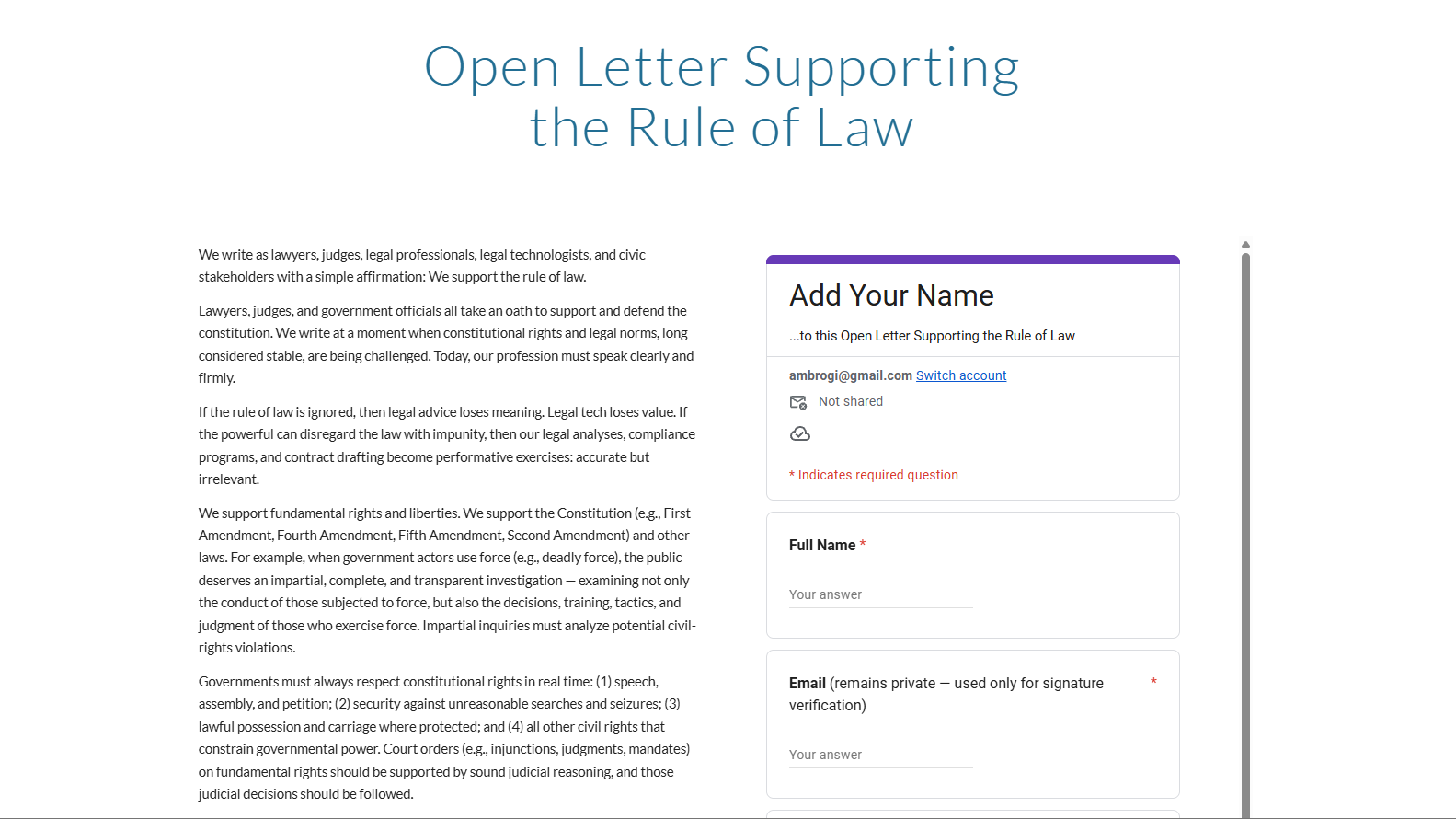
Legal Tech Leaders Join Other Legal Professionals In Open Letter Supporting the Rule of Law

A
number
of
leaders
from
the
legal
technology
community
are
joining
other
legal
professionals
in
an
open
letter
supporting
the
rule
of
law.

“Lawyers,
judges,
and
government
officials
all
take
an
oath
to
support
and
defend
the
constitution,”
the
letter
says.
“We
write
at
a
moment
when
constitutional
rights
and
legal
norms,
long
considered
stable,
are
being
challenged.
Today,
our
profession
must
speak
clearly
and
firmly.”

You
can
view
the
full
text
of
the
letter
and

add
your
name
as
a
supporter
at
this
page
.

One
of
the
organizers
of
the
letter
is

Damien
Riehl
,
solutions
champion
at
Clio,
who
lives
in
the
Twin
Cities
where
federal
agents
shot
and
killed
Minneapolis
resident
Alex
Pretti
on
Saturday.

“History
will
judge
us,”
Riehl
said
in
an
email.
“Who
is
standing
up
for
justice?
Who
is
remaining
silent?”

Lawyers,
Riehl
said,
have
an
obligation
to
uphold
the
rule
of
law
and
to
use
their
voices
to
advance
justice.

“That
has
always
been
true,”
he
said.
“And
it’s
never
been
truer
than
right
now.
If
we
don’t
stand
up
and
be
counted,
as
supporting
the
rule
of
law,
who
will?”

This
moment
even
has
implications
for
legal
tech,
he
said.

“If
the
rule
of
law
is
ignored,
what
happens
to
legal
tech?
What
good
is
a
tool
that
tells
you
the
law,
that
isn’t
followed?

Even
if
you’re
not
moved
by
our
professional
and
moral
obligations,
please
be
moved
by
your
pocketbook.”

Another
who
helped
organize
the
sign-on
campaign
is

Kara
Peterson
,
cofounder
and
CEO
of
Descrybe.ai.
In
an
email,
she
said
that
the
rule
of
law
is
foundation
to
the
work
of
legal
tech
innovators.

“When
you
spend
time
in
legal
tech,
you
quickly
realize
that
our
work
depends
on
something
deeper
than
innovation:
legitimacy,”
she
said.
“We
can
build
smarter
search,
better
analytics,
and
more
accessible
tools,
but
none
of
it
matters
if
rules
don’t
constrain
power
and
rights
can
be
overridden
without
consequence.

“This
letter
is
us
saying:
we
support
the
rule
of
law.
We
support
judicial
independence
and
accountability.
And
we
believe
those
principles
are
not
partisan.
They
are
foundational.
If
we
don’t
stand
up
for
the
conditions
that
make
law
meaningful,
we
shouldn’t
be
surprised
when
the
work
we
do
becomes
meaningless
too.”

The
letter
says
it
best:

“We,
the
undersigned,
support
and
defend
the
rule
of
law.
We
support
impartial
investigations
wherever
governmental
actions
raise
credible
legal
and
constitutional
questions.
And
we
insist
on
accountability
and
judicial
independence
as
a
business
value
and
a
societal
imperative.
We
cross
geographic
and
political
lines,
supporting
our
common
ideals.
Because
without
the
rule
of
law,
our
lives

our
work,
our
institutions,
and
our
society

all
lose
value.”

I
have
added
my
name.
I
hope
many
others
do
as
well.

Why 31,000 Kaiser Permanente Workers Are Striking — Again – MedCity News

Roughly
31,000

Kaiser
Permanente

nurses
and
other
healthcare
professionals
are
planning
to
launch
an
open-ended
strike
starting
on
Monday.

Their
main
grievances
are
chronic
understaffing,
rising
workloads
and
concerns
that
Kaiser’s
wage
and
contract
proposals
fail
to
address
cost-of-living
pressures.

The
workers
going
on
strike
are
represented
mainly
by
the
United
Nurses
Associations
of
California/Union
of
Health
Care
Professionals
(UNAC/UHCP).
Their
strike
will
affect 
20
hospitals
and
200
clinics
across
California
and
Hawaii.

Kaiser
said
it
plans
for
its
facilities
to
stay
open
but
is
warning
of
disruptions,
rescheduled
appointments
and
possible
pharmacy
closures.

This
week,
the
health
system
released
a

statement

saying
national
labor
negotiations
have
stalled
despite
what
it
called
significant
progress
and
a
“historic”
wage
proposal,
blaming
unions
for
bad-faith
tactics
and
disruptions
to
the
bargaining
process. 

Kaiser
stated
that
shifting
unresolved
issues
to
local
negotiations
is
the
most
practical
way
to
reach
agreements
on
pay
and
benefits.

The
unions
frame
the
strike
as
a
patient
safety
and
workforce
retention
crisis,
not
just
a
pay
fight.
They
argue
that
low
staffing
levels
and
mounting
administrative
pressures
are
already
delaying
care

forcing
clinicians
to
cut
back
services
and,
in
some
cases,
leave
the
organization
altogether. 

One
union
member

Cameron
Cook,
a
nurse
anesthetist
at
Kaiser’s
hospital
in
Redwood
City,
California

noted
that
Kaiser
has
not
negotiated
in
good
faith
and
has
tried
to
portray
union
workers
as
greedy
while
avoiding
serious
bargaining. 

He
said
clinicians
are
not
seeking
major
financial
gains
but
are
fighting
to
preserve
existing
benefits
and
protections
that
Kaiser
is
now
trying
to
roll
back,
despite
claims
of
generous
wage
increases.

“While
Kaiser
does
push
this
idea
that
they’re
offering
a
very
generous
wage
increase,
they’re
hiding
the
fact
that
they’re
actually
trying
to
cut
a
lot
of
our
benefits
and
retirement
and
healthcare,
as
well
as
our
ability
to
control
our
own
scheduling,”
Cook
declared.

He
also
pointed
out
that
the
dispute
is
a
patient
care
issue
and
highlighted
how
staffing
shortages
lead
to
delayed
appointments,
canceled
surgeries
and
poor
communication.

He
has
witnessed
these
problems
as
both
as
a
provider
and
as
a
patient
family
member. 

“I
have
a
child
who
has
a
permanent
disability,
so
we
are
constantly
going
to
Kaiser.
I
see
what
the
patients
face
on
that
end,
in
terms
of
delayed
or
canceled
appointments,
and
the
inability
to
get
a
response
or
talk
to
a
human.
She
recently
had
a
major
surgery,
and
we
were
never
able
to
get
in
for
her
three-month
follow
up.
We
eventually
just
had
to
stop
trying
because
no
one
would
get
back
to
us,”
Cook
stated.

Ultimately,
he
thinks
workers
still
believe
in
Kaiser’s
mission
but
worry
the
organization
is
drifting
toward
corporate
priorities
at
the
expense
of
patients
and
frontline
staff. 

He
warned
that
if
Kaiser
continues
down
its
current
path,
the
gap
between
its
stated
values
and
day-to-day
realities
for
patients
and
clinicians
will
only
widen.

“We
do
like
Kaiser.
We
believe
in
Kaiser.
I
think
in
terms
of
healthcare
in
the
U.S.,
Kaiser’s
model
is
to
be
admired

but
we
are
starting
to
see
corporate
interests
creep
in,
and
frankly,
they’re
losing
their
way.
We
want
to
see
Kaiser
invest
in
patient
care
and
the
providers
who
provide
that
care,”
Cook
remarked.

This
type
of
labor
dispute
is
nothing
new
for
Kaiser.
This
same
group
of
31,000
workers
went
on
strike
as
recently
as
October,
when
they

walked
out
for
five
days

over
concerns
related
to
staffing,
wages
and
patient
care.


Photo:
PM
Images,
Getty
Images