The
National
Democratic
Working
Group
(NDWG)
in
Zimbabwe
has
denied
that
explosives
allegedly
found
in opposition
politician
Job
“Wiwa”
Sikhala’s vehicle
during
his
arrest
in
Pretoria
belonged
to
him,
describing
the
incident
as
suspected
foul
play.
In
a
statement,
the
NDWG
said
Sikhala,
who
was
arrested
in
Gauteng
earlier
this
week,
was
“subjected
to
what
is
believed
to
be
suspected
foul
play”
when
the
vehicle
he
was
travelling
in
was
stopped
and
searched
by
members
of
the
South
African
Police
Service
(SAPS).
“During
the
search,
explosives
were
allegedly
discovered
in
the
vehicle.
Honourable
Sikhala
was
subsequently
arrested
and
is
currently
detained
at
Pretoria
central
prison,”
the
group’s
spokesperson
Silenkosi
Moyo
said.
The
NDWG
said
its
legal
team
was
“actively
engaged
on-site”
to
secure
the
opposition
leader’s
defence.
“We
categorically
maintain
that
the
explosives
found
do
not
belong
to
him,”
the
statement
added.
“As
the
National
Democratic
Working
Group,
we
stand
unwaveringly
beside
our
leader
and
reaffirm
our
commitment
to
defending
him
through
all
legal
means
available.”
The
group
appealed
to
the
public
to
keep
Sikhala
in
their
thoughts
and
prayers
during
what
it
described
as
“challenging
times.”
Sikhala’s
arrest
in
South
Africa
comes
less
than
a
year
after
his
release
from
detention
in
Zimbabwe,
where
he
was
arrested
for
allegedly
inciting
public
violence.
Rights
groups
and
opposition
figures
previously
accused
the
Harare
government
of
persecuting
him
for
his
political
activism.
Sikhala
remains
one
of
the
most
vocal
critics
of
Zanu
PF,
continuing
to
speak
out
against
corruption
and
human
rights
abuses
in
Zimbabwe.
His
latest
arrest
has
sparked
fresh
concern
among
Zimbabweans
in
the
diaspora
and
raised
questions
about
the
circumstances
surrounding
his
detention
in
South
Africa.
On
the
other
hand,
other
sections
of
the
Zimbabwean
society
accuse
Sikhala
of
being
involved
in
crime,
and
celebrated
his
arrest
in
Pretoria.
A
quiet
agricultural
revolution
is
reshaping
rural
Zimbabwe
where
solar-powered
irrigation,
AI-driven
crop
monitoring
and
mobile
market
platforms
are
helping
thousands
of
smallholder
farmers
grow
food
year-round,
boost
yields
and
access
markets.
Once
limited
by
erratic
rainfall
and
drying
dams,
farmers
in
semi-arid
regions
of
the
southern
African
country
are
now
cultivating
crops
throughout
the
year
using
solar
irrigation
systems
and
sand-abstraction
technology
that
taps
underground
water.
“We
used
to
watch
our
dam
dry
up
every
year.
Now,
we
grow
crops
all
year
round,”
said
David
Ndou,
chairperson
of
the
Sivuli
irrigation
scheme.
Supported
by
the
European
Union
and
implemented
with
technical
assistance
from
the
Food
and
Agriculture
Organisation
(FAO),
these
innovations
are
improving
productivity
and
climate
resilience.
Beyond
water
access,
FAO’s
Digital
Villages
initiative
is
equipping
over
5,000
farmers
– especially
women
–
with
digital
identities,
geo-referenced
advisory
services
and
AI-enabled
crop
insights.
Mobile
platforms
are
connecting
producers
to
markets
while
digital
literacy
is
driving
smartphone
adoption
among
women
farmers.
FAO’s
Earth
Observation
for
Agricultural
Statistics
(EOSTAT)
is
also
enhancing
Zimbabwe’s
capacity
to
monitor
crop
performance
and
climate
risks.
Using
satellite
data,
the
system
delivers
over
80
percent
accuracy
in
yield
estimates
and
supports
early
warning
for
droughts
and
floods.
“EOSTAT
is
modernising
agricultural
monitoring
through
digital
innovation
and
driving
Zimbabwe’s
shift
toward
data-driven,
climate-smart
agriculture,”
Ministry
of
Agriculture’s
early
warning
specialist
Hillary
Mugiyo
said
on
Saturday.
National
institutions,
including
the
Zimbabwe
Space
Agency
and
the
National
University
of
Science
and
Technology,
are
receiving
training
in
advanced
geospatial
analysis.
To
modernise
agricultural
finance,
FAO,
the
African
Development
Bank
and
the
AFC
Land
Bank
have
introduced
digital
loan
management
systems.
Farmers
now
access
inputs
via
e-vouchers,
with
real-time
tracking
of
disbursements
and
repayments.
This
has
supported
the
cultivation
of
17,000
hectares
of
winter
wheat
between
May
and
August
and
72,000
hectares
of
maize
under
Zimbabwe’s
Seed
Revolving
Fund.
In
parallel,
FAO
is
strengthening
food
safety
systems
with
support
from
the
Fleming
Fund
and
the
Antimicrobial
Resistance
(AMR)
Multi-Partner
Trust
Fund.
Fourteen
sentinel
laboratories
have
been
rehabilitated
to
monitor
AMR
while
farmers
are
adopting
better
hygiene
and
animal
care
practices
to
reduce
antibiotic
use.
Zimbabwe’s
integrated
approach
–
combining
indigenous
knowledge
with
modern
technology
–
is
offering
a
replicable
model
for
climate-smart,
digitally-enabled
agriculture
across
Africa.
“In
Zimbabwe,
we
are
showcasing
solutions
that
work,
partnerships
that
deliver,
and
ideas
that
grow
into
meaningful
change,”
Assistant
FAO
Representative
(Programmes),
Tendai
Munyokoveri,
said.
This
follows
remarks
made
by
Prof
Ncube
during
the
2026
pre-budget
seminar
held
in
Bulawayo
on
Wednesday,
November
5,
2025,
where
he
claimed
“most
Zimbabweans
are
now
middle-income
citizens”
citing
average
daily
spending
of
US$9,
improved
infrastructure
and
what
he
described
as
“growing
economic
stability.”
However,
AM
Party
leader,
Mudenda
Chilumbo,
said
the
minister’s
statement
was
“a
deliberate
attempt
to
deceive
the
nation,”
arguing
that
the
reality
on
the
ground
paints
a
completely
different
picture.
“The
minister
is
misleading
Zimbabweans
because
according
to
the
World
Bank,
middle-income
status
refers
to
a
country
whose
Gross
National
Income
(GNI)
per
capita
lies
between
US$1
136
and
US$4
465,”
said
Chilumbo.
“This
is
contrary
to
Zimbabwe,
where
teachers,
nurses,
and
other
public
service
workers
including
our
pensioners
are
receiving
less
than
US$250
per
month.
Many
urban
communities
including
Bulawayo
and
Harare
have
gone
for
years
without
running
water.
How
do
you
claim
upper
middle-income
status
under
these
circumstances,
Minister
Ncube?”
Chilumbo
said
the
situation
was
even
worse
in
rural
areas,
where
basic
services
remain
out
of
reach
for
most
families.
“In
rural
areas,
particularly
in
the
most
marginalised
provinces
of
Matabeleland
North,
South
and
parts
of
Midlands,
families
still
draw
drinking
water
from
open
wells
and
rivers
shared
with
wild
animals
and
livestock
and
my
home
area,
Binga,
is
a
case
study
for
this
matter.
Do
you
argue?”
he
asked.
“Schools
remain
trapped
in
the
colonial
era
without
textbooks,
furniture,
or
laboratories
and
thousands
of
children
walk
long
distances
just
to
learn
under
trees.”
Chilumbo
described
the
country’s
public
hospitals
as
“death
traps”
and
said
informal
workers
and
small
traders,
who
form
the
backbone
of
Zimbabwe’s
economy,
continue
to
operate
under
harsh
conditions.
“Hospitals
that
are
supposed
to
serve
citizens
as
a
public
good
remain
death
traps
where
patients
must
bring
their
own
gloves,
bandages
and
medicine,”
he
said.
“Meanwhile,
informal
traders,
who
employ
the
majority
of
our
citizens,
continue
to
operate
under
harassment,
spot
fines
and
arbitrary
levies
without
real
government
support.
Civil
servants
struggle
to
afford
transport
to
work.
Families
in
towns
rely
on
firewood
for
cooking,
while
rural
clinics
operate
in
darkness.
The
above
are
the
real
conditions
to
which
our
citizens
are
subjected,
Minister
Ncube
not
your
lies.”
The
AM
leader
said
comparing
Zimbabwe’s
economic
situation
to
countries
that
have
genuinely
achieved
middle-income
status
exposes
how
far
the
nation
still
has
to
go.
“To
put
Zimbabwe’s
statistical
middle-income
claim
into
perspective,
take
notes
from
the
countries
that
have
genuinely
achieved
it,”
said
Chilumbo.
“Botswana,
for
example,
has
invested
heavily
in
healthcare,
education,
and
infrastructure.
Its
average
worker
earns
over
US$800
per
month,
public
hospitals
are
well-equipped,
and
electricity
and
water
supply
reach
most
households.”
He
added
that
Mauritius
and
Malaysia
provide
clear
examples
of
countries
whose
development
is
reflected
in
tangible
quality-of-life
improvements
for
the
majority
of
citizens.
“Mauritius
provides
free
healthcare
and
education
to
all
citizens
and
its
per
capita
income
is
over
US$11
000.
Malaysia,
which
was
at
a
similar
development
stage
as
Zimbabwe
in
the
1980s,
now
boasts
modern
infrastructure,
a
thriving
industrial
base
and
a
per
capita
income
above
US$12
000,”
said
Chilumbo.
He
stressed
that
those
nations
are
globally
recognised
as
genuine
upper
middle-income
economies
“based
on
tangible
improvements
in
living
standards
for
the
majority,
not
only
the
elite
few.”
“Upper
middle-income
economies
are
defined
by
a
GNI
per
capita
of
at
least
US$4
500,
not
through
propaganda
meant
to
advance
Mnangagwa’s
ambitions
to
extend
his
tenure
of
office
unconstitutionally
using
state
platforms
such
as
a
pre-budget
seminar,”
Chilumbo
said.
The
AM
leader
further
accused
the
finance
minister
of
prioritising
political
loyalty
over
national
interests.
“The
AM
party
has
strong
evidence
that
Mthuli
Ncube
is
not
serving
the
interests
of
the
people.
He
is
serving
his
master,
Emmerson
Mnangagwa,
so
that
he
evades
justice
in
connection
with
the
Barbican
Bank
he
owned,
which
duped
Bulawayo
residents
of
their
hard-earned
money
and
never
refunded
them,”
claimed
Chilumbo.
Chilumbo
said
the
government’s
“middle-income”
narrative
was
part
of
a
broader
political
campaign
designed
to
justify
failed
economic
policies
and
maintain
power
under
the
guise
of
progress.
“Zimbabwe
cannot
claim
to
have
reached
middle-income
status
when
inflation
remains
high,
workers
are
underpaid,
hospitals
are
under-equipped,
and
millions
live
without
basic
services,”
he
said.
“The
government
must
stop
insulting
citizens
with
cooked-up
statistics.
We
live
this
reality
daily,
no
clean
water,
no
jobs,
no
electricity,
and
collapsing
infrastructure.
That
is
not
middle-income
life.
That
is
survival.”
Analysis
in
English
on
Zimbabwe
about
Agriculture,
Food
and
Nutrition
and
Drought;
published
on
7
Nov
2025
by
FEWS
NET
Key
Messages
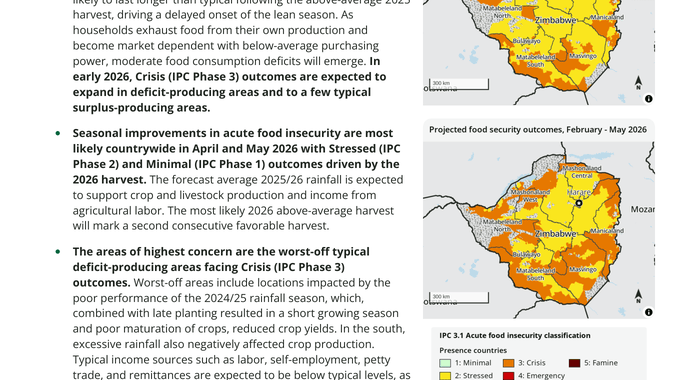
Crisis
(IPC
Phase
3)
outcomes
are
expected
to
emerge
in
November
across
many
typical
deficit-producing
areas in
Matabeleland
North
and
South,
Masvingo,
Midlands
and
Manicaland
provinces,
and
the
far
northern
parts
of
the
Mashonaland
provinces.Own-produced
food
stocks
this
year
are
likely
to
last
longer
than
typical
following
the
above-average
2025
harvest,
driving
a
delayed
onset
of
the
lean
season.
As
households
exhaust
food
from
their
own
production
and
become
market
dependent
with
below-average
purchasing
power,
moderate
food
consumption
deficits
will
emerge. In
early
2026,
Crisis
(IPC
Phase
3)
outcomes
are
expected
to
expand
in
deficit-producing
areas
and
to
a
few
typical
surplus-producing
areas.
Seasonal
improvements
in
acute
food
insecurity
are
most
likely
countrywide
in
April
and
May
2026
with
Stressed
(IPC
Phase
2)
and
Minimal
(IPC
Phase
1)
outcomes
driven
by
the
2026
harvest. The
forecast
average
2025/26
rainfall
is
expected
to
support
crop
and
livestock
production
and
income
from
agricultural
labor.
The
most
likely
2026
above-average
harvest
will
mark
a
second
consecutive
favorable
harvest.
The
areas
of
highest
concern
are
the
worst-off
typical
deficit-producing
areas
facing
Crisis
(IPC
Phase
3)
outcomes. Worst-off
areas
include
locations
impacted
by
the
poor
performance
of
the
2024/25
rainfall
season,
which,
combined
with
late
planting
resulted
in
a
short
growing
season
and
poor
maturation
of
crops,
reduced
crop
yields.
In
the
south,
excessive
rainfall
also
negatively
affected
crop
production.
Typical
income
sources
such
as
labor,
self-employment,
petty
trade,
and
remittances
are
expected
to
be
below
typical
levels,
as
is
the Mopane worm
(Gonimbrasia
belina) harvest.
Food
assistance
needs
are
expected
to
increase
through
the
peak
of
the
January
to
March
2026
lean
season. Overallfood
assistance
needs
are
expected
to
be
at
near-average
levels,
though
lower
than
the
atypically
high
El-Niño-induced
needs
during
the
last
2024/25
lean
season.
Thereafter,
food
assistance
needs
are
expected
to
declinewith
the
availability
of
the
2026
harvest.
Zimbabwe’s
economic
rebound
in
2025
has
been
stronger
than
expected,
supported
by
a
recovery
in
agriculture,
solid
mining
performance,
and
easing
inflation
amid
exchange
rate
stability.
Discussions
in
Harare
emphasized
the
importance
of
reinforcing
fiscal
discipline
in
the
2026
budget
by
aligning
expenditures
with
revenues
and
sustainable
financing
sources,
while
strengthening
expenditure
management.
Harare,
Zimbabwe: An
International
Monetary
Fund
(IMF)
staff
team,
led
by
Mr.
Wojciech
Maliszewski,
visited
Zimbabwe
from
October
29
to
November
5,
2025,
as
part
of
the
Fund’s
regular
engagement
with
the
Zimbabwean
authorities
and
other
stakeholders..
At
the
conclusion
of
the
visit,
Mr.
Maliszewski
issued
the
following
statement:
“The
IMF
mission
held
productive
discussions
with
the
Zimbabwean
authorities
on
recent
economic
developments
and
the
2026
budget
framework.
“Zimbabwe’s
economic
recovery
in
2025
is
stronger
than
previously
anticipated,
given
the
rebound
in
agriculture
and
solid
performances
in
mining,
while
inflation
has
continued
to
significantly
ease,
supported
by
a
stable
foreign
exchange
rate.
The
economy
is
expected
to
maintain
strong
momentum
in
2026.
“Discussions
in
Harare
focused
on
enhancing
fiscal
discipline
in
the
2026
budget
framework
by
aligning
expenditures
with
revenues
and
available
non-inflationary
financing
sources,
while
avoiding
the
accumulation
of
expenditure
arrears.
In
this
context,
adopting
credible
revenue
projections
supported
by
concrete
policy
and
administrative
tax
measures
for
2026,
and
strengthening
expenditure
management,
would
help
enhance
fiscal
resilience
and
the
management
of
fiscal
risks
and
pressures.
“In
the
context
of
the
requested
Staff
Monitored
Program,
IMF
staff
stand
ready
to
resume
discussions
upon
progress
towards
addressing
key
policy
issues
highlighted
in
the
Article
IV
consultations,
including
aligning
the
2026
budget
with
the
objective
of
sustaining
macroeconomic
stability.”
“IMF
staff
met
with
the
Minister
of
Finance,
Economic
Development
and
Investment
Promotion,
Hon.
Mthuli
Ncube,
the
Governor
of
the
Reserve
Bank
of
Zimbabwe,
Dr.
John
Mushayavanhu,
and
their
respective
teams,
as
well
as
other
stakeholders.
The
IMF
team
wishes
to
express
its
sincere
appreciation
to
the
Zimbabwean
authorities
and
all
counterparts
for
their
warm
hospitality,
open
dialogue,
and
excellent
cooperation
throughout
the
mission.”
When
I
took
the
bar
exam,
a
friend
of
mine
started
drinking
coffee
brewed
with
caffeinated
water.
For
his
sake,
that’s
no
longer
the
worst
bar
exam
prep
strategy
out
there.
Apparently
Kim
Kardashian
relied
on
a
veritable
coven.
Kim
Kardashian
recently
failed
the
bar
—
though
she
can
take
solace
in
knowing
that
she’s
still
likely
a
better
lawyer
than
anyone
involved
with
writing
All’s
Fair
—
and
she
knows
where
her
prep
strategy
went
off
the
rails:
the
psychics.
Talk
about
a
new
level
to
ineffective
assistance
of
counsel.
Kim
Kardashian’s
fuming
after
flunking
her
California
Bar
Exam
—
’cause
turns
out,
she
was
banking
on
a
different
kind
of
counsel…
a
bunch
of
psychics
who
swore
she’d
pass!
pic.twitter.com/QNYzmFKKS8
Psychic:
The
spirits
are
telling
me
to
acknowledge…
does
the
letter
M
have
meaning? Kardashian:
Yes!
Mary. Psychic:
And
Mary
has
passed? Kardashian:
Yes…
and
she
was
a
life
in
being
at
the
time
the
interest
was
created!
Kardashian,
of
course,
continues
her
quest
to
become
a
California
lawyer
—
despite
lacking
an
undergraduate
degree
—
through
California’s
Law
Office
Study
Program
apprenticeship,
allowing
applicants
to
take
the
bar
after
learning
under
an
attorney’s
supervision
as
opposed
to
law
school.
It’s
a
time-honored
path
to
the
profession…
just
like
Abraham
Lincoln
did
it.
Though
Abe
wasn’t
posting
self-portraits
highlighting
his
ass
while
complaining
about
Torts.
Or
did
he?
Honestly,
records
from
that
era
are
spotty
at
best.
The
California
Bar
is
designed
to
break
one’s
spirit,
but
that
doesn’t
give
actual
spirits
any
advantage.
I
mean,
what’s
next?
Deciding
civil
rights
for
women
on
the
back
of
a
Supreme
Court
seance
to
divine
the
will
of
a
17th
century
witchhunter?
In
fairness,
there’s
nothing
to
suggest
that
Kardashian
replaced
professional
bar
prep
with
Madame
Res
Ipsa.
But
mainlining
metaphysical
reassurance
doesn’t
put
an
applicant
in
the
right
headspace.
We’re
not
pinning
everything
on
psychic-induced
false
confidence,
but
it
couldn’t
have
helped.
Kardashian’s
drive
to
become
a
lawyer
without
bothering
to
go
to
school
remains
peak
celebrity
self-indulgence.
But
remember
that
she’s
probably
done
more
for
criminal
justice
reform
than
most
senators
campaigning
on
the
issue.
If
anything,
the
problem
with
Kardashian’s
pursuit
of
the
Esq.
is
that
she
doesn’t
need
it.
She
already
has
what
she
needs
to
accomplish
the
work
she’s
set
out
for
herself:
a
grasp
of
fairness,
massive
resources,
and
good
lawyers
saved
in
her
phone.
At
the
end
of
the
day,
the
people
she
wants
to
help
don’t
care
if
she’s
their
lawyer
or
running
the
legal
non-profit
that
gets
them
the
representation
they
need.
According
to
the
Zimbabwe
National
Students
Union
(ZINASU),
the
students—Lindon
Zanga
and
Marlvin
Saint
Madanda—were
violently
abducted
at
Mzimba
Shopping
Centre
in
Chinhoyi.
The
union
said
the
pair
was
taken
by
unidentified
people
in
an
unmarked
grey
Isuzu,
a
vehicle
that
had
been
seen
on
campus
distributing
campaign
materials
for
their
rivals,
the
Zimbabwe
Congress
of
Students’
Union
(ZICOSU).
Zanga
and
Madanda
were
allegedly
tortured,
threatened,
and
beaten
for
more
than
12
hours
before
being
dumped.
They
were
taken
to
Chinhoyi
Police
Station
and
later
to
a
local
hospital
for
treatment.
In
a
statement
issued
on
Tuesday,
11
November,
before
the
students
were
found,
ZINASU
president
Emmanuel
Sitima
alleged
that
the
abductions
were
part
of
a
broader
attempt
to
intimidate
students
and
silence
dissenting
voices
on
campus. The
statement
reads:
“It
is
of
greater
concern
that,
as
the
Zimbabwe
National
Students
Union
(ZINASU),
we
wake
up
today
to
sing
the
same
script
of
abduction,
terror
and
danger
for
student
leaders
who
are
doing
nothing
more
than
just
campaigning
in
an
SRC
election.
“The
two
student
leaders
were
snatched
away
in
front
of
dozens
of
witnesses
in
a
brazen
act
of
banditry
that
has
not
only
instilled
fear
but
also
a
clear
exposure
of
the
modus
operandi
of
the
rogue
regime
that
is
seemingly
scared
of
an
open
contestation
of
ideas.
“The
presence
of
the Zanu-PF Youth
League
in
Chinhoyi,
especially
the
notorious
presence
of
the
Youth
League
Political
Commissar TauraiKandishaya,
who
has
a
sordid
history
of
doing
everything
necessary
and
unnecessary
to
please
his
bosses,
should
not
be
cast
aside.
“He
is
notorious
for
threats
and
exposing
innocent
citizens
who
dare
to
think
differently
from
the Zanu-PF script;
his
hand
is
ever
more
visible
in
this
situation,
and
he
is
the
main
source
of
this
conflict.
“An
SRC
election
is
a
pure
and
representative
form
of
student
politics
that
is
supposed
to
give
young
people
a
glimpse
into
leadership,
but
the
rogue
elements
in
power
use
state
resources
to
silence
any
dissenting
voices
against
their
autocratic
and
archaic
form
of
governance.
“Zimbabwe
does
not
require
thugs
in
leadership
who
are
ready
to
sacrifice
young
people
to
win
a
university
election.
“Many
people
who
have
been
abducted
by
this
regime
have
disappeared
forever;
the
likes
of ItaiDzamara are
forever
gone,
but
his
disappearance
was
treated
as
a
non-event.
“This
comes
as
a
panic
reaction
from
both
the
opposing
student
union
ZICOSU,
which
is
directly
sponsored
by
the
oppressive
ruling
regime
ZANU
PF,
and
a
strong
indication
of
attempts
to
silence
the
students’
voice.
“It’s
another
reality
that
students
have
ceased
to
be
seen
as
beacons
of
academic
excellence,
but
in
the
eyes
of
a
jittery
regime,
they
are
terrorists
that
seek
to
defy
an
oppressive
agenda.
“The
Desperation
of
this
administration
has
now
reached
a
boiling
point,
and
as
the
bona
fide
students’
Union
of
Zimbabwe,
we
have
now
drawn
a
line
in
the
sand
where
we
say
that
enough
is
enough
and
business
can
no
longer
continue
as
usual
under
such
circumstances.
“NOT
when
the
parents
of
the
two
Comrades
do
not
know
where
their
children
are,
when
other
students
live
in
perennial
fear
of
exercising
their
Constitutionally
guaranteed
rights
due
to
a
system
so
paranoid
of
its
own
children.
“The
Authorities
at
CUT,
in
cahoots
with
the
regime,
portray
themselves
as
a
saintly
administration
when
it
does
Satanic
rituals
behind
the
scenes.
“Zanu-PF brought
a
list
of
washed-up
celebrities
to
sing
for
the
suffering
students
of
Chinhoyi,
but
whilst
they
sang,
their
masters
were
mooting
behind
the
scenes
to
bring
fear
and
untoward
suffering
to
the
general
populace.
“When
students’
rights
matter,
the
government
has
looked
the
other
way.
This
is
an
action
that
should
be
condemned
as
outrageous,
archaic,
and
anathema
to
progressive
democracy.
“Campuses
should
be
safe
havens
where
students
seek
accountability,
defy
oppression,
and
call
for
academic
freedom.
“As Zinasu,
we
have
vowed
to
respond
with
the
language
they
understand
the
most
until
our
Comrades
are
safely
returned.
“We
are
giving
those
responsible
to
act
in
a
jiffy
and
return
our
Cdes.
Zimbabwe
is
not
for
them
but
for
all
of
Us.
“As
we
utilise
other
legal
avenues,
we
believe
this
issue
is
supreme,
the
liberty
of
students
is
at
risk,
and
the
detects
of
the
Constitution
should
be
adhered
to.”
HARARE
–
Prophetic
Healing
and
Deliverance
(PHD)
Ministries
founder
Walter
Magaya
has
been
granted
US$3,000
bail
by
the
Harare
High
Court
following
his
arrest
last
week
on
rape
and
fraud
charges.
Magaya,
who
denies
the
allegations,
was
ordered
to
surrender
his
passport
and
title
deeds
as
part
of
his
bail
conditions.
Justice
Gibson
Mandaza
ordered
Magaya’s
release
following
a
virtual
hearing.
The
preacher
was
arrested
together
with
his
wife,
Tendai,
and
a
company
representative,
who
were
each
granted
US$300
bail
last
week.
The
couple
faces
13
counts
of
fraud
for
allegedly
swindling
home-seekers
through
a
failed
housing
and
investment
scheme
operated
under
their
companies,
Planet
Africa
(Pvt)
Ltd
and
Yadah
Connect
(Pvt)
Ltd.
Prosecutors
allege
that
Magaya
and
his
wife
misrepresented
to
their
followers
that
they
had
secured
large
tracts
of
land
for
residential
projects
in
Chishawasha,
Norton,
Westgate,
Fern
Valley
(Mutare),
Bulawayo,
Kwekwe,
Arcturus,
Ruwa,
Manyame
and
Nyatsime.
The
firms
allegedly
collected
about
US$50,000
and
R190,000
from
prospective
homeowners
for
stands
that
never
materialised.
In
his
bail
application,
Magaya
dwelt
much
on
the
rape
charges.
Represented
by
lawyer
Admire
Rubaya,
he
dismissed
the
allegations
as
fabrications
“at
the
instance
of
the
Zimbabwe
Gender
Commission”
which
he
said
“has
misused
its
powers
to
force
these
two
complainants
into
concocting
all
manner
of
allegations”
against
him.
He
accused
the
commission
of
“a
clear
and
brazen
abuse
of
the
criminal
justice
system,”
saying
it
was
“grandstanding
and
playing
to
the
cameras”
to
appear
as
though
it
was
defending
women’s
rights.
“The
applicant
is,
in
fact,
the
victim
of
a
calculated
campaign.
This
ploy
appears
designed
to
create
a
public
spectacle
of
efficiency
for
the
commission,
achieved
only
through
the
wholesale
vilification
and
character
assassination
of
the
applicant,”
Rubaya
argued
in
court
papers.
Magaya
further
claimed
that
the
rape
complaints
were
not
voluntary,
but
were
made
“after
adverts
were
flighted
in
the
media
inviting
alleged
victims
to
approach
the
Gender
Commission.”
He
maintained
his
innocence,
saying:
“The
applicant
denies
that
he
unlawfully
and
intentionally
had
sexual
intercourse
with
the
alleged
complainants
in
the
manner
alleged
or
at
all.”
Magaya
also
rejected
claims
that
he
interfered
with
the
complainants,
arguing
that
“he
does
not
control
the
police
and
cannot
be
persecuted
for
the
alleged
conduct
of
other
individuals
not
connected
to
him.”
The
high-profile
preacher,
who
has
previously
faced
a
number
of
legal
disputes,
said
his
detractors
were
working
“day
and
night”
to
destroy
him
and
his
ministry.
The
matter
is
scheduled
to
return
to
the
Harare
Magistrates’
Court
on
November
18
for
routine
remand.
Another
week,
another
study
demonstrating
the
gap
between
what
in-house
legal
professionals
want
from
their
outside
law
firms
and
what
they’re
getting
when
it
comes
to
innovation
and
technology.
Despite
all
the
AI
talk,
we
aren’t
there
yet.
This
time, the study
was interestingly from
a
law
firm.
Thompson Hine, an
Am
Law
200
midwestern-based
law firm,
conducted the study of
almost
200
senior in-house legal
professionals to look
at
how they were
embracing
innovation.
The
study,
entitled Bridging
the
Perception
Gap-Disconnects,
Expectations
and
Opportunities, also
focused
on how in
house legal perceived
their
law
firms
were
doing.
This
is
the
fourth
such
study
that
Thompson Hine
has
conducted. Thompson Hine
partnered
with Corporate
Counsel to
conduct it.
A Disconnect
As
the
title
suggests,
the
study
found
some
pretty
glaring
disconnects.
Only
5%
of
those
surveyed
said they
saw
a
great
deal
of
innovation
from
their
law firms.
That percentage was the
same
in
2023
and
an
increase
of only two
percentage
points
since 2020. That ain’t much
progress.
And
here
is
the
first disconnect.
When
asked
how
much
innovation
their
firms
claim, the
respondents
said 20%
of
them
are actually claiming to
be
greatly innovative.
Why the
Gap?
As
someone
once
told
me,
“There
are
firms
that
want
to
be
innovative
and
there
are
firms
that
want
to
say
they
are
innovative.”
Quite
simply, firms
are
often
telling
clients
what
they think they
want
to
hear
when
it
comes
to
innovation. Some
firms
are
content
to
say
we
did
innovation, pat
themselves
on
the
back, and
check
the
box.
Just
like
back
in
the
early
days
of
converting
to
computers,
there
were
firms
that
bought
desktops
for
all
lawyers
just
for
the
optics
when
clients
visited,
even
if
no
one
knew how
to
use
them.
Then
there
is
a definition problem. In-house legal
professionals
are
interested
in innovation
and
technology to help
them get more work done faster and more efficiently. Law
firms’ interest
in innovation
and
technology is often limited
to reducing non-billable
hours
or marketing. When
a
law
firm says it’s
innovative,
it
may
not
be
innovative
in
a
way
that resonates with
in-house.
In
addition,
note
that
only
16%
of
those
surveyed
said their
outside
firms were
superior
to in-house legal
departments
when
it
came
to
innovation. Only
3%
said
their
outside law
firms were
supplying them with all
of the
innovation
needed.
Think
about
that. Law
firms
are
often
smaller.
They operate in
practice
groups.
This
should
make
them more
nimble than
the large
corporations they
serve.
Moreover, law
firms
are
service
providers.
You’d
think
they’d
want
to be
ahead
of their
customers
in
innovation
to
provide
better
service, not
behind.
We
see
the
same
thing
with
attitudes
toward
things
like
AI. Twenty-three
percent
of
the
in-house
folks
say
AI
has
come a long way
and
should
be
used versus
18%
of
the
outside
lawyers.
Outside
lawyers
are
more
concerned
about
accuracy
and
privacy
than in-house. This
gap squares with the findings of
the Association of
Corporate
Counsel (ACC) which
I reported last
week. That survey found
that use
of
AI in-house had
grown to close
to
70%.
Why
the
Gap,
Part
Two
So
why
aren’t
law
firms
interested
in
using
things
like
innovation
and
AI
to
provide
better
service?
First
and
foremost,
the
billable
hour
model limits robust
innovation
and use
of technology.
Adoption
of
innovative techniques and
things
like
AI inevitability impact
the
billable
hour
and
law
firms
know
it.
Secondly,
the
consensus
decision-making
process
engaged
by
most
law
firms further
inhibits
adoption.
The partnership model
all too often
results
in
too
many
decision
makers, any one
of
which
can
say
no
loudly
and
long
enough
to
have
an
impact.
Add
to
the
fact
that
lawyers
are
skeptical
and independent by
nature and
you
get delay
and
often
blindness to
innovation.
Add
this
all
up
and
it’s
not
a
good
look
for
outside
lawyers.
But
they
aren’t
completely
to
blame.
So, It’s Easy
to Blame Outside Lawyers?
At
first
blush,
it’s
easy
to
blame
outside
law
firms
for dragging
their
feet
when
it
comes
to
innovation
and
technology.
But
there
is
something
else
at
work
which makes
it
easy
for
firms
to
safely
and
blissfully maintain
the
status
quo and not
rush
to
innovate
and
adopt
technology
to
provide better service.
In-house legal
professionals just
aren’t
demanding
change. In
fact,
they reward
their
firms
for
the
status
quo.
We
see
this
with
the Thompson Hine
findings: despite the
fact
that 93%
of
the
survey respondents say
innovation
is crucial or
at
least
important
in
selecting
firms, they apparently are content
with seeing a
great
deal
of
innovation
from only 5%
of
their
firms.
We
saw
a
similar
gap
in
the
ACC
Study:
59%
of
those
in-house legal professionals didn’t
know
if
their
firms
were
using
technology
on
their
legal
matters
and
80% were
not
demanding
or
even
encouraging
their
outside
lawyers
to
use
GenAI.
To
paraphrase an earlier
observation:
there
are
legal departments
that
are
demanding
innovation
and
there
are
legal
departments
who
want
to say
they
are
demanding innovation.
What
Is
In-House
Legal
Rewarding?
Which brings
me
to another recent study,
this
one
by Thomson
Reuters of
law
firm
rates
which it conducted. Based
on
the
findings,
the
study’s conclusion says
it all:
The
legal
profession
has
achieved
what
most
industries
can
only
imagine:
The
ability
to
raise
prices
year
after
year,
with
clients
consistently
agreeing
to
pay
more.
Over
the
past
decade,
law
firms
have
pushed
rates
at
twice
(or
more)
the
rate
of
inflation,
and
2025
is
no
exception
—
worked
rates
are
up
7.4%
compared
to
just
a
2.8%
inflation
rate.
This
isn’t
just
a
routine
cost-of-living
adjustment,
rather
it’s
a
demonstration
of
genuine
pricing
power
that
has
fundamentally
reshaped
how
legal
services
firms
generate
revenue.
To
be
fair,
the study also suggests
that
this
gravy
train
may
soon
be
ending due
to
a
variety
of
factors.
That
may
be
true,
although
that
sounds
a
little
like
the
“death
of
the
billable
hour”
that
has
been
predicted
as
long
as
I
have
been
practicing
law.
It
hasn’t
happened
yet.
Mind
the
Gap
Here
is
the
simple
fact:
unless
and
until
clients
demand
change
by
their
outside
law
firms, it’s not
going
to
happen. And
why
should it? Law
firms,
particularly
large
ones,
are
making
way too much
money
to
change.
Their
clients
aren’t pushing
them
to
change
and
reward
them
year
over
year
with large rate
increases.
Part
of
the
reason
for
all
this
is in-house lawyers
are
still
lawyers.
They
have
the
same
reluctance
to
change
and skepticism as
those
in
their outside
firms
from
which
many of
them came.
Part
of
it
is
because
the
practice
of
law
is
still relational: in-house legal
professionals trust
and
rely
on
their
outside
lawyers.
They are reluctant to
tamper
with
their law
firms’
business
and
perceived
needs. Plus, legal
department
budgets
are often
relatively
small when
compared
to that
of the
overall
business.
And just like in-house legal
professionals rely
on
and
trust
outside
lawyer
for
their
expertise,
the
business
must
trust
and
rely
on
the
legal
department’s
advice
and expertise.
Want
Change?
Demand
It
So we
all
bump
along
singing a Kumbaya innovation
song
but with
little really changing at many law
firms. In-house
whines;
law
firms
make changes
in
name
only. Is
it
about
to
change
with
the
advent
of
GenAI
and
agentic
AI?
Not
unless
clients make
it
so.
Perhaps
it’s time for
in-house
legal
to have a
gut
check with
their
outside
counsel. Or
simply
vote
with
their
feet.
One
thing
that’s
not
going
to
effectuate
change
is continuing
to do nothing.
And the
next
time in-house counsel
complains
about
their
outside
lawyers,
perhaps remind
them
to
mind
the
gap.
Stephen
Embry
is
a
lawyer,
speaker,
blogger,
and
writer.
He
publishes TechLaw
Crossroads,
a
blog
devoted
to
the
examination
of
the
tension
between
technology,
the
law,
and
the
practice
of
law.
The
students,
23-year-old
Marlvin
Madanda
and
21-year-old
Lindon
Zanga,
were
reportedly
abducted
on
Monday
and
found
the
following
day,
dumped,
beaten,
and
injured.
Amnesty
International
said
the
attacks
“threaten
not
only
freedoms
of
assembly,
expression,
and
association,
but
also
students’
rights
to
education,
non-discrimination,
academic
freedom,
and
participation
in
university
life.”
The
organisation
urged
authorities
to
carry
out
thorough
investigations
and
ensure
that
students
can
express
themselves
and
organise
peacefully
without
fear
of
intimidation,
reprisals,
or
abuse.
Opposition
politician
Nelson
Chamisa
also
condemned
the
abduction
and
torture,
calling
on
the
Zimbabwe
Republic
Police
(ZRP)
to
take
immediate
action. Chamisa
posted
on
X:
“Dear
@PoliceZimbabwe,
Why
should
this
terrorism
and
primitive
brutality
on
harmless
students
and
simple
innocent
citizens
be
allowed
to
continue
like
this?
“Mr
Mnangagwa,
why
should
this
not
worry
or
concern
you
??
Mugabe
was
bad.
This
is
worse.
So
barbaric.
This
is
pure
evil!!”