
Locking In Trust: Key Terms For Strong AI Vendor Contracts – Above the Law

AI
innovation
often
depends
on
partnerships.
Whether
it
is
a
cloud
provider
offering
infrastructure,
a
niche
developer
supplying
a
specialized
model,
or
a
data
vendor
providing
essential
inputs,
these
relationships
move
products
forward.
They
also
carry
risk.
If
a
vendor’s
system
malfunctions,
violates
a
regulation,
or
misuses
data,
the
consequences
land
at
your
company’s
door.

For
in-house
counsel,
the
vendor
agreement
is
the
tool
to
turn
uncertainty
into
clear,
enforceable
expectations.
It
is
not
just
about
legal
protection.
It
is
about
setting
the
tone
for
how
the
AI
will
be
developed,
maintained,
and
governed
throughout
the
life
of
the
relationship.


Defining
Responsibility
Clearly

Every
AI
contract
should
start
with
an
unambiguous
allocation
of
responsibility.
If
the
system
produces
harmful
results,
fails
accuracy
tests,
or
violates
applicable
laws,
the
agreement
should
state
who
is
accountable.
This
includes
performance
standards,
quality
controls,
and
obligations
to
fix
problems
promptly.

Regulatory
compliance
cannot
be
assumed.
Vendors
should
commit
to
meeting
relevant
laws
and
notify
you
immediately
if
legal
changes
require
updates
to
the
system
or
its
deployment.


Demanding
Operational
Transparency

To
manage
risk,
you
need
visibility
into
the
AI
system.
That
means
contractual
rights
to
documentation
that
explains
how
it
works,
where
its
data
originates,
and
how
it
reaches
its
conclusions.

This
might
take
the
form
of
technical
summaries,
training
data
disclosures,
and
change
logs
for
updates.
Without
this
information,
you
may
be
left
unprepared
when
a
regulator
asks
for
details
or
when
a
customer
challenges
the
product’s
decisions.


Clarifying
Ownership
And
Use
Rights

In
AI
projects,
intellectual
property
rights
are
rarely
straightforward.
The
contract
should
specify
who
owns
the
model,
who
owns
the
outputs,
and
whether
the
vendor
can
use
your
data
to
improve
its
technology
for
other
clients.

Clear
terms
prevent
misunderstandings
about
licensing
scope,
exclusivity,
and
the
limits
on
reusing
your
proprietary
information
or
derived
datasets.
Without
this
clarity,
disputes
can
arise
long
after
the
product
is
in
market.


Setting
Data
Governance
Standards

Data
is
the
lifeblood
of
AI
and
the
source
of
many
legal
risks.
Contracts
should
set
explicit
rules
for
how
the
vendor
will
handle
your
data,
from
storage
security
to
deletion
protocols.

Decide
in
advance
whether
production
data
can
be
used
for
further
training
or
testing
and
under
what
safeguards.
Strong
governance
clauses
help
maintain
compliance
with
privacy
regulations
and
align
with
your
company’s
own
data
policies.


Managing
Change
Over
Time

AI
systems
are
not
static.
Vendors
may
update
models,
integrate
new
datasets,
or
alter
processing
methods.
The
contract
should
require
notice
of
any
significant
changes
and
your
right
to
approve
them
before
deployment.

Termination
rights
are
also
critical.
You
should
be
able
to
exit
the
relationship
if
changes
compromise
compliance,
safety,
or
business
fit.
These
protections
are
far
easier
to
secure
at
the
start
than
in
the
middle
of
a
problem.


Contracts
As
Strategic
Tools

An
AI
vendor
contract
is
more
than
a
risk-allocation
exercise.
Done
well,
it
ensures
that
the
vendor’s
operations
support
your
regulatory
obligations,
ethical
commitments,
and
business
priorities.
It
gives
you
the
insight
and
control
needed
to
deploy
AI
responsibly,
even
when
the
core
technology
comes
from
outside
your
organization.

For
in-house
counsel,
moving
from
standard
boilerplate
to
tailored
AI
clauses
means
building
agreements
that
safeguard
trust
and
foster
collaboration.
A
strong
contract
does
not
just
protect
the
company
from
harm.
It
helps
the
partnership
deliver
AI
that
is
reliable,
compliant,
and
aligned
with
the
goals
of
the
business.


Olga
V.
Mack
 is
the
CEO
of TermScout,
an
AI-powered
contract
certification
platform
that
accelerates
revenue
and
eliminates
friction
by
certifying
contracts
as
fair,
balanced,
and
market-ready.
A
serial
CEO
and
legal
tech
executive,
she
previously
led
a
company
through
a
successful
acquisition
by
LexisNexis.
Olga
is
also
Fellow
at
CodeX,
The
Stanford
Center
for
Legal
Informatics
,
and
the
Generative
AI
Editor
at
law.MIT.
She
is
a
visionary
executive
reshaping
how
we
law—how
legal
systems
are
built,
experienced,
and
trusted.
Olga 
teaches
at
Berkeley
Law
,
lectures
widely,
and
advises
companies
of
all
sizes,
as
well
as
boards
and
institutions.
An
award-winning
general
counsel
turned
builder,
she
also
leads
early-stage
ventures
including 
Virtual
Gabby
(Better
Parenting
Plan)
Product
Law
Hub
ESI
Flow
,
and 
Notes
to
My
(Legal)
Self
,
each
rethinking
the
practice
and
business
of
law
through
technology,
data,
and
human-centered
design.
She
has
authored 
The
Rise
of
Product
Lawyers
Legal
Operations
in
the
Age
of
AI
and
Data
Blockchain
Value
,
and 
Get
on
Board
,
with Visual
IQ
for
Lawyers (ABA)
forthcoming.
Olga
is
a
6x
TEDx
speaker
and
has
been
recognized
as
a
Silicon
Valley
Woman
of
Influence
and
an
ABA
Woman
in
Legal
Tech.
Her
work
reimagines
people’s
relationship
with
law—making
it
more
accessible,
inclusive,
data-driven,
and
aligned
with
how
the
world
actually
works.
She
is
also
the
host
of
the
Notes
to
My
(Legal)
Self
podcast
(streaming
on 
SpotifyApple
Podcasts
,
and 
YouTube),
and
her
insights
regularly
appear
in
Forbes,
Bloomberg
Law,
Newsweek,
VentureBeat,
ACC
Docket,
and
Above
the
Law.
She
earned
her
B.A.
and
J.D.
from
UC
Berkeley.
Follow
her
on 
LinkedIn and
X
@olgavmack.

Kim Kardashian Turns Failing The Bar Exam Into An Inspiring Comeback Story – Above the Law

(Photo
by
Stephane
Cardinale

Corbis/Corbis
via
Getty
Images)

The
results
of
the
California
bar
exam
are
in,
and
after
years
of studying
to
become
a
lawyer
 without going
to
law
school,
reality
star
turned
business
mogul
and
actress
Kim
Kardashian
has finally
learned
her
fate.

Did
she
pass?
Unfortunately,
not
this
time,
but
her
announcement
about
it
was
refreshingly
honest.
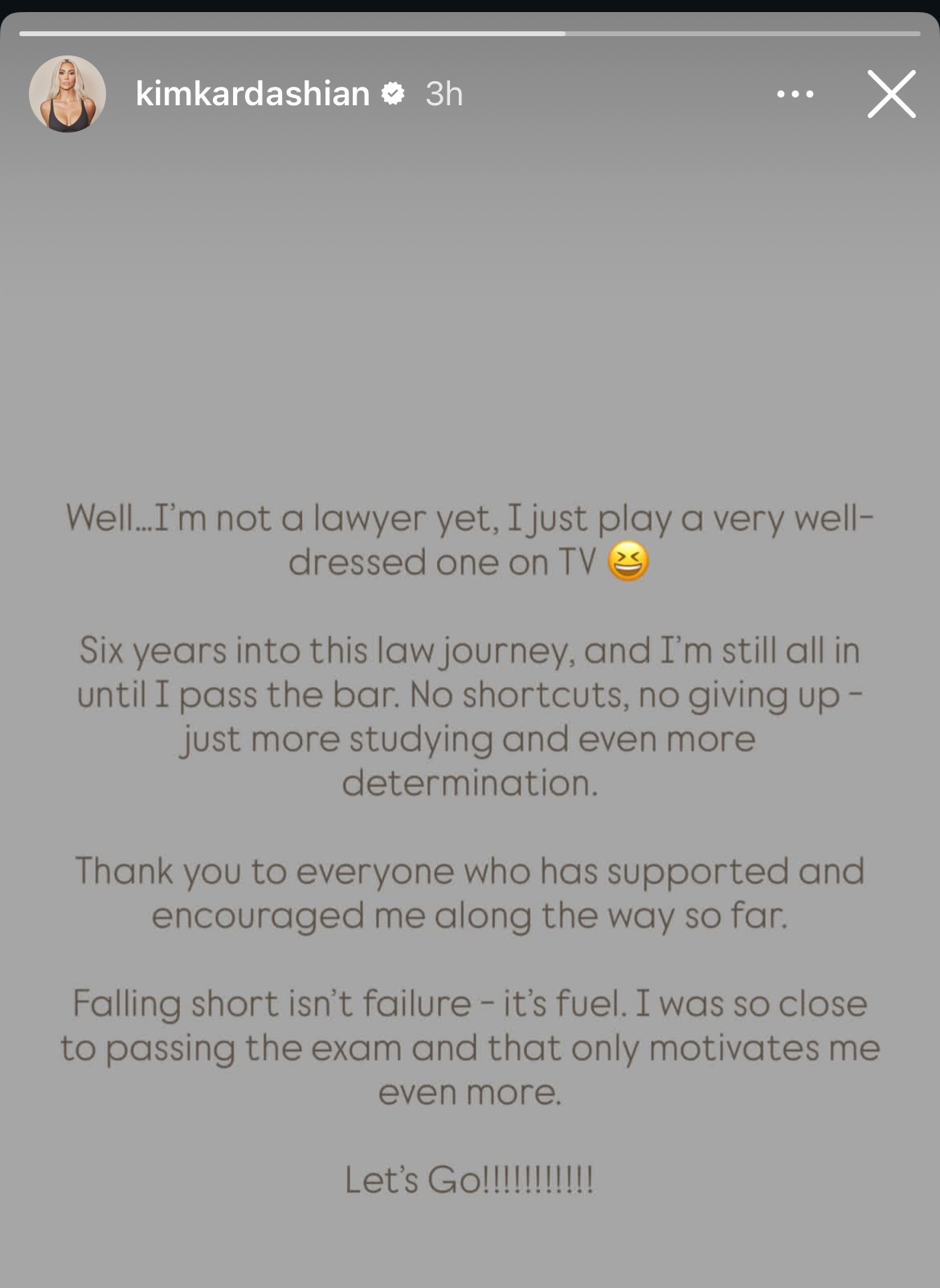
“Six
years
into
this
law
journey,
and
I’m
still
all
in
until
I
pass
the
bar,”
she
wrote
on
Instagram.
“No
shortcuts,
no
giving
up

just
more
studying
and
even
more
determination.”
See
her
full
Instagram
post,
below.

(Image
via
Instagram)

Kardashian
is
in
good
company
when
it
comes
to
the
California
bar
exam,
which
is
widely
regarded
as
one
of
the
toughest
in
the
nation.
According
to
a
press
release
from
the
State
Bar
of
California,
only
54.8%
of
those
who
took
the
July
2025
test
passed.
While
69.7%
of
all
first-time
takers
passed,
just
12.4%
of
repeat
takers
were
able
to
so
do

numbers
that
underscore
just
how
difficult
the
exam
can
be.

But
this
isn’t
a
story
about
celebrity
failure.
It’s
about
perseverance,
grit,
and
the
willingness
to
take
on
something
incredibly
hard

all
while
balancing
work
and
family
in
the
court
of
public
opinion.
By
sharing
her
results
openly,
Kardashian
showed
a
kind
of
vulnerability
that
made
her
feel
genuinely
relatable.
“Falling
short
isn’t
failure

it’s
fuel,”
she
said.
“I
was
so
close
to
passing
the
exam
and
that
only
motivates
me
even
more.”

Kardashian
began
her
studies
in
2018,
officially
announcing
the
following
year
that
she
was studying
to
become
a
lawyer
 through
the
law
office
study
program,
which
allows
aspiring
lawyers
in
California
to
apprentice
under
practicing
attorneys
rather
than
attend
law
school.
Though
the
program
is
typically
four
years
long,
the
pandemic
and
her
demanding
schedule
stretched
the
process
a
little
longer
than
expected.

Along
the
way,
Kardashian
documented
her
struggles
and
small
victories
with
unusual
candor

on
social
media
.
The
would-be
lawyer
once
admitted
she “fucking
hate[d]”
Constitutional
Law
,
and
later
confessed
she “[couldn’t]
deal
with
all
these
fucking
hearsay
exceptions.”
 For
many
law
students
and
practicing
attorneys,
her
frustrations
felt
all
too
familiar.
When
she
announced
in
2021
that

after
three
prior
attempts

she
had
finally

passed
the
baby
bar
,
social
media
lit
up
with
congratulations
from
fans
and
lawyers
alike.

Today,
Kardashian
plays
a
lawyer
on

Hulu’s
legal
drama
All’s
Fair
,
but
she’s
still
chasing
her
dream
of
becoming
one
in
real
life.
For
Kardashian,
the
law
isn’t
just
a
role,
it’s
a
mission

and
she’s
clearly
not
done
yet.

The
next
California
bar
exam
is
set
for
February
24-25,
2026.
Here’s
hoping
the
future
brings
us
Kim
Kardashian,
Esq. 


Staci
Zaretsky
 is
the
managing
editor
of
Above
the
Law,
where
she’s
worked
since
2011.
She’d
love
to
hear
from
you,
so
please
feel
free
to

email

her
with
any
tips,
questions,
comments,
or
critiques.
You
can
follow
her
on BlueskyX/Twitter,
and Threads, or
connect
with
her
on LinkedIn.

Debunked Episode 21: The Drug Price Debate, AI in Healthcare Companies Face Consolidation But How Much? – MedCity News

An
exploration
of
the
AI
companies
in
healthcare,
the
drug
price
debate
and
the
latest
twist
in
the
Trump
Administration’s
allegation
that
Tylenol
is
linked
to
autism
were
the
hot
topics
on
the
latest
episode
of
the
Debunked
Podcast
hosted
by
Arundhati
Parmar,
editor-in-chief
of
MedCity
News,
and
Samir
Batra,
managing
partner
of
Health
Innovation
Pitch.

Part
of
the
conversation
focused
on

TrumpRx
,
a
platform
the
Trump
administration
announced
this
summer
that
is
being
designed
to
reduce
drug
prices
for
Americans.
So
far,
two
drug
makers
have
committed
to
support
TrumpRx.
Pfizer
was
the
first
and
published
an
announcement
at
the
end
of
September.

“Pfizer
has
voluntarily
agreed
to
implement
measures
designed
to
ensure
Americans
receive
comparable
drug
prices
to
those
available
in
other
developed
countries
and
pricing
newly
launched
medicines
at
parity
with
other
key
developed
markets,”
the
company

said
in
a
press
release
,
adding
that
“Pfizer
will
also
participate
in
a
direct
purchasing
platform,
TrumpRx.gov,
that
will
allow
American
patients
to
purchase
medicines
from
Pfizer
at
a
significant
discount.
The
large
majority
of
the
company’s
primary
care
treatments
and
some
select
specialty
brands
will
be
offered
at
savings
that
will
range
as
high
as
85%
and
on
average
50%.”
One
caveat:
“specific
terms
of
the
agreement
remain
confidential”.

AstraZeneca
also

committed
to
reducing
prices
on
many
of
its
drugs
,
as
well
as
supporting
domestic
manufacturing.

Much
of
the
conversation
focused
on
the
outlook
for
companies
jockeying
for
position
in
the
race
to
adopt
AI
in
healthcare.

Ambient
AI

and

Abridge

are
major
players
that
have
raised
millions
to
advance
and
grow
their
AI
software
applications.

Nabla

has
grabbed
attention
for
streamlining
clinical
documentation
for
electronic
health
records
(EHRs).

Nvidia
is
working
with
Eli
Lilly

on
using
AI
to
identify
drug
development
targets
and
other
applications.
Arundhati
and
Samir
also
offered
their
outlook
on
AI.
Samir
said
he
expects
a
lot
of
consolidation
across
the
sector
in
the
next
12-18
months.
He
said
he
expects
70%
of
the
smaller
AI
businesses,
including
startups,
to
either
be
absorbed
by
the
larger
players
through
M&A
deals
or
fade
away.

The
conversation
also
touched
on
HHS
and
the
drama
over
HHS
Secretary
Robert
F
Kennedy
Jr’s
allegations
tying
the
active
ingredient
in
Tylenol,
acetaminophen,
to
autism

before
clarifying

he
has
no
sufficient
evidence
of
a
causal
link.

Texas
Attorney
General
Ken
Paxton
recently
filed
a
lawsuit

against
Johnson
&
Johnson,
which
owns
the
Tylenol
brand.


Watch
the
full
episode
:

Morning Docket: 11.10.25 – Above the Law

*
Donald
Trump
pardons
Giuliani
and
other
Big
Lie
ringleaders.
[Reuters]

*
Judge
Wolf
is
resigning
so
he
can
explain,
as
a
Reagan-appointee,
just
how
dangerous
the
Trump
administration
is.
[The
Atlantic
]

*
Are
lawyers
calling
out
AI
hallucinations…
vigilantes?
[NY
Times
]

*
Faculty
blast
UVA’s
Trump
deal.
[Law.com]

*
Taking
control
of
government
worker
emails
to
send
partisan
messaging
violates
First
Amendment
decides
court
in
easiest
case
ever.
[Courthouse
News
Service
]

*
Todd
Blanche
declares
“war”
on
federal
judges
respecting
existing
precedent
rather
than
deferring
to
executive
initiatives.
[Law360]

*
Trump
threatens
to
sue
BBC.
[Guardian]

Can the Presidential Term-Limit be Extended?


For
well
over
a
year
the
President
has
been
urged
by
some
sections
of
his
party
to
stand
for
a
third
term
in
office
after
his
current
term
expires
in
2028. 
The
calls
for
him
to
remain
in
office
culminated
in
a
resolution
at
the
party’s
recent
national
conference
in
Mutare
that
the
President’s
term
should
be
extended
by
two
years
to
2030,
and
that:

“The
party
and
government
are
therefore
directed
to
initiate
the
requisite
legislative
amendments
to
give
full
effect
to
this
resolution
to
ensure
continuity,
stability
and
the
sustained
transformation
of
the
nation.”

In
this
bulletin
we
shall
examine
what
constitutional
changes
would
have
to
take
place
for
the
President
to
be
allowed
to
serve
after
2028.

Would
a
Constitutional
Amendment
be
Necessary?

The
first
point
to
make
is
that
the
Constitution
would
need
to
be
amended
before
the
President’s
current
term
could
be
extended
or
the
President
could
be
allowed
to
serve
another
term
in
office.

According
to
section
91(2)
of
the
Constitution:

“A
person
is
disqualified
for
election
as
President
or
appointment
as
Vice-President
if
he
or
she
has
already
held
office
as
President
for
two
terms,
whether
continuous
or
not,
and
for
the
purpose
of
this
subsection
three
or
more
years’
service
is
deemed
to
be
a
full
term.”

By
the
time
of
the
next
general
election
in
2028,
President
Mnangagwa
will
have
served
two
full
terms
in
office,
so
he
will
not
be
eligible
to
stand
for
election
as
President
or
Vice-President. 
Hence,
as
we
have
said,
the
Constitution
would
have
to
be
amended
if
he
is
to
be
allowed
to
do
so.

One
lawyer
has
suggested
that
the
Presidential
term
might
be
extended
from
five
years
to
seven
years
to
enable
Mr
Mnangagwa
to
serve
until
2030,
but
once
again
the
Constitution
would
have
to
be
amended
to
achieve
this
because
section
95(1)
fixes
length
of
the
President’s
term
of
office
at
five
years.

So
whichever
device
is
used
to
allow
the
President
to
remain
in
office,
a
constitutional
amendment
would
be
necessary. 
Which
provisions
of
the
Constitution
would
need
to
be
amended?

Amendment
of
Section
91

The
first
and
most
obvious
amendment
would
be
to
section
91,
which
as
we
have
seen
sets
out
the
current
presidential
term-limit. 
The
amendment
would
entail
repealing
section
91(2)
(if
it
is
decided
to
scrap
presidential
term-limits
altogether)
or
changing
the
words
“two
terms”
to
“three
terms”,
“four
terms”
or
however
many
terms
a
President
will
be
allowed
to
serve
(if
it
is
decided
to
extend
the
number
of
terms
rather
than
scrap
the
limits
completely).

Amendment
of
section
95

If
it
is
decided
to
lengthen
the
presidential
term
from
five
to
seven
years,
then
section
95(1)
of
the
Constitution
would
have
to
be
amended,
because
it
provides
that
the
length
of
the
President’s
term
of
office
is:

“five
years
and
coterminous
with
the
life
of
Parliament”.

The
words
“five
years”
would
need
to
be
changed
to
“seven
years”
and
the
words
“coterminous
with
the
life
of
Parliament
would
have
to
be
deleted
unless
the
life
of
Parliament
is
also
to
be
extended
to
seven
years. 
An
extension
of
the
life
of
Parliament
would
involve
further
constitutional
amendments,
this
time
to
sections
143(1)
and
158(1),
which
fix
the
life
of
Parliament
at
five
years.

The
steps
needed
to
amend
these
section

i.e.
sections
91,
95,
143
and
158

are
set
out
in
section
328
of
the
Constitution:

  • The
    Speaker
    must
    publish
    “the
    precise
    terms”
    of
    the
    proposed
    amendment
    in
    the
    Gazette,
    and
    the
    amendment
    cannot
    be
    introduced
    in
    Parliament
    until
    90
    days
    after
    that
    publication
    [section
    328(3)].
  • The
    staff
    of
    Parliament
    must
    immediately
    invite
    the
    public
    to
    comment
    on
    the
    proposed
    amendment,
    through
    written
    submissions
    and
    public
    hearings
    convened
    by
    Parliament
    [section
    328(4)]. 
    In
    practice
    these
    hearings
    are
    convened
    by
    the
    Portfolio
    Committee
    on
    Justice,
    Legal
    and
    Parliamentary
    Affairs,
    and
    written
    submissions
    from
    the
    public
    are
    sent
    to
    that
    Committee.
  • The
    Bill
    containing
    the
    amendment
    must
    be
    passed
    by
    a
    two-thirds
    majority
    at
    its
    final
    reading
    [i.e.
    the
    Third
    Reading]
    in
    both
    the
    National
    Assembly
    and
    the
    Senate,
    and
    when
    the
    Bill
    is
    sent
    to
    the
    President
    for
    assent
    the
    Speaker
    and
    presiding
    officer
    of
    the
    Senate
    must
    certify
    that
    it
    has
    received
    the
    requisite
    majorities
    [section
    328(5)
    and
    (10)
    of
    the
    Constitution].
  • If
    these
    steps
    are
    taken,
    the
    Constitution
    will
    be
    amended
    to
    allow
    a
    President
    to
    serve
    more
    than
    two
    terms
    in
    office. 
    There
    is
    a
    catch,
    however: 
    the
    amendments
    will
    not
    apply
    to
    President
    Mnangagwa.

Section
328(7)
of
the
Constitution

The
reason
why
the
amendments
would
not
apply
to
President
Mnangagwa
lies
in
section
328(7),
which
was
designed
to
make
it
difficult
for
incumbent
office-holders
(particularly
Presidents)
to
extend
their
terms
of
office. 
It
states:

“Notwithstanding
any
other
provision
of
this
section,
an
amendment
to
a
term-limit
provision,
the
effect
of
which
is
to
extend
the
length
of
time
that
a
person
may
hold
or
occupy
any
public
office,
does
not
apply
in
relation
to
any
person
who
held
or
occupied
that
office,
or
an
equivalent
office,
at
any
time
before
the
amendment.”

The
phrase
“term-limit
provision”
is
defined
in
section
328(1)
as
meaning:

“a
provision
of
this
Constitution
which
limits
the
length
of
time
that
a
person
may
hold
or
occupy
a
public
office.”

Sections
91(2)
and
95(2)
are
both
term-limit
provisions
according
to
this
definition.

What
all
this
means,
put
simply,
is
that
an
amendment
to
section
91
or
95
of
the
Constitution
extending
the
number
of
terms
that
a
President
can
serve
or
increasing
the
length
of
presidential
terms
will
apply
only
to
future
Presidents. 
It
will
not
allow
an
incumbent
or
past
President
to
extend
the
period
he
may
hold
presidential
office. 
So
if
section
91
or
95
were
amended
by
following
the
steps
we
outlined
above,
President
Mnangagwa
could
not
benefit
from
the
amendment
and
could
not
legally
be
elected
for
a
third
term
or
continue
serving
an
extra
two
years
of
his
current
term.

To
enable
him
to
be
elected
for
a
third
term
or
to
serve
an
extra
two
years,
section
328(7)
itself
would
have
to
be
amended
or
repealed. 
To
do
this,
a
Bill
amending
or
repealing
section
328(7)
would
have
to
go
through
all
the
steps
we
outlined
above

the
Bill
would
have
to
be
published
in
the
Gazette
for
90
days,
it
would
have
to
be
passed
by
two-thirds
majorities
in
the
National
Assembly
and
the
Senate,
and
so
on

and
then,
within
three
months
after
being
so
passed, the
Bill
would
have
to
be
submitted
to
a
national
referendum
and
approved
by
a
majority
of
the
voters
casting
their
votes
 at
the
referendum. 
This
is
set
out
in
section
328(9)
of
the
Constitution
.  We
might
add that
the
referendum
would
have
to
be
held
in
accordance
with
the
principles
set
out
in
section
155
of
the
Constitution,
which
means
it
would
have
to
be
peaceful,
free
and
fair
and
based
on
universal
adult
suffrage
and
equality
of
votes.

Summary
of
Procedure
for
Extending
the
Current
President’s
Term

To
sum
up
the
procedure
that
would
have
to
be
followed
if
the
Government
decided
that
President
Mnangagwa
should
be
allowed
to
stand
again
for
election
or
that
his
current
term
should
be
extended,
the
following
steps
would
have
to
be
taken:

  • A
    Bill
    amending
    section
    91
    and/or
    95,
    as
    well
    as
    section
    328(7)
    of
    the
    Constitution
    would
    have
    to
    be
    published
    in
    the
    Gazette
    for
    at
    least
    90
    days.
  • Parliament
    would
    have
    to
    invite
    public
    comments,
    written
    and
    verbal,
    on
    the
    proposed
    amendments.
  • The
    Bill
    would
    have
    to
    be
    passed
    by
    two-thirds
    majorities
    at
    its
    final
    readings
    in
    both
    the
    National
    Assembly
    and
    the
    Senate.
  • Within
    three
    months
    the
    Bill
    would
    have
    to
    be
    put
    to
    a
    referendum
    and
    passed
    by
    a
    majority
    of
    the
    voters
    who
    cast
    their
    votes.

Circumventing
The
Constitution

  • We
    said
    earlier
    that
    one
    lawyer
    has
    proposed
    getting
    round
    the
    need
    for
    a
    referendum
    by
    inserting
    a
    new
    provision
    in
    the
    Constitution
    stating
    that
    presidential
    terms
    last
    seven
    years,
    not
    five
    years. 
    This,
    he
    suggests,
    would
    not
    amend
    section
    95(2)

    which
    is
    a
    term-limit
    provision

    and
    so
    would
    not
    require
    a
    referendum
    for
    it
    to
    apply
    to
    President
    Mnangagwa. 
    There
    are
    problems
    with
    this
    proposal:
  • The
    word
    “amend”
    is
    defined
    very
    broadly
    in
    the
    Constitution,
    to
    include: 
    “vary,
    alter,
    modify,
    add
    to,
    delete
    or
    adapt”. 
    A
    new
    section
    fixing
    seven-year
    presidential
    terms
    would
    certainly
    vary,
    alter,
    modify
    or
    adapt
    section
    95(2)

    in
    fact,
    it
    would
    practically
    nullify
    it
    because
    while
    section
    95(2)
    says
    presidential
    terms
    last
    for
    five
    years
    the
    new
    provision
    would
    say: 
    “No,
    actually
    they
    are
    seven
    years.” 
    Hence
    the
    new
    provision
    would
    amend
    a
    term-limit
    provision
    and
    so
    could
    not
    apply
    to
    the
    incumbent
    President
    unless
    it
    was
    approved
    at
    a
    referendum.
  • More
    broadly,
    the
    new
    provision
    would
    have
    to
    be
    interpreted
    in
    the
    same
    way
    as
    any
    other
    provision
    of
    the
    Constitution,
    that
    is
    to
    say
    it
    would
    have
    to
    be
    given
    a
    purposive
    and
    contextual
    interpretation
    which
    gives
    expression
    to
    the
    underlying
    values
    of
    the
    Constitution. 
    Giving
    it
    a
    purposive
    interpretation,
    one
    would
    have
    to
    concede
    that
    the
    only
    purpose
    of
    the
    new
    provision
    would
    be
    to
    get
    round
    or
    circumvent
    section
    328(7)
    of
    the
    Constitution

    hardly
    a
    legitimate
    purpose. 
    One
    would
    have
    to
    concede,
    also,
    that
    the
    new
    provision
    would
    violate
    at
    least
    one
    underlying
    constitutional
    value,
    namely
    that
    term-limits
    cannot
    be
    extended
    so
    as
    to
    benefit
    incumbent
    office-holders

    a
    value
    so
    important
    that
    it
    is
    specially
    entrenched
    like
    the
    Declaration
    of
    Rights.
  • We
    might
    add
    that
    this
    same
    hurdle
    would
    be
    faced
    any
    other
    ingenious
    scheme
    to
    extend
    President
    Mnangagwa’s
    term
    without
    holding
    a
    referendum

    it
    would
    violate
    the
    important
    constitutional
    value
    or
    principle
    that
    incumbents
    cannot
    benefit
    from
    an
    extension
    of
    term-limits

    a
    value
    that
    can
    be
    abolished
    or
    altered
    only
    with
    the
    approval
    of
    a
    majority
    of
    voters
    voting
    in
    a
    referendum.

In
Defence
of
Term
Limits

Term-limits
on
the
exercise
of
executive
power
are
an
important
democratic
check
on
the
abuse
of
that
power,
and
this
has
been
recognised
since
the
days
of
ancient
Rome,
when
consuls
held
office
for
one
year
only.
 If
politicians
know
that
their
time
in
office
will
come
to
an
end
within
a
relatively
short
period,
they
are
likely
to
moderate
their
conduct
in
order
to
avoid
retribution
when
they
cease
to
hold
office. 
They
are
more
likely
to
treat
colleagues
and
even
political
opponents
with
respect
if
they
know
that
in
a
few
years’
time
those
colleagues
or
opponents
may
be
occupying
their
office. 
The
term-limits
laid
down
in
our
Constitution
are
there
for
a
very
good
reason. 
They
must
not
be
altered
lightly.


Veritas
makes
every
effort
to
ensure
reliable
information,
but
cannot
take
legal
responsibility
for
information
supplied

Post
published
in:

Featured

Politeness Matters, Even In Biglaw – See Generally – Above the Law

Kirkland
Lawyers
Sent
To
Etiquette
School:
Feedback
suggests
they
don’t
play
well
with
others..
DOJ
Warns
Judge
That
They’re
Not
Going
To
Listen
Anyway:
Government
lawyers
extend
courtesy
of
informing
judge
of
upcoming
contempt.
Conservatives
Already
Dreaming
Of
Impeaching
All
Those
Radical
Leftist
Reagan
Judges:
Federalist
Society’s
annual
“let’s
pretend
this
isn’t
a
political
conference”
conference
calls
upon
Republican
lawmakers
to
start
impeaching
judges
blocking
Trump
administration.
Cadwalader
Spotted
At
The
Merger
Mixer
Again:
Firm
reportedly
in
talks
with
top-50
suitor,
proving
that
“it’s
complicated”
can
also
apply
to
corporate
law.
Judge
Resigns
Over
Traffic
Tickets:
After
facing
disciplinary
action
for
minor
violations,
one
judge
decided
to
yield
rather
than
fight
the
citation-industrial
complex.
Not
All
Heroes
Wear
Capes…
Some
Are
Wrapped
Up:
D.C.
Sandwich
Thrower
trial
offered
plenty
of
comedy.
Simpson
Thacher
Starts
Working
For
Trump:
Another
of
the
elite
firms
embroiled
in
Trump
payola
deals
has
taken
on
administration
work.

‘Explosives are not his’: Zimbabwean group defends Job Sikhala after his arrest in South Africa

The
National
Democratic
Working
Group
(NDWG)
in
Zimbabwe
has
denied
that
explosives
allegedly
found
in opposition
politician
Job
“Wiwa”
Sikhala’s
 vehicle
during
his
arrest
in
Pretoria
belonged
to
him,
describing
the
incident
as
suspected
foul
play.

In
a
statement,
the
NDWG
said
Sikhala,
who
was
arrested
in
Gauteng
earlier
this
week,
was
“subjected
to
what
is
believed
to
be
suspected
foul
play”
when
the
vehicle
he
was
travelling
in
was
stopped
and
searched
by
members
of
the
South
African
Police
Service
(SAPS).

“During
the
search,
explosives
were
allegedly
discovered
in
the
vehicle.
Honourable
Sikhala
was
subsequently
arrested
and
is
currently
detained
at
Pretoria
central
prison,”
the
group’s
spokesperson
Silenkosi
Moyo
said.

The
NDWG
said
its
legal
team
was
“actively
engaged
on-site”
to
secure
the
opposition
leader’s
defence.

“We
categorically
maintain
that
the
explosives
found
do
not
belong
to
him,”
the
statement
added.
“As
the
National
Democratic
Working
Group,
we
stand
unwaveringly
beside
our
leader
and
reaffirm
our
commitment
to
defending
him
through
all
legal
means
available.”

The
group
appealed
to
the
public
to
keep
Sikhala
in
their
thoughts
and
prayers
during
what
it
described
as
“challenging
times.”

Sikhala’s
arrest
in
South
Africa
comes
less
than
a
year
after
his
release
from
detention
in
Zimbabwe,
where
he
was
arrested
for
allegedly
inciting
public
violence.
Rights
groups
and
opposition
figures
previously
accused
the
Harare
government
of
persecuting
him
for
his
political
activism.

Sikhala
remains
one
of
the
most
vocal
critics
of
Zanu
PF,
continuing
to
speak
out
against
corruption
and
human
rights
abuses
in
Zimbabwe.

His
latest
arrest
has
sparked
fresh
concern
among
Zimbabweans
in
the
diaspora
and
raised
questions
about
the
circumstances
surrounding
his
detention
in
South
Africa.

On
the
other
hand,
other
sections
of
the
Zimbabwean
society
accuse
Sikhala
of
being
involved
in
crime,
and
celebrated
his
arrest
in
Pretoria.

Source:


‘Explosives
are
not
his’:
Zimbabwean
group
defends
Job
Sikhala
after
his
arrest
in
South
Africa

Post
published
in:

Featured

Tech-driven farming revolution transforms rural Zimbabwe

A
quiet
agricultural
revolution
is
reshaping
rural
Zimbabwe
where
solar-powered
irrigation,
AI-driven
crop
monitoring
and
mobile
market
platforms
are
helping
thousands
of
smallholder
farmers
grow
food
year-round,
boost
yields
and
access
markets.

Once
limited
by
erratic
rainfall
and
drying
dams,
farmers
in
semi-arid
regions
of
the
southern
African
country
are
now
cultivating
crops
throughout
the
year
using
solar
irrigation
systems
and
sand-abstraction
technology
that
taps
underground
water.

“We
used
to
watch
our
dam
dry
up
every
year.
Now,
we
grow
crops
all
year
round,”
said
David
Ndou,
chairperson
of
the
Sivuli
irrigation
scheme.

Supported
by
the
European
Union
and
implemented
with
technical
assistance
from
the
Food
and
Agriculture
Organisation
(FAO),
these
innovations
are
improving
productivity
and
climate
resilience.

Beyond
water
access,
FAO’s
Digital
Villages
initiative
is
equipping
over
5,000
farmers

especially
women

with
digital
identities,
geo-referenced
advisory
services
and
AI-enabled
crop
insights.

Mobile
platforms
are
connecting
producers
to
markets
while
digital
literacy
is
driving
smartphone
adoption
among
women
farmers.

FAO’s
Earth
Observation
for
Agricultural
Statistics
(EOSTAT)
is
also
enhancing
Zimbabwe’s
capacity
to
monitor
crop
performance
and
climate
risks.

Using
satellite
data,
the
system
delivers
over
80
percent
accuracy
in
yield
estimates
and
supports
early
warning
for
droughts
and
floods.

“EOSTAT
is
modernising
agricultural
monitoring
through
digital
innovation
and
driving
Zimbabwe’s
shift
toward
data-driven,
climate-smart
agriculture,”
Ministry
of
Agriculture’s
early
warning
specialist
Hillary
Mugiyo
said
on
Saturday.

National
institutions,
including
the
Zimbabwe
Space
Agency
and
the
National
University
of
Science
and
Technology,
are
receiving
training
in
advanced
geospatial
analysis.

To
modernise
agricultural
finance,
FAO,
the
African
Development
Bank
and
the
AFC
Land
Bank
have
introduced
digital
loan
management
systems.

Farmers
now
access
inputs
via
e-vouchers,
with
real-time
tracking
of
disbursements
and
repayments.

This
has
supported
the
cultivation
of
17,000
hectares
of
winter
wheat
between
May
and
August
and
72,000
hectares
of
maize
under
Zimbabwe’s
Seed
Revolving
Fund.

In
parallel,
FAO
is
strengthening
food
safety
systems
with
support
from
the
Fleming
Fund
and
the
Antimicrobial
Resistance
(AMR)
Multi-Partner
Trust
Fund.

Fourteen
sentinel
laboratories
have
been
rehabilitated
to
monitor
AMR
while
farmers
are
adopting
better
hygiene
and
animal
care
practices
to
reduce
antibiotic
use.

Zimbabwe’s
integrated
approach

combining
indigenous
knowledge
with
modern
technology

is
offering
a
replicable
model
for
climate-smart,
digitally-enabled
agriculture
across
Africa.

“In
Zimbabwe,
we
are
showcasing
solutions
that
work,
partnerships
that
deliver,
and
ideas
that
grow
into
meaningful
change,”
Assistant
FAO
Representative
(Programmes),
Tendai
Munyokoveri,
said.

Source:


Tech-driven
farming
revolution
transforms
rural
Zimbabwe

|
APAnews

African
Press
Agency

Assembly of Minorities dismisses Mthuli Ncube’s ‘Middle-Income’ claim

This
follows
remarks
made
by
Prof
Ncube
during
the
2026
pre-budget
seminar
held
in
Bulawayo
on
Wednesday,
November
5,
2025,
where
he
claimed
“most
Zimbabweans
are
now
middle-income
citizens”
citing
average
daily
spending
of
US$9,
improved
infrastructure
and
what
he
described
as
“growing
economic
stability.”

However,
AM
Party
leader,
Mudenda
Chilumbo,
said
the
minister’s
statement
was
“a
deliberate
attempt
to
deceive
the
nation,”
arguing
that
the
reality
on
the
ground
paints
a
completely
different
picture.

“The
minister
is
misleading
Zimbabweans
because
according
to
the
World
Bank,
middle-income
status
refers
to
a
country
whose
Gross
National
Income
(GNI)
per
capita
lies
between
US$1
136
and
US$4
465,”
said
Chilumbo.

“This
is
contrary
to
Zimbabwe,
where
teachers,
nurses,
and
other
public
service
workers
including
our
pensioners
are
receiving
less
than
US$250
per
month.
Many
urban
communities
including
Bulawayo
and
Harare
have
gone
for
years
without
running
water.
How
do
you
claim
upper
middle-income
status
under
these
circumstances,
Minister
Ncube?”

Chilumbo
said
the
situation
was
even
worse
in
rural
areas,
where
basic
services
remain
out
of
reach
for
most
families.

“In
rural
areas,
particularly
in
the
most
marginalised
provinces
of
Matabeleland
North,
South
and
parts
of
Midlands,
families
still
draw
drinking
water
from
open
wells
and
rivers
shared
with
wild
animals
and
livestock 
and
my
home
area,
Binga,
is
a
case
study
for
this
matter.
Do
you
argue?”
he
asked.

“Schools
remain
trapped
in
the
colonial
era
without
textbooks,
furniture,
or
laboratories
and
thousands
of
children
walk
long
distances
just
to
learn
under
trees.”

Chilumbo
described
the
country’s
public
hospitals
as
“death
traps”
and
said
informal
workers
and
small
traders,
who
form
the
backbone
of
Zimbabwe’s
economy,
continue
to
operate
under
harsh
conditions.

“Hospitals
that
are
supposed
to
serve
citizens
as
a
public
good
remain
death
traps
where
patients
must
bring
their
own
gloves,
bandages
and
medicine,”
he
said.

“Meanwhile,
informal
traders,
who
employ
the
majority
of
our
citizens,
continue
to
operate
under
harassment,
spot
fines
and
arbitrary
levies
without
real
government
support.
Civil
servants
struggle
to
afford
transport
to
work.
Families
in
towns
rely
on
firewood
for
cooking,
while
rural
clinics
operate
in
darkness.
The
above
are
the
real
conditions
to
which
our
citizens
are
subjected,
Minister
Ncube
not
your
lies.”

The
AM
leader
said
comparing
Zimbabwe’s
economic
situation
to
countries
that
have
genuinely
achieved
middle-income
status
exposes
how
far
the
nation
still
has
to
go.

“To
put
Zimbabwe’s
statistical
middle-income
claim
into
perspective,
take
notes
from
the
countries
that
have
genuinely
achieved
it,”
said
Chilumbo.

“Botswana,
for
example,
has
invested
heavily
in
healthcare,
education,
and
infrastructure.
Its
average
worker
earns
over
US$800
per
month,
public
hospitals
are
well-equipped,
and
electricity
and
water
supply
reach
most
households.”

He
added
that
Mauritius
and
Malaysia
provide
clear
examples
of
countries
whose
development
is
reflected
in
tangible
quality-of-life
improvements
for
the
majority
of
citizens.

“Mauritius
provides
free
healthcare
and
education
to
all
citizens
and
its
per
capita
income
is
over
US$11
000.
Malaysia,
which
was
at
a
similar
development
stage
as
Zimbabwe
in
the
1980s,
now
boasts
modern
infrastructure,
a
thriving
industrial
base
and
a
per
capita
income
above
US$12
000,”
said
Chilumbo.

He
stressed
that
those
nations
are
globally
recognised
as
genuine
upper
middle-income
economies
“based
on
tangible
improvements
in
living
standards
for
the
majority,
not
only
the
elite
few.”

“Upper
middle-income
economies
are
defined
by
a
GNI
per
capita
of
at
least
US$4
500,
not
through
propaganda
meant
to
advance
Mnangagwa’s
ambitions
to
extend
his
tenure
of
office
unconstitutionally
using
state
platforms
such
as
a
pre-budget
seminar,”
Chilumbo
said.

The
AM
leader
further
accused
the
finance
minister
of
prioritising
political
loyalty
over
national
interests.

“The
AM
party
has
strong
evidence
that
Mthuli
Ncube
is
not
serving
the
interests
of
the
people.
He
is
serving
his
master,
Emmerson
Mnangagwa,
so
that
he
evades
justice
in
connection
with
the
Barbican
Bank
he
owned,
which
duped
Bulawayo
residents
of
their
hard-earned
money
and
never
refunded
them,”
claimed
Chilumbo.

Chilumbo
said
the
government’s
“middle-income”
narrative
was
part
of
a
broader
political
campaign
designed
to
justify
failed
economic
policies
and
maintain
power
under
the
guise
of
progress.

“Zimbabwe
cannot
claim
to
have
reached
middle-income
status
when
inflation
remains
high,
workers
are
underpaid,
hospitals
are
under-equipped,
and
millions
live
without
basic
services,”
he
said.

“The
government
must
stop
insulting
citizens
with
cooked-up
statistics.
We
live
this
reality
daily,
no
clean
water,
no
jobs,
no
electricity,
and
collapsing
infrastructure.
That
is
not
middle-income
life.
That
is
survival.”

Food Security Outlook: Favorable 2025 harvest drives delays in typical onset of lean season, October 2025 – May 2026


8.11.2025


3:55

Analysis
in
English
on
Zimbabwe
about
Agriculture,
Food
and
Nutrition
and
Drought;
published
on
7
Nov
2025
by
FEWS
NET


Key
Messages


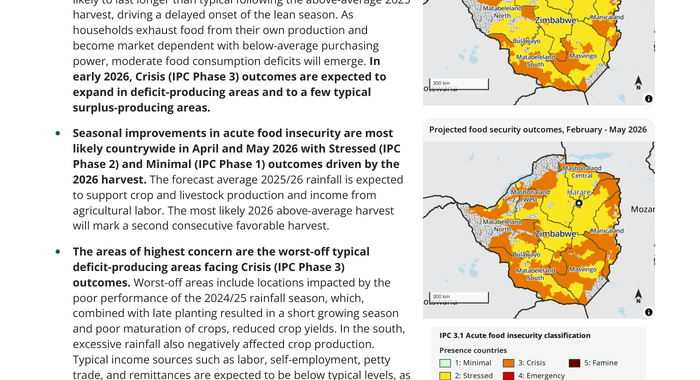
  • Crisis
    (IPC
    Phase
    3)
    outcomes
    are
    expected
    to
    emerge
    in
    November
    across
    many
    typical
    deficit-producing
    areas
     in
    Matabeleland
    North
    and
    South,
    Masvingo,
    Midlands
    and
    Manicaland
    provinces,
    and
    the
    far
    northern
    parts
    of
    the
    Mashonaland
    provinces.Own-produced
    food
    stocks
    this
    year
    are
    likely
    to
    last
    longer
    than
    typical
    following
    the
    above-average
    2025
    harvest,
    driving
    a
    delayed
    onset
    of
    the
    lean
    season.
    As
    households
    exhaust
    food
    from
    their
    own
    production
    and
    become
    market
    dependent
    with
    below-average
    purchasing
    power,
    moderate
    food
    consumption
    deficits
    will
    emerge. In
    early
    2026,
    Crisis
    (IPC
    Phase
    3)
    outcomes
    are
    expected
    to
    expand
    in
    deficit-producing
    areas
    and
    to
    a
    few
    typical
    surplus-producing
    areas.

  • Seasonal
    improvements
    in
    acute
    food
    insecurity
    are
    most
    likely
    countrywide
    in
    April
    and
    May
    2026
    with
    Stressed
    (IPC
    Phase
    2)
    and
    Minimal
    (IPC
    Phase
    1)
    outcomes
    driven
    by
    the
    2026
    harvest.
     The
    forecast
    average
    2025/26
    rainfall
    is
    expected
    to
    support
    crop
    and
    livestock
    production
    and
    income
    from
    agricultural
    labor.
    The
    most
    likely
    2026
    above-average
    harvest
    will
    mark
    a
    second
    consecutive
    favorable
    harvest.

  • The
    areas
    of
    highest
    concern
    are
    the
    worst-off
    typical
    deficit-producing
    areas
    facing
    Crisis
    (IPC
    Phase
    3)
    outcomes.
     Worst-off
    areas
    include
    locations
    impacted
    by
    the
    poor
    performance
    of
    the
    2024/25
    rainfall
    season,
    which,
    combined
    with
    late
    planting
    resulted
    in
    a
    short
    growing
    season
    and
    poor
    maturation
    of
    crops,
    reduced
    crop
    yields.
    In
    the
    south,
    excessive
    rainfall
    also
    negatively
    affected
    crop
    production.
    Typical
    income
    sources
    such
    as
    labor,
    self-employment,
    petty
    trade,
    and
    remittances
    are
    expected
    to
    be
    below
    typical
    levels,
    as
    is
    the Mopane worm
    (Gonimbrasia
    belina)
     harvest.

  • Food
    assistance
    needs
    are
    expected
    to
    increase
    through
    the
    peak
    of
    the
    January
    to
    March
    2026
    lean
    season.
     Overallfood
    assistance
    needs
    are
    expected
    to
    be
    at
    near-average
    levels,
    though
    lower
    than
    the
    atypically
    high
    El-Niño-induced
    needs
    during
    the
    last
    2024/25
    lean
    season.
    Thereafter,
    food
    assistance
    needs
    are
    expected
    to
    declinewith
    the
    availability
    of
    the
    2026
    harvest.

Post
published
in:

Agriculture