More Milbank Money: Bonus Season Rolls On With Another Match

Now that Cravath has settled into its apparent new role as a market follower, other firms have decided to dutifully fall in line with Milbank’s incredibly early year-end bonus announcement.

Once again, commercial litigation boutique Holwell Shuster & Goldberg — the firm founded by Judge Richard Holwell (formerly of the Southern District of New York) and his former White & Case colleagues Mike Shuster, Dan Goldberg, and Dorit Ungar Black — has taken the lead on compensation and joined Milbank in announcing bonuses, ahead of almost all the other Biglaw firms that will match the market in the days and weeks to come.

Here’s a kind note to associates that was included in the firm’s bonus memo:

2019 was another great year for the firm as we continued to deliver top notch legal services to our clients, achieve impressive victories on their behalf and add remarkably talented attorneys to our bench. You are all a big part of what makes the firm’s successes possible and why HSG is a very special place to practice law.

Read the full bonus memo on the next page. Money will land in associates’ bank accounts on or before December 31.

Remember everyone, we depend on your tips to stay on top of important bonus updates, so when your firm matches, please text us (646-820-8477) or email us (subject line: “[Firm Name] Matches”). Please include the memo if available. You can take a photo of the memo and send it via text or email if you don’t want to forward the original PDF or Word file.

And if you’d like to sign up for ATL’s Bonus Alerts (which is the alert list we also use for salary announcements), please scroll down and enter your email address in the box below this post. If you previously signed up for the bonus alerts, you don’t need to do anything. You’ll receive an email notification within minutes of each bonus announcement that we publish. Thanks for all of your help!


Staci ZaretskyStaci Zaretsky is a senior editor at Above the Law, where she’s worked since 2011. She’d love to hear from you, so please feel free to email her with any tips, questions, comments, or critiques. You can follow her on Twitter or connect with her on LinkedIn.


Law School Lawyer Drops N-Word But Self-Censors ‘F**k’ Because We Wouldn’t Want To Offend Anybody

Alright, let’s do this one last time.

If that sentence sounds familiar, it might be because it’s the device used in Into The Spiderverse every time the film introduces another alternate dimension version of Spiderman, and the joke is that it’s “one last time” over and over and over again. The precise details always change, but in broad strokes, someone is always bitten by a radioactive spider (technically Peter Porker was a spider bitten by a radioactive pig, but I digress) and becomes a superhero.

That’s a decent analogy for the phenomenon of law schools dropping the n-word every few months. The precise details always change, but in broad strokes, someone is always invited to discuss the First Amendment and hate speech and feels the need to hurl out racial slurs lest the black students in the room not fully understand the gravity of hate speech.

And every time this happens, it’s heralded as some kind of one-off outlier. Until we do it again a few months later… one last time.

This time it was Caitlin Sewell, who was assistant general counsel at the University of North Texas, until an invitation to speak at an event on “understanding of civil discourse and the type of language protected under the First Amendment” and was bitten by the radioactive desire to explain the First Amendment by tossing around the n-word.

To Sewell’s credit, she resigned the next day, fully grasping that she’d made it untenable to continue working in an academic environment. That’s the kind of professional responsibility that doesn’t often show up in incidents like this — it’s not an excuse for doing it in the first place, but it should be recognized in a world where too many just double down.

From the New York Post:

“Gonna say a lot of offensive things in here, because it’s impossible to talk about the First Amendment without saying horrible things,” Sewell said during the discussion, which a student in the crowd recorded. “Um, you know, ‘You’re just a dumb n—-r and I hate you.’ That alone, that’s protected speech.”

Indeed, it is! It’s also entirely unnecessary to say it when making the point.

But the worst twist came later when astute observers noticed that Sewell was saying “f-word,” you know, so she wouldn’t offend anybody.

However, SGA Senator Daniel Ojo said afterwards that Sewell continued with her example and used the term “f-word” in an attempt to censor herself, but didn’t seem to worry about using the n-word.

“So, you didn’t censor the n-word, but you definitely censored f—,” Ojo said.

Yeah, that says a lot.

Whenever this comes up, there’s a cadre of hot-take artists ready to duke it out online about how professors need to be able to use literal examples of racial slurs in class or the education system will fall apart. Those folks are wrong, but let’s sidestep this question for a second.

Even if you ascribe to the worldview that academic discourse requires white people to use literal examples of hate speech to describe the First Amendment, why are we only ever hearing about the n-word? These days there doesn’t seem to be the burning desire to toss around anti-Semitic slurs. Or homophobic rhetoric. Or derogatory terms for women. These are all equally protected terms, yet they never seem to work their way into these examples.

If this really is just an academic exercise, why does it always have to be this specific example? Because that says a lot too.

University of North Texas lawyer resigns after using n-word at free speech panel [New York Post]
UNT System assistant general counsel says the n-word at “When Hate Comes to Campus” event [North Texas Daily]

Earlier: T14 Law School Professor’s Tradition Of Using The N-Word In Class
The Original Emory Law School N-Word-Using Professor Faces A Hearing On His Future Today
Welcome To Emory Law School — It’s Been 0 Days Since We Last Used The N-Word In Class
Why Can’t Emory Law School Professors Stop Using The N-Word All The Time?
Law School Professor Drops The N-Word In The First Week Of Class
Law School Professor Who Dropped The N-Word In Class Is Back At It
Law Professor Drops Racial Slur In Class Because Otherwise How Will Black Students Ever Learn About Racism?


HeadshotJoe Patrice is a senior editor at Above the Law and co-host of Thinking Like A Lawyer. Feel free to email any tips, questions, or comments. Follow him on Twitter if you’re interested in law, politics, and a healthy dose of college sports news. Joe also serves as a Managing Director at RPN Executive Search.

Biglaw Bonus Bonanza Gets Underway With Latest Announcement

(Image via Getty)

After Milbank announced their 2019 bonus scale last week, and Cravath matched it, the die has pretty much been cast for the top of the compensation market. Though we’d love to be wrong and see a firm take the leap to become the new compensation leader, that doesn’t seem likely, particularly with Biglaw in defense mode over the coming recession.

Still, there’s a certain cache for the truly elite of Biglaw firms to make their bonus announcements as quickly as possible, once the market rate has been set. So, which firm is the latest to match the Milbank scale on bonuses? Why it’s none other than Paul Weiss, who sent around a memo (available in full on the next page) yesterday announcing the following bonuses:

Class of 2019 – $15,000 (pro-rated)
Class of 2018 – $15,000
Class of 2017 – $25,000
Class of 2016 – $50,000
Class of 2015 – $65,000
Class of 2014 – $80,000
Class of 2013 – $90,000
Class of 2012 and senior – $100,000

There was some grumpiness initially from associates at the market bonus scale being the same as last year’s. However, with multiple elite firms now on board, this scale will likely dominate across Biglaw.

Remember, we depend on your tips to stay on top of important bonus updates, so when your firm matches, please text us (646-820-8477) or email us (subject line: “[Firm Name] Matches”). Please include the memo if available. You can take a photo of the memo and send it via text or email if you don’t want to forward the original PDF or Word file.

And if you’d like to sign up for ATL’s Bonus Alerts (which is the alert list we also use for all salary announcements), please scroll down and enter your email address in the box below this post. If you previously signed up for the bonus alerts, you don’t need to do anything. You’ll receive an email notification within minutes of each bonus announcement that we publish. Thanks for your help!


headshotKathryn Rubino is a Senior Editor at Above the Law, and host of The Jabot podcast. AtL tipsters are the best, so please connect with her. Feel free to email her with any tips, questions, or comments and follow her on Twitter (@Kathryn1).

Nationalism Seeks To Eradicate The Light Of Reason And The Love Of Liberty

I am leaving for New Zealand this week to marry my best friend. Being that I come from Fairbanks, Alaska, and she is from the Albany, New York area, it only seemed fair for us to make our families collectively travel to a destination wedding. An added perk to the wedding trip is that it allows me to reconnect in person with some dear friends from Alaska who have since immigrated to New Zealand. From my friends’ description of the New Zealand immigration system, the process sounds arduous, more akin to a job interview where New Zealand takes into account your professional standing, education level, and finances into its ultimate decision-making.

There are undeniably powerful logistical/logical reasons for a country the size of New Zealand to want to restrict immigration to its islands. Moreover, it does say something positive about the life my friends had built that they satisfied this process and successfully immigrated to New Zealand. However, I also cannot help but feel a sense of pride that in my country, the United States, a majority of the overall population still desires to set us apart from the merit-based immigration of other countries. Most encouraging, the pure economic, universally beneficial argument for meritless-based immigration remains powerful. Principles are nice and I strive to maintain them, but to a cynic like me, principles are not as reliable in getting people to act in a certain way as much as economic incentive does.

The economic need is why Republican senators from red states have this year begged for increasing the number of H-2B visas, when their current party leadership’s “principles” advocate the opposite. The “argument” that the United States is somehow “full” is also provably false. First of all, as Shikha Dalmia explains, there is a glaring problem with the logic that the country is full. It is simply telling that no one, including anyone in anti-immigration MAGA world, is worrying about restricting child birth or an increasing U.S. population that is outgrowing its resources.

But there is also a more fundamental issue underlying the economic argument for increasing immigration, per Dalmia:

At the heart of this issue is the question: Are humans a liability who deplete resources or an asset who themselves are a resource—indeed, to use the parlance of the late, great environmental economist Julian Simon, the “ultimate resource”?

It is the ingenuity of human beings that turns fallow land bounteous, dirt into valuable metals, and sand into computer chips. There is no given or fixed set of natural resources out there, Simon pointed out. Useless materials become resources once human creativity finds a way to harnesses them. Oil was just a toxic black liquid in the ground till humans discovered that it could be burnt for light and power. The development of high-yield grains increased the productivity of land exponentially while human population grew only arithmetically—the exact opposite of what Malthus predicted.

The most important factor limiting a country’s economic progress, then, isn’t insufficient physical resources but insufficient human resources. Hence, contrary to Malthusian—or Trumpian—thinking, population increases through immigration are nothing to fret over when you have institutions able to harness human talent. Immigrants are not only mouths that need to be fed but also minds and hands that grow the economic pie. They certainly consume resources. But they produce far more than they consume over the long run when given an opportunity. To the extent that immigrants, whether high- or low-skilled, have jobs, it’s because they produce more wealth or value for their employers than they consume in wages.

Imagine for a moment that there were foreign planes periodically airdropping free goods on American homes. Wouldn’t it be colossally stupid to send missiles to shoot them down? Yet why is it not equally foolish to shoo away the real source of this wealth, namely, Mexicans whose sweat makes affordable housing possible for Americans and puts cheap goods in these houses? Or when it turns away Chinese computer engineers whose smarts virtually spin gold from sand?

Going beyond the economic case to a principled one, I think the argument for increasing immigration is strongest, even if it is less influential, perhaps, than pure economics. The reason I find the principled argument to be so superior is I fail to see how anyone can deny that the nativist argument against immigration is based on nothing but luck. In other words, no one can pick their birth parents, nor the place or time for which they will be born, meaning every American is American entirely by chance. Even if you immigrated here after you were born, the issue of personal responsibility remains, and luck or lack thereof depending on how you might look at it, is still the dominating factor.

The Nationalist desired policies of this current president fly in the face of all this evidence and reason. What has replaced each in MAGA world is slave-like devotion to the word of one man, and instead of a love for liberty there is outright bigotry. So, if by the time I get back from my wedding, if you all can just go ahead and impeach the guy that would be great.


Tyler Broker is the Free Expression and Privacy Fellow at the University of Arizona James E. Rogers College of Law. His work has been published in the Gonzaga Law Review and the Albany Law Review. Feel free to email him or follow him on Twitter to discuss his column.

Morning Docket 11.12.19

* A University of North Texas lawyer has resigned after using the N-word during a free speech panel at the school. This attorney just learned a valuable lesson in free speech. [New York Post]

* A lawyer set to argue an important case about DACA in front of the Supreme Court is a Dreamer himself. [CNN}

* Hundreds have signed a petition in opposition to Scott Brown’s appointment as president of New England Law. [Boston Globe]

* An attorney from Roswell, New Mexico, is running against President Donald Trump in the New Hampshire primary. His chances of winning are out of this world… [KOAT Action News]

* Lawyers for Representative Tulsi Gabbard are demanding that Hillary Clinton retract allegedly defamatory comments about Gabbard’s relationship with Russia. [The Hill]


Jordan Rothman is a partner of The Rothman Law Firm, a full-service New York and New Jersey law firm. He is also the founder of Student Debt Diaries, a website discussing how he paid off his student loans. You can reach Jordan through email at jordan@rothmanlawyer.com.

‘Where’s the money?’: Zimbabwe’s new banknotes fail to arrive – The Zimbabwean

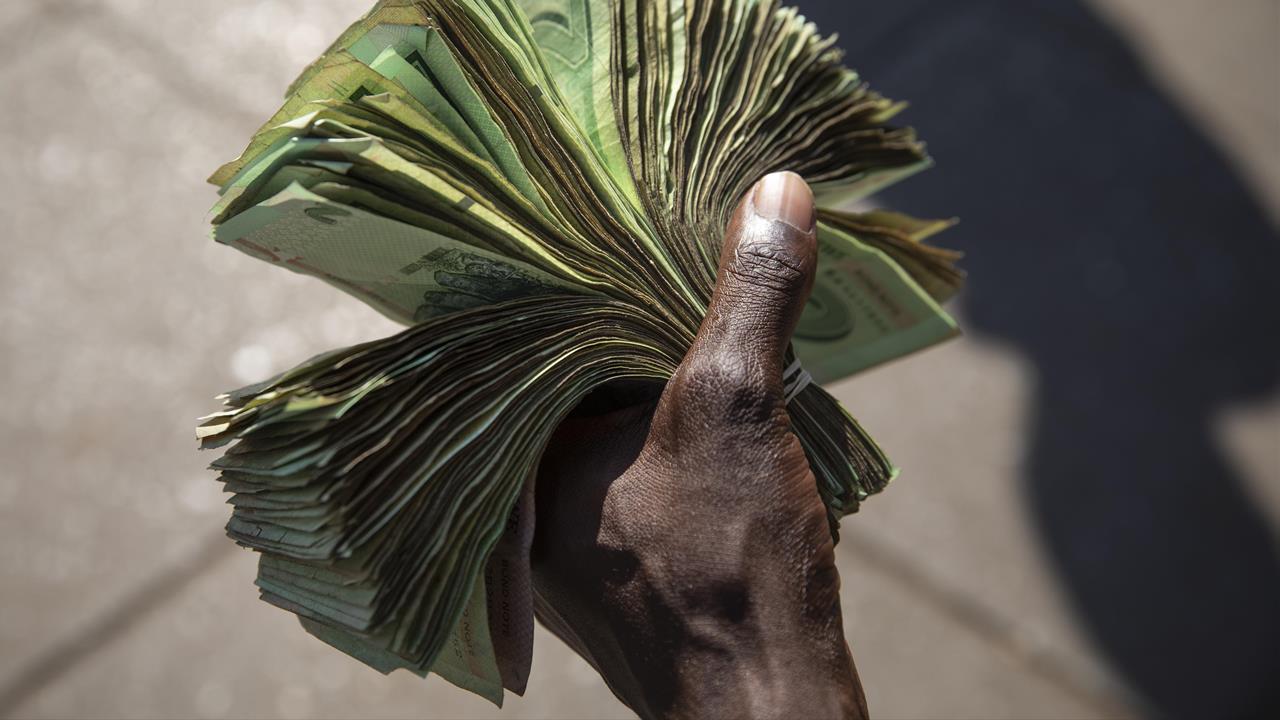
A street vendor displays bond notes before the introduction of new currency in Harare, Zimbabwe [Philimon Bulawayo/Reuters]

New low-denomination banknotes touted by the government of Zimbabwe as the solution to the acute cash shortage crippling the country’s economy failed to arrive on Monday, leaving banks confused and customers frustrated.

The dearth of cash – along with shortages of staple goods exacerbated by a long drought – has sent inflation to its highest since 2008, estimated at 380 per cent year on year.

“Where’s the money?”, the government’s mouthpiece, The Herald newspaper, asked in an online report.

The central bank had failed to circulate the new banknotes by the close of business on Monday, it said.

Banking executives told the Reuters news agency that they had received no new bills as expected, or any communication from the Reserve Bank of Zimbabwe (RBZ) about why the notes had not been distributed.

RBZ Governor John Mangudya could not be reached for comment after earlier promising to speak.

“We now think we may get the cash on Tuesday,” an executive at a foreign-owned bank said. “People have been calling all day to inquire whether they can come to make withdrawals.”

The executive, who declined to be named because he is not authorised to speak to the press, said the RBZ’s failure to deliver the notes would add to the mistrust that citizens have towards the central bank.

In 2008, hyperinflation wiped out many Zimbabweans’ pensions and savings and forced the southern African country to dump the Zimbabwe dollar currency.

In June of this year, the government unexpectedly ended a decade of dollarisation by reintroducing the Zimbabwe dollar to give it more flexibility in shaping monetary policy.

Not resolving economic problems

The government hopes the new notes – which will have the same denominations as bond notes currently in circulation – will help end the cash crunch, bring down inflation and speed up the restoration of the long-neglected domestic currency.

The RBZ said it would issue new five-dollar and two-dollar notes as the next stage of that process, similar in design and colour to the bond notes that were introduced in 2016 as a surrogate for United States dollars.

The RBZ has said it plans to inject one billion Zimbabwe dollars in cash into the economy the next six months.

But many locals and market analysts are unconvinced that new notes will do much to alleviate the crisis.

“If only they had introduced higher denomination notes like 50 dollars, that would have made more sense. What do you do with five dollars?” said Rachel Mandeya, a 28-year-old street trader for foreign currencies.

The five-dollar note, the highest new denomination, is worth just 32 US cents and is only enough to buy a bottle of soda.

Tony Hawkins, a professor of business studies at the University of Zimbabwe, said the central bank was trying to deal with “symptoms of a bigger problem”.

That larger issue includes foreign currency shortages, lack of foreign investment, inflation and lack of consumer confidence in policy.

“The new cash will not resolve the economic problems we face,” Hawkins added. “What it means is that we will probably have more cash around to feed the black market for currency.”

Many businesses discount prices by up to 40 percent for customers paying cash and charge more for those using mobile money or bank cards.

Zimbabwe Bourse CEO Bemoans 80% Currency Crash Ravaging Market – The Zimbabwean

Consider the challenges confronting Zimbabwe Stock Exchange Chief Executive Officer Justin Bgoni: a local currency that has crashed more than 80% since a peg to the U.S. dollar was ended in February and annual inflation that the International Monetary Fund estimates at 300%.

While Harare’s Industrial Index is at a record high and market capitalization in local currency terms has surged by 169% from a year ago to Z$31 billion, in dollar terms they have crumbled to the lowest in a decade, at $1.9 billion. In the past, investors have used the stock market as a shelter to ride out economic turmoil in the southern African nation, but its haven status has been shaken by the return of the Zimbabwe dollar and hyperinflation.

“Our market capitalization in U.S. dollar terms — that’s just been worse, we are almost half of what we are normally at,” Bgoni, in the job since March, said in an interview in his office in the capital, Harare. “If it was a normal country, where things are not indexed in U.S. dollars, things wouldn’t be so bad.”

When it comes to assessing individual stocks, hyperinflation skews the picture for traders, said Lloyd Mlotshwa, head of equities at IH Securities, a Harare-based brokerage. While companies are showing significant gains in revenue, actual volumes of products sold are down and overall performance is deteriorating.

“The massive devaluation of the currency has also caused a dislocation in stock market valuations,” said Mlotshwa. “Some firms are trading below the replacement values of their plants. At the same time, sentiment is so negative that this isn’t necessarily being interpreted as a buy signal.”

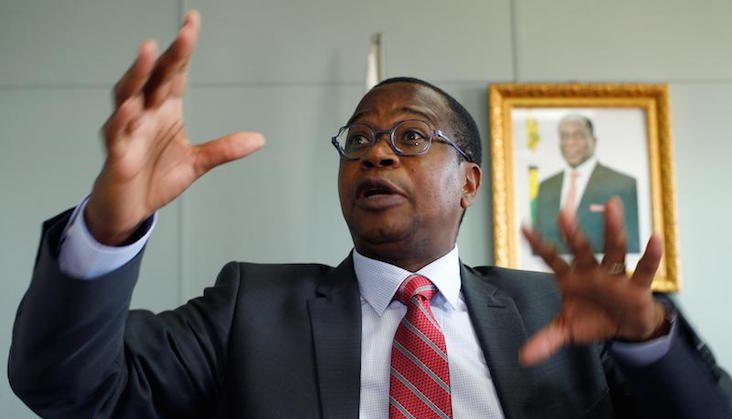
In February, the 1:1 parity peg between so-called bond notes and the U.S dollar was removed. In June, Finance Minister Mthuli Ncube abolished the use of the multicurrency system and reintroduced the Zimbabwe dollar as sole legal tender, almost a decade after it went out of circulation because of hyperinflation. The Zimbabwe dollar on Friday was trading at 15.85 per U.S dollar, compared with the February rate of 2.5 adopted at the end of parity.

Economic conditions in Zimbabwe, its struggling companies and inconsistent government policies all make local stocks less attractive to foreigners, Bgoni said. In terms of market development and options for investors, he estimated the bourse trailed African peers in Botswana, Kenya and Nigeria by about 10 years.

“We are really down on foreign investors and we almost have no new money coming in,” he said.

Foreigners accounted for 15% of trades in October, the lowest in three years, and down from the record 82% in February this year.

“We want foreign investors, especially when you have a devaluation of this sort, because they would be able to see bargains and bring up the prices,” Bgoni said. “But then, they can’t take their money out,” due to foreign-exchange controls and other Treasury regulations, he added.

The 2020 National Budget Presentation will be on Thursday 14th November – The Zimbabwean

Both Houses of Parliament Will be Sitting This Week

The 2020 National Budget Presentation will be on Thursday 14th November

The Senate and the National Assembly last sat on Thursday 24th October.  Since then MPs have been occupied mainly with Budget business.  From 30th October to 4th November their time was committed to the Pre-Budget Seminar at the Victoria Falls – an occasion for interaction between MPs and Ministers, particularly the Minister of Finance and Economic Development, and advisers on the priorities and content of the coming 2020 National Budget.  The Speaker of the National Assembly, Hon Jacob Mudenda, opened the Seminar with a thoughtful keynote address [full text available on the Veritas website [link]].

This week it will be business as usual in both Houses on Tuesday and Wednesday afternoons – unless the Speaker is ready to clarify two current thorny issues, both of them referred to in Bill Watch 57/2019 of 7th November [link]:

  • the penalty he imposed on MDC-A MPs for disrespecting the President at the opening of the session on 1st October [forfeiture of sitting allowances] and
  • his ban on MDC-A asking questions during National Assembly Question Time on 23rd October.

Budget Presentation on Thursday

On Thursday afternoon the Minister of Finance and Economic Development will present the 2020 National Budget to the National Assembly.  Senators will listen by media link to the presentation in the comfort of the Senate, instead of the usual Thursday afternoon Question Time.

In the remainder of this bulletin we cover the latest developments on the group of Bills passed by Parliament in the last session but not yet gazetted as law.  This will be followed by what is due to come up in both Houses under the heading of business as usual on Tuesday and Wednesday.

Bills Sent to the President for Assent and Gazetting as Acts

Parliament sent three Bills to the President on 5th November, and gave public notice of this action [as required by section 131(5) of the Constitution] in General Notices 2040, 2041 and 2042/2019 published in the Government Gazette of 8th November:

Microfinance Amendment Bill

Maintenance of Peace and Order Bill

Companies and Other Business Entities Bill.

Section 131 allows the President 21 days in which to decide whether to assent to a Bill or to return it to Parliament for reconsideration.

Note: Only one Bill passed by Parliament during the last session still has to go to the President – the Consumer Protection Bill. 

Coming Up in the National Assembly

Lapsed Bills to be restored to the Order Paper

On Tuesday 12th November item 1 on the Order Paper will be a motion by the Minister of Justice, Legal and Parliamentary Affairs seeking the approval of the House for the restoration of six lapsed Bills to the Order Paper at the stage reached in the last session.  The following list shows the stage reached previously for each of these Bills:

Zimbabwe Investment and Development Agency Bill [Committee Stage in National Assembly to be completed, including consideration of amendments proposed by the Portfolio Committee on Industry and Commerce]

Money Laundering and Proceeds of Crime Amendment Bill [for Second Reading stage]

Coroner’s Office Bill [for continuation of Second Reading debate]

Marriages Bill [waiting for Parliamentary Legal Committee [PLC] report]

Freedom of Information Bill [waiting for PLC report]

Education Amendment Bill [waiting for resolution of last-minute disagreement between the Houses, the National Assembly having rejected an amendment made by the Senate]

All these Bills lapsed at the end of the last session because they had not been completed.  Standing Order 161(1) allows the House to approve the Minister’s motion – a means of avoiding wasting work devoted to a Bill by MPs and Parliamentary staff – and the expense incurred in carrying out that work.

Note: The Zimbabwe Media Commission Bill also lapsed at the end of the last session while it was under consideration by the PLC after its First Reading [but is missing from the Minister’ motion]. 

Gazetted Bills Now Ready to be Presented

The following Bills, having been gazetted more than fourteen days ago, all qualify for presentation and First Reading and then automatic referral for consideration by the Parliamentary Legal Committee – which means that presentation may occur this week:

Reserve Bank of Zimbabwe Amendment Bill

International Treaties Bill

Constitutional Court Bill

The Veterans of the Liberation Struggle Bill, which was only gazetted on 1st November, does not yet qualify for presentation and First Reading.

International Agreements for Parliamentary Approval

Two international agreements are listed for approval in terms of section 327(2) of the Constitution.  Approval by both Houses of Parliament will clear the way for Zimbabwe to ratify these agreements.

Economic Partnership Agreement between the UK and Eastern and Southern African States

This agreement was signed on behalf of Zimbabwe on 31st January 2019.

Framework Agreement of the International Solar Alliance

This agreement was signed on behalf of Zimbabwe on 17th July 2018.

Motions

Two partly-debated motions are items 4 and 5 on the Order Paper:

  • the vote of thanks for the President’s speech at the opening of this session;
  • the anti-sanctions motion, debate on which terminated abruptly in great disorder on Thursday 24th October, just as Hon Biti entered the chamber to make his contribution [see Bill Watch 57 of 7th November [link]].

Take note motions on reports

Items 6 to 15 on the Order Paper are motions for the House to take note of various reports including include the report of the Public Accounts Committee [PAC] on Compliance Issues for the Reserve Bank, and a report on the Benchmarking Visit to the Parliament of Zambia by a delegation of some members of the PAC.

These reports will be posted on the Veritas website when they become available, which will be once the take note motions have been moved.

Question Time

This is due to go ahead on Wednesday, Questions Without Notice being allotted the first hour and Questions With Notice the next hour.  Hon Madzimure has 7 questions with notice listed, including asking the Minister of Public Service, Labour and Social Welfare for details of distribution of food to the elderly in his Kabuzuma constituency and several for the Minister of Local Government, Public Works and National Housing seeking information on a large number of allegedly irregular land allocations and transfers in the constituency.  Hon S. Chamisa has 5 questions listed, including some for the same Minister seeking information on progress with issuing of title deeds to Mbare residents and construction of a secondary school in Mbare, and the official attitude towards returning vehicle licensing functions to local authorities to enable them to maintain roads.

Coming up in the Senate

The Senate will continue debating the motion for a vote of thanks to the President for his address opening this Parliamentary session and the anti-sanctions motion.  Both debates started during the first working sittings of the Houses on 22nd, 23rd and 24th October.

As already noted above, the Senate’s usual Thursday afternoon Question Time will not take place.  Instead, Senators will remain in their own chamber to listen by media link to the 2020 Annual Budget presentation in the National Assembly.

Veritas makes every effort to ensure reliable information, but cannot take legal responsibility for information supplied.

Zimbabwe Bourse CEO Bemoans 80% Currency Crash Ravaging Market
Dought-hit Zimbabwe readies mass wildlife migration

Post published in: Featured

Dought-hit Zimbabwe readies mass wildlife migration – The Zimbabwean

FILE PHOTO: A group of elephants and giraffes walk near a carcass of an elephant at a watering hole inside Hwange National Park, in Zimbabwe, October 23, 2019. REUTERS/Philimon Bulawayo/File Photo

At least 200 elephants have already died at two other parks due to lack of food and water, along with scores of buffalo and antelope, Zimbabwe Parks and Wildlife Management Authority (Zimparks) said on Monday.

“They will continue (to die) until the rains come. The biggest threat to our animals right now is loss of habitat,” Zimparks spokesman Tinashe Farawo told Reuters.

The El Nino-induced drought has also taken its toll on crops, leaving more than half of the population in need of food aid.

Farawo said Zimparks and private partners planned to move 600 elephants – as well as giraffe, lions, buffalo, antelope and spotted wild dogs – from Save Valley Conservancy in southern Zimbabwe to three other national parks.

“This is the biggest translocation of animals in the history of wildlife movement here because we are talking of distances of more than 1,000 kilometers,” said Farawo.

It will start once the summer rains come. Those are expected to start this week, which would offer major relief for the stricken animals and for farmers who are preparing for the 2019/20 planting season.

The migration will also help to save the conservancy’s ecosystem by depopulating it because the animals “are now becoming a threat to their own survival,” Farawo said

Zimbabwe is home to some 80,000 elephants, around a fifth of Africa’s total, conservationists estimate. Overall numbers have declined sharply in recent years, mostly due to a combination of poaching, illegal hunting and drought.

Farawo said Zimparks, which does not receive government funding, requires $40 million annually for conservation efforts but only generates half the amount.

Zimbabwe, together with South Africa, Botswana and Namibia, unsuccessfully lobbied the Convention on International Trade in Endangered Species for controlled sales of their ivory stocks at a meeting in August.

Trade in ivory is banned to deter poaching. Zimparks says its ivory stockpile is worth $300 million, money it can use for wildlife conservation.

Zimbabwe has also exported nearly 100 elephants, mainly to China, earning $3 million, Zimparks statistics show.

The 2020 National Budget Presentation will be on Thursday 14th November
Severely Dry Weather Is Killing Zimbabwe’s Wildlife

Post published in: Featured

Severely Dry Weather Is Killing Zimbabwe’s Wildlife – The Zimbabwean

Many of Africa’s best known kinds of wild animals are dying from lack of food and water in Zimbabwe’s Mana Pools National Park.

The 2,196- square-kilometer wildlife reserve gets its name from the four nearby bodies of water that the flooding Zambezi River fills every rainy season. The area is home to elephants, zebras, hippopotamuses and many other kinds of wildlife.

But the Zimbabwe National Parks and Wildlife Management Authority reports that at least 105 elephants have died in Zimbabwe’s wildlife areas recently. Most of the deaths have been in Mana and the larger Hwange National Park in the past two months, the agency said.

Many animals are moving out of the parks and into nearby communities in search of food and water.

Mana Pools is a United Nations Educational, Scientific and Cultural Organization World Heritage Site known for its beauty. The area experiences hot, dry weather at this time every year. But this year, the dry conditions have been much worse. Even the river’s flow has reduced.

The drought hitting southern Africa is also affecting people. The World Food Program reports that hunger threatens an estimated 11 million people in nine countries. The organization is planning large food distribution projects. The countries of southern Africa have experienced normal rainfall in only one of the past five growing seasons, the group says.

Hopes for rain

Each morning, Munyaradzi Dzoro, a parks agency wildlife officer, hopes for rain.

“It’s beginning to be serious,” he told the Associated Press, standing next to the remains of a dead elephant and buffalo. “It might be worse if we fail to receive rains” by early November.

The last major rainfall came in April, he said.

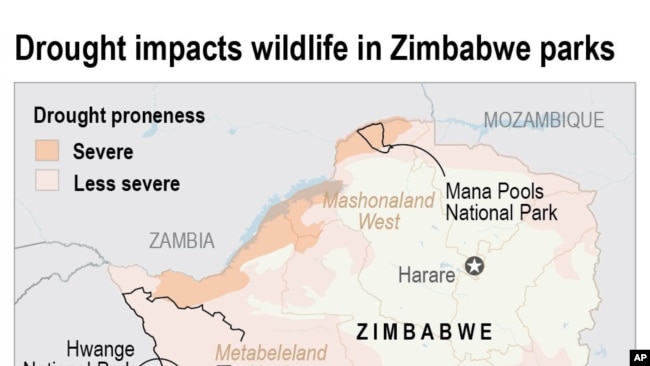
Map illustrates Zimbabwe’s severe drought which is killing elephants, other wildlife.

Mel Hood works with the Feed Mana project, which is providing food support to animals in the area. She said an early end to a “very poor rainy season” has limited the growth of plants the animals need.

The area’s once dependable water resources have turned dangerous for the animals. Many have gotten stuck in the soft soil or clay while trying to reach Long Pool, a five-kilometer-long watering hole. It is one of the few remaining water resources in the park but is only five percent of its normal size.

There are more than 12,000 elephants in Mana’s flood plains. Lions, buffaloes, zebras, wild dogs, hyenas, 350 kinds of birds and many water animals live in the park, the parks agency reports.

“We used to say nature should take its course,” Dzoro said of the park’s normal policy of not getting involved and letting the ecosystem find its own balance.

Now, he said, officials are getting involved to avoid losing animals and maintain population sizes.

Local plant life such as acacias, as well as other trees and grasses, provide most of the food for big animals like elephants and buffaloes. But the lack of rain has severely reduced the amount of plant life, so officials began bringing food to the park in July.

Mel Hood says The Feed Mana project has been asking for “urgent” donations of animal feed such as soy bean hay and grass.

“Although it may not be enough to stave off all the hunger…it is certainly giving these animals a chance to survive until conditions improve,” Hood said.

I’m ­Pete Musto.

Farai Mutsaka reported this story for the Associated Press. Pete Musto adapted it for VOA Learning English. Mario Ritter Jr. was the editor. We want to hear from you. How do officials protect endangered animals in your country? Write to us in the Comments Section or on our Facebook page.

________________________________________________

Words in This Story

reserve – n. an area of land where animals and plants are given special protection

drought – n. a long period of time during which there is very little or no rain

distribution – n. the act of giving or delivering something to people

plain(s) – n. a large area of flat land without trees

take its course – expr. to permit something to happen without trying to control it

ecosystem – n. everything that exists in a given environment

stave off – p.v. to keep someone or something away usually for a short time