Has the economy stopped declining? – The Zimbabwean

Zimbabwe has not had its own independent currency for a decade, relying instead on the US dollar and a local money system pegged to the dollar.

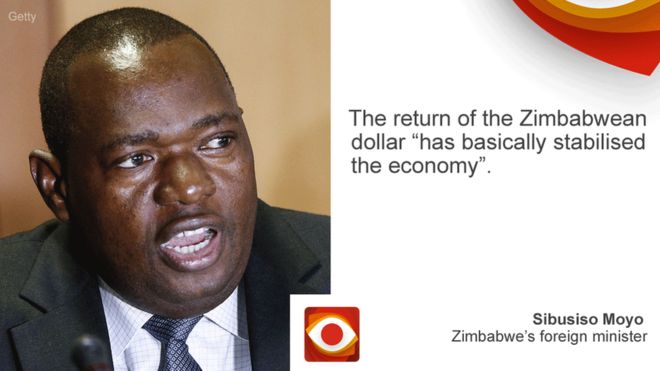
Foreign Minister Sibusiso Moyo said that reintroducing the Zimbabwe dollar has stabilised the economy.

But is he right? Reality Check looked at the country’s key economic indicators before and after the currency was reintroduced.

It’s true the economy is no longer in the extreme inflationary spiral seen in 2008, but there continue to be severe shortages of food, medicine and fuel.

Fears of a return to hyperinflation

The introduction of the new currency came at a sensitive time.

There was understandable concern that bringing back the Zimbabwe dollar would lead to a return to the chaotic hyperinflation which destroyed savings and made wages worthless.

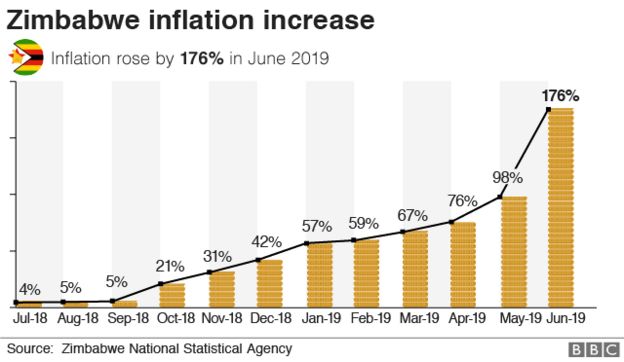
The most recent figures suggest annual inflation has risen sharply over the last year. In May it was 98% and by June, annual inflation stood at 176%.

This is nowhere near the spiralling inflation levels of a decade ago, but the trend has not been encouraging.

We don’t have the inflation figures for July as the authorities have said they won’t be publishing annual inflation data until February 2020.

Zimbabwe inflation increase

There’s also debate about whether the official number accurately captures the increase in goods on shop floors and at petrol stations, for instance.

Leading economists say it’s likely the cost of living is higher than official figures indicate.

Zimbabwe’s exchange rate with US dollar

Since the introduction of the new currency on 24 June, it has fallen against the US dollar.

This benefits Zimbabwe’s agricultural exports, mainly its tobacco sector.

But any positive effects are likely to be outweighed by more expensive imports, leading to further inflationary pressures on the economy.

Zimbabwe’s trade deficit (2017)

The weaker currency is likely to have an impact across the economy, as importers struggle to get access to foreign exchange such as the US dollar in order to buy goods from abroad.

Taking a longer term view, the government has reduced spending since October last year and is now running a budget surplus, which it says is an indication of an improving economy.

Independent economists are sceptical about these numbers.

Harare, Zimbabwe - where the price of goods has increasedImage copyrightGETTY IMAGESImage captionHarare, Zimbabwe – where the price of goods has increased

Falling value of salaries

Public sector workers in Zimbabwe are paid in local currency and there are fears that because of its decline against the US dollar, and because of inflation, they are now, in effect, earning less.

Zimbabwe’s main public sector workers’ union, Apex Council, said in a petition that the value of earnings has fallen “from at least $475 to a mere $47 currently for the lowest paid civil servant” since October last year.

Cecilia Alexander, Apex Council chairwoman, said the government’s austerity plans had left workers mired in poverty.

Unions have, however, agreed a one-off payment of 400 Zimbabwean dollars ($45) to every worker in July, while talks on pay continue.

Zimbabweans Claim Police Brutality During Economic Protests
Zimbabwe police violently break up protests after court ban

Post published in: Business

Zimbabwe police violently break up protests after court ban – The Zimbabwean

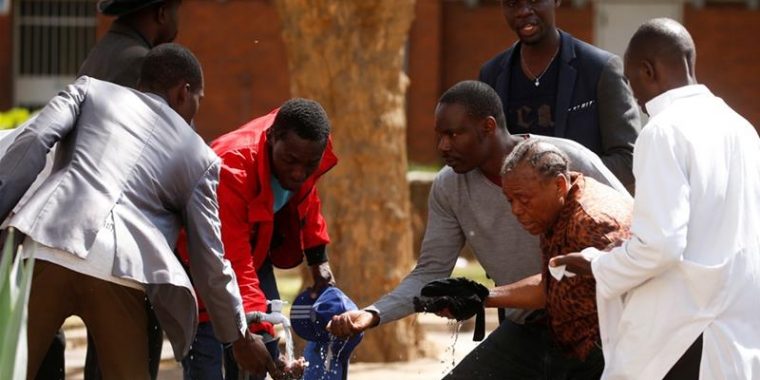
Bystanders assist a woman injured during clashes in Zimbabwe [Philimon Bulawayo/Reuters]

Scores of people gathered in Africa Unity Square to demonstrate against a worsening economic situation in defiance of the ban, which was upheld by a court on Friday.

Supporters of Zimbabwe’s opposition Movement for Democratic Change (MDC) sang songs condemning the police brutality as officers fired tear gas to disperse them.

Police also cornered a group of protesters and beat them with batons, with one woman being carried into a Red Cross ambulance.

“This is worse than during colonial times,” said a man who declined to be identified.

“We aren’t armed but the police just beat us while we were sitting on the street,” he told the AFP news agency.

Dozens of police and three water cannon were involved in running street battles with protesters in the square, which overlooks the country’s parliament and is where thousands gathered in November 2017 to call for then-president Robert Mugabe to step down. Following a military-led coup, Emmerson Mnangagwa took over and went on to win disputed presidential elections in 2018.

Friday’s protests went ahead after opposition plans for large-scale marches were banned by the police late on Thursday.

An MDC attempt to challenge the ban in court was then rejected.

“The court has said the demonstration should be off,” MDC spokesman Nkululeko Sibando told AFP.

The party’s Vice President Tendai Biti told reporters outside the high court that “we differ respectfully with the ruling”.

“The fascist regime has denied the right for Zimbabweans to demonstrate,” Biti said.

“There is no difference between Mnangagwa and Mugabe. We jumped from the frying pan into the fire after the November coup”.

Al Jazeera’s Haru Mutasa, reporting from Harare, said police had said they did not want the protests to go ahead as they had received information that some of the demonstrators were armed and that rocks were stashed in some parts of the city to be used as weapons.

The opposition denied this, saying the protests were peaceful.

Five million face ‘starvation’

Upon taking office, Mnangagwa had vowed to revive Zimbabwe’s economy, but people in the country say things have gone from bad to worse amid shortages of basic goods and skyrocketing prices.

Around five million people – almost a third of the country’s population – required aid and at least half of them were on the cusp of “starvation”, the World Food Programme (WFP) said this month.

Armed police had put up barricades around the city early on Friday in a bid to deter protesters, turning back cars on streets leading to the MDC’s party headquarters.

Long queues of traffic formed as the police searched cars and commuter buses for weapons. Riot police also searched pedestrians.

At least six opposition and rights activists were abducted and tortured by unidentified assailants in the days leading up to the protest, according to the Zimbabwe Human Rights NGO Forum, a coalition of 21 human rights groups.

Friday’s protests were the first since rallies in January against Mnangagwa’s decision to raise fuel prices ended in deadly clashes with troops.

At least 17 people were killed and scores wounded after the army used force, including live ammunition, to end the demonstrations.

Zimbabwe police beat anti-government protesters in capital – The Zimbabwean

Seven people were injured, including one in critical condition and 80 people were arrested, said Nelson Chamisa, leader of the Movement for Democratic Change opposition party that organized the demonstrations.

“There is not going to be any rest until we achieve a people’s government…we will continue to mobilize,” said Chamisa at a press conference, following a day of clashes between police and opposition demonstrators.

A few hundred demonstrators gathered in Africa Unity Square in central Harare, despite a police ban on the protest that was upheld by Zimbabwe’s High Court.

Riot police arrest and forcibly apprehend protestors during protests in Harare, Zimbabwe.Riot police arrest and forcibly apprehend protestors during protests in Harare, Zimbabwe.AP

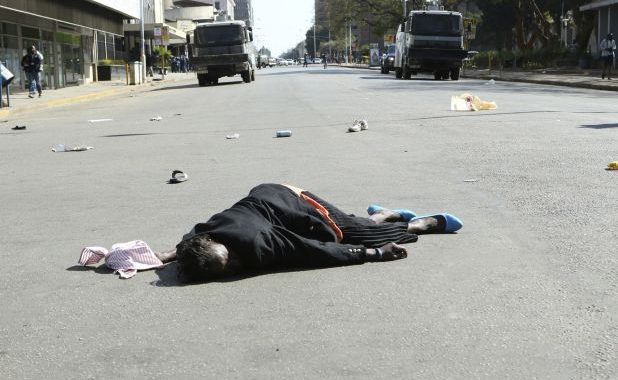
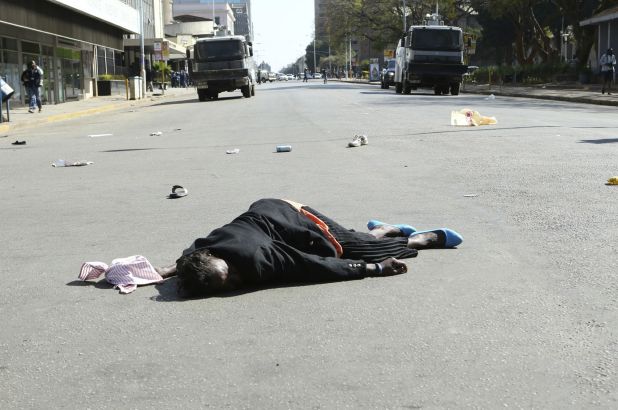
Police fired tear gas which engulfed the square to disperse the protesters, who ran into nearby streets. Police used batons to beat several people. One woman collapsed on the street after being beaten. She and others received emergency treatment and were taken to hospitals by Red Cross ambulances.

Groups of young men moved around the downtown area, shouting anti-government slogans and singing protest songs.

“Don’t weep for me if I die. I chose to die for Zimbabwe,” sang some protesters, in the Shona language, before running away from clouds of tear gas.

Sitting on a sidewalk in the city center with a swollen leg he said was from a beating he received from the police, Tafara Chiringa criticized the government.

Zimbabwean riot police block a road ahead of the planned protest.Zimbabwean riot police block a road ahead of the planned protest.AP

“We came in peace today, just like we did in 2017 (in demonstrations to oust former President Robert Mugabe) but look at what they have done to us,” said Chiringa. “It’s as if Mugabe is back.”

The clashes came after Zimbabwe’s High Court upheld the police ban on the opposition protest. The court early Friday rejected the appeal from the opposition party to declare the planned protest to be legal.

Although a few hundred protesters gathered, many more Harare residents stayed off the streets and shops did not open to avoid any possible trouble.

The opposition party had planned what it said would be a peaceful protest to press President Emmerson Mnangagwa to set up a transitional authority to address economic problems and organize credible elections. The protests will spread to other cities next week, the opposition said.

Enlarge ImageRiot police arrest and forcibly apprehend protestors during protests in HarareAP

Zimbabwe’s economic turmoil with inflation at 175 percent, widespread power cuts lasting up to 19 hours a day and shortages of water are blamed for the rising political tensions.

From the hope that swept across the country with the forced resignation of repressive ruler Robert Mugabe in November 2017, the nation has returned to widespread resentment and fear, according to government critics and residents.

Six anti-government activists were abducted and tortured this week ahead of the protests, according to human rights groups.

Zimbabwe’s president urged the opposition to engage in dialogue, but at the same time his government pushed parliament to quickly adopt new security legislation criticized as repressive.

To discourage the protests teams of police officers searched vehicles at checkpoints on roads leading into the city. Police warned people to stay away from the demonstrations.

A riot police man kicks out at a man.A riot police man kicks out at a man.AP

“Do not take part, you will rot in jail,” shouted police officers through megaphones on Thursday in downtown Harare and some residential areas.

The Harare protest highlights the challenges that confront Mnangagwa, 77, who came to power with promises of sweeping political and economic reforms. But now his government is widely viewed as an extension of Mugabe’s economic mismanagement and even more heavy-handed on security, according to human rights groups.

In addition to the debilitating shortages of power and water, about a third of Zimbabwe’s 15 million people are in dire need of food aid, according to aid agencies.

Amnesty International accused Mnangagwa’s administration of “using some of the brutal tactics seen under the government of Robert Mugabe,” said Muleya Mwananyanda, Amnesty International’s deputy regional director for southern Africa. “Instead of listening to protestors’ concerns about the economy, the authorities have used torture and abduction to crush dissent and instill fear.”

Protesters run from teargas.Protesters run from teargas.AP

The Zimbabwe government should allow peaceful protests, said Rupert Colville, the spokesman for the UN High Commissioner for Human Rights.

“With opposition demonstrations still likely to take place in Zimbabwe in the near future, we urge the government to find ways to continuously engage with the population about their legitimate grievances on the economic situation and to stop cracking down on peaceful protesters,” said Colville, in a statement Friday.

“We are deeply concerned by the socio-economic crisis that continues to unfold in Zimbabwe,” he said. “The dire economic situation is now impacting negatively on the realization of the economic and social rights of millions of Zimbabweans.”

Colin Kaepernick Settled His Grievance, Jay-Z Is Just Taking The Money

Colin Kaepernick (Photo by Streeter Lecka/Getty Images)

There seems to be some confusion about the difference between Colin Kaepernick settling his collusion grievance with the National Football League before an arbitrator could rule on the merits, and Jay-Z allowing the NFL to paint itself in Hovaface in exchange for some Super Bowl money. The mischaracterization seems to be: Kaep “took the money” and Jay-Z took the money, so it’s all the same and so now let’s get READY FOR SOME FOOTBAW!!!

Here’s wide receiver Dez Bryant stumbling into the confusion:

You see this a lot from people who don’t understand how the legal system works. In the common parlance, “settlement” connotes “weakness.” You “settle” when you can’t get what you “really” want. You “settle” when somebody names your price. You “settle” when you punt on 4th-and-1 when you are losing late in the game (which, honestly, is pathetic). Winners win, losers settle.

Thinking that way is not Dez’s fault. He went to school to learn how to catch footballs, I went to school to learn how to debate the definition of a “catch” into total absurdist obfuscation. I got you, Mr. Bryant.

Simply put, the colloquial understanding of “settlement” has no place in the law. Many aspects of the legal system are designed, specifically, to encourage legal settlements. A legal settlement is not an admission of defeat, it’s not “selling out.” It’s just the outcome the system is designed to produce. And, of all of those designs, none work as well as “forced arbitration.” Forced arbitration is entirely about making people settle their grievances before an arbitrator makes an “all or nothing” ruling.

It’s that forced arbitration process that Kaepernick’s collusion grievance was subjected to. Let’s start with the obvious: Kaepernick accused all 32 NFL teams of colluding to keep him out of the league. However, in order to “sue” the NFL for collusion, the only thing Kaepernick could legally do was file a grievance and subject himself to arbitration. That was the only process available, because that’s what is laid out in the collective bargaining agreement between the NFL and the NFL Players Association. A football player cannot just sue the NFL in civil court, without first going through this process. That’s just how the law works. Kaepernick didn’t “give up” his right to sue the NFL, the Player’s Association gave up that right for him, and there was nothing he could reasonably do about it.

Kaepernick filed his grievance, under the terms of the NFL collective bargaining agreement, and that meant his case would be heard by an arbitrator. Think of an arbitrator like a guy whose only tool is a hammer. If you have some exposed nails, it’s going to work out. But if you have any other problem, you might want to fix it yourself before the guy with a hammer shows up and starts knocking things over.

Over the course of the arbitration, it appears that Kaepernick and his legal team were able to bring enough evidence to light to reasonably support their claim that the NFL colluded against him. We don’t know what that evidence was, because arbitration proceedings are secret. Again, this is the legal system favoring a process where parties can settle without having to “admit” any fault, as opposed to a process where parties are boxed into defending embarrassing evidence.

Understand, collusion cases are notoriously hard to “prove.” How can you prove why a thing didn’t happen? It’s almost like trying to prove a negative. Still Kaepernick and his team got it done. The NFL collective bargaining agreement is notoriously crappy for the players. Kaepernick, and fellow NFL player Eric Reid, filed their grievance in October, 2017. In August, 2018, the court dismissed the NFL’s motion for summary judgement. This was crucial. It meant that, according to the arbitrator, Kaepernick and Reid had made enough of a showing that collusion might have happened that his legal team could continue gathering evidence and making their case. Surviving the motion for summary judgement was a major victory for the players.

That’s also why the NFL went into settlement mode. A ruling in the players favor would have made Kaepernick and Reid eligible for treble damages: that’s all the money they would have made, times three. Plus the arbitrator’s ruling would have included likely damaging details about the NFL’s attempts to blackball Kaepernick. There may have been calls for complicit owners to sell their teams. NFL Commissioner Roger Goodell could have easily been fired for allowing such a public relations disaster to occur on his watch.

OR… the players could have gotten NOTHING. In order to encourage settlements, the arbitrator in this case was only empowered to rule completely on the side of the players, or completely on the side of the owners. There was no in-between. There was no “moderation.” Either Kaep and Reid get everything they want, or they get nothing.

Except that even if they won, Kaepernick and Reid wouldn’t have gotten everything they wanted. What they wanted was to play football. These men have any extremely short amount of time where they are physically capable of doing that. Reid signed during the proceedings, but was also trying to get a new, lucrative contract. Kaepernick just wants a damn try-out. Even if they had won their arbitration and “proved” that the NFL colluded against them, the court had no power to force the NFL to sign them. All the arbitrator could do, all it could ever do, was punish the NFL for its possible collusion. That punishment was always going to be doled out in dollars and cents, not right and wrong.

That’s why the players took the settlement offer once the NFL made a reasonable one. They had taken their case as far as it could go without it being subjected to the random wheel of an all-or-nothing judgement. Even in defeat, the NFL would not have “admitted wrongdoing.” It would not have been forced to re-hire Kaepernick or allow other players to protest or kneel for social justice. It just would have paid Kaepernick $X million dollars, instead of $Y million dollars. The larger point, that the NFL did Kaep dirty, should have been proved in the court of public opinion when the NFL lost its motion to dismiss. Winning the heart and mind of an arbitrator is, you know, kind of an arbitrary standard in a system where the arbitrator’s primary role is to scare parties into settlement negotiations.

Every lawyer on the planet would have advised Kaepernick to take the settlement. Only a very bad client would ignore this advice.

Now that you understand what Kaepernick did, and why, let us turn our attention to Shawn Corey Carter. From Vox:

On August 13, the NFL announced that it was entering a partnership with Roc Nation, the entertainment company founded and led by rapper and mogul Jay-Z. The deal, which has reportedly been in the works for several months, means that Roc Nation will now help “advise on selecting artists for major NFL performances like the Super Bowl.”

While the deal effectively gives Jay-Z a major role in developing one of the most-watched concerts in the country, it also includes a social justice partnership between the rapper and the NFL. Roc Nation, the NFL adds, will play an important role in the NFL’s recently launched “Inspire Change” initiative, a collaboration between the NFL and the Players Coalition, a group of NFL players seeking to advance social and racial justice. The initiative focuses on three causes in particular: “education and economic advancement; police and community relations; and criminal justice reform.”

Both parties say the deal is an important step forward in indicating the NFL’s strong commitment to helping marginalized communities. “With its global reach, the National Football League has the platform and opportunity to inspire change across the country,” Jay-Z said in a statement this week. “This partnership is an opportunity to strengthen the fabric of communities across America.”

Comparing what Kaepernick did to what Jay-Z is doing is unmitigated BS. Kaepernick took the NFL to court, in the only manner he was legally allowed to do, to highlight their unfair labor practices towards black people. Jay-Z is making a deal to supply the NFL with more black labor. Kaepernick and Reid took the NFL to the bank as punishment for their mistreatment of them. Jay-Z is making bank off the “social awareness” that Kaepernick shamed the NFL into showing. Kaepernick settled to avoid a time consuming legal process that could have left him zero dollars for the ruins of his NFL career. Jay-Z made a deal that allows him, but not Kaepernick, to capitalize off of the ruins of Kaepernick’s NFL career. Kaepernick did the right thing by following all the rules to demand accountability for the NFL’s actions. Jay-Z is doing the wrong thing to help the NFL avoid accountability.

I reached out to Kaepernick’s lawyer, Mark Geragos — who did the hard legal work of actually fighting the NFL on Kaepernick’s behalf, something that Jay-Z is evidently no longer interested in doing — for his thoughts on the Jay-Z deal. He said simply: “That was cold-blooded.”


Elie Mystal is the Executive Editor of Above the Law and a contributor at The Nation. He can be reached @ElieNYC on Twitter, or at elie@abovethelaw.com. He will resist.

The Future Of The Bar Exam

The next generation of the bar exam is coming. Well, hopefully.

The National Conference of Bar Examiners (NCBE) released its Testing Task Force’s Phase 1 report this week. The report summarizes what people throughout the legal profession think about the current licensing process and exam. While readers will not be surprised by the general sentiments — people are generally dissatisfied with the current bar exam — they may be surprised that the NCBE published such forceful critiques.

But first some background.

The NCBE is the nonprofit organization that state regulators in all U.S. jurisdictions outsource between some and a lot of the work that goes into determining whether someone should receive a law license. The NCBE is the group behind the Multistate Professional Responsibility Exam (MPRE), Multistate Bar Exam (MBE), Multistate Essay Exam (MEE), and the Multistate Peformance Test (MPT). The NCBE also coordinates the Uniform Bar Exam (UBE), a compact among 36 jurisdictions to uniformly administer, grade, and score the MBE, MEE, and MPT. A test-taker’s results can then be transferred to any of the other UBE jurisdictions. Each state still sets its own passing score, so you can pass the UBE in one state but not another.

The NCBE created its Task Force as part of its efforts “to sustain confidence by all stakeholders in the testing process.” While some consternation stems from falling bar pass rates, legitimate criticism of the exam’s validity from some of legal education’s best thinkers has plagued the bar exam for several decades. That is, the exam may not measure what it says it does: whether an individual is minimally competent to practice law.

From my conversations with NCBE’s new leadership over the past few years, they are deadly serious about the exam’s validity. The Testing Task Force’s transparent process is a tacit acknowledgment that the NCBE has not listened very well in the past, and that there are meaningful questions about how the exam measures minimum competence.

Phase I involved listening sessions with lawyers, judges, examiners, and educators. Phase II involves a practice analysis to “gather current, empirical data on the knowledge, skills, abilities, other characteristics, and technologies that newly licensed lawyers use to accomplish the job tasks they perform.” Phase III will involve turning the results of Phase I and II into exam design recommendations by the end of 2020.

(If you practice law, go take the 20 minute practice analysis survey.)

That brings us to the Phase I report and some common threads throughout all the listening sessions.

  • The exam tests both too much and too little. That is, it should emphasize more lawyering skills and less subject matter knowledge.
  • The exam should utilize more writing, less multiple-choice, and additional methods like simulation.
  • Jurisdictions should consider breaking the exam into different parts over more than just a few days.

The report also includes notes for each session. The following bullets are directly from the report but paraphrased from attendees.

  • “The MEE is the least valuable component of the bar exam because it is not realistic: it requires answering short essays based upon memorization of the law, which is not consistent with how lawyers practice (e.g., with access to electronic databases like Westlaw or LexisNexis)”
  • “The inconsistent passing scores implemented across states raise questions about the legitimacy of exam results; states need to agree on a definition of minimum competence”
  • “The MBE tests arcane, obscure, or trivial aspects of the law that new practitioners should not be expected to know and are not reflective of minimum competence; the MBE tests too deeply on subjects; memorizing black-letter law for the MBE to answer multiple-choice questions (MCQs) does not mimic real practice because lawyers would look up the law and not rely only on memory in representing clients; too much focus on memorization; the MBE tests only memorization and no skills; the MBE questions are full of red herrings and intentionally tricky”
  • “MCQs are not realistic or an effective way to test what lawyers do; if retaining MCQs for the MBE, reduce the number of questions or increase the amount of time allowed”

I’ve focused on these negative sentiments because they tell us something important about NCBE’s approach. Because NCBE paraphrased what session attendees said, it could have softened these remarks without anyone being the wiser. Session attendees also provided enough material that NCBE could have told a completely different story in its executive summary and declined to publish such extensive session notes.

Instead, the report showcases an array of dissatisfied stakeholders who directly question whether the exam actually measures minimum competence at all. Each of these critiques cut right to the heart of the bar exam itself. If the test methods and content are not effective or realistic or relevant to law practice, it’s difficult to imagine how the exam could be valid.

We operate in a world of standardized tests for some good reasons, and the bar exam is no exception. Not only do state regulators expect the exam to be valid, but also to be reliable and thus able to yield stable scores over time. Often, however, test-makers sacrifice validity for reliability because the principal means for achieving reliability is through multiple-choice questions that don’t quite reflect what people in the real world do. I’m hopeful that the bar exam of the future will focus significantly more on validity.

NCBE is not the only organization concerned about validity. I am working with a team of researchers on the Building a Better Bar project at the Institute for the Advancement of the American Legal System (IAALS) to explore the work that new lawyers do during their first year after licensing. We’re holding 60 focus groups in 12 states to shed light on the “minimum competence” that lawyers need to serve clients in a wide variety of practice settings. Our focus-group approach, we believe, will complement NCBE’s job analysis surveys.

The only fair reason to limit licensure to those who pass the bar is to protect the public. If the bar exam does not measure minimum competence, it needs to change or be eliminated. Fortunately the NCBE seems poised to oversee that change in the near future.


Kyle McEntee is the executive director of Law School Transparency, a 501(c)(3) nonprofit with a mission to make entry to the legal profession more transparent, affordable, and fair. You can follow him on Twitter @kpmcentee and @LSTupdates.

That Sucked! Now What?

(Image via Getty)

As recently explained by our firm’s managing partner, John Balestriere, complaining serves no benefit to the client and takes focus away from our jobs as lawyers: winning. While my colleagues and I do our best to uphold a strict no complaining policy, we get as frustrated and angry as anyone else when things do not go our way.

Give Yourself Time to Process

More often than not, the hours immediately after a bad event are the worst time to analyze what happened. Everyone processes defeat and failure differently, but none of us are clear minded right after getting bad news or going through a bad experience. Personally, I internalize everything. I feel defeated, demotivated, and tend to blame everything on myself as though I am the sole cause of my own demise. Others process with anger, they want to yell, complain, and blame everyone and everything under the sun except for themselves for what went wrong. More often than not, there are a combination of factors that lead to a loss. Understanding and analyzing these factors with a cool and logical mind can prevent these events from recurring, or worse yet, becoming a norm.

The Post-Mortem Examination

Whether it be a failure to foresee an argument from an opposing counsel in court, a seemingly unnecessary or avoidable all-nighter, or a decision from a judge that just went the wrong way, we must evaluate bad events and learn from them. Ideally, we should channel the energy we feel when we are angry or frustrated in our jobs into productive lessons, rather than dwell upon them or hide our feelings thus leaving them to fester. To wit, after something goes particularly sideways, my colleagues and I take a page out of the medical field’s playbook and perform a post-mortem examination to evaluate the best way to prevent such events from repeating in the future.

While stewing over a loss is unproductive, planning for your next victory is vital. Our post-mortem conversations focus on future facing plans and what safeguards we can institute to prevent issues from arising on our next venture. Often times these discussions center on hypotheticals and can feel a bit like Monday morning quarterbacking. The key to keeping this practice productive is a level of removal from the subject matter.

Discuss in Terms of General Issues, Not Specific Concerns

When conducting our post-mortem examinations, we do not focus on specific arguments or issues that related to the bad event, but instead speak in more general terms. We often discuss faults in logistics — who was supposed to do what and what went wrong (without allocating blame); issues with internal procedures — what interim deadlines should we have in place to prevent falling behind; and potential future pitfalls — why didn’t we see this coming, how do we prevent these blind spots in the future. While we are using the scope of a single situation to analyze our practices, the purpose is not to point fingers, but rather to extrapolate what we can learn from the bad occurrence to benefit future analogous situations.

Failure Does Not Mean You Did Something Wrong

While post-mortem examinations have yielded a plethora of insightful tips and directed future functional procedures for our Firm, sometimes a bad event is a result of factors outside our control. I recall a discussion with a friend recently who bragged incessantly about how well he argued a summary judgment motion. A few months later, he received a losing decision and was devastated. A few of us reviewed the transcript from the argument and underlying papers. We unanimously agreed that it was not his fault. He argued persuasively, the facts appeared to be in his favor, and we could not point to an error that he made (sure things can always be better, but he legitimately did a great job). Nevertheless, the decision did not go his way. Sometimes we lose and it is not our fault, but if we can identify points of weakness or procedural missteps that led to a bad event, it is our duty to ourselves and our clients to address them.


Andrew C. Bershtein is an attorney at Balestriere Fariello who represents clients in in all stages of litigation, arbitration, and mediation. He focuses practice on complex commercial litigation, contract disputes, and real estate law. You can reach Andrew at andrew.c.bershtein@balestrierefariello.com.

High-Flying Lawyer Used Private Plane To Smuggle Drugs Say Feds

The dream of many lawyers is to own their own plane and never worry about a deposition running late ever again. Federal prosecutors believe 33-year-old New York attorney Manish Patel used his personal Learjet for more creative purposes than getting out of town without having to share an armrest with boorish retirees.

They claim he used the plane to smuggle drugs.

Manish Patel, an attorney licensed in New York and New Jersey, is named in a criminal complaint unsealed Thursday morning in federal court and is due to make his initial appearance in court Thursday afternoon.

Patel, who already is in custody on charges filed earlier by El Dorado County District Attorney Vern Pierson, is accused in court documents of flying marijuana and cannabis oil into California and other locales since at least August 2018, using a $345,000 Learjet he purchased mostly with cash.

Nothing’s ever fishy when someone buys a plane in cash. As the passage above notes, Patel was already in trouble with local authorities after they raided an office he’d rented earlier this year:

The owner of this building said on May 1, new tenants began leasing this 4,000 square foot suite, saying they were starting a new fabrication business.

Just weeks later, a business owner next door says he saw police activity at the new business. The building’s owner says neighboring tenants began complaining about a foul smell coming from inside the building and contacted the sheriff’s department.

That patchouli oil will get you every time.

Feds say East Coast lawyer used his Learjet to ship pot, hash oil across the country [Sacramento Bee]
New York Attorney Accused Of Running Drug Operation In El Dorado County [CBS13]

Welcome To Law School 1Ls: Try to Keep Your Wits About You

(Image via Getty)

“There was a time America wouldn’t let us ball / Those times are now back, just now called Afro-tech / Generational wealth, that’s the key / My parents ain’t have shit, so that shift started with me.”Jay Z

It seems like just yesterday we were compiling commencement address speeches. Now the first day of the fall semester quickly approaches us. A time to say goodbye to your old summer crews once again, and welcome the new 1Ls at your various law schools.

Last year’s 1Ls gave us plenty of reasons to be excited about law school. While those who just sat for last month’s bar exam may not be such Polyannas during this purgatory period for results. As my colleague Staci Zaretsky has written: Bar Exam Suicides Are Disturbingly Common Among Recent Law School Graduates.

Regardless of where you are in your law career journey, the state of your mental health should be actively cultivated and tended to daily. After all, the goal shouldn’t be to merely survive your legal career journey but to thrive in your pursuit of it. When life serves you lemonades, be like Beyoncé.

In a punishing profession, too many of us are paying the ultimate price. A few years ago, we wrote about Eilene Zimmerman, a Biglaw widow who is featured in the New York Times article, “The Lawyer, the Addict — A high-power Silicon Valley attorney dies. His ex-wife investigates, and finds a web of drug abuse in his profession,”

Just late last year, we covered Joanna Litt, an attorney and wife of Sidley Austin partner Gabe MacConaill, who penned an opinion piece for Law.com titled, ‘Big Law Killed My Husband’: An Open Letter From a Sidley Partner’s Widow.

In Litt’s feature, I had the opportunity to speak with several experts on happiness, human nature, and mental health. Most notably, I had the chance to catch up with one of my favorite authors, Gretchen Rubin.

Through her research and scholarship, Rubin has emerged as one of the most interesting commentators on habits and happiness. A graduate of Yale and Yale Law School, where she was Editor-in-Chief of the Yale Law Journal and winner of the Edgar M. Cullen Prize, Rubin started her career in law. She clerked for Judge Pierre Leval and was clerking for Justice Sandra Day O’Connor when she realized she really wanted to be a writer. Of everything she’s ever written, she says, her one-minute video, The Years Are Short, resonates most with people.

One excerpt from last year’s article specifically comes to mind:

Renwei Chung: Why do you think our profession is so prone to mental health issues?

Gretchen Rubin: There are many reasons, but I wonder if this is part of it: Many people who go to law school don’t necessarily want to become lawyers. I count myself in this group. I thought, “I’m good at research and writing, I can always change my mind later, it’s great preparation, it will keep my options open.”

In fact, law school prepares you very well to be a lawyer, and many people end up going into the legal profession even though they didn’t really intend to do so. Money and security play their part as well. In many other professions, it’s much less likely to be a default decision, so there’s a better fit between skill, interest, and expectations.

As you embark on this law school journey, remember it’s going to be a mental marathon. The rollercoaster of emotions you’ll feel in law school will be unlike any other experience you’ve ever had.

To help deal with the impending existential crises of your legal education, here are Amal Clooney’s four bits of wisdom for law students and young lawyers. Here are other law school tips from some notable legal figures. And if the first semester happens to sucker punch you in the face, then sip some wine and rebound like Greg Popovich.

Please remember, with experiences like law school, it is easy to become one-track-minded and singularly focused. But it is important to regularly recognize people who have helped you achieve your personal success. And don’t ever become too busy to return your parents’ phone calls. They deserve to hear from you more often. In fact, call them right now and thank them for everything they’ve done for you.


Renwei Chung is the Diversity Columnist at Above the Law. You can contact Renwei by email at projectrenwei@gmail.com, follow him on Twitter (@renweichung), or connect with him on LinkedIn.