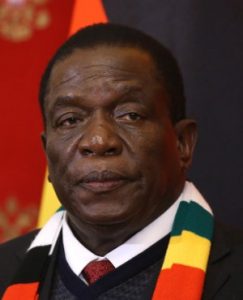
Zimbabwean president urges Chinese investment in Zimbabwe’s tourism sector – The Zimbabwean

Emmerson Mnangagwa

He made the remarks on the occasion where a visiting delegation from China’s Zhejiang Province and the Zimbabwean government officials and business leaders witnessed the signing of a twinning arrangement between Zimbabwe’s Chinhoyi City and China’s Dongyang City.

He said Zimbabwe possesses vast tourism opportunities which if fully harnessed, could help the country in its quest to become an upper middle income economy by 2030.

It emerged at the meeting that Zimbabwe had set aside 1,200 hectares of prime land in the resort town of Victoria Falls for tourism development.

“I urge you, prospective investors (from China), to seize this opportunity to turn Victoria Falls into a competitive tourism hub and financial center,” Mnangagwa said.

The resort town, in Matabeleland North Province, is home to the magnificent Victoria Falls, one of the seven natural wonders of the world.

On Wednesday, officials from the two countries are set to sign twinning agreements between Zhejiang Province and Matabeleland North Province, and Jinhua City and Victoria Falls.

Mnangagwa said his government has a plan to develop a tourism corridor along the Zambezi River, covering two provinces in the north and western parts of the country.

Ge Huijun, head of the Chinese delegation and chairman of the People’s Political Consultative Conference (CPPCC) Zhejiang Provincial Committee, said China was keen to consolidate its friendly ties and cooperation with Zimbabwe, particularly in the tourism sector.

“Zimbabwe is an important partner of China in Africa. Today, we come from afar to Zimbabwe to comprehensively strengthen our exchanges and collaboration with Zimbabwe and set an example of mutually beneficial cooperation between China and Africa,” Ge said.

She said cooperation between Zhejiang and Zimbabwe continued to grow, with seven reputable companies from the province making significant investments in Zimbabwe over the past few months.

Bilateral trade between Zhejiang and Zimbabwe grew by 17.32 percent in 2018 to 180 million U.S. dollars, and there was huge potential for further growth, Ge said.

She urged Zimbabwean companies to participate in China’s business events to grow business opportunities and expand cooperation between the two countries.

Currency Problems Persist in Zimbabwe
Why Zimbabwe is running on empty, again

Post published in: Business

Why Zimbabwe is running on empty, again – The Zimbabwean

Hunger, rocketing inflation, power blackouts, fuel queues – Zimbabwe has been here before, but it’s been a decade since things were quite this bad, ever-resilient citizens in the capital, Harare, say.

The trigger for a sudden surge in prices came last month, when the US dollar was abandoned as legal tender, 10 years after Zimbabwe ditched its worthless local currency and dollarised as inflation hit 89.7-sextillion percent – that’s 20 zeroes.

The same ruling party is at the helm now as 10 years ago, noted Godfrey Kanyenze of the Labour and Economic Research Unit of Zimbabwe, a trade union-linked think tank. And that has added to the worries, he said, because few people trust it has the ability to steer the country out of the current mess – in which a third of the rural population is struggling to cover basic food needs.

Zimbabwe already faces a range of humanitarian concerns, with the UN and international aid groups filling gaps in food security, health and HIV care, water and sanitation, and social protection for vulnerable citizens.

“This is management by crisis,” Kanyenze told The New Humanitarian. The government is “pushing a mantra of ‘austerity for prosperity’, but it’s a government without a human face and it’s just knee-jerk reactions.”

The government says the decision to return to a single, Zimbabwean, currency is crucial to stabilising the economy.

John Kazingizi sells fruit and vegetables with his wife in Hatcliffe market, a high-density suburb of Harare. “What worries me most is prices keep increasing and my sales keep going down, as people are no longer buying as they used to,” he told TNH last week.

The couple struggle to find the money to buy a little fresh stock each day and meet their basic household costs – including repayments on a debt they took out to cover school fees for their five children. “We just need our economy to work again,” said Kazingizi.

The Zimbabwe Coalition on Debt and Development, a social and economic justice NGO, has argued that banning the US dollar and all foreign currencies will simply boost the black market.

“There is a need to address the root causes of the current currency crisis, which are rampant corruption, mismanagement of public finances, and impunity being enjoyed by those that are fuelling the crisis through arbitrage and resource haemorrhage,” the NGO noted in a press statement.

The central bank’s move has not put an end to strike threats, which likely helped prompt the government’s currency decision last month. The Zimbabwe Congress of Trade Unions is warning it will call a stayaway to protest the rising cost of living, although it has not yet set a date.

When the unions last led a work stoppage in January, following the sudden announcement of a fuel price increase of 150 percent, security forces shot dead 17 people and raped 17 women, according to Human Rights Watch.

Fuel prices have been hiked three-more times since January, with an average daily commute now costing as much as $20.

More of the same

President Emmerson Mnangagwa’s cash-strapped government had long insisted the Zimbabwe dollar would only be re-introduced when the economic fundamentals were right.

Yet with inflation almost hitting 175 percent for June, 18-hour power cuts, and 3.5 million people facing drought-induced hunger in the countryside, “the fundamentals are clearly out of whack,” noted Mike Chipere-Ngazimbi, economics researcher at South Africa’s University of Pretoria.

disastrous harvest – with maize production just 45 percent of last season – has compounded the hardships. The World Food Programme aims to reach 1.2 million people with food aid, but by March next year an estimated 5.5 million will be unsure where their next meal will come from.

When Mnangagwa came to power 18 months ago after a military coup ended the 30-year reign of President Robert Mugabe, he promised reforms.

But Mnangagwa, a ruling party stalwart, has failed to deliver a programme attractive enough to investors or multilateral financial institutions, or win over a country shocked by the army’s violent enforcement of last year’s close-run election result.

The one bright spot in Zimbabwe’s recent economic history was a period of coalition government between Mugabe’s ZANU-PF and the opposition Movement for Democratic Change lasting from 2009-2013. Then, GDP growth ramped up to more than 9 percent – although overall poverty levels remained stubbornly high.

To rescue the country from hyperinflation, in which prices doubled almost daily, an early decision in 2009 did away with the Zimbabwe dollar in favour of a basket of foreign currencies. The downside was foreign currency shortages in an import-dependent economy where more dollars leave the country than arrive.

Since then, an ever-more creative series of currency policies have been put in place to address that problem.

Currency conundrums

In 2016, the government introduced bond notes and coins, supposedly worth the same as the US dollar. But they steadily lost value on the informal market – and became an immediate source of arbitrage profits for the well-connected.

The Mnangagwa government has encouraged adopting mobile money to reduce the need for physical cash. According to the reserve bank, mobile money was used for 85 percent of all retail transactions in the last quarter of 2018.

But high transaction fees and a 2 percent government tax makes mobile money expensive – further eroding people’s purchasing power. In the rural areas, where mobile money is the common payment system for livestock sales, people are turning to barter instead, according to FEWS NET, the USAID-funded early warning hunger monitor.

In February, as a step towards creating a local currency, the government introduced the Real Time Gross Settlement dollar, or RTGS – effectively a digital currency harmonising bond notes, mobile money, and debit cards tied to an official US dollar exchange rate.

Immediately, the RTGS dollar began to lose value on the parallel market.

“The economic situation makes us feel like orphans in our own country.”

Last month, the RTGS dollar was trading on the streets at about 13 to the US dollar, more than double the official interbank rate.

On 24 June, the government abruptly decreed that the country’s sole legal tender was the RTGS, renamed the Zimbabwe dollar, and abolished the use of multiple currencies. The aim was to end the informal market contributing to galloping inflation and restore government control over monetary policy.

Civil servants had been threatening to strike, demanding payment in US dollars, and there were reports the military was also unhappy with their RTGS denominated pay packets.

But the introduction of the Zimbabwe dollar has not halted its slide on the black market, and soon after the ban on the use of foreign currencies was announced, Finance Minister Mthuli Ncube said the tourist destination of Victoria Falls was exempted.

“It’s very clear the decision to move to a local currency was done in haste,” said Kanyenze of the labour think tank. “The economy was re-dollarising, and particularly the military were demanding to be paid in dollars.”

Kazingizi, the fruit and vegetable seller, said he sees little sign that things will improve any time soon. His wife gets up every day at 3 am to go to the market, he said, but the family still struggles to stay afloat.

“The economic situation makes us feel like orphans in our own country,” he told TNH.

Zimbabwean president urges Chinese investment in Zimbabwe’s tourism sector
Both Houses of Parliament will Continue Sitting This Week

Post published in: Business

The Land Of Israel: An Example Of The Joys And Complications Of Inheritance

(Image via Getty)

The practice of estate law pervades all aspects of my life, professional, religious, and personal. I cannot avoid making connections, telling stories, or analyzing issues with my legal lens. On a recent family trip to Israel, I was unable to escape the obvious connections between the Jewish homeland and the theory, law, and ramifications of inheritance as I experience them in my daily practice.

Amongst many religions and people, the land of Israel is referred to as the inheritance of the Jewish people. To inherit means to receive property as an heir at the death of the previous holder. In the case of the land of Israel, the Jewish people are said to have inherited the land from God. Readers of the Hebrew Bible cite Deuteronomy 4:1 as a source: “And now, O Israel, hearken to the statutes and to the judgments which I teach you to do, in order that you may live, and go in and possess the land which the Lord, God of your forefathers, is giving you as the legacy for the inheritance of the land to the Jews.”  Additionally, Genesis describes God’s promise to Abraham, then Isaac, and then Jacob (Genesis 15:18-21, 26:3 and 28:13). The specifically inherited land is further detailed in Exodus 23:31 as the territory from the River of Egypt to the Euphrates River. It may be said that certain moral and religious standards are attached to the inheritance as Leviticus 18:26 states, “But you must keep My laws and My rules, and you must not do any of those abhorrent things, neither citizen nor the stranger who resides among you.”

Religious and political beliefs aside, it is impossible to travel through Israel without feeling the connection between the Jewish people and the land.  This relationship is evident on visits and tours throughout the country, whether it is walking the ramparts of Jerusalem’s Old City, hiking the green valleys of Galilee, or sailing the Mediterranean coast. Each town bears some historical significance, whether an event from the Bible or a modern-day feat.

Applying the concept of inheritance to the relationship among God, Israel, and the Jewish people reveals the same complications and conflicts that plague inheritances among families. Leaving an asset to one beneficiary over another generally results in some kind of complication. Following the transfer of assets, family relationships, specifically those between the decedent and her children, are questioned based on the size and tenure of the gift. Furthermore, inheritances, especially when one child is given more than another, causes strain between siblings. Often there are reasons for one child being treated better than other. Such rationale does not remove the hurt that many feel when they do not receive similarly to their family members, even if it can be explained. Heirs bear unanswered questions as they can no longer speak to the decedent.

In visiting Israel, meeting its inhabitants, reading its newspapers, and learning its history, I could not help but focus on the idea of inheritance, specifically inheritance by a people. My interest, however, was not about the right to the land or political and religious beliefs, but the responsibility of the heir. If one is blessed enough to receive an inheritance, it behooves her to honor the decedent — the giver of the gift — and her memory by acting responsibly. This means accepting a bequests with grace and not wasting assets, editorializing others’ relationships, or lacking empathy. If there is a question as to title to an asset or the validity of a last will, out of respect to the decedent, one should handle herself with reasonableness, decorum, and even humility. Moreover, it is important to understand that no one is entitled to any asset. You are granted a bequest by the grace of the decedent. There is a reason why inheritance is often referred to as “found money.” The beneficiary did not work for it. It is a gift and all more reason to act with propriety.

At the same time, it is also difficult to be the chosen child, the one who receives more. Certainly the Hebrew Bible relays many examples of children treated differently by their parents and the trials experienced by the favored and disfavored siblings. The controlling heir may need to work with her siblings, to provide for them to be sensitive to their financial and emotional needs. Perhaps this is the greatest lesson learned on my trip. With inheritance comes an obligation to act with decency and to ensure that all of our siblings are provided for and treated with respect and protection. Israel strongly reminded me of this, by way of its armed forces, bustling economy, hospitals and medical care, tourists from around the world, and most poignantly, the free practice of different religions.


Cori A. Robinson is a solo practitioner having founded Cori A. Robinson PLLC, a New York and New Jersey law firm, in 2017. For more than a decade Cori has focused her law practice on trusts and estates and elder law including estate and Medicaid planning, probate and administration, estate litigation, and guardianships. She can be reached at cori@robinsonestatelaw.com

Law Firm Portfolio Financing: A Primer On The Current State Of Ethical Considerations

(Image via Getty)

Litigation funding generally comes in two varieties — funding to a claimholder or funding to a law firm.  Last year, an advisory ethics opinion by the New York City Bar Association called into question the propriety of providing funding to a law firm in certain circumstances.  Ethical concerns about litigation funding are already one of the main reasons that some attorneys shy away from litigation funding — so what is the current state of play?  Can law firms ethically take litigation funding secured by their anticipated fees?

ABA Model Rule 5.4(a), the widely adopted provision which addresses the “Professional Independence of a Lawyer,” contains a general rule that “a lawyer or law firm shall not share legal fees with a nonlawyer.”  According to the comments to the model rule, “[t]hese limitations are to protect the lawyer’s professional independence of judgment” and “also express[ ] traditional limitations on permitting a third party to direct or regulate the lawyer’s professional judgment in rendering legal services to another.”

ABA Model Rule 5.4(a) does not preclude law firms from taking recourse funding on a fixed return basis from a litigation-finance company (or from a bank or other funding source).  According to the New York City Bar Association, “the fee-sharing rule does not forbid a traditional recourse loan requiring the lawyer to repay the loan at a fixed rate of interest without regard to the outcome of, or the lawyer’s receipt of a fee in, any particular lawsuit or lawsuits.”   This includes fixed return loans made with recourse to fees that have already been earned but have not yet been collected.

But the question becomes more complicated when the funding is nonrecoursei.e., when the returns for the litigation-funding arrangement depend on the law firm’s ultimate success in specific matters and, if successful, the amount of fees earned.  At Lake Whillans, we have seen inquiries for this type of law firm financing increase as firms seek ways to accelerate monetization of their contingent interests, meet current case needs, and enable firm growth and client acquisition.  Realization of contingent fees can take years, and despite their successes, firms may have less cash than they would like or need to grow their business and pay their attorneys while waiting for contingent fees to be realized.

Because this type of funding has been in such high demand, in the litigation-funding industry it has been common practice to provide funding to law firms secured against a basket, or portfolio, of cases, rather than a single case, to avoid running afoul of ABA Model Rule 5.4.  Although litigation funders like Lake Whillans have no right to control the cases funded as a matter of contract, tying returns to a basket of cases further ensures that funding does not appear to compromise an attorney’s independence and professional judgment.

One interpretation of Rule 5.4, called the “direct relation test,” posits that Rule 5.4 “intend[s] to bar any financial arrangement in which a nonlawyer’s profit or loss is directly related to the successfulness of a lawyer’s legal business.”  Some legal ethicists consider earned but not yet collected fees to not implicate a business’s success, but consider that unearned contingent fees do depend upon the successfulness of the lawyer’s business.  This distinction between lending against earned but uncollected fees and unearned contingent fees seems academic and ignores the reality that most businesses are permitted to secure financing based on expectations about future earnings.  Courts have generally agreed that this is a distinction without a meaningful difference.

In a 2015 case, for example, a New York court rejected the argument that “a credit facility secured by a law firm’s accounts receivable constitutes impermissible fee sharing with a non-lawyer.”  In that case, significantly, the agreement entitled the funder to a “percentage of the Law Firm’s gross revenue . . .  essentially composed of contingent fees earned on client settlements and verdicts.”  The court stated:

[C]ourts have expressly permitted law firms to fund themselves in this manner. Providing law firms access to investment capital where the investors are effectively betting on the success of the firm promotes the sound public policy of making justice accessible to all, regardless of wealth. Modern litigation is expensive, and deep pocketed wrongdoers can deter lawsuits from being filed if a plaintiff has no means of financing her or his case. Permitting investors to fund firms by lending money secured by the firm’s accounts receivable helps provide victims their day in court.

That decision came on the heels of another New York decision similarly finding such an agreement enforceable.  That court similarly recognized the value of litigation-financing arrangements: “There is a proliferation of alternative litigation financing in the United States, partly due to the recognition that litigation funding allows lawsuits to be decided on their merits, and not based on which party has deeper pockets or stronger appetite for protracted litigation.”  The court quoted a 1997 Delaware case “not[ing] that there is no suggestion that it is inappropriate for a lender to have a security interest in an attorney’s accounts receivable. It is, in fact, a common practice. Yet there is no real ‘ethical’ difference whether the security interest is in contract rights (fees not yet earned) or accounts receivable (fees earned) in so far as Rule of Professional Conduct 5.4, the rule prohibiting the sharing of legal fees with a nonlawyer, is concerned.”

A number of other decisions have likewise either summarily dismissed the idea that a financed law firm should be relieved of its obligations “under guise of ethics” or concluded that a lender had properly secured an interest in contingent fees without reaching the ethical question.   There does not appear to have been any decision in which a litigation-financing arrangement for contingent fees has been held illegal or unenforceable due to alleged “fee splitting” concerns.

But a New York City Bar Association advisory opinion issued in July 2018 called the practice into question.  The opinion noted that ethics opinions both from the New York City Bar and other bar associations have prohibited arrangements where, for example, a marketing service or landlord would be paid based on a percentage of a law firm’s revenues.

Rule 5.4(a) forbids a funding arrangement in which the lawyer’s future payments to the funder are contingent on the lawyer’s receipt of legal fees or on the amount of legal fees received in one or more specific matters. That is true whether the arrangement is a non-recourse loan secured by legal fees or it involves financing in which the amount of the lawyer’s payments varies with the amount of legal fees in one or more matters.

The opinion acknowledged that it appeared to be at odds with the New York courts that had found such arrangements enforceable but concluded that “New York courts could be expected to enforce the arrangements, because lawyers who violate the Rules cannot ordinarily invoke their own transgressions to avoid contractual obligations.”  The opinion also acknowledged that its advice might be seen as “overbroad” but contended that, if so, the place for a remedy should be in the state judiciary or state legislature, which ultimately has authority to change the ethics rules.

The New York City Bar Association opinion has caused significant consternation among funders and attorneys.  Ultimately, the New York City Bar established a “Litigation Funding Working Group” to address the “ethics rules and framework” related to the advisory opinion, current and best practices for litigation funding, and disclosure issues, among other topics.  In establishing the working group — which includes NYU ethics professor Stephen Gillers and former SDNY Judge Katherine Forrest — the NYC Bar indicated it “will not be revisiting Opinion 2018-5, but is open to exploring potential revisions to the ethics rules and/or legislation.”  It expects to issue findings by the end of 2019 and recently received comments from interested parties.

The vast majority of bar associations have not opined on this issue but the handful that have reached a similar conclusion to the NYC bar:  Maine, Missouri, Nevada, North Carolina, Texas, Utah, and Virginia.  Although many of these opinions predate the large-scale litigation funding industry, the basic idea is generally the same as the NYC bar precedents.  The only bar association to have affirmatively approved of contingent financing appears to be Philadelphia, which found no issue with contingent, fixed-return financing because it “appears to be no different than when an attorney negotiates a loan from a bank to cover operating costs or as working capital.”

So where does this leave law firms seeking funding — particularly law firms that are seeking financing against a portfolio of cases?

  • First, the New York City Bar Association advisory opinion is just that — advisory — and, while it may be persuasive should an ethics issue arise, it is not a prohibition on litigation financing of law firm portfolios. Ultimately, it is one effort at an interpretation of an ethical rule that is subject to multiple interpretations.
  • Second, under New York law these funding agreements remain enforceable and legally valid providing peace of mind from that perspective both to the funder and law firm. We are unaware of any jurisdiction that has declined to enforce this type of funding agreement on the basis of the fee-splitting rule.
  • Third, the ethical issue at stake is ultimately the independence of the attorney, and the attorney can ensure that such independence is not compromised both in practice and through terms in the funding agreement protecting attorney independence. Numerous ethics experts have opined that the distinction between prohibiting litigation funding based on a law firm portfolio and bank lending is illusory in this context.  The NYC Bar opinion, according to Professor Anthony Sebok and Hinshaw & Culbertson Partner Anthony David, “creates distinctions between the loss of independence of lawyers who engage in traditional borrowing from their banks — where they place all of their receivables at the ultimate mercy of the ender if they default — and the supposed greater loss of independence where instead the lawyer borrows based on the results of specific cases, where the lender has no recourse if the cases fail to yield those results.  Such an interpretation is, surely, absurd.”

Each firm must weigh the risks and benefits of seeking portfolio financing and seek outside advice if necessary.  While we view the NYC Bar opinion and those like it as ill-considered and overly formalistic, they are a reality with which a law firm seeking funding must be comfortable.  (Anecdotally, based on the inquiries Lake Whillans receives, the opinion has not stopped law firms from actively seeking portfolio financing in New York or elsewhere.)  The landscape continues to evolve and funders and attorneys alike hope that a more reasonable and realistic interpretation of Rule 5.4 prevails.  Until that consensus emerges, Lake Whillans and, we expect, other funders will work with law firms and their counsel to craft agreements that address their concerns and minimize risk.

Academia Means Never Having To Say, ‘I Got Fired’

Thankfully I don’t have to take responsibility for my actions. (Image via Getty)

Joe and Elie react to the news that Penn Law School’s Amy Wax has stepped up her efforts to be noticed by right-wing media by appearing at a “nationalism” conference and explicitly stating that America would be “better off with more whites and fewer nonwhites.” Who is this Amy Wax person, and why does she still have a job at this point? The answer is a toxic blend of tenure and cowardice.

‘Kidney Stones Postponing Charity Lunch Meeting’ The Latest Cryptocurrency Downside Risk

Alleged kidney stones, it unfortunately has to be said.

Of Claws And Copyright

Kawhi Leonard (Photo by Kyle Terada-Pool/Getty Images)

Two-time NBA Finals MVP. Living proof that one transcendent player can change the fortunes of a franchise by willing it to its first championship. Perhaps the most coveted free agent in a summer where basketball free agency has hit levels of attention and discussion heretofore unseen. Kawhi Leonard’s list of professional accomplishments, as well as his personal legend as one of a handful of stars capable of delivering championships, continues to grow. In fact, you could say that his decision (and the level of interest preceding it) this past summer to forego a return to the champion Raptors in favor of a fresh start with the Clippers confirmed his status in the pantheon of current NBA stars. The one-namers if you will… Kawhi, Lebron, Steph, Kyrie, etc. (What they all share in common? Lucrative sneaker deals showcasing their personal line of kicks.)

But Kawhi’s exploits this summer have not been limited to deciding which team will enjoy his services for the next few years. Now that the hubbub around his free agency decision has started to die down a bit, more attention is being paid to an interesting copyright case between the player and his former sneaker sponsor, Nike. As a preliminary matter, it is good to remind ourselves just how important sneaker contracts are to players, as well as to the shoe companies that offer them. The relationship between star players and sneaker companies starts well before players become stars, with sponsorships of AAU and college teams. It continues when players reach the NBA, with shoe companies vying to tie-up high draft picks in the hopes of locking in the next major star. Needless to say, the numbers are staggering, both in terms of payments to star players and the influence those players have on the purchasing decisions of sneaker customers.

In fact, it was a sneaker contract, not basketball salary, that propelled Michael Jordan into the ranks of billionaire and NBA owner. Likewise, today’s stars know how important their imprimatur is on keeping a sneaker company’s fortunes on the upswing. A transcendent star can even make a brand relevant to youngsters single-handedly, as the case of Steph Curry and Under Armour proves. To that end, star players each have a distinctive logo, prominently emblazoned on merchandise sold in their names. Against this backdrop, it is easy to understand why the recent separation between Nike and Kawhi Leonard has turned acrimonious, with the split between the two parties leading to an IP dispute between them.

There would be no dispute, of course, absent Kawhi’s decision to try and do for New Balance what Curry has done for Under Armour. Namely, to utilize his personal star power to kick off the basketball fortunes of a brand outside the traditional power structure for basketball sneakers. If successful, the potential rewards for both Kawhi and his new sponsor are significant. At the same time, Kawhi wanted to bring over more than just his name from Nike. He also wanted to bring over his logo (seen in this article about the case), which he has already affixed to items since leaving Nike. Unsurprisingly, Nike has said that it owns the actual logo, consistent with its registering of the copyright in the logo without notifying Kawhi that it had done so.

As with any copyright dispute, it is important that we consider exactly each side is claiming it owns. On Nike’s end, it contends that it owns the copyright in the stylized “claw” logo that its designers created based on a rough draft supplied by Kawhi himself. Nike argues that Kawhi himself has previously conceded that Nike’s designers deserve the credit for the logo — consistent with Kawhi’s prior agreement that Nike would own the rights to anything created in the course of its sponsorship. As for the rough draft of the logo? Nike makes no claim to that “artwork” and concedes that Kawhi is free to use it without restriction.

In contrast, Kawhi argues that he owns both the rough draft and the now-copyrighted logo. He complains that Nike registered the copyright without telling him and argues that he should be free to use the logo as he sees fit. In effect, he is arguing some kind of ownership in the idea of a claw logo associated with his name, even though copyright doesn’t protect ideas. Nor does his argument that he shouldn’t be bound by his agreement that Nike owns IP around his sponsorship carry much water in my view. That said, there is still a good chance that the case will settle, because of the business realities Nike faces in terms of having to maintain a player-friendly orientation, even if Kawhi himself has already left Nike’s employ. As with most copyright cases, there is apparent room for compromise on a revised artwork that Kawhi could use going forward. Whether that settlement will happen early or later in the case is as of now unclear. But a settlement of some kind remains likely.

Ultimately, this case provides a good set of lessons for athletes and celebrities, especially when it comes to the IP ramifications of their dealings with more sophisticated sponsors. At minimum, they should develop some level of IP literacy so that they are not left regretting agreements that they may have made while caught up in the understandable excitement of having landed a sponsorship deal. Whether they develop that literacy on their own or in concert with having experienced IP counsel to guide them is their decision. Doing so as early as possible, however, will go a long way towards helping them avoid disputes like the one Kawhi finds himself him. At this point, whether or not he will be able to claw back his logo from Nike is unknown. But he could have given himself a hand by thinking through his potential IP issues before he signed his contract, rather than waiting until after he walked away. As for Nike? They are proving that they won’t let copyrights get clawed away without a fight.

Please feel free to send comments or questions to me at gkroub@kskiplaw.com or via Twitter: @gkroub. Any topic suggestions or thoughts are most welcome.


Gaston Kroub lives in Brooklyn and is a founding partner of Kroub, Silbersher & Kolmykov PLLC, an intellectual property litigation boutique, and Markman Advisors LLC, a leading consultancy on patent issues for the investment community. Gaston’s practice focuses on intellectual property litigation and related counseling, with a strong focus on patent matters. You can reach him at gkroub@kskiplaw.com or follow him on Twitter: @gkroub.

Biglaw Is Losing Out On Legal Work

Corporations just keep on moving more and more of their legal work in-house, and it doesn’t look like that trend will stop any time soon. According to a survey by the Corporate Legal Operations Consortium (CLOC), only 46 cents of every dollar went to external legal costs — like law firms — in 2018, compared with external costs taking 62 cents per dollar in 2017. That’s a big swing in only a year.

For the survey, CLOC spoke with 213 companies of various sizes in 32 industries and it showed internal legal operations, technology, and alternate legal service providers are increasingly filling in the gaps. As reported by Law360, legal departments are quickly finding new ways to improve their performance:

“This year’s data shows that the role and function of legal operations continues to grow,” said CLOC President Mary O’Carroll, who also holds the role of director of legal operations at Google. “Technology is changing quickly and more legal operations departments are embracing solutions to improve productivity and results.”

Of the survey respondents, 41 percent said they’ve increased the number of full-time attorneys on staff, and 39 percent of companies said they’re increasing their legal ops staff. And the percentage of companies spending more than $750,000 on technology is now at 37 percent.

Even though the overall external legal spend is decreasing, more and more companies are spending that money on alternative legal service providers rather than traditional law firms. In this year’s survey, 53 percent of respondents said they are using alternative legal service providers a significant jump from the 36 percent from last year’s survey.

Legal problems aren’t getting smaller, but companies are getting smarter (and more frugal) about how they deal with them.


headshotKathryn Rubino is a Senior Editor at Above the Law, and host of The Jabot podcast. AtL tipsters are the best, so please connect with her. Feel free to email her with any tips, questions, or comments and follow her on Twitter (@Kathryn1).