
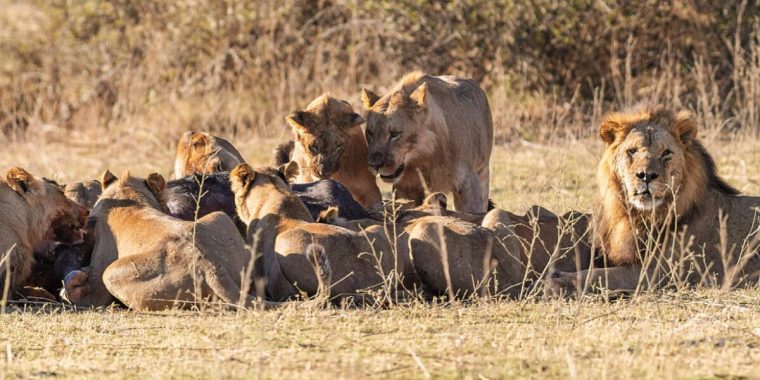

A
pack
of
lions
in
Botswana.
Image
by
Diego
Delso
via Wikimedia
Commons (CC
BY-SA
4.0).
-
Prosecutors
in
Zimbabwe
used
lion
DNA
forensics
for
the
first
time
to
successfully
convict
two
people
for
poaching
and
trafficking
a
male
lion
near
Hwange
National
Park. -
Investigators
analyzed
DNA
from
confiscated
lion
parts
and
were
able
to
match
it
to
a
radio-collared
lion
in
their
database
that
was
killed
in
2024. -
Proving
that
the
seized
parts
came
from
a
poached
wild
lion
provided
the
evidence
that
sent
the
two
poachers
to
prison
for
two
years. -
Experts
say
DNA
forensics
provide
invaluable
proof
in
hard-to-prosecute
wildlife
crimes,
and
this
recent
conviction
sets
a
precedent
for
bringing
poachers
to
justice
in
court
using
the
forensic
technology.
A
CSI-style
investigation
in
Zimbabwe
helped
to
successfully
prosecute
two
people
for
killing
a
lion
and
trafficking
its
teeth,
flesh
and
other
body
parts
in
February.
Forensic
specialists
analyzed
DNA
collected
from
parts
seized
by
authorities
and
matched
it
with
a
radio-collared
lion
that
was
killed
two
years
ago.
This
conviction
was
historic:
It’s
the
world’s first
case
to
use
a
lion’s
genetic
material and
trace
it
back
to
an
individual
to
pin
down
wildlife
criminals.
The
two
defendants
were
sentenced
to
two
years
in
prison
for
their
crimes.
The
conviction
is
tied
to
a
2024
case
in
which
poachers
snared
and
killed
a
male
lion
near
Hwange
National
Park,
close
to
the
world-famous
Victoria
Falls.
Researchers
knew
this
particular
lion,
as
they’d
tracked
its
movements
as
part
of
a
study.
When
they
captured
and
anesthetized
the
cat
to
fit
it
with
a
radio
collar
some
years
ago,
biologists
took
blood
samples
and
logged
its
genetic
and
health
information
into
their
database.
Investigators
used
that
DNA
data
to
trace
the
origins
of
seized
lion
parts,
which
included
three
bags
of
meat,
16
claws
and
four
teeth
that
were
to
be
sold
on
the
black
market.
Parts
from
captive-bred
lions
can
be
traded
internationally
and
in
Zimbabwe
with
the
appropriate
paperwork,
but
the
sellers
didn’t
have
permits,
and
proving
these
seized
parts
came
from
a
wild
lion
and
not
a
captive-bred
one
was
key
to
this
case.
That
would
mean
poaching,
which
is
illegal.

lions
are
the
most-traded
wildcats
in
the
world
legally,
and
are
also
heavily
poached,
driven
by
demand
for
their
body
parts
used
in
traditional
medicine
as
well
as
cultural
practices
in
Asia
and
Africa.
Image
by
Sharon
Guynup/Mongabay.
“This
breakthrough
represents
more
than
scientific
achievement;
it
embodies
our
determination
to
protect
biodiversity
for
future
generations
to
come,”
Zimbabwe-based
nonprofit Victoria
Falls
Wildlife
Trust wrote
in
a statement.
Scientists
from
that
organization,
with
support
from
the
U.K.-based
NGOs TRAFFIC and TRACE,
conducted
the
genetic
analysis
to
generate
a
full
DNA
profile
from
the
lion
parts
and
match
it
with
the
slain
lion’s
genetic
material.
DNA
forensics
first
came
into
use
in
criminal
investigations
in
1985,
after
British
geneticist
Alec
Jeffreys
discovered
that
genetic
patterns
could
effectively
identify
individuals,
a
process
he
dubbed
“DNA
fingerprinting.”
The
process
has
been
used
for
decades
to
identify
trafficked
wildlife,
but
recent
developments
in
genetic
analysis
and
growing
databases
have
helped
researchers
trace
samples
to
specific
individuals.
DNA
evidence
has
since
been
used
to convict
wildlife
poachers,
but
this
is
the
first
instance
of
a
lion’s
DNA
being
used
to
nab
its
killers.

bones
are
used
as
substitutes
for
tiger
bones
in
Traditional
Chinese
Medicine
formulations,
and
remain
in
high
demand
in
Southeast
Asia
and
particularly,
China.
Image
courtesy
of
Viv-Williams
and
TRAFFIC.
Wildlife
poaching
and
trafficking
cases
are
often
difficult
to
prosecute
because
often
rely
on
circumstantial
evidence.
In
Zimbabwe,
where
the
trade
in
captive-bred
lion
parts
is
permitted
with
necessary
paperwork,
prosecutors
face
the
added
complication
of
having
to
prove
that
parts
came
from
a
wild
lion.
Without
convincing
evidence,
making
successful
convictions
in
wildlife-related
crimes
are
challenging
and
rare.
But
the
recent
case
shows
DNA
forensics
is
beginning
to
change
that.
“DNA
has
revolutionized
how
we
present
evidence
in
court,
because
the
sequencing
can
go
right
down
to
the
individual
in
most
cases,”
said
Sheldon
Jordan,
who
has
worked
with
Canada’s
wildlife
enforcement
agency
but
wasn’t
involved
in
this
conviction.
“I
don’t
think
we
could
regulate
trade
as
well
as
we
do
without
being
able
to
fall
back
on
DNA
analysis
for
evidentiary
purposes.”
Lions
are
the most-traded
wildcats in
the
world.
Although
African
lions
can
be
traded
internationally
with
permits,
they’re
also
heavily
poached
across
the
continent,
driven
by
demand
for
their
body
parts
that
are
used
in
traditional
medicine
as
well
as cultural
practices in
Asia
and
Africa.

body
parts,
such
as
claws
and
teeth,
are
used
in
jewelry.
Image
courtesy
of
TRAFFIC.
Tigers
have
been
in
the
crosshairs
for
four
decades,
targeted
for
their
bones.
China
and
Southeast
Asian
countries
are
cracking
down
on
trafficked
tiger
bones,
which
are
used
in tiger
bone
wine,
an
exorbitantly
expensive
elixir
used
as
traditional
medicine
and
served
as
a
way
to
flaunt
prestige
and
power.
The
bones
of
other
big
cats,
including
lions,
sometimes replace them.
Lion
parts
are
also
widely
used
within
Africa
for
medicines,
rituals
and
as
talismans.
Poaching
poses
an
“existential
threat”
to
African
lions,
a
2026 study found:
fewer
than
25,000
wild
lions
remain
across
the
continent,
an
order
of
magnitude
less
than
the
roughly
200,000
found
there
a
century
ago.
In
Zimbabwe,
poaching
is
an
ongoing
threat.
Two
lions
were
poached
there
last
year,
according
to
TRAFFIC’s Wildlife
Trade
Portal data.
Beyond
the
loss
of
individual
lions,
killing
a
male
that
heads
a
pride
often
spells
doom
for
its
cubs:
When
a
new
male
takes
over,
he
often
kills
off
the
former
leader’s
progeny.
Now,
another
lion
case
is
in
court
in
South
Africa,
with
prosecutors
again
using
DNA
fingerprinting
as
evidence.
The
recent
conviction
in
neighboring
Zimbabwe
“sets
an
important
precedent
for
how
science
can
support
enforcement”
in
the
future,
according
to
Markus
Burgener,
a
wildlife
trade
expert
with
TRAFFIC,
focusing
on
Southern
Africa.
It
can
help
bring
criminals
to
justice,
he
said.
Post
published
in:
Featured